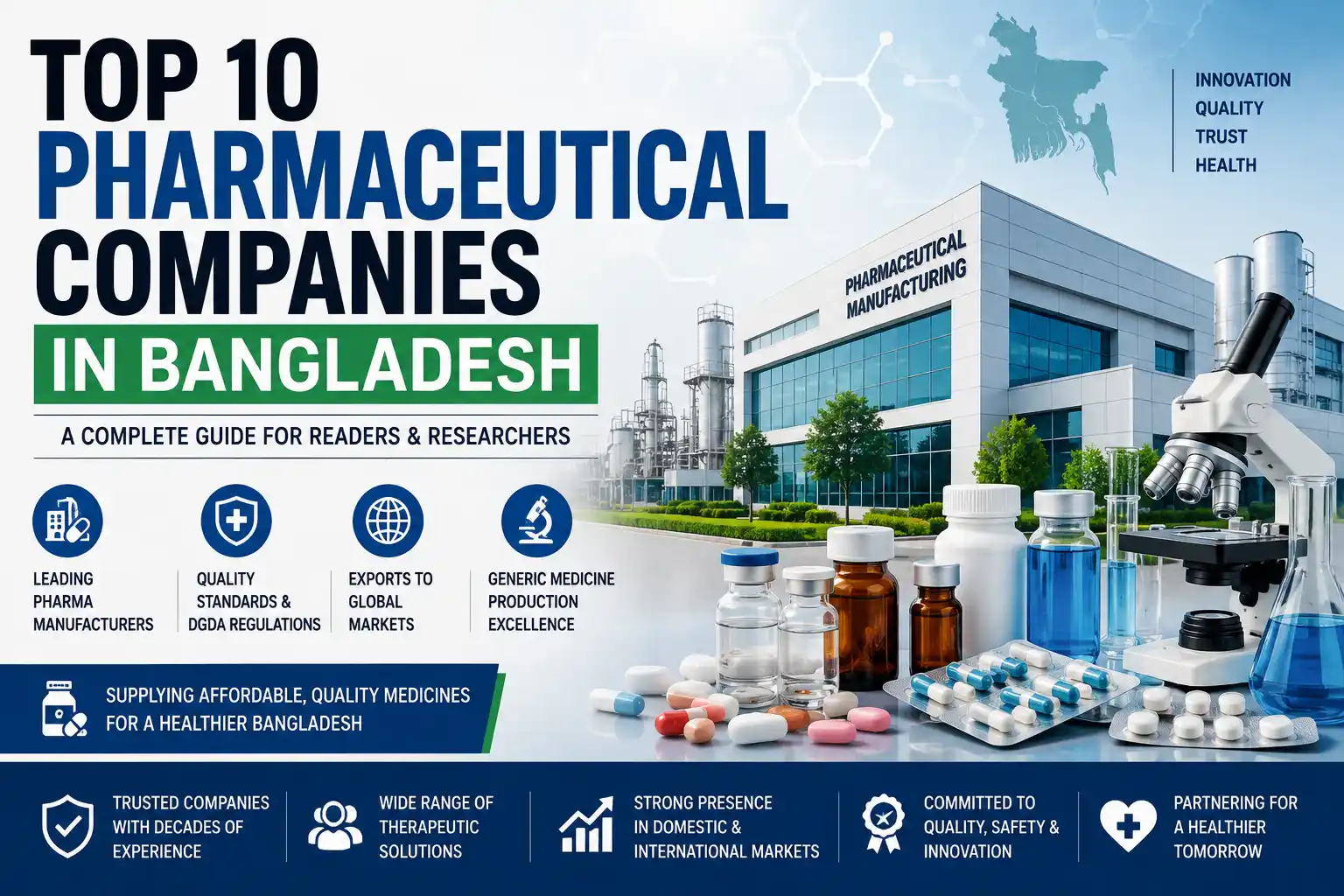
Top 10 Pharmaceutical Companies in Bangladesh
Bangladesh has built one of South Asia’s most notable pharmaceutical manufacturing sectors. Bangladesh’s pharmaceutical sector supplies most of the medicines used domestically, according to widely cited industry reporting and regulatory context, while also exporting to a growing number of international markets. The industry plays a central role in national healthcare, supplying generic versions of essential medicines at accessible prices, and it has become an important part of the country’s export economy alongside sectors like ready-made garments. Bangladesh is widely recognized for its capacity to manufacture generic drugs at scale, supported by a regulatory framework overseen by the Directorate General of Drug Administration (DGDA).
For ordinary readers, healthcare professionals, students, procurement teams, and business researchers, understanding who the major pharmaceutical manufacturers are can be a useful starting point — whether the interest is in how domestic medicine supply works, which companies export internationally, or simply how the industry is structured. This guide on the Top 10 Pharmaceutical Companies in Bangladesh looks at some of the country’s most established and frequently documented pharmaceutical manufacturers, based on publicly available and verifiable information about their history, manufacturing operations, product areas, and regulatory footprint.
This is an editorial selection prepared by Info Ghor, not an official industry ranking, and the order in which companies appear does not reflect market share, sales volume, or any judgment about product quality. Company details such as certifications, export markets, manufacturing facilities, and product portfolios can change, so readers should verify current information through the companies themselves and through authoritative sources such as DGDA. This article is intended purely as general, informational content. It is not medical advice, and it does not recommend any specific medicine, brand, or treatment.
Quick Answer: Bangladesh has several established pharmaceutical manufacturers with long operating histories and significant domestic and export activity. Companies frequently mentioned in industry discussions include Square Pharmaceuticals, Beximco Pharmaceuticals, Incepta Pharmaceuticals, Renata, Eskayef Pharmaceuticals (SK+F), ACI Pharmaceuticals, Aristopharma, Popular Pharmaceuticals, Drug International, and Healthcare Pharmaceuticals. This is an editorial list rather than an official ranking, and it is not a recommendation of any particular company’s medicines.
Disclaimer: This article is an informational, editorial guide prepared by Info Ghor. The order of companies is not an official industry ranking, and inclusion in this list does not constitute an endorsement by Info Ghor. Company information — including products, regulatory approvals, manufacturing facilities, export markets, and certifications — can change over time. Readers should verify current information directly through each company and through relevant regulatory authorities such as DGDA. This article does not provide medical advice and does not recommend specific medicines or treatments; questions about medicines should be directed to a qualified physician or pharmacist.
1. Square Pharmaceuticals PLC
Commonly known for: Large-scale generic pharmaceutical manufacturing and API production Head Office: Square Centre, 48 Mohakhali Commercial Area, Dhaka-1212, Bangladesh
Square Pharmaceuticals PLC, the flagship company of the Square Group, was established in 1958 and has developed into one of Bangladesh’s long-established pharmaceutical manufacturers. The company manufactures generic finished dosage forms, including tablets, liquids, topicals, and sterile products, and has also manufactured active pharmaceutical ingredients (APIs) since 1995. Square states that specific solid-dosage manufacturing units have received approvals from regulators including the US FDA, UK MHRA, and South Africa’s MCC, and Square states that its products are exported to more than 40 countries across Asia, Africa, Europe, and other regions. The company operates manufacturing sites in Dhaka and Pabna, and it is publicly listed on the Dhaka and Chittagong Stock Exchanges.
Commonly associated with: Generic finished dosage forms across multiple therapeutic areas, plus API manufacturing May suit: Researchers, procurement teams, and readers seeking information on one of Bangladesh’s largest and longest-operating pharmaceutical manufacturers
🔗 INFO GHOR LISTING: View Square Pharmaceuticals on Info Ghor
2. Beximco Pharmaceuticals Ltd.
Commonly known for: Generic medicines and active pharmaceutical ingredients, including US-market exports Head Office: 19, Dhanmondi R/A, Road No. 2, Dhaka-1205, Bangladesh
Beximco Pharmaceuticals Ltd., commonly known as Beximco Pharma, is part of the Beximco Group and describes its origins as dating back to 1976, with manufacturing operations beginning in 1980. The company manufactures generic pharmaceutical products and active pharmaceutical ingredients, and Beximco Pharma states that a specific manufacturing facility received US FDA approval in 2015, following an inspection of its oral solid dosage facility at Tongi. Beximco states that specific facilities have obtained approvals or accreditations in regulated markets including the EU, Australia, and Canada, and the company has described shipping export consignments to the United States. Beximco Pharma is publicly listed on the Dhaka Stock Exchange, with a secondary listing on the London Stock Exchange’s AIM market.
Commonly associated with: Generic medicines and API manufacturing, with stated regulated-market export activity May suit: Readers interested in a publicly listed manufacturer with stated international regulatory approvals
🔗 INFO GHOR LISTING: View Beximco Pharmaceuticals on Info Ghor
3. Incepta Pharmaceuticals Ltd.
Commonly known for: A broad portfolio of generic medicines, biologics, and vaccines Head Office: 40, Shahid Tajuddin Ahmed Sarani, Tejgaon Industrial Area, Dhaka-1208, Bangladesh Manufacturing location(s): Zirabo, Savar, and Dhamrai, Dhaka District
Incepta Pharmaceuticals Ltd. was established in 1999 and has grown into one of Bangladesh’s larger pharmaceutical manufacturers, producing a wide range of dosage forms including tablets, capsules, oral liquids, injectables, and vaccines. The company states that it has introduced a number of new products to the Bangladeshi market over the years and that it has increasingly focused on biological products and vaccine manufacturing. Incepta reports product-specific WHO prequalification and export activity to multiple countries, and according to company-published and industry membership information, it also holds certifications and registrations connected to markets including the UK and the European Union. Incepta has also stated involvement in partnerships with international health organizations on vaccine access initiatives.
Commonly associated with: Generic dosage forms, biologics, and vaccine manufacturing May suit: Readers researching companies active in vaccine and biologics manufacturing in Bangladesh
🔗 INFO GHOR LISTING: View Incepta Pharmaceuticals on Info Ghor
4. Renata PLC
Commonly known for: Human pharmaceuticals and animal health products Head Office: Plot No. 1, Milk Vita Road, Section-7, Mirpur, Dhaka-1216, Bangladesh Manufacturing location(s): Mirpur, Dhaka, and Rajendrapur, Gazipur
Renata PLC began operations in 1972 as Pfizer Laboratories (Bangladesh) Limited and was transferred to local ownership in 1993, when it was renamed Renata. The company manufactures human pharmaceutical products, including hormones, contraceptives, and other conventional medicines, and it also manufactures animal health and nutrition products. Renata also has a significant presence in Bangladesh’s animal health and nutrition market. Renata states that its Potent Product Facility has received UK MHRA approval and that specific products, including prednisolone, have been exported to the UK. Renata states that its products are exported to a number of countries across South Asia, Southeast Asia, Africa, Europe, and Latin America. Renata is publicly listed on the Dhaka Stock Exchange.
Commonly associated with: Human pharmaceuticals and animal health/veterinary products May suit: Readers interested in a dual human-and-animal-health manufacturer with a long operating history
🔗 INFO GHOR LISTING: View Renata on Info Ghor
5. Eskayef Pharmaceuticals Ltd. (SK+F)
Commonly known for: A wide portfolio of therapeutic drugs and animal health products, part of the Transcom Group Head Office: Plot 82, Road 14, Block-B, Banani, Dhaka-1213, Bangladesh Manufacturing location(s): Tongi Industrial Area, Tongi, Gazipur
Eskayef Pharmaceuticals Ltd., widely known by its earlier name SK+F, traces its roots to Smith, Kline & French’s Bangladesh operations, which were acquired by the Transcom Group in 1990. The company was renamed Eskayef Pharmaceuticals Limited in 2017 and manufactures a broad range of therapeutic drugs, bulk pellets, and animal health and nutrition products. According to publicly available company information, specific Eskayef manufacturing facilities or product lines have received UK MHRA-related approval/accreditation. Industry sources have stated that Eskayef exports finished products to a substantial number of countries, though exact current export figures should be confirmed directly with the company.
Commonly associated with: Therapeutic drugs, bulk pellets, and animal health/nutrition products May suit: Readers researching a Transcom Group manufacturer with a Tongi-based production facility
🔗 INFO GHOR LISTING: View Eskayef Pharmaceuticals (SK+F) on Info Ghor
6. ACI Pharmaceuticals (Advanced Chemical Industries Limited)
Commonly known for: A diversified pharmaceutical portfolio under Bangladesh’s broader ACI Limited conglomerate Head Office: ACI Centre, 245 Tejgaon Industrial Area, Dhaka-1208, Bangladesh
ACI Pharmaceuticals operates as a business division of Advanced Chemical Industries (ACI) Limited, a publicly listed Bangladeshi conglomerate that traces its origins to a 1973 successor of ICI’s Bangladesh operations, before being renamed ACI following a change of ownership in 1992. ACI states that its pharmaceutical division achieved ISO 9001 certification in 1995 and later added ISO 14001 certification. ACI states that it manufactures and markets a broad range of pharmaceutical products across most major therapeutic areas, and that it also acts as a contract manufacturer for certain multinational pharmaceutical brands in Bangladesh. The company reports exporting products to around 30 countries across multiple continents, and it lists GMP-related certifications from several export-market regulators, according to its own published information.
Commonly associated with: A broad general pharmaceutical portfolio, plus contract manufacturing for multinational brands May suit: Readers interested in a manufacturer operating under a larger, diversified conglomerate structure
🔗 INFO GHOR LISTING: View ACI Pharmaceuticals on Info Ghor
7. Aristopharma Ltd.
Commonly known for: A broad therapeutic portfolio with a particular focus on ophthalmic products Head Office: 7, Purana Paltan Line, Dhaka-1000, Bangladesh Manufacturing location(s): Shampur-Kadamtali Industrial Area, Dhaka, and Gachha, Gazipur
Aristopharma Ltd. was established in 1986 and has grown into one of the companies frequently referenced among Bangladesh’s larger pharmaceutical manufacturers. The company’s original manufacturing plant is located at Shampur-Kadamtali, with a second, newer facility built at Gachha, Gazipur that the company states was constructed to UK MHRA-oriented standards, with a focus on cephalosporin products. According to the company, Aristopharma began manufacturing sterile ophthalmic products in 2002 and has a significant ophthalmic product presence in Bangladesh. Aristopharma also states that it manufactures insulin and other biotechnology-related products, and that it exports to roughly 25 to 30 countries across multiple continents, according to the company’s own published figures.
Commonly associated with: Ophthalmic products, insulin, and a broad range of general therapeutic categories May suit: Readers researching manufacturers with a stated specialization in ophthalmic pharmaceuticals
🔗 INFO GHOR LISTING: View Aristopharma on Info Ghor
8. Popular Pharmaceuticals PLC
Commonly known for: Human insulin manufacturing and a vertically integrated generic pharmaceuticals business Head Office: 17 Shukrabad, West Panthapath, Dhaka-1207, Bangladesh
Popular Pharmaceuticals PLC was established in December 2002 and describes itself as a vertically integrated manufacturer, marketer, and distributor of generic pharmaceutical formulations. The company operates several dedicated manufacturing facilities covering areas such as hormones, insulin, vaccines, cephalosporins, and sterile and injectable products, and it states that its manufacturing site is built to comply with WHO cGMP standards, alongside further claims of alignment with US FDA and UK MHRA requirements. Popular Pharmaceuticals states that it performs toll (contract) manufacturing for other pharmaceutical companies, producing specialty product lines on behalf of a number of other pharmaceutical companies. According to the company, its products are exported to roughly 25 to 32 countries, with figures varying slightly across the company’s own published materials.
Commonly associated with: Human insulin, hormone products, and toll/contract manufacturing for other pharmaceutical companies May suit: Readers interested in a manufacturer with a stated focus on insulin and specialty sterile products
🔗 INFO GHOR LISTING: View Popular Pharmaceuticals on Info Ghor
9. Drug International Limited
Commonly known for: Being an early manufacturer of soft gelatin capsule formulations in Bangladesh Head Office: Khwaja Enayetpuri (R) Tower, 17 Bir Uttam K. M. Shafiullah Sarak (Green Road), Dhaka-1205, Bangladesh Manufacturing location(s): Tongi Industrial Area, Tongi, Gazipur
Drug International Limited (DIL) describes its establishment as dating back to 1974, making it one of the longer-operating companies in this guide. Drug International states that it was an early manufacturer of soft gelatin capsule formulations in Bangladesh and that it developed a soft gelatin capsule vaginal suppository product. Drug International manufactures a range of dosage forms, including capsules, tablets, syrups, suspensions, and injectables, covering several hundred generic product formulations according to company-published information. The company states that it exports pharmaceutical products to a number of countries and has received registrations or accreditations from several national regulatory bodies, according to its own published materials.
Commonly associated with: Soft gelatin capsule formulations and a broad range of general dosage forms May suit: Readers interested in a long-operating manufacturer with an early focus on soft-capsule technology
🔗 INFO GHOR LISTING: View Drug International on Info Ghor
10. Healthcare Pharmaceuticals Ltd.
Commonly known for: A pharmaceutical manufacturer with historical ties to Roche’s Bangladesh operations Head Office: Nasir Trade Centre (Level 9), 89 Bir Uttam C. R. Datta Sarak, Dhaka, Bangladesh Manufacturing location(s): Gazariapara, Mirzapur Bazar, Rajendrapur, Gazipur
Healthcare Pharmaceuticals Ltd. (HPL) traces its origins to 1988, when it began operations as Healthcare Distribution Limited in association with Roche (Bangladesh) Limited, initially importing and distributing Roche products locally. In 1996, the company established its own manufacturing plant to produce both Roche-licensed products and its own local generic formulations, with technical input the company describes as having come from Roche experts during the plant’s design and validation. HPL manufactures a range of dosage forms, including tablets, capsules, liquids, dry syrups, creams, ointments, gels, small-volume parenterals, and eye drops. Healthcare Pharmaceuticals states that certain products or facilities have received TGA and EU GMP-related certifications, and the company states it exports products to markets in Asia, Africa, and the CIS region.
Commonly associated with: Roche-licensed and generic formulations across a broad range of dosage forms May suit: Readers interested in a manufacturer with a documented multinational licensing history
🔗 INFO GHOR LISTING: View Healthcare Pharmaceuticals on Info Ghor
Comparison of Top Pharmaceutical Companies in Bangladesh
|
Company |
Established |
Main Pharmaceutical Areas |
Head Office / Main Location |
Export Presence |
|---|---|---|---|---|
|
Square Pharmaceuticals PLC |
1958 |
Generic dosage forms, APIs |
Mohakhali, Dhaka |
Company states exports to 40+ countries |
|
Beximco Pharmaceuticals Ltd. |
1976 (operations from 1980) |
Generic medicines, APIs |
Dhanmondi, Dhaka |
Company states regulated-market exports, including the US |
|
Incepta Pharmaceuticals Ltd. |
1999 |
Generics, biologics, vaccines |
Tejgaon, Dhaka |
Company/industry sources describe broad export activity |
|
Renata PLC |
1972 (as Pfizer Bangladesh); renamed 1993 |
Human pharmaceuticals, animal health |
Mirpur, Dhaka |
Company states exports to several countries, incl. the UK |
|
Eskayef Pharmaceuticals (SK+F) |
1990 |
Therapeutic drugs, animal health/nutrition |
Banani, Dhaka (factory: Tongi, Gazipur) |
Industry sources describe multi-country export activity |
|
ACI Pharmaceuticals |
1973 (as successor to ICI Bangladesh); renamed 1992 |
Broad general pharmaceutical portfolio |
Tejgaon, Dhaka |
Company states exports to around 30 countries |
|
Aristopharma Ltd. |
1986 |
Ophthalmic products, insulin, general therapeutics |
Purana Paltan Line, Dhaka (factories: Dhaka, Gazipur) |
Company states exports to roughly 25–30 countries |
|
Popular Pharmaceuticals PLC |
2002 |
Insulin, hormones, toll manufacturing |
Shukrabad, Dhaka |
Company states exports to roughly 25–32 countries |
|
Drug International Limited |
1974 |
Soft gelatin capsules, general dosage forms |
Green Road, Dhaka (factory: Tongi, Gazipur) |
Company states multi-country export activity |
|
Healthcare Pharmaceuticals Ltd. |
1988 (own plant from 1996) |
Roche-licensed and generic formulations |
Banglamotor, Dhaka (factory: Rajendrapur, Gazipur) |
Company states exports to Asia, Africa, and the CIS region |
This table summarizes company-reported and publicly documented information for general orientation only. Figures such as export country counts vary across sources and company materials, so readers should confirm current details directly with each company.
How Bangladesh’s Pharmaceutical Industry Works
Bangladesh’s pharmaceutical sector is built primarily around the manufacturing of generic medicines — drugs that use the same active ingredients as originator (brand-name) products but are produced once the relevant patents have expired or under other legal frameworks. Bangladesh’s status as a least-developed country has, at various points, allowed local manufacturers additional flexibility under international intellectual property rules, which has contributed to the growth of local generic drug production. This is a simplified overview of the policy context and should not be read as legal guidance.
Most Bangladeshi pharmaceutical companies focus on formulation manufacturing — turning active pharmaceutical ingredients (APIs) into finished products like tablets, capsules, syrups, or injectables. Some larger companies, including a few covered in this guide, also manufacture their own APIs domestically, while many companies rely at least partly on imported APIs and raw materials.
The domestic supply chain typically runs from manufacturer to distributor or the company’s own sales network, then to retail pharmacies, hospitals, and healthcare institutions. On the export side, companies register their products with the drug regulatory authorities of the countries they wish to sell in, a process that can take significant time and requires meeting the importing country’s own quality and documentation standards.
Regulatory oversight in Bangladesh is centered on the Directorate General of Drug Administration (DGDA), discussed in more detail below, which governs manufacturing licenses, drug registration, and market surveillance for the sector.
Role of the Directorate General of Drug Administration (DGDA)
The Directorate General of Drug Administration (DGDA) is Bangladesh’s national drug regulatory authority, operating under the Ministry of Health and Family Welfare. DGDA operates under the country’s current drugs and cosmetics legal framework, including the Drugs and Cosmetics Act, 2023.
DGDA’s responsibilities include licensing pharmaceutical manufacturing premises, registering and approving individual drug products before they can be marketed, regulating drug pricing, conducting inspections of manufacturing facilities, and carrying out post-market surveillance to monitor the safety of medicines already on the market. The Director General of DGDA also acts as the country’s Licensing Authority for drugs, responsible for issuing licenses to manufacture, store, sell, import, and export pharmaceutical products. DGDA’s National Drug Control Laboratory performs testing functions; any specific accreditation claims should be verified from current official sources.
It is important to understand that being covered in an editorial guide like this one is entirely separate from DGDA regulatory status. Appearing in this Info Ghor article does not imply DGDA approval, endorsement, or any particular regulatory standing. Readers who want to confirm a company’s current licensing or a specific product’s registration status should consult DGDA’s official resources directly.
How to Evaluate a Pharmaceutical Company
Readers, business buyers, and researchers looking into a Bangladeshi pharmaceutical company can examine several practical factors, rather than relying on marketing claims alone:
- Regulatory status: Check whether the company and its relevant manufacturing facilities hold current DGDA licenses, and whether specific products are properly registered.
- Manufacturing facilities: Look at where products are actually manufactured, and whether the company discloses details about its production sites.
- GMP-related information: Note which Good Manufacturing Practice standards or international accreditations (such as WHO GMP, or approvals from specific regulators) apply to specific manufacturing sites — and remember these often apply to a site or product line rather than to a company as a whole.
- Product portfolio and therapeutic areas: Review which therapeutic categories and dosage forms a company focuses on, since this affects relevance to a given research or procurement need.
- Export presence: Consider which markets a company currently exports to, recognizing that export registration in a given country is a meaningful, verifiable marker of regulatory engagement.
- Company disclosures: Look for information the company publishes about its history, ownership, facilities, and quality systems, and treat self-reported claims as company statements rather than independently verified facts unless a third-party source confirms them.
- Manufacturing-site approvals: Where a company states that a facility has received a specific international regulator’s approval (such as US FDA or UK MHRA), this generally applies to a specific site or product line, not automatically to every product the company makes.
This guide does not suggest that patients choose medicines based on manufacturer reputation alone. Medicine selection should be based on a prescribing clinician’s guidance, the specific approved product, and relevant regulatory information — not simply on which company is better known.
Pharmaceutical Exports from Bangladesh
Export activity is an increasingly important part of Bangladesh’s pharmaceutical sector. A number of Bangladeshi manufacturers have expanded beyond the domestic market to supply generic medicines, active pharmaceutical ingredients, or specialty products to other countries, particularly across Asia, Africa, and parts of Latin America and Europe.
Several companies profiled in this guide state that they export to dozens of countries, and a small number have secured approvals from stringent regulatory authorities such as the US FDA or UK MHRA for specific manufacturing facilities, which can open access to more tightly regulated markets. However, export claims — including specific country counts — are generally self-reported by the companies themselves and can vary across different company publications and time periods. Readers researching a specific company’s current export markets or regulatory registrations in a target country should verify this directly with the company or with the relevant importing country’s drug regulatory authority, rather than relying solely on promotional statements.
Generic Medicine Manufacturing in Bangladesh
Most of the pharmaceutical products manufactured in Bangladesh are generic medicines. A generic medicine contains the same active pharmaceutical ingredient, in the same strength and dosage form, as an originator (brand-name) product, and it is generally expected to demonstrate comparable therapeutic performance once approved by the relevant regulatory authority.
It’s worth being clear that “generic” is a regulatory and commercial classification, not an indicator of inherently lower or higher quality. A generic medicine’s quality depends on whether it is manufactured to appropriate standards and properly regulated — not on the generic classification itself. Bangladesh’s large-scale generic manufacturing capacity has been an important factor in keeping medicines accessible and affordable, both domestically and, increasingly, for export markets. This section is general background information and is not intended as medical guidance about any specific generic product; questions about a particular medicine should be directed to a pharmacist or physician.
Manufacturer, Brand, Generic Name, Distributor, and Pharmacy: Key Distinctions
These terms are often used loosely, but they refer to different things:
- Pharmaceutical manufacturer: The company that formulates and produces the medicine, such as the companies profiled in this guide.
- Medicine brand: The commercial name a manufacturer gives to a specific product (for example, a particular tablet formulation), which may differ from country to country even for the same active ingredient.
- Generic name: The official, non-proprietary name of the active pharmaceutical ingredient itself, which is standardized internationally regardless of which company manufactures it or what brand name is used.
- Distributor: A business that purchases medicines from a manufacturer and handles onward distribution to pharmacies, hospitals, or other outlets, but does not itself manufacture the product.
- Pharmacy: The retail or institutional outlet where patients ultimately obtain medicines, whether over the counter or by prescription.
Understanding these distinctions can help readers make sense of how a single active ingredient might appear under several different brand names, all manufactured by different companies, while still sharing the same generic name.
Frequently Asked Questions
What are some major pharmaceutical companies in Bangladesh?
Some of the country’s most frequently documented pharmaceutical manufacturers include Square Pharmaceuticals, Beximco Pharmaceuticals, Incepta Pharmaceuticals, Renata, Eskayef Pharmaceuticals (SK+F), ACI Pharmaceuticals, Aristopharma, Popular Pharmaceuticals, Drug International, and Healthcare Pharmaceuticals. This is not an exhaustive or official list.
Which authority regulates pharmaceutical companies in Bangladesh?
The Directorate General of Drug Administration (DGDA), under the Ministry of Health and Family Welfare, is Bangladesh’s national drug regulatory authority. It oversees manufacturing licenses, product registration, pricing regulation, and post-market surveillance.
Does Bangladesh manufacture generic medicines?
Yes. Generic medicines make up a substantial share of pharmaceutical products manufactured in Bangladesh. Domestic manufacturers produce medicines across many therapeutic categories under the country’s regulatory framework overseen by DGDA.
Do Bangladeshi pharmaceutical companies export medicines?
Yes. A number of Bangladeshi pharmaceutical manufacturers export products internationally, and some have received approvals from regulators such as the US FDA or UK MHRA for specific manufacturing facilities. Export markets and volumes vary by company and can change over time.
What is DGDA?
DGDA stands for the Directorate General of Drug Administration, Bangladesh’s principal drug regulatory agency, responsible for licensing, product registration, pricing oversight, and safety monitoring of pharmaceuticals in the country.
How can I verify a pharmaceutical company in Bangladesh?
Readers can check a company’s official website, DGDA’s official resources for licensing and registration information, and, for publicly listed companies, filings with the Dhaka or Chittagong Stock Exchanges.
What is the difference between a pharmaceutical company and a pharmacy?
A pharmaceutical company manufactures medicines, while a pharmacy is the retail or institutional outlet where patients obtain those medicines, often after purchasing from a distributor that sits between the manufacturer and the pharmacy.
Are all pharmaceutical companies in Bangladesh locally owned?
Most of the major manufacturers covered in this guide are Bangladeshi-owned companies, though some, such as Renata, originated as subsidiaries of multinational companies before transitioning to local ownership. Company ownership structures can change over time and should be confirmed directly with each company.
Final Thoughts
Bangladesh has multiple established pharmaceutical manufacturers, each with a different history, product portfolio, manufacturing footprint, and regulatory and export profile. Some companies emphasize broad general portfolios, while others have built particular strength in areas like vaccines, insulin, animal health, or ophthalmic products. There is no single company that is objectively “best” for every purpose, and this guide does not attempt to rank the companies covered by quality or trustworthiness. Readers interested in a specific company’s current products, certifications, or regulatory status are encouraged to verify that information directly with the company and with authoritative sources such as DGDA, rather than relying solely on this guide or on any single promotional source.
Useful Pharmaceutical Industry Resources
- Directorate General of Drug Administration (DGDA), Bangladesh — the national drug regulatory authority
- Ministry of Health and Family Welfare, Government of Bangladesh — the parent ministry overseeing drug regulation and public health policy
- Bangladesh Association of Pharmaceutical Industries (BAPI) — the industry association representing pharmaceutical manufacturers in Bangladesh
- Dhaka Stock Exchange (DSE) and Chittagong Stock Exchange (CSE) — for filings and financial disclosures of publicly listed pharmaceutical companies
Editorial Note
This article was prepared by Info Ghor as an informational industry guide. It is not an official ranking of Bangladesh’s pharmaceutical companies, and inclusion in this list does not constitute an endorsement by Info Ghor. Information was prepared from publicly available and verifiable sources, prioritizing official company information, regulatory information, and public company filings. Pharmaceutical company details and regulatory information can change over time. Readers should verify current information from authoritative sources, including DGDA, before making any business, procurement, or health-related decisions. This article is not medical advice.
Last Updated
This guide was last reviewed and updated in August 2026 to reflect the latest publicly available information on Bangladesh’s pharmaceutical industry. As company information and regulatory status may change over time, readers should verify the latest details through official sources before making any business or procurement decisions.