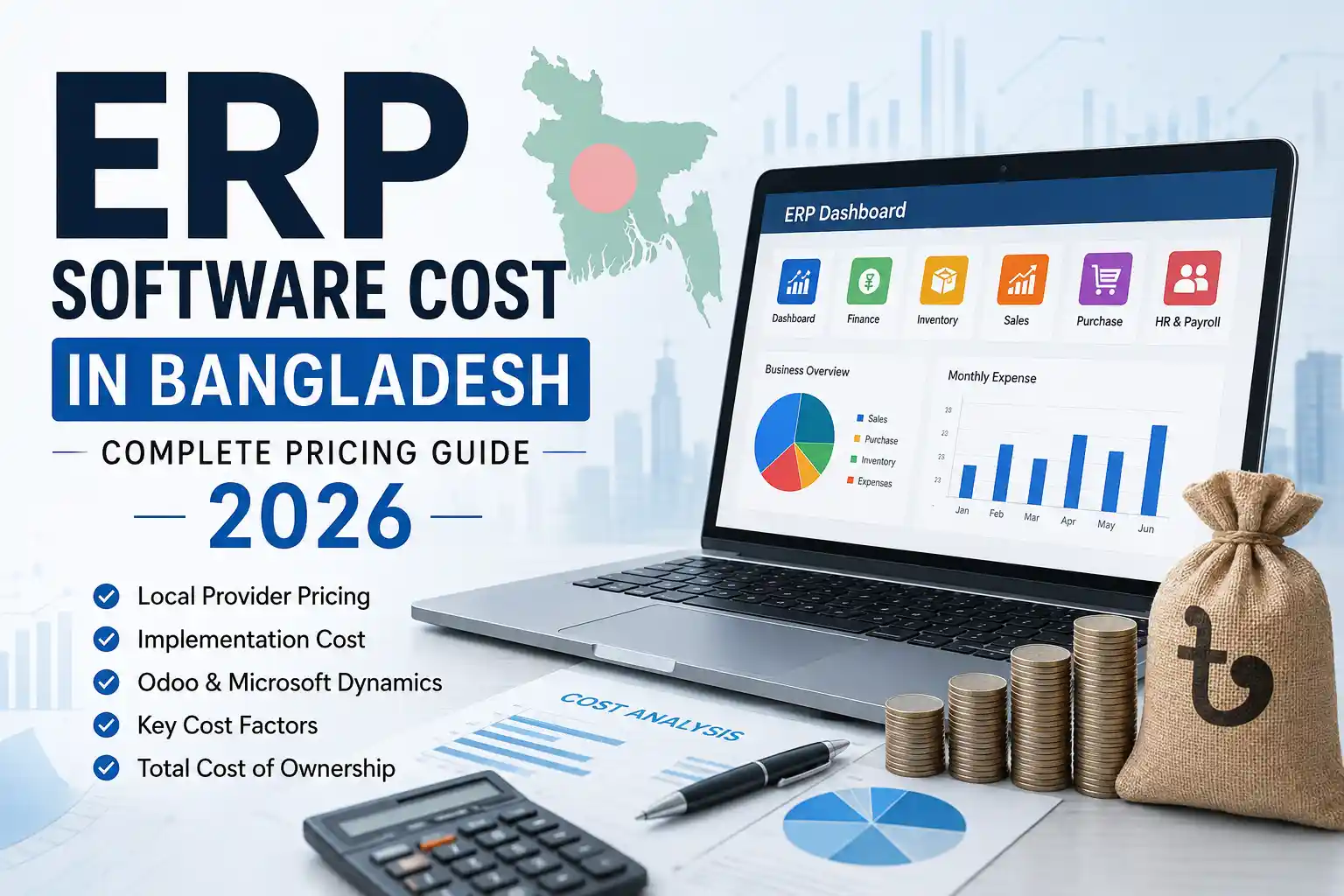
ERP Software Cost in Bangladesh: Complete Pricing Guide for 2026
ERP software does not have one fixed price in Bangladesh. A small trading business running a lightweight cloud package and a garment manufacturer rolling out a multi-module production system are both buying “ERP,” but the actual investment can differ enormously.
The advertised software price is also rarely the full story. Implementation, customization, integrations, data migration, training, hosting, and ongoing support can substantially increase the total cost. For complex or highly customized projects, these additional services may cost as much as—or more than—the initial software license or subscription.
This guide explains what determines ERP software cost in Bangladesh, provides selected provider-published pricing examples, examines international ERP platforms, and shows how businesses can compare quotations based on total cost of ownership rather than the advertised software price alone.
Quick Answer: How Much Does ERP Software Cost in Bangladesh?
There is no official or standardized “average ERP cost” for Bangladesh, and businesses should be cautious about treating any single price range as representative of the entire market.
ERP pricing varies greatly depending on the provider, licensing model, number of users, modules, implementation requirements, customization, integrations, and business complexity.
Some ERP vendors publish starting prices or indicative price ranges, while many provide pricing only after reviewing a business’s requirements.
For example, Biznify currently advertises pricing starting from ৳1,000 per month, while PinTechERP publishes indicative business-size ranges beginning at approximately ৳1,00,000–৳5,00,000 for small businesses and increasing for larger implementations. These are individual providers’ own pricing references—not Bangladesh-wide ERP market rates.
International cloud ERP platforms such as Odoo and Microsoft Dynamics 365 Business Central publish subscription pricing, generally on a per-user basis, while implementation is handled separately.
Beyond the base software price, businesses may also need to budget for implementation, customization, integrations, data migration, training, hosting, support, VAT or tax, and future upgrades.
For accurate budgeting, businesses should request a current, written, itemized quotation from each ERP vendor they are considering.
|
ERP Type / Business Size |
Pricing Model |
Typical Cost Components |
Best For |
|---|---|---|---|
|
Entry-level / small business ERP |
Varies by vendor |
Software subscription/license, basic setup, implementation |
Small businesses and single-location operations |
|
SME ERP |
Subscription, license, package, or quotation |
Software, implementation, modules, training, customization |
Growing SMEs with multiple departments |
|
Industry-specific ERP |
Usually custom quotation |
Industry modules, implementation, compliance features, customization |
Manufacturing, garments, healthcare and specialized industries |
|
International cloud ERP |
Usually subscription-based |
Subscription, implementation, localization, customization |
Businesses wanting internationally supported ERP platforms |
|
Large enterprise ERP |
Custom quotation |
Software, extensive implementation, integrations, migration, support |
Large, multi-branch or multi-entity organizations |
What Is ERP Software?
ERP stands for Enterprise Resource Planning.
ERP software connects different parts of a business—such as accounting and finance, inventory, sales, procurement, HR and payroll, manufacturing, CRM, supply chain, warehouse management, and reporting—within a shared system, depending on the product and modules selected.
Instead of accountants, warehouse managers, sales teams, and other departments maintaining disconnected records, an ERP system can provide a more consistent view of business information across departments.
It can also reduce manual data reconciliation and help businesses manage processes from a central platform.
What Determines ERP Software Cost in Bangladesh?
ERP pricing depends on several factors, which means two businesses purchasing the same ERP platform may still pay significantly different total amounts.
Number of Users
Many cloud ERP platforms charge per user per month. In these systems, increasing the number of licensed users increases recurring software costs.
However, not every ERP provider uses per-user pricing.
Number of Modules
A business requiring only accounting, sales, and inventory may have a simpler implementation than one requiring manufacturing, HR, payroll, CRM, procurement, warehouse management, and advanced reporting.
The modules included—and whether they are bundled or separately priced—depend on the vendor.
Company Size and Number of Branches
Businesses with multiple locations, departments, warehouses, or legal entities generally require more configuration and may need more complex reporting and access controls.
Deployment Model
ERP can be deployed through the cloud or on-premise.
Cloud ERP commonly uses recurring subscriptions, while on-premise ERP may involve licensing, servers, infrastructure, maintenance, and internal IT administration.
Customization
Custom workflows, dashboards, reports, approval systems, industry-specific features, and custom modules can increase implementation and future maintenance costs.
Implementation Complexity
ERP implementation can include requirements analysis, configuration, process mapping, testing, migration, training, and deployment.
A complex organization usually requires more implementation work than a small business with straightforward processes.
Integrations
Businesses may need to connect ERP software with e-commerce websites, POS systems, payment gateways, banks, courier services, biometric attendance systems, CRM tools, or other third-party applications.
These integrations may require additional development and testing.
Data Migration
Moving customer, supplier, inventory, accounting, employee, and historical transaction data from an existing system can add cost.
Migration becomes more difficult when data is incomplete, duplicated, inconsistent, or spread across multiple spreadsheets and legacy systems.
Training
ERP vendors may include some training in implementation packages or charge for it separately.
Training requirements also depend on the number of users and their roles.
Support and Maintenance
Ongoing support, updates, maintenance, hosting, and upgrades may be included, partially included, or charged separately depending on the vendor and contract.
Industry-Specific Requirements
Garments, manufacturing, healthcare, education, retail, and other industries may require specialized functionality that affects implementation complexity and cost.
VAT, Tax, and Currency
Local ERP prices may or may not include applicable VAT or taxes.
International platforms usually display prices in foreign currencies, and regional pricing or currency conversion can affect the amount a Bangladesh business ultimately pays.
Cloud ERP vs On-Premise ERP Cost
Cloud ERP
Cloud ERP is generally hosted by the software provider or its cloud infrastructure provider.
Pricing is commonly subscription-based, sometimes per user per month.
Because businesses may not need to purchase and maintain their own servers, cloud deployment can reduce upfront infrastructure requirements.
However, subscription fees continue for as long as the business uses the platform.
On-Premise ERP
On-premise ERP runs on infrastructure controlled by the business.
Costs may include:
- Software licensing
- Servers
- Networking and infrastructure
- Installation
- Implementation
- Internal IT administration
- Maintenance
- Backups
- Security
- Upgrades
- Support
An on-premise deployment may have a higher upfront infrastructure requirement, but this does not necessarily mean cloud ERP will always be cheaper over the long term.
The total cost of either model depends on user count, infrastructure, maintenance, support requirements, and future growth.
ERP Software Cost by Business Size
ERP Cost for Small Businesses
Small businesses and single-location shops generally consider the lowest tiers offered by ERP vendors, although what qualifies as “entry-level” differs significantly between providers.
As one provider-published example, Biznify advertises pricing starting from ৳1,000 per month, with 5% VAT stated as applicable.
Biznify’s FAQ separately states that implementation starts from ৳10,000, depending on factors such as data size, training requirements, and selected modules.
The provider also gives an approximate small-business estimate of ৳15,000–৳40,000 per year.
These figures are Biznify’s own advertised starting price and approximate estimate. They should not be interpreted as the standard cost of small-business ERP across Bangladesh.
ERP Cost for SMEs
Growing SMEs often need additional departments, users, reporting, HR, supply chain management, and other functionality.
PinTechERP publishes indicative ERP cost ranges on its official product page.
The provider gives approximate ranges of:
- Small business: ৳1,00,000–৳5,00,000
- Medium business: ৳5,00,000–৳15,00,000
PinTechERP also states that subscription-based and one-time licensing models are available.
However, these figures are provider-published indicative ranges rather than formal fixed pricing plans, and the published ranges are not clearly mapped to one particular licensing model.
They should therefore not be treated as Bangladesh-wide SME ERP prices.
ERP Cost for Large Enterprises
Large enterprises, multi-branch businesses, manufacturers, and multi-entity organizations usually require custom quotations.
PinTechERP states that large-enterprise implementations can exceed ৳20,00,000, depending on factors such as customization and integration requirements.
Again, this is a provider-published indicative figure rather than a standard enterprise ERP price for Bangladesh.
Many other enterprise and industry-specific ERP vendors do not publish a fixed price and instead provide quotations after reviewing project requirements.
ERP Cost by Module
Public ERP pricing pages in Bangladesh generally do not provide a standardized price for each individual module.
Common ERP modules can include:
- Accounting and finance
- Inventory
- Sales
- Purchasing and procurement
- HR and payroll
- CRM
- Manufacturing
- Warehouse management
- Supply chain management
- POS
- Reporting and business intelligence
Vendors package these modules differently.
Biznify’s official information indicates that its base offering covers areas such as accounting, inventory, sales, purchase, HR, and CRM, while manufacturing, POS, and e-commerce can be added according to business requirements or the selected plan.
Other ERP vendors may structure their packages differently.
Because there is no reliable standardized per-module pricing structure across the Bangladesh ERP market, businesses should ask each provider exactly which modules are included and which require additional payment.
ERP Implementation Cost
ERP implementation is the process of turning software into a working system for a particular business.
Implementation can include:
- Requirements analysis
- Business-process mapping
- Configuration
- User setup
- Module setup
- Workflow configuration
- Data migration
- Testing
- Training
- Deployment
- Integration with other systems
There is no reliable Bangladesh-wide implementation price.
Biznify’s official FAQ states that implementation starts from ৳10,000, with the final cost depending on factors such as data size, training requirements, and selected modules.
For international ERP platforms, implementation is generally separate from the software subscription.
Odoo, for example, offers official Success Packs for implementation assistance, while Microsoft does not publish a universal implementation price for Dynamics 365 Business Central and directs customers toward partners for project-specific implementation services.
For complex ERP projects, implementation may equal or exceed the initial software subscription or license cost. This is project-specific rather than a universal rule or fixed ratio.
ERP Customization Cost
Customization refers to functionality developed specifically for a particular business rather than used directly from the standard ERP product.
Examples include:
- Custom workflows
- Custom reports
- Dashboards
- Approval processes
- Custom forms
- Industry-specific functionality
- Custom modules
Customization can increase both initial implementation cost and future maintenance requirements.
For example, Odoo excludes maintenance of custom code from its standard subscription offering.
Businesses planning extensive customization should ask vendors how custom work will be maintained when the core ERP platform is updated.
No reliable standardized Bangladesh-specific customization price can be applied across vendors, so customization should be quoted according to project requirements.
ERP Integration Cost
Many Bangladesh businesses need ERP software to connect with other systems, such as:
- E-commerce websites
- POS systems
- Banks or payment gateways
- Courier and logistics systems
- Biometric attendance devices
- Existing accounting systems
- CRM software
- Third-party APIs
Integration availability and pricing vary by vendor, plan, and technical complexity.
A provider may include certain integrations, offer them as add-ons, or charge separately for setup and development.
Businesses should therefore confirm in writing whether each required integration—including e-commerce, SMS/email, payment gateways, or third-party APIs—is supported, included in the quotation, or billed separately.
Data Migration Cost
Data migration involves moving existing business information into the new ERP system.
This can include:
- Customer records
- Supplier records
- Inventory
- Accounting balances
- Employee data
- Historical transactions
Migration cost depends heavily on the quality and structure of existing data.
Clean, well-organized information can generally be migrated more easily than data scattered across spreadsheets, paper records, or poorly documented legacy software.
Businesses should ask ERP providers to assess existing data before estimating migration requirements.
ERP Training Cost
ERP training may include:
- Administrator training
- Employee/end-user training
- Documentation
- Initial onboarding
- Training for new employees
- Refresher training
- Training when new modules are introduced
Some ERP providers include training within implementation packages, while others charge separately.
Odoo Success Packs, for example, can include configuration, training, and data-import assistance.
There is no standardized Bangladesh-wide ERP training price. Businesses should ask vendors to specify exactly what training is included in the quotation.
ERP Support and Maintenance Cost
ERP support and maintenance can be recurring expenses.
Depending on the platform and contract, costs may include:
- Technical support
- Software updates
- Hosting
- Maintenance
- Upgrades
- Backup services
- Additional support packages
Odoo’s Standard and Custom subscriptions include support, hosting, maintenance, and upgrades within the applicable offering, while Odoo.sh hosting, implementation services, and maintenance of custom code are treated separately.
Other vendors may structure support differently.
Businesses should therefore request written details of ongoing support and maintenance charges before purchasing an ERP system.
Publicly Listed ERP Pricing Examples in Bangladesh
Pricing Note: The figures below are provider-published examples and should not be interpreted as an official Bangladesh-wide ERP market average. Packages, inclusions, VAT, implementation, and other conditions can change. Always request a current written quotation before making a purchasing decision.
|
Provider |
Product / Pricing Reference |
Published Price |
Pricing Basis |
What the Source Confirms |
Important Note |
|---|---|---|---|---|---|
|
Biznify |
Starting monthly pricing |
From ৳1,000/month |
Recurring subscription |
Official pricing page advertises pricing starting from ৳1,000/month; 5% VAT applicable |
Exact user allowance and additional-user pricing should be confirmed directly |
|
Biznify |
Implementation |
Starting from ৳10,000 |
Separate, scope-dependent |
Official FAQ states implementation starts from ৳10,000 |
Final cost depends on data size, training needs and modules |
|
Biznify |
Small-business estimate |
Approx. ৳15,000–৳40,000/year |
Vendor’s approximate estimate |
Official FAQ provides this approximate range |
Not a fixed plan price or Bangladesh-wide benchmark |
|
Biznify |
Custom / Enterprise ERP |
Custom quotation |
Scope-dependent |
Pricing depends on scope, modules and implementation requirements |
Request an itemized quotation |
|
PinTechERP |
Small business |
Approx. ৳1,00,000–৳5,00,000 |
Provider-published indicative range |
Official product page publishes this general range |
Not a formal fixed pricing plan |
|
PinTechERP |
Medium business |
Approx. ৳5,00,000–৳15,00,000 |
Provider-published indicative range |
Official product page publishes this general range |
Not mapped specifically to subscription or one-time licensing |
|
PinTechERP |
Large enterprise |
Can exceed ৳20,00,000 |
Provider-published indicative range |
Official product page states large-enterprise implementations can exceed this amount |
Actual pricing depends on scope, customization and integration |
Other ERP vendors operating in Bangladesh may provide pricing only after a consultation or requirements assessment.
Marketplace listings have not been used as a reliable ERP pricing benchmark because marketplace asking prices may not clearly show what is included in terms of modules, implementation, training, support, VAT, or licensing.
International ERP Options Used in Bangladesh
International ERP platforms are also used by businesses in Bangladesh, often with implementation provided directly or through local or regional partners.
Odoo
Odoo publishes pricing through its official pricing system, with displayed rates varying by country or region.
Odoo currently offers a One App Free plan at $0 for one app with unlimited users on Odoo Online, with required dependency apps potentially included.
On the pricing view checked for this guide, the Standard plan displays:
- Yearly pricing: $24.90 promotional / $31.10 renewal per user/month
- Monthly pricing: $31.10 promotional / $38.90 renewal per user/month
The Custom plan displays:
- Yearly pricing: $49.00 promotional / $61.10 renewal per user/month
- Monthly pricing: $61.00 promotional / $76.20 renewal per user/month
The lower displayed rates apply as promotional pricing for the first 12 months to the initial users ordered.
Because Odoo pricing is country- and region-sensitive, Bangladesh businesses should check the applicable current pricelist directly before budgeting.
Odoo Online hosting, support, maintenance, and upgrades are included within the applicable listed plans, while Odoo.sh hosting, implementation or expert services, and maintenance of custom code are excluded.
Odoo Success Packs
Odoo also provides Success Packs for implementation assistance.
Its official Success Packs information lists first-pack prices for new customers from $493 to $21,250 for packages of:
- 4 consultant hours
- 25 consultant hours
- 50 consultant hours
- 100 consultant hours
- 200 consultant hours
The displayed first-pack pricing reflects a 15% first-pack discount.
These are official displayed USD reference prices rather than guaranteed final prices for customers in Bangladesh, as regional, tax, and commercial conditions may affect the final amount.
Odoo states that companies with fewer than 50 employees usually work directly with Odoo using Success Packs, while mid-size and larger companies generally work with implementation partners. Companies with more than 250 employees are directed to contact Odoo directly.
Microsoft Dynamics 365 Business Central
Microsoft Dynamics 365 Business Central uses per-user subscription licensing.
Microsoft’s official US pricing page currently lists:
- Essentials: $80 per user/month
- Premium: $110 per user/month
- Team Members: $8 per user/month
The listed subscriptions are paid yearly.
Microsoft’s November 2025 pricing update increased the US reference price for Essentials from $70 to $80 and Premium from $100 to $110, applying to new cloud subscriptions and existing subscriptions at their first renewal on or after November 1, 2025.
These figures are US list/reference prices, not guaranteed Bangladesh prices.
Actual pricing can vary by country, currency, region, licensing arrangement, and Microsoft partner.
Microsoft does not publish a universal Business Central implementation price. Implementation and consulting are normally scoped separately through a Microsoft partner.
Businesses in Bangladesh should therefore obtain current local pricing and an implementation quotation before budgeting.
SAP Business One
SAP does not publish one standardized public price for SAP Business One that can be treated as a universal Bangladesh price.
Prospective customers generally need to contact SAP or an appropriate partner for pricing based on their requirements.
Oracle NetSuite
Oracle NetSuite similarly directs prospective customers to its sales/contact channels rather than providing one universal public price that can be applied to every implementation.
Bangladesh businesses considering NetSuite should request a quotation based on users, modules, implementation requirements, and other project-specific factors.
Understanding the Total Cost of ERP Ownership
The advertised ERP subscription or license price is only one component of the total cost.
A more complete ERP budget may include:
- License or subscription fees
- Implementation
- Customization
- Integrations
- Data migration
- Training
- Hosting or servers
- Ongoing support
- Maintenance
- Future upgrades
- Additional users
- Future custom development
Not every ERP project will incur every one of these costs, and some providers bundle multiple services into one package.
Two businesses paying the same software subscription can therefore have very different total project costs.
When comparing ERP systems, businesses should ask vendors to itemize what is included and what is charged separately.
For businesses also evaluating other digital investments, our guide to website development cost in Bangladesh explains a related but different category of technology spending.
Hidden or Additional ERP Costs to Consider
ERP costs that can be overlooked during initial budgeting include:
- Additional users added later
- Additional modules
- Custom reports
- API integrations
- Data cleanup before migration
- Additional training
- Server upgrades for on-premise systems
- Third-party software
- Subscription renewals
- Higher-level support packages
- Future customization
- VAT and applicable taxes
- Currency conversion
- Payment-related charges
Businesses should ask vendors about these potential expenses before signing a contract.
Example ERP Budget Scenarios
Because reliable public pricing is available from only a limited number of ERP providers, the examples below focus primarily on the cost components different businesses may need rather than suggesting one universal total price.
Small Trading Business
A single-location trading business with a small number of users may need:
- Accounting
- Inventory
- Sales
- Basic setup
- Implementation
- Hosting or subscription
- Support
As one provider-published example, Biznify advertises pricing starting from ৳1,000 per month, with 5% VAT applicable, while its FAQ states that implementation starts from ৳10,000 depending on data size, training requirements, and selected modules.
These figures are Biznify-specific and should not be treated as the general cost of small-business ERP in Bangladesh.
Growing SME
A growing SME may need:
- Accounting and finance
- Inventory
- Sales
- HR
- Supply chain management
- Advanced reporting
- More users
- Implementation
- Training
- Customization
As one vendor-specific reference, PinTechERP publishes indicative ranges of approximately ৳1,00,000–৳5,00,000 for small businesses and ৳5,00,000–৳15,00,000 for medium businesses.
These are provider-published indicative estimates rather than formal fixed plans or Bangladesh-wide market rates.
Manufacturing Company
A manufacturing company may need:
- Manufacturing and production planning
- Bill of materials
- Inventory
- Warehouse management
- Procurement
- Quality-related workflows
- Data migration
- Customization
- Integrations
- Training
Manufacturing ERP projects are often quotation-based because the required workflows and level of customization can vary substantially.
Multi-Branch Retail Business
A multi-branch retailer may need:
- Inventory across branches
- POS integration
- User access across locations
- Centralized reporting
- Stock transfers
- Sales reporting
- Accounting
- Implementation and training
The total cost depends on the number of branches, users, integrations, and vendor pricing model.
Large Enterprise
A large or multi-entity enterprise generally requires a custom quotation.
The project may involve:
- Multiple entities or branches
- Large numbers of users
- Complex integrations
- Extensive data migration
- Security and permissions
- Custom reporting
- Dedicated implementation
- Training
- Long-term support
At this scale, businesses should compare detailed project scopes rather than relying on generic ERP price estimates.
How to Compare ERP Quotations
When comparing ERP quotations, do not compare only the headline price.
Check:
- Number of modules included
- Number of users
- License or subscription duration
- Hosting
- Implementation scope
- Customization
- Training
- Support
- Data migration
- Integrations
- Renewal fees
- VAT and tax
- Currency
- Upgrade costs
Two quotations with very different prices may include completely different scopes of work.
Requesting an itemized quotation makes comparison much easier.
Questions to Ask an ERP Vendor Before Buying
Before choosing an ERP vendor, ask:
- Is the price one-time or recurring?
- How many users are included?
- Which modules are included?
- Which modules cost extra?
- Is implementation included?
- Is training included?
- How many employees will receive training?
- Is data migration included?
- What does migration cover?
- How is customization priced?
- Are integrations charged separately?
- What are the renewal fees?
- What are the support fees?
- Does the quotation include VAT and taxes?
- Are there currency-conversion charges?
- Who owns the business data?
- Can the data be exported if the company changes ERP providers?
- Is exit assistance available?
- How will pricing change if additional users or branches are added?
These questions can help uncover costs that may not be obvious from the advertised software price.
Cheap ERP vs Professional ERP
A lower-priced ERP system is not automatically a poor choice, just as a more expensive ERP system is not automatically better.
Choosing software based only on price can create risks such as:
- Limited scalability
- Inadequate support
- Missing functionality
- Limited integrations
- Difficult data migration
- Vendor lock-in
- Limited data-export options
However, paying more does not automatically eliminate these risks.
Businesses should evaluate functionality, scalability, implementation quality, support, data ownership, integration options, and contractual terms alongside price.
How Long Does ERP Implementation Take?
There is no single implementation timeline that applies to every ERP project in Bangladesh.
Implementation duration depends on:
- Company size
- Number of users
- Number of modules
- Data migration
- Customization
- Integrations
- Testing
- Training
- Existing business processes
- Organizational complexity
A straightforward deployment with few users and minimal customization may be completed more quickly than a complex manufacturing or multi-entity implementation.
Businesses should request a project plan and estimated timeline directly from the selected ERP provider rather than relying on a generic number of weeks or months.
Is ERP Software Worth the Cost for a Bangladesh Business?
ERP can be useful for businesses managing:
- Multiple departments
- Increasing transaction volume
- Multiple branches
- Complex inventory
- Manufacturing
- Disconnected spreadsheets
- Separate software systems
- Complex reporting requirements
An ERP system can help centralize business information and processes.
However, very small businesses with straightforward operations may not immediately need a full ERP platform and may be able to use simpler tools until their requirements become more complex.
Whether ERP is worth the investment depends on the organization’s processes, growth, operational challenges, and budget.
Businesses should evaluate these factors rather than assuming ERP is automatically necessary for every organization.
Final Thoughts
ERP software cost in Bangladesh cannot be reduced to a single figure, and businesses should avoid treating the advertised price of one provider as a market-wide benchmark.
Some vendors publish starting prices or indicative ranges. For example, Biznify currently advertises pricing starting from ৳1,000 per month, while PinTechERP publishes indicative business-size ranges from approximately ৳1,00,000–৳5,00,000 for small businesses to amounts that can exceed ৳20,00,000 for large-enterprise implementations.
These figures represent the respective providers’ own pricing references—not standardized ERP prices for Bangladesh.
Many other ERP providers use custom quotations.
The more useful approach is to compare total cost of ownership, including:
- Software license or subscription
- Implementation
- Customization
- Integrations
- Data migration
- Training
- Hosting
- VAT or tax
- Support
- Maintenance
- Future expansion
Before making a decision, businesses should request current, written, itemized quotations and compare them on a like-for-like basis.
Frequently Asked Questions
How much does ERP software cost in Bangladesh?
There is no verified national average for ERP software cost in Bangladesh, and pricing varies widely by vendor, licensing model, and project scope. As provider-specific examples, Biznify currently advertises pricing starting from ৳1,000 per month, while PinTechERP publishes indicative ranges of approximately ৳1,00,000–৳5,00,000 for small businesses, ৳5,00,000–৳15,00,000 for medium businesses, and amounts that can exceed ৳20,00,000 for large-enterprise implementations. These are individual providers’ advertised starting prices or indicative estimates, not Bangladesh-wide ERP market rates. Many other vendors provide pricing only after reviewing a business’s requirements.
How much does ERP implementation cost in Bangladesh?
No reliable Bangladesh-wide ERP implementation price range is available because implementation cost depends on the platform and project scope. Biznify’s official FAQ states that implementation starts from ৳10,000, depending on data size, training needs, and selected modules. For Odoo, official Success Packs list first-pack prices for new customers from $493 to $21,250 for packages of 4 to 200 consultant hours, with a 15% first-pack discount; these are official displayed USD reference prices rather than guaranteed Bangladesh final prices. Microsoft does not publish a universal implementation price for Dynamics 365 Business Central and normally directs businesses to partners for project-specific assessment and quotation.
Is cloud ERP cheaper than on-premise ERP?
Not necessarily. Cloud ERP can reduce upfront infrastructure spending because hosting is commonly included in the subscription, but recurring subscription fees continue while the service is used. On-premise ERP may require greater upfront infrastructure investment while still having ongoing maintenance, support, and upgrade expenses. Which option costs less over time depends on the business’s users, infrastructure, support requirements, and deployment model.
How much does ERP cost for a small business?
There is no single representative ERP price for every small business in Bangladesh. Biznify currently advertises pricing starting from ৳1,000 per month and separately states that implementation starts from ৳10,000, while its FAQ gives an approximate small-business estimate of ৳15,000–৳40,000 per year. PinTechERP, using a different pricing approach, publishes an indicative small-business range of approximately ৳1,00,000–৳5,00,000. These are provider-specific examples rather than a general market rate, so businesses should compare current quotations based on their required users, modules, implementation, and support.
What factors affect ERP software pricing?
Important factors include the number of users, modules, branches, deployment model, customization requirements, implementation complexity, integrations, data migration, training, support, industry-specific functionality, VAT or tax, and currency.
Is ERP charged per user?
Not always. International platforms such as Odoo and Microsoft Dynamics 365 Business Central use per-user subscription pricing, while other ERP providers may use package, business-size, module-based, subscription, one-time licensing, or custom-quotation models. PinTechERP, for example, publishes indicative business-size ranges and states that both subscription-based and one-time licensing options are available, without mapping those published ranges to a specific licensing model. Businesses should confirm the exact pricing basis with each vendor.
Does ERP pricing include implementation?
Not always. Odoo separates implementation and expert services from its software subscription pricing, while Microsoft directs Business Central customers to partners for implementation. Biznify separately publishes a starting implementation fee. Businesses should never assume that implementation is included in an advertised ERP price unless the vendor explicitly confirms it in the quotation.
What is the difference between ERP license cost and implementation cost?
The license or subscription cost pays for the right to use the ERP software. Implementation cost covers the work required to configure and deploy the software for the business, which may include requirements analysis, configuration, process mapping, migration, testing, training, and deployment.
For complex projects, implementation can equal or exceed the initial software cost, although this varies by project.
How much does ERP customization cost?
There is no standardized ERP customization price in Bangladesh. Cost depends on the number and complexity of custom workflows, reports, integrations, modules, and other requested functionality. Customization may also create future maintenance costs, so businesses should ask vendors to provide separate estimates for both initial development and ongoing maintenance.
How do I choose an ERP vendor in Bangladesh?
Compare total cost of ownership rather than only the advertised software price. Review the modules included, implementation scope, customization, training, support, data migration, integrations, VAT or tax, currency, renewal costs, data ownership, export options, exit assistance, and how pricing changes when users or branches are added. Request a detailed written quotation from each vendor before making a decision.
Sources and Verification Notes
Pricing in this guide is based on publicly available provider or platform information reviewed for this article. Published ERP prices, packages, discounts, regional pricing, VAT or tax treatment, and included services can change.
Provider-published prices should therefore be treated as reference points rather than permanent quotations.
For current pricing and contractual terms, businesses should check the relevant provider’s official website and request a current written quotation before purchasing.
Key first-party sources used for pricing and product information include:
- PinTechERP — official product information
- Biznify — official pricing and product information
- Odoo — official pricing and Success Packs information
- Microsoft — official Dynamics 365 Business Central pricing information
- SAP — official SAP Business One product information
- Oracle NetSuite — official product and sales information