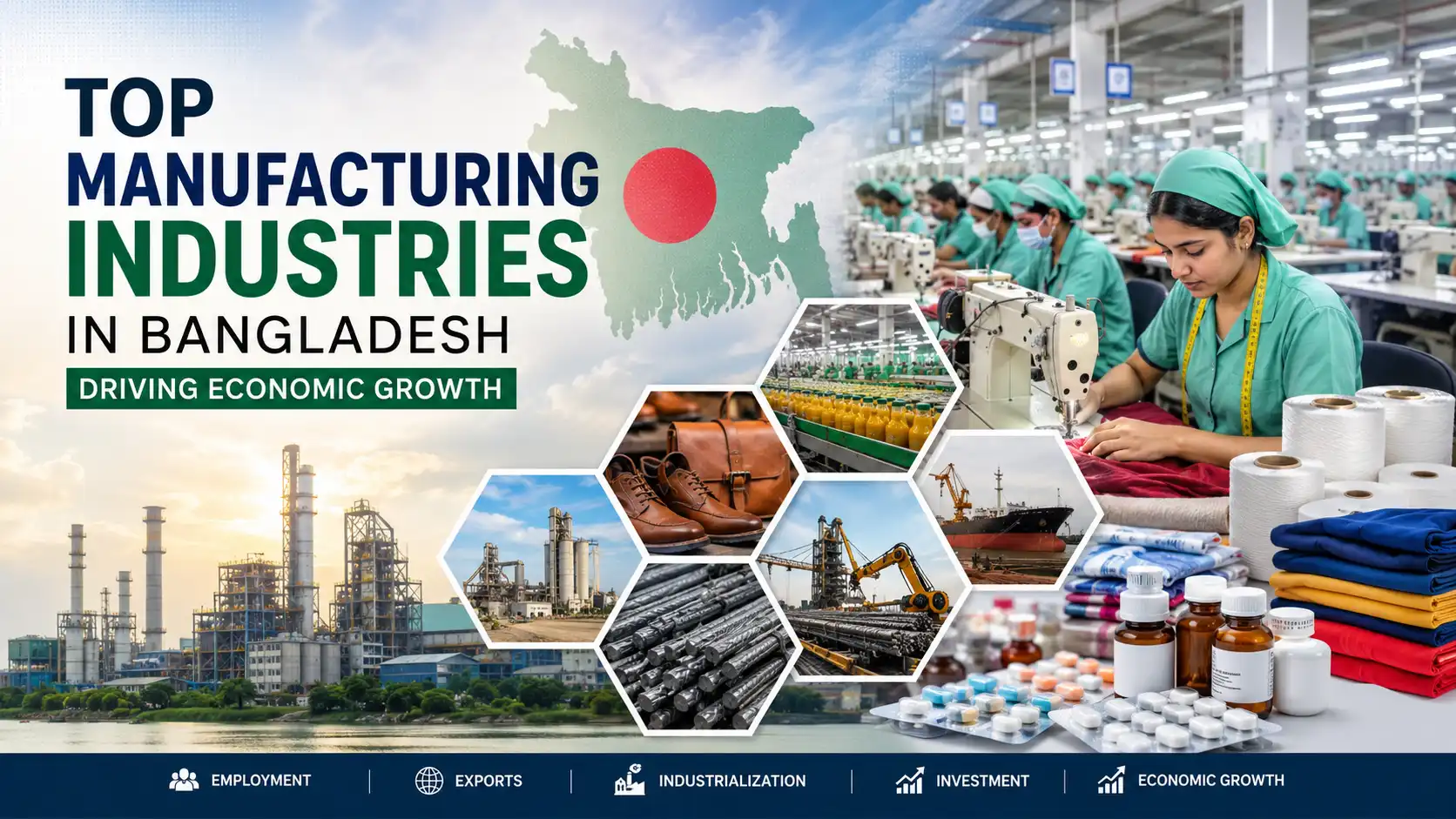
Top Manufacturing Industries in Bangladesh Driving Economic Growth
Manufacturing sits at the centre of Bangladesh’s remarkable economic transformation. In the space of a few decades, a country once described primarily in terms of agriculture and aid has become one of the world’s most significant garment producers, a pharmaceutical manufacturer serving markets across continents, and home to factories producing everything from ceramics and cement to ships and steel. Industrial production drives the country’s exports, employs millions of workers, anchors urban growth, and shapes how Bangladesh is perceived by global investors and trading partners.
This guide examines the top manufacturing industries in Bangladesh — what they produce, why they matter, and where they appear to be heading. A note on approach before we begin: the industries in this article are presented alphabetically and based on publicly available information about their documented role in Bangladesh’s economy. This is not an official ranking. Economic figures such as export values, employment numbers, and sectoral contributions change frequently and are reported differently by different sources, so this guide deliberately uses cautious, qualified language rather than precise statistics. For current data, readers should consult official sources such as the Bangladesh Bureau of Statistics, the Export Promotion Bureau, and relevant industry associations.
What Is the Manufacturing Industry?
Manufacturing is the process of transforming raw materials, components, or inputs into finished goods through the use of labour, machinery, and industrial processes. A manufacturing business takes something of lower value — cotton, clay, steel billets, chemical compounds — and converts it into something of higher value: a shirt, a tile, a construction rod, a medicine.
Manufacturing matters to economic development for reasons economists have documented across virtually every country that has industrialised:
- Value addition. Manufacturing captures more of a product’s final value inside the country than exporting raw materials does.
- Employment at scale. Factories absorb large numbers of workers, including those moving out of agriculture, and historically have offered a pathway from rural poverty to urban wage income.
- Productivity growth. Manufacturing tends to adopt technology, improve processes, and raise output per worker faster than many other sectors.
- Linkages. A single factory supports networks of suppliers, transporters, packagers, and service providers, multiplying its economic effect.
The key difference between manufacturing and service industries lies in the output. Manufacturing produces tangible goods that can be stored, shipped, and exported physically; services — banking, education, software, logistics — produce intangible value delivered through activity and expertise. The two are deeply interconnected: modern manufacturing depends on services such as design, finance, and distribution, while many services exist to support industrial production.
Why Manufacturing Is Important to Bangladesh’s Economy
Manufacturing’s importance to Bangladesh goes well beyond factory gates.
Employment. Industrial sectors — led by ready-made garments — employ millions of workers, a large share of them women. Manufacturing jobs have been widely credited in development literature with transforming household incomes, expanding women’s economic participation, and accelerating urbanisation.
Exports. Bangladesh’s export economy is overwhelmingly a manufacturing story. Ready-made garments dominate the export basket, with leather goods, jute products, pharmaceuticals, ceramics, and other manufactured items contributing alongside. Manufactured exports earn the foreign currency that pays for the country’s imports of fuel, machinery, and raw materials.
Industrialisation. Manufacturing growth has driven the structural transformation of the economy — the long shift from agriculture toward industry and services that characterises development everywhere.
Foreign investment. Export-oriented manufacturing has attracted foreign investors, joint ventures, and international buyers, bringing capital, technology, and management practices into the country. Special economic zones and export processing zones have been developed to encourage this investment.
Value addition and backward linkages. Over time, industries have built domestic supply chains — spinning and fabric mills feeding garment factories, accessory makers, packaging producers — keeping more value inside the economy.
Technology adoption. Competitive pressure in export markets pushes manufacturers to adopt modern machinery, quality systems, and, increasingly, automation and digital tools that spill over into the wider economy.
One further context matters for everything that follows: Bangladesh is expected to graduate from the United Nations’ Least Developed Country (LDC) category around 2026–2027, according to UN recommendations and national plans, although the exact implementation timeline and transition arrangements remain subject to final decisions. This milestone reflects decades of progress but also means the eventual phase-out of LDC-specific trade preferences that have supported manufactured exports — an outcome that will shape the competitive environment for nearly every industry discussed below.
Top Manufacturing Industries in Bangladesh
The industries below are listed alphabetically. Their order does not represent a ranking.
Cement Manufacturing
Bangladesh’s cement industry has grown alongside the country’s construction boom, supplying the housing, commercial real estate, and infrastructure projects that have reshaped its cities and transport networks. The industry primarily operates on a grinding model: since Bangladesh lacks significant limestone reserves, most producers import clinker and other raw materials, then grind and blend them into finished cement domestically.
Major products include ordinary Portland cement and blended cements used in everything from village homes to mega-infrastructure such as bridges, highways, and power plants. The market is overwhelmingly domestic, though producers have exported to neighbouring regions at times.
The industry’s importance lies in its role as an enabler: virtually every construction and infrastructure investment in the country depends on locally produced cement. Public infrastructure programmes and steady urbanisation have provided long-term demand.
Current trends include capacity expansion, competition among established producers, and growing attention to energy efficiency in grinding operations. Key challenges are dependence on imported raw materials — which exposes the industry to currency movements and shipping costs — along with energy prices and periods of overcapacity relative to demand.
Future opportunities lie in continued infrastructure development, rural housing growth, and potential efficiency gains through modern grinding technology and alternative fuels.
Ceramics Manufacturing
Bangladesh’s ceramics industry produces tableware, tiles, and sanitaryware for both domestic consumption and export, and has earned a reputation for quality that extends well beyond the country’s borders. Bangladeshi ceramic tableware, in particular, has been exported to demanding markets in Europe, North America, and Asia, with several long-established producers widely recognised in the sector.
Major product lines include porcelain and bone china tableware, ceramic and porcelain tiles for the construction market, and bathroom sanitaryware. The domestic construction boom has driven strong demand for tiles and sanitaryware, while tableware serves both home and international markets.
The industry matters as a demonstration of Bangladeshi manufacturing capability in a design- and quality-sensitive product category — evidence that the country can compete on more than low-cost basics. It also supports skilled employment in areas such as design, moulding, glazing, and quality control.
Current trends include capacity growth in tiles driven by urban construction, product innovation in tableware, and rising energy-efficiency investment, since ceramics production is energy-intensive and depends heavily on reliable gas supply.
Challenges include energy availability and pricing, imported raw material dependence for certain inputs, and competition from producers in other Asian countries. Opportunities lie in export expansion, premium product segments, and supplying the region’s growing construction markets.
Chemical Manufacturing
Chemical manufacturing in Bangladesh spans a wide range of products that feed both industry and daily life: fertilisers supporting the country’s agriculture, basic industrial chemicals, paints and coatings, soaps and detergents, cosmetics and toiletries, and inputs used by the textile, leather, and pharmaceutical industries.
Fertiliser production — particularly urea, historically manufactured using domestic natural gas — has long been one of the sector’s most strategically important segments, given its direct link to national food security. Consumer chemical products such as detergents, personal care items, and household cleaners represent another substantial segment, serving a large and growing domestic market.
The industry’s importance lies in its backward-linkage role: textiles need dyes and processing chemicals, leather needs tanning agents, agriculture needs fertilisers and crop protection, and construction needs paints and adhesives. A capable domestic chemical industry reduces import dependence across many other sectors.
Current trends include growth in consumer and specialty chemicals, investment by established industrial groups, and increasing regulatory attention to safety and environmental standards. Challenges include feedstock and energy constraints — particularly natural gas availability for fertiliser production — import dependence for many raw materials, and the need for stronger environmental compliance.
Future opportunities include import substitution in specialty chemicals, textile and leather chemical production, and gradual moves up the value chain as industrial demand deepens.
Electronics Manufacturing
Electronics has emerged as one of Bangladesh’s most visible newer manufacturing stories. Where the market was once supplied almost entirely by imports, domestic manufacturers and assemblers now produce refrigerators, televisions, air conditioners, washing machines, mobile phones, and small appliances at scale — with Walton frequently cited as the widely recognised example of a Bangladeshi brand manufacturing electronics locally and exporting to international markets.
Major products span home appliances, consumer electronics, mobile handsets assembled domestically by several brands, and electrical equipment such as fans, cables, and lighting. The primary market is domestic — a large population with rising purchasing power — with exports developing gradually.
The industry matters because it represents diversification beyond garments: higher-technology production, engineering employment, and the growth of domestic brands rather than purely contract manufacturing. Government policy has generally encouraged local assembly and manufacturing through tariff structures that favour domestic production over imported finished goods.
Current trends include deepening local component production, expansion of mobile handset assembly plants, and early-stage export efforts. Challenges include reliance on imported components, technology gaps relative to established electronics-producing countries, and the need for skilled technical manpower.
Opportunities lie in expanding component ecosystems, positioning Bangladesh in regional electronics supply chains, and building on domestic brand success to grow exports.
Food & Beverage Manufacturing
Food and beverage manufacturing is among Bangladesh’s largest industrial activities by any measure of daily relevance, converting the country’s agricultural output into processed foods, drinks, and packaged products for a market of well over one hundred and fifty million consumers — and, increasingly, for export.
Major products include rice and flour milling, edible oils, sugar, dairy products, biscuits and bakery items, snacks, juices and carbonated beverages, spices, frozen foods, and processed agricultural goods. Bangladeshi processed foods have found export markets in regions with large South Asian diaspora populations and beyond, with PRAN frequently cited as a widely recognised example of a Bangladeshi agro-processing exporter.
The industry’s importance is threefold: it adds value to domestic agriculture, provides extensive employment across processing, packaging, and distribution, and supplies affordable nutrition to the population. Its deep rural linkages mean growth in food processing directly benefits farming communities.
Current trends include rising demand for packaged and branded foods driven by urbanisation, growth in export-oriented agro-processing, and increasing attention to food safety standards and certification.
Challenges include food safety enforcement, cold chain and logistics limitations, raw material seasonality, and quality consistency for export markets. Opportunities lie in expanding processed food exports, halal-certified products, and modern packaging and preservation technologies.
Furniture Manufacturing
Bangladesh’s furniture industry has evolved from a craft-based trade of small workshops into an organised manufacturing sector with modern factories, national brands, and growing export ambitions. The industry produces home furniture, office furniture, institutional furnishings, and increasingly design-led products for urban consumers.
Major products include wooden, laminated board, metal, and upholstered furniture for bedrooms, living spaces, offices, and commercial interiors. The market remains predominantly domestic — fuelled by urbanisation, apartment living, and a growing middle class — while exports have developed gradually to various international markets.
The industry matters for its employment intensity, spanning skilled carpentry and modern factory work, and for its extensive linkages with timber processing, board manufacturing, hardware, foam, and fabric suppliers. It also demonstrates the formalisation path many Bangladeshi industries follow: from informal workshops toward branded, factory-based production.
Current trends include showroom-based branded retail, machine-based production replacing purely manual methods, use of engineered boards alongside solid wood, and e-commerce sales channels.
Challenges include raw material sourcing — much timber and board input is imported — competition from informal producers, design and finishing standards for export markets, and skilled workforce development. Opportunities lie in export growth, office and institutional segments, and design-driven products that capture more value than commodity furniture.
Garments & Textile Manufacturing
Ready-made garments (RMG) and textiles form the backbone of Bangladesh’s industrial economy and its single most consequential export industry. Bangladesh is widely recognised as one of the world’s largest apparel exporters, supplying global fashion brands and retailers across Europe, North America, and beyond with knitwear, woven garments, denim, and increasingly diversified apparel products.
The industry spans the full chain: spinning mills producing yarn, weaving and knitting mills producing fabric, dyeing and finishing units, and thousands of garment factories cutting and sewing finished clothing. Backward linkage — domestic yarn and fabric production feeding the garment factories — has deepened substantially over the decades, keeping more value within the country.
Its importance is difficult to overstate: RMG accounts for the dominant share of national export earnings according to official trade reporting, employs millions of workers — a large proportion of them women — and has shaped Bangladesh’s urbanisation, social change, and international economic identity.
Current trends include a widely reported concentration of green-certified garment factories, movement into higher-value products, automation in sewing and fabric processing, and intensified buyer requirements on labour, safety, and environmental compliance.
Challenges include global price pressure, the approaching loss of LDC trade preferences, energy costs, and compliance demands. Opportunities lie in man-made fibre products, higher-value segments, and sustainability leadership as a competitive asset.
Jute Manufacturing
Jute occupies a unique place in Bangladesh’s industrial history — the “golden fibre” was the country’s original export industry, and Bangladesh remains one of the world’s principal producers and exporters of raw jute and jute goods. While the industry’s relative economic weight declined over the decades as synthetics displaced natural fibres, it has retained genuine international relevance and gained renewed attention amid global demand for biodegradable materials.
Major products include jute yarn and twine, hessian cloth, sacks and bags, carpet backing, and an expanding range of diversified jute products — shopping bags, home décor items, geotextiles used in soil stabilisation, and jute-blended composites.
The industry matters for its deep rural linkage — millions of farming households cultivate jute — its export earnings, and its employment across mills and processing units. It also carries strategic promise in a world seeking alternatives to plastic packaging.
Current trends include growth in diversified jute products, private-sector milling alongside the state-owned legacy sector, and international interest in natural-fibre packaging driven by environmental regulation in importing countries.
Challenges include price volatility, ageing mill technology in parts of the sector, competition from synthetic substitutes, and quality consistency. Opportunities lie in eco-friendly packaging, jute geotextiles, and branding Bangladeshi jute in sustainability-conscious markets.
Leather & Footwear Manufacturing
Leather and footwear together constitute one of Bangladesh’s most significant export industries after garments, built on a domestic supply of hides and skins and expanding manufacturing capability in finished products. The industry spans tanning, leather goods production — bags, wallets, belts — and footwear manufacturing in both leather and non-leather categories.
Major products include finished leather, leather footwear, sports and casual shoes, and leather accessories, exported to markets in Europe, Asia, and elsewhere, alongside a large domestic footwear market served by both branded manufacturers and small producers.
The industry’s importance lies in its export diversification role, its employment across tanneries, factories, and craft units, and its use of domestic raw materials — giving it stronger local value addition than many import-dependent sectors. The relocation of tanneries from Hazaribagh in Dhaka to the planned tannery estate at Savar has been one of the industry’s most widely reported structural developments, aimed at addressing long-standing environmental concerns.
Current trends include growth in non-leather and sports footwear exports, international brands sourcing from Bangladeshi factories, and continuing efforts to achieve environmental compliance certifications that unlock premium buyers.
Challenges centre on environmental management — particularly effluent treatment at the tannery estate — compliance certification, and quality standards. Opportunities include capturing footwear orders diversifying away from other producing countries and moving into higher-value finished goods.
Light Engineering
Light engineering is often described as the workshop of Bangladeshi industry — a vast ecosystem of small and medium enterprises producing machinery parts, spare components, moulds, dies, agricultural implements, bicycle components, automotive parts, and repair services that keep the country’s factories, farms, and transport running.
Major products include machine spares for the textile, jute, and food industries, agricultural machinery and parts, construction equipment components, foundry products, and fabricated metal items. Clusters of light engineering workshops — such as the well-known concentration in Old Dhaka — supply customised parts that would otherwise require imports.
The industry matters enormously as an enabler: nearly every other manufacturing sector depends on light engineering for maintenance, spares, and machinery support. It is also a significant employer of skilled and semi-skilled technicians and a training ground for the country’s industrial workforce. Government and development-sector programmes have periodically identified light engineering as a priority sector for support.
Current trends include gradual technology upgrading, entry into component exports, and linkages with the growing electronics and automotive assembly activities in the country.
Challenges include limited access to finance for small workshops, outdated machinery in parts of the sector, quality certification gaps, and skills shortages. Opportunities lie in import substitution of machinery parts, contract manufacturing for larger industries, and integration into regional supply chains.
Paper Manufacturing
Bangladesh’s paper industry produces writing and printing paper, packaging paper and board, tissue products, and specialty papers for a market driven by education, publishing, commerce, and — increasingly — packaging demand from other industries.
Major products include printing and writing paper for the country’s vast educational needs, kraft and packaging papers, paperboard for cartons, tissue and hygiene papers, and newsprint. The market is primarily domestic, with the packaging segment growing alongside the food, pharmaceutical, and export industries that require cartons and paper-based packaging.
The industry’s importance flows from its linkages: education and publishing depend on affordable paper, while the export economy depends on packaging. Domestic production reduces reliance on imports for these essential inputs. The sector includes both long-established mills and newer private producers, with recycled paper forming a significant part of the raw material base.
Current trends include growth in packaging grades driven by industrial and e-commerce demand, expansion of tissue production for a growing consumer market, and greater use of recycled fibre.
Challenges include raw material sourcing — Bangladesh lacks large-scale pulpwood resources, making mills dependent on imported pulp and recovered paper — along with energy costs and environmental compliance in water use and effluent treatment. Opportunities lie in packaging growth, hygiene products, and recycling-based production models.
Pharmaceuticals Manufacturing
Pharmaceuticals is widely regarded as one of Bangladesh’s most sophisticated manufacturing success stories. Domestic manufacturers meet the overwhelming majority of the country’s medicine demand, according to industry and government reporting, and Bangladeshi pharmaceutical products are exported to a large number of countries across several continents — including some highly regulated markets.
Major products include generic medicines across virtually all therapeutic categories, along with vaccines, biosimilars in early development, and active pharmaceutical ingredient (API) production that remains a national priority for expansion. Several leading companies have obtained approvals from stringent international regulatory authorities, a widely reported marker of the industry’s quality standards.
The industry matters for public health — affordable domestically produced medicines — for high-skilled employment of pharmacists, chemists, and engineers, and for export diversification beyond garments. As an LDC, Bangladesh has benefited from a waiver of certain pharmaceutical patent obligations under the WTO TRIPS framework, a flexibility whose eventual expiry after LDC graduation is among the industry’s most discussed strategic issues.
Current trends include API investment — including a dedicated API industrial park initiative — export market expansion, and movement toward more complex products.
Challenges include API import dependence, the post-graduation intellectual property transition, and regulatory capacity. Opportunities lie in global generic demand, contract manufacturing, and building on established quality credentials.
Plastic Manufacturing
Plastic manufacturing has grown into a substantial and versatile Bangladeshi industry, producing household items, packaging, industrial components, construction materials, toys, and garment accessories. The sector spans large modern factories and thousands of small enterprises, making it one of the more employment-intensive manufacturing activities relative to its size.
Major products include household plasticware, PET bottles and packaging, flexible packaging films, pipes and fittings for construction and agriculture, furniture, toys, and components supplied to the garment industry — hangers, buttons, and packaging materials that link plastics directly to the export economy. Bangladeshi plastic products are also exported in their own right, including household items and packaging materials.
The industry’s importance lies in its supporting role for other sectors — packaging for food and pharmaceuticals, accessories for garments, pipes for construction and irrigation — alongside its direct consumer market and export earnings.
Current trends include growth in packaging driven by consumer goods and e-commerce, quality upgrades among export-oriented producers, and early attention to recycling as environmental scrutiny of plastics intensifies worldwide.
Challenges include full dependence on imported polymer raw materials, environmental concerns and waste management pressure, and compliance expectations in export markets. Opportunities lie in recycling-based production, higher-grade packaging, engineering plastics, and supplying the accessory needs of the export industries.
Shipbuilding
Shipbuilding represents one of Bangladesh’s more striking industrial achievements — the country moved from repairing and building vessels for domestic inland waterways to exporting ocean-going ships to international buyers, with exports of small and medium vessels to European and other markets widely reported since the late 2000s.
Major products include small and medium ocean-going cargo vessels, ferries and passenger vessels for the country’s vast river network, fishing vessels, and specialised craft. The domestic market alone is substantial: Bangladesh’s rivers carry enormous passenger and cargo traffic requiring continuous fleet construction and replacement. A number of established shipyards serve both domestic and export orders.
The industry matters because it demonstrates heavy-engineering capability — welding, steel fabrication, marine engineering, and project management at scale — and because it employs skilled workers in a high-value activity with long industrial linkage chains into steel, machinery, and components.
Current trends include periodic export orders for specialised vessels, modernisation of yards, and interest in the sector’s potential as global buyers diversify sourcing. The related ship recycling industry in Chattogram — one of the largest ship recycling hubs globally according to multiple international studies — is undergoing a widely covered transition toward compliance with international environmental and safety standards.
Challenges include financing for long production cycles, infrastructure constraints, and international certification requirements. Opportunities lie in niche vessel exports, inland fleet modernisation, and compliant green ship recycling.
Steel Manufacturing
Steel manufacturing underpins Bangladesh’s construction-driven growth, producing the reinforcement bars, structural sections, and flat products that go into housing, commercial buildings, bridges, and infrastructure projects across the country. The industry has developed largely around recycling: melting scrap steel — much of it historically supplied by the ship recycling industry — into billets and rolling them into finished products.
Major products include reinforcement bars (rod) for construction, structural steel, corrugated galvanised sheets widely used in rural and urban roofing, and other flat and long products. Several large domestic producers are widely recognised names in the construction market, operating modern melting and rolling facilities.
The industry’s importance parallels cement’s: it is the essential input for the construction and infrastructure activity that has defined Bangladesh’s recent development, from mega-bridges to apartment towers. It also supports substantial employment and a large distribution ecosystem.
Current trends include capacity expansion by leading producers, adoption of modern steelmaking technology, and quality standardisation as infrastructure projects demand certified products.
Challenges include energy intensity and power costs, dependence on imported scrap and raw materials, price volatility, and environmental compliance in melting operations. Opportunities lie in continued infrastructure and housing demand, product diversification into higher grades, and efficiency gains through technology upgrades.
Fast-Growing Manufacturing Sectors
Beyond the established industries above, several newer manufacturing areas are attracting attention and investment.
Renewable energy equipment. Growing solar adoption is creating demand for locally assembled panels, mounting structures, batteries, and related components, with early-stage domestic activity developing alongside imports.
Electric vehicles. Bangladesh already operates one of the world’s largest fleets of electric three-wheelers, and interest in locally assembling electric two- and three-wheelers — along with batteries and charging equipment — has grown visibly, supported by evolving government policy attention to the sector.
Medical devices. Building on pharmaceutical manufacturing credibility, early ventures into medical consumables and devices point toward a potential adjacent industry serving domestic healthcare demand.
Agro-processing. Modern food processing — freezing, drying, packaging, and export-grade preparation of fruits, vegetables, fish, and specialty crops — is expanding, connecting Bangladeshi agriculture to premium domestic and international markets.
Smart manufacturing. Larger factories, particularly in garments and pharmaceuticals, are adopting automation, sensors, and data-driven production management, laying foundations for broader Industry 4.0 practices.
Packaging. Demand from food, pharmaceuticals, consumer goods, and export industries has made packaging — flexible films, cartons, labels, PET, and paper-based formats — one of the most consistently growing industrial segments.
Digital manufacturing. Design software, computer-controlled machinery, 3D prototyping, and digitally managed production are gradually entering Bangladeshi factories, particularly among export-oriented and engineering-focused firms.
Challenges Facing Bangladesh’s Manufacturing Industries
Bangladesh’s manufacturing momentum is real, but several structural challenges cut across nearly every sector.
Energy. Reliable, affordable energy remains the industry’s most frequently cited constraint. Gas supply limitations, electricity costs, and periodic disruptions directly affect energy-intensive sectors such as ceramics, steel, textiles, and fertiliser.
Logistics. Port congestion, transport bottlenecks, and lead-time pressures raise costs and complicate export commitments, making logistics modernisation a persistent industry demand.
Skilled workforce. Factories increasingly need technicians, machine operators, engineers, and managers faster than the education and training system produces them — a gap that widens as automation spreads.
Technology adoption. Many small and medium manufacturers operate with dated machinery and limited access to finance for upgrades, holding back productivity and quality.
Global competition. Bangladeshi manufacturers compete with established producers across Asia, and the scheduled loss of LDC trade preferences will intensify competitive pressure in key export markets.
Sustainability and environmental compliance. International buyers, regulators, and financiers increasingly require environmental performance — effluent treatment, emissions management, chemical safety — that demands investment and institutional capability.
Supply chain risks. Heavy dependence on imported raw materials — cotton, polymers, clinker, scrap, chemicals, components — exposes manufacturers to currency movements, shipping disruptions, and global price swings.
Future of Manufacturing in Bangladesh
Several forces are likely to shape the sector’s next decade.
Industry 4.0 and automation. Automation is expected to spread from leading factories to the broader industrial base, changing both productivity and the skills workers need. Managed well, it raises competitiveness; managed poorly, it risks leaving workers behind — making reskilling a national priority.
Artificial intelligence. AI applications in production planning, quality inspection, demand forecasting, and machine maintenance are beginning to appear in advanced factories and are likely to become standard tools among export-oriented manufacturers.
Green manufacturing. Bangladesh’s garment industry has already built an internationally noted portfolio of green-certified factories, and environmental performance is increasingly a selling point rather than merely a compliance cost — a pattern likely to extend into textiles, leather, and other sectors.
Export diversification. Reducing dependence on garments is a long-standing national goal that gains urgency with LDC graduation. Pharmaceuticals, footwear, agro-processing, jute products, light engineering, and electronics are the sectors most frequently discussed as diversification candidates.
Smart factories and ESG. International buyers and investors increasingly evaluate manufacturers on environmental, social, and governance performance, pushing transparency, worker welfare, and traceability from optional to expected.
Circular economy. Recycling — already central to steel, significant in paper and plastics, and emerging in textiles through garment waste recycling initiatives — is positioned to become a defining theme as global brands seek circular supply chains.
The throughline is clear: the era of competing purely on low cost is giving way to competition on quality, compliance, technology, and sustainability. The industries that adapt fastest will define Bangladesh’s next chapter of growth.
Frequently Asked Questions
What are the major manufacturing industries in Bangladesh?
The most widely documented sectors include ready-made garments and textiles, pharmaceuticals, leather and footwear, jute, food and beverage processing, steel, cement, ceramics, plastics, light engineering, electronics, furniture, paper, chemicals, and shipbuilding.
Which industry dominates Bangladesh’s exports?
Ready-made garments account for the dominant share of national export earnings, according to official trade reporting, making Bangladesh one of the world’s largest apparel exporters.
Why is manufacturing so important to Bangladesh’s economy?
Manufacturing drives export earnings, employs millions of workers, adds value to raw materials, attracts foreign investment, and powers the structural shift from an agricultural to an industrial economy.
What is LDC graduation and why does it matter for manufacturers?
Bangladesh is expected to graduate from the UN’s Least Developed Country category around 2026–2027, subject to final decisions on the implementation timeline. Graduation eventually phases out LDC-specific trade preferences and policy flexibilities — including duty-free market access in key export destinations — making competitiveness, compliance, and diversification more important for exporters.
Is Bangladesh’s pharmaceutical industry export-oriented?
Yes. While domestic producers primarily serve the local market — meeting the large majority of national medicine demand, according to industry reporting — Bangladeshi pharmaceuticals are exported to a large number of countries, including some regulated markets.
What challenges do Bangladeshi manufacturers face?
The most commonly cited challenges are energy supply and cost, logistics bottlenecks, skilled workforce shortages, imported raw material dependence, global competition, and rising environmental compliance requirements.
Which newer manufacturing sectors are growing in Bangladesh?
Frequently discussed emerging areas include packaging, agro-processing, electronics and electrical goods, electric vehicle assembly, renewable energy equipment, and medical consumables.
Does Bangladesh manufacture ships?
Yes. Bangladeshi shipyards build vessels for the country’s extensive river transport system and have exported small and medium ocean-going ships to international buyers, according to widely published reporting.
How is sustainability changing Bangladeshi manufacturing?
International buyers increasingly require environmental and social compliance. Bangladesh’s garment sector has built a notable portfolio of green-certified factories, and themes such as recycling, effluent treatment, and ESG reporting are spreading across other industries.
Where can I find manufacturing companies and industrial suppliers in Bangladesh?
Industry associations and official trade bodies publish member directories, and business directories such as Info Ghor allow readers to discover and compare manufacturers, factories, and industrial service providers — after which credentials should always be verified directly.
Final Thoughts
Bangladesh’s manufacturing story is one of steady, compounding transformation: from a single dominant export industry toward a broader industrial base spanning medicines and machinery, ceramics and ships, food and furniture. The years around LDC graduation will test that base — rewarding manufacturers who invest in quality, technology, compliance, and sustainability, and pressuring those who compete on cost alone. For entrepreneurs, investors, workers, and buyers alike, understanding these industries is the first step toward participating in what comes next.
Readers looking to explore manufacturing businesses, factories, industrial suppliers, and related service providers across the country can do so through Info Ghor’s business directory, a Bangladesh-focused business directory that also publishes informational articles and guides like this one.