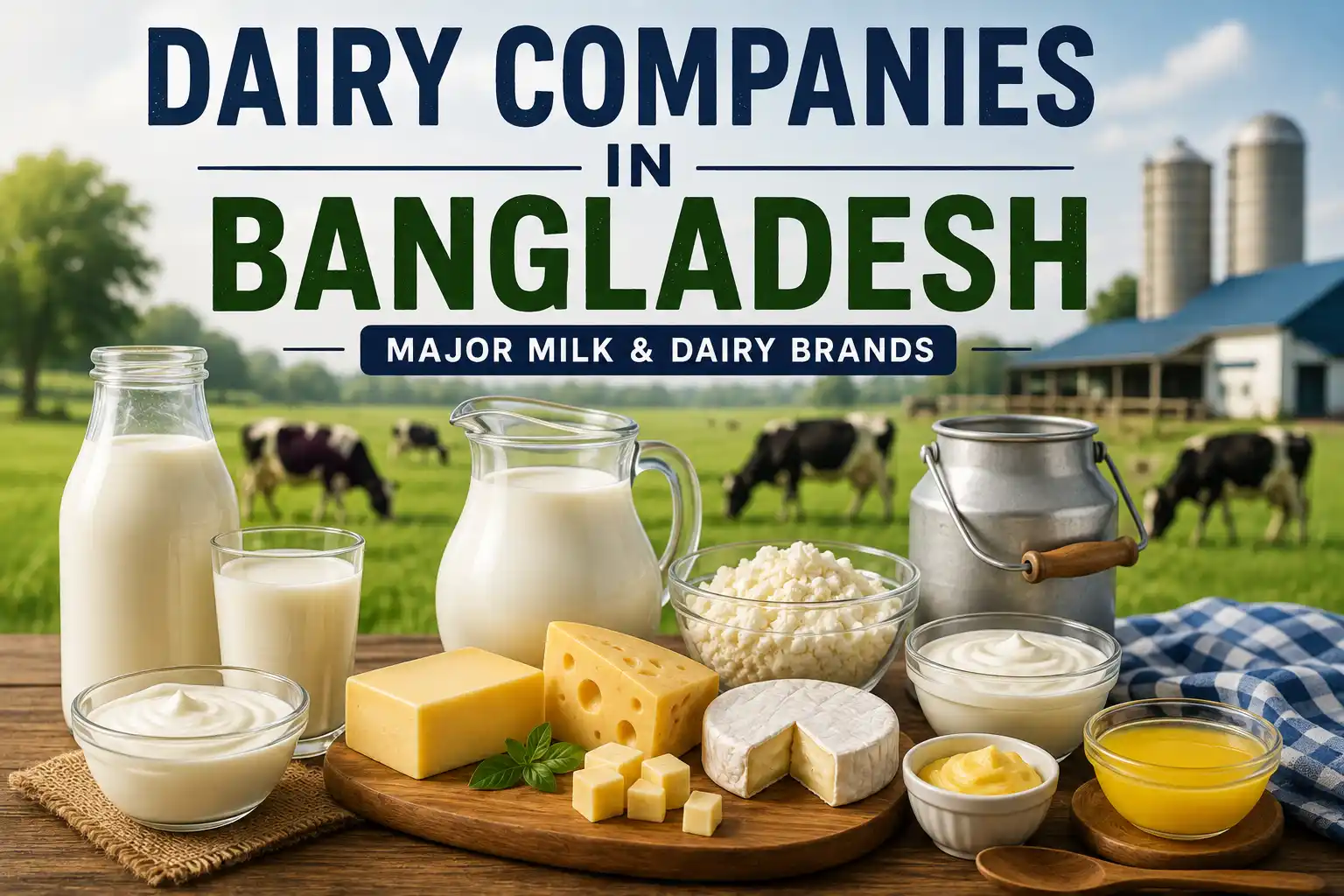
Dairy Companies in Bangladesh: Major Milk & Dairy Brands
Milk and dairy foods reach Bangladeshi households through a mix of cooperatives, conglomerate-owned processors, and multinational brands, and this overview of dairy companies in Bangladesh looks at how that system works. Some organizations collect raw milk directly from smallholder farmers and run their own chilling and processing plants, while others import dairy ingredients, pack them locally, or sell products made elsewhere under a familiar local brand name. Products found on Bangladeshi shelves include pasteurized and UHT milk, powdered milk, yogurt, ghee, butter, cheese, flavored milk, cream, and dairy-based ice cream, and not every company that touches the dairy sector makes all of these.
This article is an informational overview of organizations connected to Bangladesh’s dairy sector. It is not a ranking, not a “best dairy companies” list, and not an endorsement of any brand named here; inclusion simply reflects that a genuine, verifiable dairy-related role could be established for that organization. Readers will find a plain-language look at the dairy industry, profiles of several major milk collectors, processors, and brands, a side-by-side comparison, an explanation of common dairy product categories, a look at how milk moves from farm to shelf, guidance on food safety and choosing products, and answers to common questions about dairy companies in Bangladesh.
Dairy Industry in Bangladesh
Bangladesh’s dairy sector is still built mainly around smallholder farmers rather than large commercial dairy farms. Estimates vary by source and methodology, but Bangladesh has well over one million dairy farms, many of them smallholder operations keeping just a few cows alongside other household activities. Domestic milk production has increased substantially over recent years, although Bangladesh continues to import milk powder and other dairy ingredients to meet demand, so the sector is best understood as a mix of local collection and imported supply rather than one or the other.
Because raw milk is highly perishable, the organized part of the industry depends on cold-chain logistics: milk must be collected, tested, cooled, and moved to a processing plant quickly to stay safe to drink. Cooperatives such as Milk Vita were built specifically to solve this problem for rural farmers, while conglomerates like BRAC, Akij, and PRAN-RFL later built their own parallel collection networks.
Government and regulatory bodies such as the Department of Livestock Services, the Bangladesh Food Safety Authority, and the Bangladesh Standards and Testing Institution have different roles across livestock development, food safety, and applicable product standards, though specific requirements and certifications depend on the product category and current regulations rather than being uniform across the entire dairy sector.
Dairy Companies in Bangladesh
The organizations below are presented alphabetically, not by size, reputation, or market performance. Being included here is not an endorsement, and the list is not exhaustive; it reflects entities whose dairy-sector role in Bangladesh could reasonably be verified through official or well-established sources at the time of writing.
Aarong Dairy (BRAC Dairy and Food Project)
Aarong Dairy is the brand associated with BRAC’s dairy enterprise, started in 1998 to give rural farmers a reliable, fair-priced outlet for milk after BRAC’s earlier artificial-insemination program raised yields without a matching cold chain. BRAC Dairy states it works with tens of thousands of registered farmers through rural milk collection and chilling points, transporting milk to its own processing facility. Products sold under the Aarong Dairy name include pasteurized milk, UHT milk, flavored milk, yogurt, and butter, though this is not necessarily an exhaustive list, and the operation has cited ISO 22000 certification for its facility in its own materials. Aarong Dairy is distinct from Aarong, BRAC’s well-known handicrafts and lifestyle retail chain; the two share an owner but operate in different sectors.
Akij Food & Beverage Ltd. (Farm Fresh)
Farm Fresh is the dairy brand of Akij Food & Beverage Ltd. (AFBL), part of the diversified Akij Group. The brand’s own communications describe a supply chain that collects raw milk from contracted farmers, tests it for quality and adulteration, cools it at company-run chilling centers, and transports it under controlled temperature to AFBL’s factory for processing and packaging. Farm Fresh markets pasteurized milk as a core product, alongside items such as UHT milk, flavored milk, yogurt, butter, and ghee sold under the same brand, though this list is not necessarily exhaustive. “Farm Fresh” is the product brand name, while Akij Food & Beverage Ltd. is the legal manufacturing entity behind it.
Arla Foods Bangladesh Limited (Dano)
Arla Foods Bangladesh Limited is the corporate entity behind Arla Foods’ operations in Bangladesh, best known locally for the Dano milk powder brand. Arla’s own materials describe its Bangladesh facility as packaging and repacking Dano milk powder produced at Arla’s factories abroad, rather than manufacturing milk powder from locally collected raw milk. Dano’s Bangladesh range has included milk powders such as Dano Power and Dano Daily Pushti, along with other Arla-owned brands such as Lurpak (butter) and Castello (cheese); these are international Arla brands, and their presence in the market does not mean they are manufactured locally. Exact current product availability can vary and is best confirmed from retail listings or Arla’s own current materials.
Igloo (Abdul Monem Limited)
Igloo is a brand and business line under Abdul Monem Limited (AML), a Bangladeshi conglomerate founded in the 1950s with interests spanning construction, beverages, and consumer goods. Igloo is most widely recognized as an ice cream brand with a long operating history in the country, and AML operates dedicated ice cream production facilities under the Igloo name. Igloo’s public identity and market presence center on ice cream rather than a full range of liquid milk or powdered dairy products, so it should be understood primarily as an ice cream business rather than a conventional milk-processing company.
Kazi Food Industries Limited (Bellissimo)
Kazi Food Industries Limited (KFIL) is a food-manufacturing concern of the Kazi Farms Group, a conglomerate whose core business is poultry and agribusiness. KFIL’s own materials describe its dairy-related activity as centered on the Bellissimo brand, an ice cream and frozen-dessert line, alongside a separate ice cream brand and a frozen-food brand. KFIL’s role in the dairy sector is narrower than that of a milk collector or liquid-dairy processor; its verifiable dairy connection is through frozen desserts rather than raw milk collection or liquid milk processing.
Milk Vita (Bangladesh Milk Producers’ Co-operative Union Limited)
Milk Vita is the trade name associated with the Bangladesh Milk Producers’ Co-operative Union Limited (BMPCUL), a cooperative organization rather than a conventional private dairy company. Milk Vita’s cooperative structure was established in the years immediately following Bangladesh’s independence, with sources pointing to the involvement of international agencies and a model influenced by India’s Amul cooperative, though the precise founding year differs across sources. BMPCUL is governed under cooperative rules and operates through a large network of primary milk producers’ cooperative societies, whose farmer-members supply milk that is collected, chilled, and processed at BMPCUL’s plants. Sources describe BMPCUL running processing operations across several milk-shed regions, producing liquid milk, cream, ice cream, flavored milk, and yogurt at some plants, and powdered milk, butter, and ghee at others. Milk Vita is a long-established participant in Bangladesh’s organized dairy sector; this article does not cite a specific current market-share figure, since such figures vary across sources and change over time.
PRAN Dairy (PRAN-RFL Group)
PRAN Dairy Limited is the dairy-focused company within the PRAN-RFL Group, a diversified conglomerate founded in 1981 and active in food, beverages, plastics, agribusiness, and other sectors. PRAN’s dairy operations are marketed primarily under the PRAN Milk brand, with the company describing milk sourced from its own dairy hubs and a supply chain connecting farmers to processing facilities. PRAN Dairy Limited is the company, PRAN Milk is its dairy brand identity, and PRAN-RFL Group is the broader parent group; the three terms are related but not interchangeable.
Company Comparison
|
Company / Organization |
Dairy Brand |
Main Role |
Selected Dairy Products |
Milk Collection / Processing |
Notes |
|---|---|---|---|---|---|
|
BRAC (dairy enterprise) |
Aarong Dairy |
Milk collector and processor |
Pasteurized milk, UHT milk, flavored milk, yogurt, butter |
Own collection/chilling points; own processing facility |
Distinct from the Aarong handicrafts retail chain |
|
Akij Food & Beverage Ltd. |
Farm Fresh |
Milk collector and processor |
Pasteurized milk, UHT milk, flavored milk, yogurt, butter, ghee |
Company-run chilling centers and factory |
Farm Fresh is the brand; AFBL is the manufacturer |
|
Arla Foods Bangladesh Limited |
Dano |
Corporate entity handling packaging/repacking of imported milk powder |
Milk powder, plus other Arla-owned brands such as Lurpak and Castello |
Packages/repacks milk powder produced abroad; does not process local raw milk into powder |
Imported/repacked products should not be described as locally manufactured from raw milk |
|
Abdul Monem Limited |
Igloo |
Ice cream brand/business line |
Ice cream |
Company-operated ice cream production facility |
Not a full-range liquid milk processor |
|
Kazi Food Industries Limited |
Bellissimo |
Ice cream/frozen-dessert brand |
Ice cream, frozen desserts |
Company-operated ice cream production |
Part of the poultry-focused Kazi Farms Group; dairy role limited to ice cream |
|
Bangladesh Milk Producers’ Co-operative Union Ltd. (BMPCUL) |
Milk Vita |
Cooperative milk collector and processor |
Liquid milk, powdered milk, yogurt, ghee, butter, ice cream, flavored milk |
Farmer cooperative societies feeding cooperative-run plants |
Cooperative structure, not a conventional private company |
|
PRAN Dairy Limited (PRAN-RFL Group) |
PRAN Milk |
Milk collector and processor |
Liquid milk and other dairy items |
Company-described dairy hubs and processing facilities |
PRAN Dairy Limited is the company; PRAN Milk is the dairy brand; PRAN-RFL Group is the parent group |
Common Dairy Products in Bangladesh
Bangladeshi consumers encounter several broad categories of dairy products, and not every company profiled above makes every category.
- Pasteurized milk: liquid milk heated briefly to kill harmful bacteria; short shelf life, needs refrigeration.
- UHT (ultra-high-temperature) milk: processed at higher heat and packed in sterile cartons for longer unrefrigerated shelf life before opening.
- Powdered milk: milk with moisture removed for a long shelf life, reconstituted with water; a meaningful share sold in Bangladesh is imported and locally repacked rather than produced from domestic raw milk.
- Yogurt: fermented milk sold plain, sweetened, or flavored.
- Ghee and butter: milk-fat products used in cooking, made through different processing methods.
- Cheese: Bangladesh’s cheese market includes both locally produced products and imported international brands, rather than being made up of imports alone.
- Flavored and cultured milk drinks: sweetened or flavored liquid milk aimed largely at retail and impulse purchase.
- Dairy-based ice cream: a milk-fat-based frozen dessert, often treated by companies as a separate category from liquid milk and yogurt.
Local Milk Collection and Dairy Processing
Because raw milk spoils quickly, Bangladesh’s organized dairy sector depends on a fairly consistent supply chain: a farmer milks the cow, the milk goes to a nearby collection point, it is checked for basic quality, it is cooled at a chilling center, it is transported under temperature control to a processing plant, it is pasteurized or otherwise processed and packaged, and it is distributed to retailers and consumers.
Every step matters for food safety. Milk that sits too long without cooling can spoil; testing at collection points helps catch contamination or dilution early; and a broken cold chain between the chilling center and factory can undo earlier quality checks. This is why cooperatives and conglomerates alike describe their own collection points, chilling infrastructure, and processing in some detail: these steps are central to whether a dairy product is safe by the time it reaches a shop shelf. Not every organization here collects and processes its own raw milk the same way, since some primarily import and repack finished or semi-finished products instead.
How to Choose Dairy Products or Brands
Choosing packaged dairy products in Bangladesh comes down to a few practical checks rather than brand reputation alone.
- Check the product type: pasteurized, UHT, and powdered milk have different shelf lives and storage needs.
- Read the ingredient list: some milk-based products include added sugar, flavoring, stabilizers, or vegetable fat.
- Check manufacturing and expiry information: printed dates and batch details confirm the product is within its usable period.
- Inspect the packaging: swollen, leaking, dented, or otherwise damaged packaging is a reason to avoid a product, regardless of brand.
- Follow storage instructions: some products need continuous refrigeration, while UHT products are shelf-stable only until opened.
- Consider pack size for your household: larger packs may suit bigger households; smaller packs reduce waste risk for smaller ones.
- Buy from reliable retailers: established shops and supermarkets reduce the risk of counterfeit packaging or improper storage.
Dairy Product Quality and Food Safety
Packaged dairy products in Bangladesh fall under the general oversight of the Bangladesh Food Safety Authority and the Bangladesh Standards and Testing Institution, alongside the Department of Livestock Services for farm- and production-level matters. Applicable standards and certification requirements depend on the specific product and current regulations rather than being identical across every dairy item, so they are best confirmed from these authorities directly rather than assumed.
For everyday buying decisions, a few habits are useful: check that packaging is sealed and undamaged, note expiry information before purchase, and always follow the storage instructions printed on the specific product’s packaging, since these differ between brands and product types.
An unusual smell, texture, or appearance is a reason for caution, though it is not on its own a guarantee either way about safety; the printed instructions and expiry information remain the more reliable guide. Because certification status can change and is specific to a company, product line, or facility rather than automatic across an entire brand, this article does not assign specific certifications to individual companies beyond what those companies themselves have publicly stated.
Frequently Asked Questions
Which dairy companies operate in Bangladesh?
Several kinds of organizations are active in the sector, including the cooperative Milk Vita (BMPCUL), conglomerate-run processors such as BRAC’s Aarong Dairy, Akij’s Farm Fresh, and PRAN Dairy Limited under the PRAN-RFL Group, Arla Foods Bangladesh Limited through its Dano brand, and companies whose dairy involvement centers mainly on ice cream, such as Abdul Monem Limited’s Igloo and Kazi Food Industries Limited’s Bellissimo.
Which companies collect and process milk directly from local farmers?
Milk Vita, Aarong Dairy, Farm Fresh, and PRAN Dairy each describe their own networks of farmer milk collection points and chilling centers feeding company- or cooperative-run processing plants, rather than relying primarily on imported ingredients.
Is Milk Vita a private company?
No. Milk Vita is the trade name of the Bangladesh Milk Producers’ Co-operative Union Limited, a cooperative organization governed under cooperative rules, with farmer-members organized into primary societies, rather than a conventional privately owned business.
What is the difference between pasteurized milk and UHT milk?
Pasteurized milk is heated briefly and generally needs continuous refrigeration with a shorter shelf life, while UHT milk is processed at higher heat and packed in sterile cartons, giving it a longer unrefrigerated shelf life until opened.
Does Bangladesh produce powdered milk locally?
Bangladesh has both domestic powdered-milk processing at cooperative and company plants, and imported milk powder that is packaged or repacked locally, as with Arla’s Dano milk powder, which the company describes as produced abroad and packaged at its Bangladesh facility; not all brands fall into the same category.
How should I choose packaged milk in Bangladesh?
Match the product type to your storage situation, read the ingredient and date information, check that packaging is undamaged, follow the printed storage instructions, and buy from retailers likely to store products correctly.
How should dairy products be stored safely at home?
Follow the storage instructions printed on the specific product’s packaging, since these vary by brand and product type; as general practice, keep pasteurized milk, yogurt, butter, and similar chilled products refrigerated at all times, store unopened UHT products in a cool, dry place, refrigerate UHT products promptly after opening, and treat any unusual smell, texture, or damaged packaging as a reason for caution.
Sources and Verification Notes
This article is based on official company and cooperative websites, group and brand communications, and established news and organizational sources available at the time of writing. Company ownership, brand relationships, product portfolios, processing arrangements, and certifications in the dairy sector can change over time, and product availability can vary by region and retailer. Readers planning to buy a specific product, evaluate a company, or rely on a certification claim are encouraged to verify current details directly from the company’s own official channels, along with relevant government sources such as the Department of Livestock Services, the Bangladesh Food Safety Authority, and the Bangladesh Standards and Testing Institution, since this article reflects a general snapshot rather than a live database of company information.