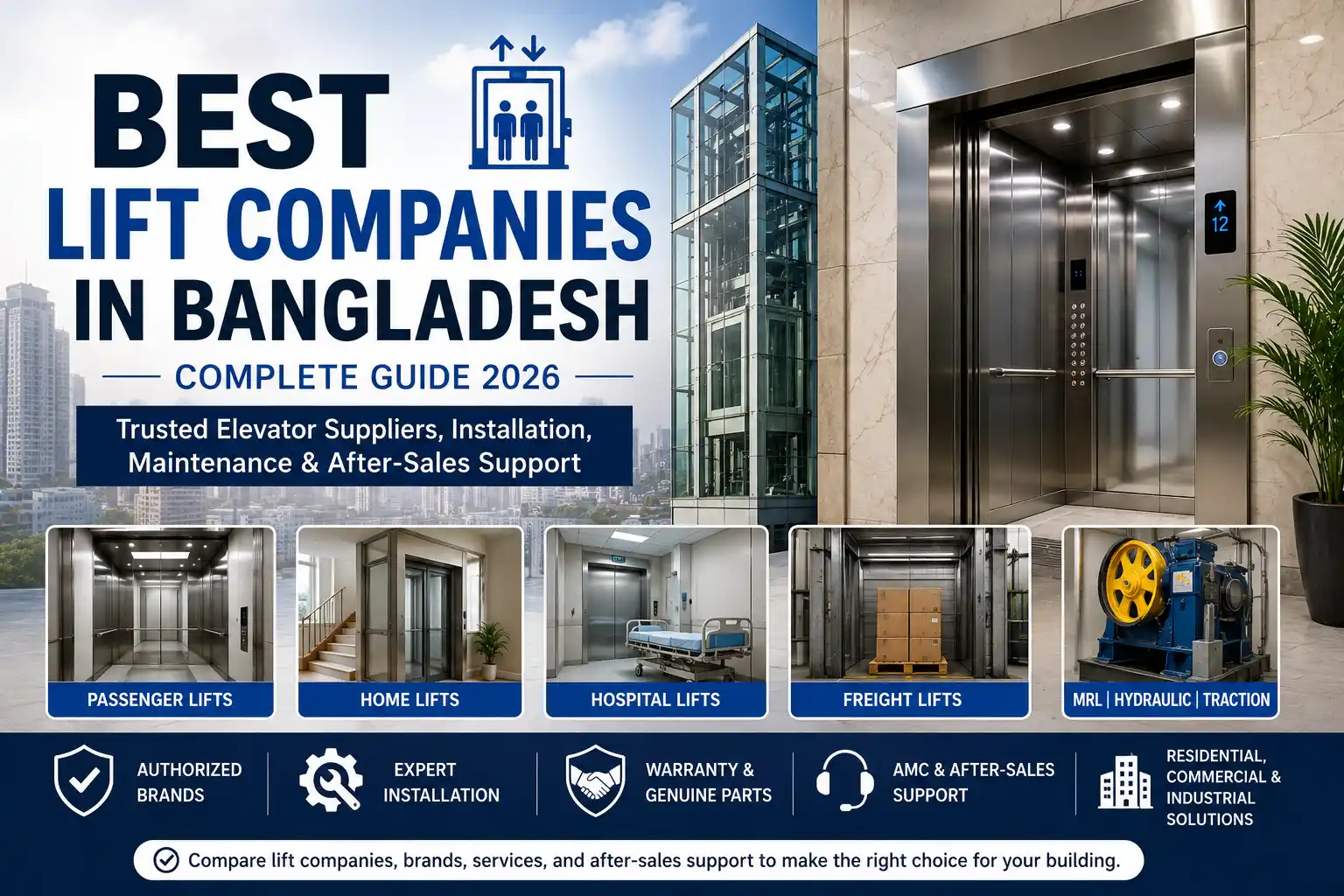
Best Lift Companies in Bangladesh 2026
As Bangladesh’s cities grow taller and denser, lifts have shifted from a luxury feature to a basic requirement for residential buildings, offices, hospitals, and shopping centers alike. A well-chosen lift company affects far more than the initial purchase — it shapes how quickly a fault gets fixed, how easily spare parts are sourced years down the line, and how safely a building’s vertical transportation performs over its entire service life.
This guide is written to help readers understand Bangladesh’s lift and elevator market before making a purchase or signing a maintenance contract. It looks at well-known and established companies supplying passenger lifts, commercial elevators, freight lifts, home lifts, and hospital lifts, along with the installation, modernization, maintenance, and after-sales support that typically comes with them.
Bangladesh’s lift market includes a mix of business models: multinational brand-authorized companies representing global elevator manufacturers, a domestic manufacturer producing lifts locally, and long-running trading houses that have imported and serviced elevators for decades. Industry reporting has also noted that the market remains fairly fragmented, with hundreds of companies importing lift components under general trade licenses, which makes verifying a supplier’s actual brand authorization and track record especially important before signing any contract.
The sections that follow cover how to evaluate a lift company, the types of lifts available, common building applications, signs a lift may need modernization, a buying checklist, and frequently asked questions — all aimed at helping readers compare options rather than pushing any single supplier.
Quick Answer: Bangladesh’s lift market includes companies such as Creative Engineers Ltd. (Schindler’s Bangladesh representative), AG Industrial Solutions under Anwar Group (Otis Elevator Company’s exclusive authorized distributor), AG MELCO’s Bangladesh office (a local contact point for Mitsubishi Electric elevators), Walton Elevator (which describes its Gazipur facility as Bangladesh’s first locally operated lift manufacturing plant), and TGBD Private Ltd. (a long-running multi-brand lift and escalator supplier).
These companies differ in brand focus, manufacturing versus importing model, and service coverage, so the right fit depends on your building type, budget, and after-sales support needs. Always verify current brand authorization, warranty terms, and AMC coverage directly with the company before purchasing.
Disclaimer: This article is an editorial informational guide prepared by Info Ghor and is not an official ranking or endorsement of any company. It does not claim that any single supplier is the “best,” “largest,” or “most trusted” in Bangladesh. Product availability, authorized partnerships, pricing, branches, and services may change over time. Readers should verify current information directly with each company before making a purchase or signing a maintenance contract.
Well-Known Lift Companies in Bangladesh
Bangladesh’s elevator and lift supply market includes companies with very different business models — from multinational brand-authorized distributors to a domestic manufacturer and long-running multi-brand trading houses. The companies below are presented in no particular order and are not ranked against one another. Readers should independently verify current brand authorization, warranty terms, and pricing before committing to a purchase or AMC.
Creative Engineers Ltd.
Creative Engineers Ltd. is listed on Schindler Group’s own worldwide representative directory as the company’s contact point for Bangladesh, based in Motijheel, Dhaka. The company states it began developing Bangladesh’s elevator market with the Haushahn brand of Germany before later stating it acquired distributorship rights for Schindler Group products and services in the country, a relationship also reflected in Schindler’s own published list of country representatives.
Its portfolio spans passenger lifts, commercial elevators, and escalators for high-rise and large-scale developments, and the company has worked on commercial and high-rise elevator projects in Bangladesh, according to its published materials. Beyond elevators, the company has also described involvement in industrial pumps and related engineering equipment, suggesting a broader engineering services base rather than a single-product focus.
Creative Engineers offers installation, commissioning, modernization, and annual maintenance contracts for the Schindler equipment it supplies, along with spare parts support drawn from its distributorship relationship.
Given its direct association with a major global elevator brand, Creative Engineers may particularly suit developers and institutional buyers working on large commercial or high-rise projects who want a Schindler-specific solution with dedicated local support. As with any brand distributorship, buyers should confirm Creative Engineers’ current authorization scope and specific service terms directly with the company before signing a contract.
AG Industrial Solutions (Anwar Group)
AG Industrial Solutions, a subsidiary of the Anwar Group, was announced in October 2024 as the exclusive authorized distributor for Otis Elevator Company in Bangladesh, following a formal appointment reported by Otis India’s leadership and covered by multiple Bangladeshi and international trade news outlets. Anwar Group itself is one of Bangladesh’s large, diversified business conglomerates, with existing operations spanning textiles, jute, chemicals, and other industrial sectors, which may give AG Industrial Solutions a broader institutional and corporate client base to draw on for building projects.
This arrangement allows AG Industrial Solutions to deliver Otis elevator and escalator solutions, along with installation, servicing, and maintenance support, to customers in the country. The company has described its team as providing customer support for Otis equipment, including elevators installed in Bangladesh prior to the distributorship agreement, though the specific scope of this support is best confirmed directly with the company.
Because this is a relatively recent and clearly documented distributorship, AG Industrial Solutions may particularly suit buyers who specifically want Otis-branded elevators and prefer working with a company holding a current, publicly confirmed authorization, rather than an older or less transparent arrangement. Buyers should still confirm current service coverage, AMC terms, and spare parts turnaround directly with the company.
AG MELCO — Mitsubishi Electric Elevators in Bangladesh
AG MELCO’s Bangladesh office serves as a local contact point for Mitsubishi Electric elevator and escalator solutions. According to publicly available company information, the Bangladesh operation functions under AG MELCO Elevator Co. L.L.C., a joint venture company associated with Mitsubishi Electric Corporation of Japan. The company provides Mitsubishi Electric elevator and escalator solutions in Bangladesh. Buyers should confirm the current scope of regional operations, manufacturer authorization, and local corporate structure directly with AG MELCO before making a purchasing decision.
According to publicly available company information, the Bangladesh office, based in Dhaka, markets, sells, installs, and maintains Mitsubishi-brand elevators and escalators, covering passenger lifts, commercial installations, and related vertical transportation equipment. As part of a larger regional group with a long operating history and design support based out of its Dubai headquarters, AG MELCO’s Bangladesh office can typically draw on group-level technical resources, traffic analysis, and design planning support for larger commercial and high-rise projects.
The company offers installation and commissioning services along with maintenance contracts for the equipment it supplies, and, as a representative of a global manufacturer, is positioned to provide manufacturer-linked spare parts support.
AG MELCO may particularly suit developers, corporate clients, and institutional buyers looking for Mitsubishi Electric-branded lifts backed by a company with documented regional group ownership rather than a purely local, independent operator. Buyers should confirm the exact local entity name, current warranty terms, AMC coverage, and project lead times directly with the Bangladesh office before committing to a purchase.
Walton Elevator
Walton Elevator, part of the wider Walton Group — one of Bangladesh’s largest home-grown electronics and appliance manufacturers — has publicly described its Gazipur facility, established in 2014, as Bangladesh’s first locally operated lift manufacturing plant, and began commercial sales of its elevators a few years later.
The company manufactures passenger lifts, cargo or freight lifts, and capsule-style lifts locally, with published capacity ranges spanning roughly 300 kg to several thousand kilograms depending on the lift type. Walton states that certain lift models are designed with reference to standards such as EN 81-20 and EN 81-50; buyers should request model-specific certification or technical documentation before purchase rather than assuming uniform compliance across its full range.
The company offers installation, after-sales servicing, and maintenance support directly through its own technical teams. Because Walton already operates a large nationwide sales and service network built for its appliance business, its elevator division may be positioned to offer local response and flexible payment options, though buyers should confirm current payment plans, response times, and service availability directly with Walton rather than relying on general marketing material.
Walton reports holding a meaningful and growing share of Bangladesh’s domestic lift market as a local manufacturer rather than an importer, which may appeal to buyers interested in shorter supply chains and locally available spare parts. Walton Elevator may particularly suit residential and mid-scale commercial buyers who value a Bangladeshi-manufactured product with an established nationwide service network, while very large or specialized industrial projects may still be better served by multinational brand-specific suppliers.
TGBD Private Ltd.
TGBD Private Ltd. describes a business history in Bangladesh dating back to 1948 under the Turner Grahams name, and describes itself as one of the oldest suppliers of elevators and escalators in the country. The company states that its elevator business began in the early 1980s through the FIAM lift brand from Italy, and that it has continued working with the brand’s successor, KONE of Finland, following FIAM’s acquisition by KONE; this lineage is described in the company’s own materials and, as with any long-running brand relationship, its current authorization scope is worth confirming directly with the company.
Beyond this, TGBD’s portfolio includes other brands such as Mars/Merih from Turkey, Kohler from Germany, and Fuji from China, giving it a broader multi-brand offering compared to single-brand distributors. The company describes having several thousand lifts in operation across the Bangladeshi market and describes itself as a leading supplier of cargo lifts specifically, alongside passenger lifts and escalators; these figures reflect the company’s own stated claims rather than independently verified data.
TGBD offers importing, installation, and commissioning services, and has served a range of real estate developers and corporate groups over its operating history.
Given its long track record and multi-brand portfolio, TGBD may particularly suit buyers looking for flexibility across several elevator brands and capacity ranges, including cargo and freight lift buyers, though warranty terms and AMC coverage should be confirmed per brand rather than assumed to be uniform across its full product range.
How to Choose a Lift Company
Selecting a lift company involves weighing more than the upfront quotation. A few practical factors make a meaningful difference over the life of the equipment:
Building requirements. Consider the building’s height, number of floors, expected passenger or cargo load, and shaft dimensions, since these determine whether a hydraulic, traction, or machine-room-less system is appropriate.
Safety standards. Ask which international or regional safety codes (such as EN 81 series standards) the lift is designed and certified against, and whether the supplier conducts its own inspection before handover. Lift projects in Bangladesh may involve multiple building, safety, and standards-related requirements, so buyers and developers should consult the applicable BNBC provisions, relevant authorities, and qualified engineers before installation.
Authorized supplier status. Where a company claims to be an authorized distributor or representative for a specific global brand, verify this directly with the brand or through consistent, independently checkable sources, since Bangladesh’s lift market includes many companies using global brand names without confirmed authorization.
Installation quality. Proper installation affects long-term safety and reliability; ask about the qualifications of the installation team and whether commissioning includes load testing and safety certification.
Maintenance support and technical response. A lift with excellent specifications is only as good as the company’s ability to service it quickly when something goes wrong. Ask about typical response times for breakdowns, especially outside Dhaka.
Availability of genuine spare parts. Confirm whether parts are stocked locally or need to be imported on request, since this affects how long a lift may be out of service during a repair.
Warranty terms. Compare what is actually covered, for how long, and under what conditions the warranty may be voided, since warranty coverage can vary by manufacturer, model, and even installation date, and buyers should always request the warranty terms in writing.
AMC (Annual Maintenance Contract) terms. Review what is included in a proposed AMC — routine servicing frequency, emergency callout response time, and whether parts replacement is covered or billed separately.
Technical support. Confirm whether the company provides ongoing technical support, including remote monitoring or diagnostic capability where available, and how modernization or upgrade requests are handled in the future.
Types of Lifts Available in Bangladesh
Lifts sold and installed in Bangladesh generally fall into a few broad categories, and understanding the differences can help narrow supplier conversations:
Passenger lifts are the most common type, designed for moving people in residential buildings, offices, and commercial spaces, with capacity and speed varying by building height and expected traffic.
Home lifts are smaller, lower-capacity lifts designed for private residences, often chosen for accessibility needs or as a modern convenience feature in newer homes.
Hospital lifts are built with wider cabins and specific dimensions to accommodate stretchers, wheelchairs, and medical equipment, along with smoother ride characteristics for patient comfort.
Freight or cargo lifts are designed for moving goods rather than people, typically featuring higher load capacities and more robust cabin construction, and are common in factories, warehouses, and commercial kitchens.
Panoramic lifts feature glass walls or cabins, often used in shopping malls, hotels, and office atriums where the lift itself is part of the building’s aesthetic design.
Machine-room-less (MRL) lifts eliminate the need for a separate machine room by housing the drive mechanism within the shaft, which can save space and is increasingly common in mid-rise residential and commercial buildings.
Hydraulic lifts use a hydraulic piston system and are typically suited to lower-rise buildings, often valued for lower upfront installation costs in smaller structures.
Traction lifts use a system of ropes and a counterweight driven by an electric motor, and are generally preferred for taller buildings due to higher speed capability and energy efficiency compared to hydraulic systems.
Common Applications of Elevators
Lifts and elevators serve a wide range of purposes across Bangladesh’s growing urban landscape:
- Residential buildings and apartment complexes, where lifts have become an expected feature in most mid-rise and high-rise developments.
- Commercial buildings and office towers, which rely on multiple lifts to manage employee and visitor traffic efficiently throughout the working day.
- Shopping malls, which often use a combination of passenger elevators, escalators, and sometimes panoramic lifts to manage large volumes of foot traffic.
- Hospitals, where hospital-specific lifts support the movement of patients, medical equipment, and staff, often requiring wider cabins and stretcher-compatible dimensions.
- Hotels, which use passenger elevators for guests along with service lifts for staff, luggage, and housekeeping operations.
- Factories, where freight or cargo lifts move raw materials and finished goods between floors as part of production workflows.
- Office towers, particularly in central business districts, where multiple high-speed traction lifts are typically required to handle peak-hour traffic.
- Educational institutions, which increasingly install lifts for accessibility purposes and to move equipment or furniture between floors.
Signs It May Be Time to Modernize or Replace Your Lift
Lifts, like other mechanical and electrical systems, have a finite service life, and certain signs suggest it may be time to consider modernization or replacement rather than continued repair:
- Frequent breakdowns or repeated call-outs for the same fault, which often indicate that core mechanical or control components are reaching the end of their useful life.
- Increasing difficulty sourcing spare parts, particularly for older lift models or discontinued control systems, which can significantly extend repair downtime.
- Slower ride quality, rough stops, or leveling issues, where the lift no longer stops precisely level with the floor.
- Outdated safety features, such as a lack of modern door protection sensors, emergency communication systems, or automatic rescue devices found in newer models.
- Rising energy consumption compared to more modern, energy-efficient drive systems now available.
- Unusual noise or vibration during operation, which may point to wear in mechanical components.
- A lift significantly older than its expected service life, especially one that has not undergone periodic major component upgrades over the years.
Lift Buying Checklist
- Confirm the building’s floor count, expected passenger or cargo load, and available shaft space before requesting quotations.
- Decide on the lift type (hydraulic, traction, or MRL) based on building height and budget.
- Shortlist companies with a verifiable presence and track record in Bangladesh’s lift market.
- Ask directly about brand authorization status rather than assuming it from marketing material or website claims.
- Compare warranty terms in writing, including duration and what components are covered.
- Ask about installation timelines, including site preparation, shaft readiness, and commissioning steps.
- Confirm the availability of genuine spare parts and expected turnaround time for repairs.
- Request full AMC terms in writing, including servicing frequency, emergency response time, and parts coverage.
- Ask about the company’s technical support network and response times specific to your location, including outside Dhaka if relevant.
- Request references or examples of similar completed projects where possible.
- Verify company contact details, office address, and service center locations before making any payment.
FAQ
How do I choose the right lift for my building?
Start with your building’s floor count, expected passenger or cargo load, and available shaft dimensions, since these largely determine whether a hydraulic, traction, or machine-room-less lift is appropriate. A supplier’s technical team can help refine this further, but arriving with a basic understanding of your building’s requirements helps you evaluate their recommendation.
Which type of lift is best for a residential building?
There is no single “best” type for all residential buildings; the right choice depends on the number of floors, expected usage, and budget. Lower-rise buildings often use hydraulic lifts for cost reasons, while mid- and high-rise residential buildings more commonly use traction or machine-room-less systems.
Should I buy from an authorized supplier?
Buying from a company that can verifiably demonstrate current authorization for a specific brand generally provides greater assurance regarding genuine components, access to manufacturer-supported technical resources where applicable, and clearer warranty terms, compared with purchasing from a company whose authorization cannot be independently confirmed. However, buyers should still verify the supplier’s current authorization status, warranty coverage, and after-sales support directly with both the supplier and the manufacturer where possible.
How important is annual maintenance for a lift?
Very important. Lifts are mechanical and electrical systems that require regular servicing to remain safe and reliable. A properly maintained lift under an active AMC is generally less likely to experience unexpected breakdowns than one serviced only on an as-needed basis.
How long does lift installation typically take?
Installation timelines vary significantly depending on the lift type, building readiness, and shaft construction status, and can range from a few weeks for simpler installations to several months for larger or more complex commercial projects. Always request a project-specific timeline from the supplier rather than relying on a general estimate.
What should be included in an AMC?
A typical AMC should clearly state the frequency of routine servicing visits, emergency callout response times, whether spare parts and consumables are included or billed separately, and what situations are excluded from coverage. Always review these terms in writing before signing.
What warranty coverage is typical for lifts sold in Bangladesh?
Warranty coverage varies by manufacturer, model, and even installation date, and may cover specific components rather than the entire system. Always request the exact warranty documentation in writing rather than relying on verbal assurances from a sales representative.
Can an existing lift be modernized instead of fully replaced?
In many cases, yes. Modernization can involve upgrading the control system, drive unit, cabin interior, or safety features without replacing the entire lift structure, which can be more cost-effective than a full replacement, depending on the age and condition of the existing equipment.
Are hospital lifts different from standard passenger lifts?
Yes. Hospital lifts are typically built with wider cabin dimensions to accommodate stretchers and wheelchairs, along with smoother ride characteristics and sometimes dedicated controls for medical staff use, distinguishing them from standard passenger lift specifications.
What happens if the power goes out while a lift is in use?
Many modern lift systems may include an Automatic Rescue Device (ARD), which can move the cabin to a nearby floor and open the doors during certain power interruptions. However, ARD availability and operation depend on the specific lift model, installation, and backup power configuration. Buildings with frequent outages often also pair lifts with backup power systems, and buyers researching backup power options may find it useful to compare established generator companies in Bangladesh alongside their lift purchase.
Final Thoughts
Bangladesh’s lift and elevator market includes a mix of multinational brand-authorized companies, a growing domestic manufacturing option, and long-running multi-brand trading houses, each suited to different types of buyers. No single company is objectively the “best” choice for every building — the right fit depends on your building’s height and layout, budget, brand preference, and how much ongoing maintenance support your location requires.
Because the market includes many suppliers using global brand names with varying degrees of verifiable authorization, taking the time to confirm a company’s current distributorship status, warranty terms, and AMC coverage directly before signing any contract remains the most reliable way to make an informed decision.
Useful Resources
- Bangladesh Standards and Testing Institution (BSTI) — for product standards and certification information
- RAJUK (Rajdhani Unnayan Kartripakkha) — relevant for building approval requirements that may affect lift installation in Dhaka
- Bangladesh National Building Code (BNBC) — for building safety provisions relevant to lift shafts and installations
- Official manufacturer websites (Schindler, Otis, Mitsubishi Electric, and others) for official product specifications
- Lift owner’s manuals provided by the manufacturer or supplier for model-specific operating and maintenance guidance
Editorial Note
This article was researched and compiled by the Info Ghor editorial team for general informational purposes. It is not sponsored by, affiliated with, or endorsed by any of the companies mentioned, and inclusion in this guide does not constitute a recommendation or ranking. Company details were cross-checked against publicly available sources at the time of writing, but details such as pricing, product availability, authorized partnerships, and services may change. Readers should independently verify current information with each company before making a purchasing decision or signing a maintenance contract.
Last Updated
This article was last updated in August 2026. It is periodically reviewed to reflect changes in company information, manufacturer partnerships, installation services, maintenance offerings, and Bangladesh’s lift and elevator industry.