BUET Auto Rickshaw Price in Bangladesh: Complete Buying Guide
The phrase “BUET Auto Rickshaw” has become increasingly common in Bangladesh’s transport conversations, but it is often misunderstood. In simple terms, it usually refers to a battery-powered three-wheeler built using — or inspired by — a safer, standardised auto-rickshaw design developed by a research team at the Bangladesh University of Engineering and Technology (BUET). The design was created to address the well-known safety problems of the battery rickshaws already running on the country’s roads.
Safer auto-rickshaw designs have gained serious attention in Bangladesh for a clear reason. Battery-powered rickshaws multiplied rapidly in recent years, often unregistered and operated by untrained drivers, and their weak brakes and unstable structures have been linked to frequent accidents. When a respected engineering institution proposed a standardised, safety-focused alternative, it drew wide public and government interest — and, naturally, a wave of buyers asking what such a vehicle costs.
Prices, however, vary a great deal. A battery three-wheeler is not a single fixed product; it is a combination of a battery, a motor, a controller, a chassis, a body, and optional accessories, each of which can be sourced at different quality levels and price points. Two vehicles that look similar can cost quite differently depending on how they are built and who builds them.
It is also important to understand from the start that specifications, prices, warranty terms, and even regulations around these vehicles change over time. This guide explains what a BUET Auto Rickshaw is, what publicly reported prices suggest, what drives those prices, and what to check before buying — while encouraging you to confirm the latest details directly with authorised manufacturers or dealers.
What Is a BUET Auto Rickshaw?
A BUET Auto Rickshaw generally refers to a battery-run three-wheeler based on a safer design concept developed by a team from BUET’s Department of Mechanical Engineering. Professor Md Ehsan has been publicly associated with the safer auto-rickshaw project since around 2022, following earlier efforts to engage relevant authorities before the project gained wider public attention.
The six-member research team included, alongside Professor Ehsan, Professor A Salam Akand and Md Aman Uddin of the Mechanical Engineering Department, Professor Md Ziaur Rahman Khan of the Electrical and Electronic Engineering Department, and research engineers Md Asaduzzaman and Abdul Aziz Bhuiyan. Rather than designing in a lab alone, the team reportedly studied battery rickshaws across the country, examined roadside garages, and spoke with drivers and mechanics before finalising their approach.
The safety-focused engineering concept
The core idea was to build a standardised three-wheeler that matches its structure to its speed. According to public reports, the team identified safety flaws in around 12 common battery-rickshaw types on the market and introduced roughly 16 improvements to address them.
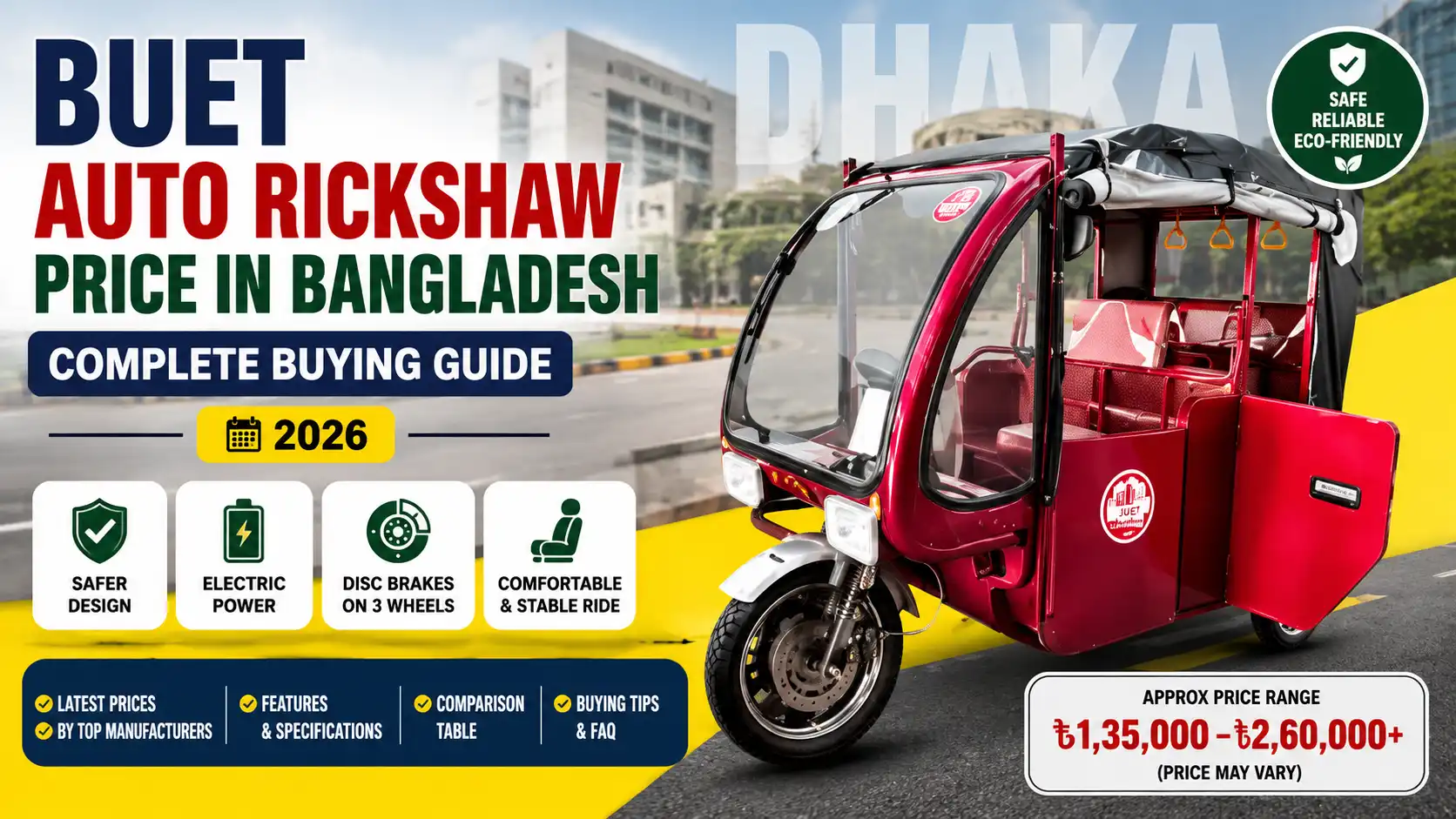
Publicly documented features of the design include hydraulic disc brakes on all three wheels, a dedicated parking brake, rear-view mirrors, turn indicators, a canopy with a glass windshield, and a headlight system with high beam, low beam, and daytime running lamps. The design has been described as roughly 3.2 metres long, 1.5 metres wide, and 2.1 metres high, with a stated load capacity in the range of about 325 to 425 kilograms and a design choice to limit seating to two passengers for better balance. Its top speed is reported to be capped at 30 kilometres per hour, matched to a reinforced structure and stronger braking.
The reasoning behind these choices is straightforward: a frame built for a slow pedal rickshaw is not safe at higher motorised speeds, so the design pairs a controlled speed with brakes and a structure built to handle it.
The difference between the BUET concept and vehicles sold commercially
This is the most important distinction for any buyer to understand. The BUET team created a design concept and prototype. It does not follow that every vehicle advertised as a “BUET Auto Rickshaw” is manufactured by BUET, certified by BUET, or fully compliant with the original design.
In practice, the design was intended to be produced commercially by private manufacturers. Public reporting has indicated that authorities reviewed and approved a BUET-developed prototype, with the rollout tied to registration, driver training, and licensing rules. The design is intended for commercial production by private manufacturers as government approval and implementation processes continue. At the same time, various manufacturers and dealers now market vehicles under the “BUET” label or as “BUET-standard” and “BUET-inspired.” These descriptions are commonly used in the marketplace and should not automatically be interpreted as official BUET certification, and the quality, compliance, and authorisation behind them can differ from seller to seller.
In other words, “BUET Auto Rickshaw” functions partly as a market term. Some vehicles may genuinely be built to the standardised design by authorised makers; others may simply borrow the name for marketing. This is why verifying the actual manufacturer and any documented compliance matters so much.
Why buyers should verify the manufacturer
Because the label is used broadly, a buyer cannot assume that a vehicle is officially sanctioned just because it is called a BUET Auto Rickshaw. Before buying, it is worth confirming who actually manufactured the vehicle, whether that manufacturer is authorised or recognised under the current regulatory framework, and what documentation is provided. Treat any claim of “BUET certification” as something to verify with evidence rather than accept at face value.
BUET Auto Rickshaw Price in Bangladesh
Prices for these vehicles are best understood as ranges, not fixed numbers, and they should always be confirmed directly with a manufacturer or dealer. The figures below reflect publicly reported information and are shared to give buyers a realistic starting point for comparison — not as guaranteed prices.
Approximate price ranges reported publicly
When the BUET team consulted private firms about commercial production, the estimated cost to build the redesigned rickshaw was reported to be around Tk 1.7 lakh (roughly Tk 170,000), described as broadly comparable to many existing battery rickshaws on the market. Some public reports estimate that the battery alone may account for roughly Tk 50,000–60,000 of the total production cost, although the actual amount varies depending on battery type, supplier, and market conditions. The remainder generally covers the frame, body, and other components.
Retail listings from individual dealers have sometimes appeared higher than the production estimate. Public reports and official discussions have indicated that commercially produced BUET-designed auto rickshaws may be priced within or up to around Tk 2 lakh, depending on the manufacturer, configuration, and market conditions. This is normal: a production-cost estimate and a finished retail price are not the same thing, and retail prices include the seller’s margin, features, and service.
As a practical takeaway, buyers can reasonably expect prices in the general vicinity of the mid-one-lakh range and upward, depending heavily on configuration and seller. Because these figures shift with market conditions and the specific build, always request a current, itemised quotation before making any decision.
Why battery, motor, and body choices change the price
The single biggest reason two BUET-style rickshaws differ in price is the components inside them.
Battery is usually the largest single cost. Some public reports estimate that the battery alone may account for roughly Tk 50,000–60,000 of the total production cost, although the actual amount varies depending on battery type, supplier, and market conditions. Battery choice affects not just price but range and lifespan. The motor and controller determine performance and also influence cost. The chassis and body materials affect durability, weight, and safety, and higher-grade materials generally cost more.
Optional accessories add further variation. Items such as upgraded lighting, better seating, improved suspension, or additional safety fittings all change the final figure. A stripped-down build and a well-equipped one can sit at noticeably different price points even under the same product name.
A note on treating prices as approximate
It is worth repeating clearly: do not treat any single number as the definitive price of a BUET Auto Rickshaw. Final prices depend on battery type, motor, controller, body configuration, manufacturer, dealer, and prevailing market conditions. Prices also change frequently. Use published figures only as a rough guide, and confirm the latest price and specifications directly with authorised sellers before purchasing.
Approximate BUET Auto Rickshaw Prices by Manufacturer in Bangladesh
The table below brings together publicly available price information from manufacturers and dealers commonly associated with BUET-designed or BUET-inspired battery three-wheelers. It is meant to help you compare and know where to ask, not to rank the companies — no company here is presented as better, cheaper, or more trusted than another.
A few reminders before you read it. Descriptions such as “BUET-designed,” “BUET-inspired,” or “BUET-approved” are used in the marketplace and should not automatically be treated as official BUET certification; verify a seller’s actual compliance directly. Where an exact current price is not publicly available, the table shows “Contact for Latest Price” rather than an invented figure. And because these prices change over time, treat everything below as approximate.
|
Company |
Approximate Price |
Publicly Available Notes |
|---|---|---|
|
GoodHope Motors |
Around ৳1.9 lakh (publicly listed; subject to change) |
Markets a BUET-inspired, battery-operated three-wheeler; price varies by battery and configuration; dealer quotation recommended |
|
Bivatek |
Contact for Latest Price |
Among the firms BUET consulted on production costs; battery-operated three-wheelers; price varies by battery and configuration; dealer quotation recommended |
|
Akij Motors |
Contact for Latest Price |
Markets the “Pothik” electric three-wheeler; buyers should verify any publicly documented link to the BUET-developed design concept; price varies by configuration; dealer quotation recommended. |
|
Monir Auto Engineering |
Contact for Latest Price |
Battery-operated three-wheeler EV maker; a BUET-specific model is not publicly documented — verify BUET compliance and price directly |
|
Hi-Tech Power Auto-Mobiles Ltd. |
Contact for Latest Price |
Battery-operated three-wheeler EV maker; a BUET-specific model is not publicly documented — verify BUET compliance and price directly |
|
New Grameen Motors Ltd. |
Contact for Latest Price |
Battery-operated three-wheeler EV maker; a BUET-specific model is not publicly documented — verify BUET compliance and price directly |
The table above is based on publicly available information at the time of writing. Actual prices may vary depending on the manufacturer, battery type, motor, controller, warranty, optional features, dealer location, and market conditions. Buyers should always request the latest written quotation directly from the manufacturer or authorised dealer before making a purchase decision.
Factors That Affect BUET Auto Rickshaw Prices
Understanding what goes into the price helps you compare offers fairly and avoid overpaying. The following factors most commonly influence what you will pay.
- Battery capacity. Larger-capacity batteries generally support longer range but cost more. Since the battery is often the most expensive single component, its capacity has a strong effect on the total price.
- Battery chemistry. Different battery types — such as conventional lead-acid versus lithium-based options — vary widely in price, weight, lifespan, and charging behaviour. The chemistry you choose can shift the total cost substantially, so confirm exactly what is fitted.
- Motor power. A more powerful motor can improve load handling and performance but typically adds to the price. Motor and controller quality together affect both cost and reliability.
- Chassis quality. The strength and build quality of the frame directly affect safety, durability, and price. A reinforced, well-built chassis is a core part of what makes a safer design meaningful, and it is not where a careful buyer should cut corners.
- Safety features. Features such as hydraulic disc brakes, a parking brake, mirrors, indicators, and proper lighting add value and can add cost. When these are genuinely present and well-made, they are part of what you are paying for.
- Manufacturer. Who builds the vehicle matters. Established or authorised manufacturers may price differently from small, informal workshops, and the difference often reflects build quality, consistency, and accountability.
- Dealer. Even for the same vehicle, dealer pricing can vary based on location, margins, and the services bundled with the sale. Comparing multiple dealers is one of the simplest ways to gauge fair pricing.
- Warranty. Vehicles or components sold with a documented warranty may be priced higher than those sold without one. A written warranty can be worth the difference if it is honoured, so weigh price against the coverage offered.
- Delivery charges. Transport and delivery costs can add to the final amount, especially outside major cities. Clarify whether a quoted price includes delivery or whether it is charged separately.
Key Features Buyers Should Look For
When comparing BUET-style auto rickshaws, focus on features that are publicly documented for the design and that genuinely affect safety and usability. Confirm each one on the specific vehicle you are considering rather than assuming it is present.
- Braking system. The BUET design is publicly associated with hydraulic disc brakes on all three wheels plus a dedicated parking brake. Strong, responsive braking is central to the safety concept, so check that the brakes on the actual vehicle match what is advertised.
- Structural strength. A reinforced chassis and sensible weight distribution are core to the design’s safety rationale. Inspect the frame and build quality, since structural strength is what allows the vehicle to handle its rated speed more safely.
- Battery quality. The battery affects range, lifespan, and running cost. Ask exactly which battery is fitted, its chemistry and capacity, and its expected service life. Some public reports reference battery replacement after approximately 18 months under typical operating conditions, although actual battery life varies depending on battery type, charging habits, maintenance, and usage.
- Range. Range is a practical concern for anyone using the vehicle daily. Public reporting has cited a range of up to around 120 kilometres on a single charge for this design, though actual range varies with load, road conditions, battery health, and driving style. Treat any range figure as an estimate to verify.
- Charging time. Charging time affects how many hours the vehicle can realistically operate each day. Confirm the expected charging time for the specific battery and charger, since this is not one-size-fits-all.
- Suspension. Comfort and control on rough, congested roads depend heavily on suspension quality. A smoother ride is easier on passengers and can reduce wear, so assess suspension as part of the overall build.
- Lighting. The design is publicly associated with a headlight system that includes high beam, low beam, and daytime running lamps, along with indicators. Proper lighting improves visibility and helps prevent turning mishaps, so check that lighting works correctly.
- Safety features. Beyond brakes and lighting, look for mirrors, indicators, a canopy, and a windshield, all of which appear in the documented design. Confirm these are fitted and functional rather than simply listed on paper.
Advantages of Buying a BUET-Inspired Auto Rickshaw
A well-built, BUET-inspired auto rickshaw offers several practical benefits over the unregulated battery rickshaws that became common on the roads. Note that descriptions such as “BUET-inspired” and “BUET-standard” are commonly used in the marketplace and should not automatically be interpreted as official BUET certification. These advantages are worth understanding, though they depend on the vehicle actually being built to a good standard.
The clearest benefit is safety. A design that pairs a controlled top speed with stronger brakes, a reinforced structure, mirrors, indicators, and proper lighting is inherently better suited to real road conditions than a pedal frame fitted with a motor. For drivers and passengers alike, that combination can meaningfully reduce risk.
There is also the benefit of a more considered, standardised design. Because the concept was engineered specifically for local roads and local manufacturing, a compliant vehicle aims to balance safety, affordability, and practicality rather than chasing speed alone.
Everyday usability is another advantage. A canopy and windshield offer protection from rain and sun, and features like a proper braking system and lighting make daily operation more comfortable and predictable.
For those considering it as a livelihood, a vehicle built to a recognised safety standard may also align better with the emerging regulatory framework, which ties operation to registration, training, and licensing. Aligning with that framework can matter for anyone who wants to operate legally as rules tighten.
It is important, however, to keep expectations realistic. These are practical, affordable urban vehicles, not high-performance machines. The advantages are real when the vehicle is genuinely well-built and compliant — which again comes back to verifying the manufacturer and the actual specifications.
Tips Before Buying
Buying any vehicle is a significant decision, and a BUET-style auto rickshaw is no exception. A little diligence up front can save considerable money and trouble later.
- Verify the manufacturer. Confirm who actually built the vehicle and whether that manufacturer is authorised or recognised under the current framework. Do not rely on the “BUET” name alone as proof of quality or approval.
- Check battery warranty. The battery is the most expensive component and the one most likely to need replacement. Ask specifically about the battery’s warranty — its length, what it covers, and who honours it — and get it in writing.
- Confirm spare parts availability. A vehicle is only as practical as its ability to be repaired. Check that spare parts for the battery, motor, controller, brakes, and body are readily available and reasonably priced in your area.
- Compare multiple dealers. Prices, warranties, and service can vary between dealers for similar vehicles. Visit several, request itemised quotations, and compare not just the headline price but the full package.
- Ask for written warranty. Verbal assurances are hard to enforce. Request written warranty terms covering the vehicle and key components, and make sure the document clearly states what is and is not covered.
- Verify after-sales service. Find out what after-sales support the seller provides, where servicing is done, and how issues are handled. Reliable after-sales service is especially valuable for a vehicle used daily.
- Check registration requirements if applicable. Regulations around battery-run three-wheelers are evolving, and in some areas operation is being tied to registration, driver training, and licensing. Confirm the current requirements that apply to you before buying, so you are not left with a vehicle you cannot legally operate where you need to.
Comparison Table
The table below summarises common factors buyers weigh when comparing BUET-style auto rickshaws. It is a general guide; the actual specifications, prices, and terms must be confirmed directly with each manufacturer or dealer.
|
Factor |
Why It Matters |
What to Verify |
|---|---|---|
|
Battery (type & capacity) |
Largest cost driver; affects range and lifespan |
Exact chemistry, capacity, warranty, replacement interval |
|
Motor & controller |
Affects performance and reliability |
Rated power, quality, compatibility |
|
Chassis & body |
Central to safety and durability |
Build quality, materials, structural strength |
|
Braking system |
Core safety feature of the design |
Hydraulic disc brakes on all wheels, parking brake, condition |
|
Lighting & indicators |
Improves visibility and prevents mishaps |
Headlights (high/low/DRL), indicators, mirrors present and working |
|
Manufacturer |
Affects quality, consistency, accountability |
Who built it; whether authorised/recognised |
|
Warranty |
Protects your purchase |
Written terms, coverage, duration |
|
After-sales & spares |
Keeps the vehicle running |
Service availability, spare parts access and cost |
|
Price |
Your total investment |
Current itemised quote; whether delivery is included |
|
Registration/licensing |
Affects legal operation |
Current rules in your area, if applicable |
Frequently Asked Questions
What is a BUET Auto Rickshaw?
It generally refers to a battery-powered three-wheeler built using, or inspired by, a safer, standardised auto-rickshaw design developed by a research team at BUET’s Department of Mechanical Engineering. The design focuses on stronger braking, a reinforced structure, and safety features such as mirrors, indicators, and proper lighting, with a controlled top speed. In the market, the term is used broadly, so it is best understood as a design concept rather than a single official product.
Is every BUET Auto Rickshaw officially made by BUET?
No. BUET developed the design concept and a prototype; it is not the manufacturer of every vehicle sold under the name. The design was intended for commercial production by private manufacturers, and various dealers now market vehicles as “BUET-standard” or “BUET-inspired.” These descriptions are commonly used in the marketplace and should not automatically be interpreted as official BUET certification. Because the label is used broadly, buyers should verify the actual manufacturer and any documented compliance rather than assume a vehicle is officially certified.
What is the average price range?
Publicly reported figures have placed the estimated commercial production cost of the redesigned rickshaw at around Tk 1.7 lakh, described as broadly comparable to existing battery rickshaws. Some public reports estimate that the battery alone may account for roughly Tk 50,000–60,000 of the total production cost, although the actual amount varies depending on battery type, supplier, and market conditions. Public reports and official discussions have indicated that commercially produced BUET-designed auto rickshaws may be priced within or up to around Tk 2 lakh, depending on the manufacturer, configuration, and market conditions. These are approximate figures that change over time, so treat them as a starting point and confirm the current price directly with sellers.
Which battery is commonly used?
Battery choice varies by manufacturer and build, and different vehicles may use different battery types and capacities. Some public reports estimate that the battery alone may account for roughly Tk 50,000–60,000 of the total production cost, although the actual amount varies depending on battery type, supplier, and market conditions. Some public reports reference battery replacement after approximately 18 months under typical operating conditions, although actual battery life varies depending on battery type, charging habits, maintenance, and usage. Since battery chemistry and capacity strongly affect price, range, and lifespan, always confirm exactly which battery is fitted before buying.
How far can it travel on a charge?
Public reporting for the BUET design has cited a range of up to around 120 kilometres on a single charge. Real-world range depends on factors such as load, road conditions, battery health, and driving style, so actual performance can differ. Treat any range figure as an estimate to verify with the seller for the specific vehicle and battery.
Is it suitable for commercial use?
The design was created with everyday urban and commercial transport in mind, and its safety-focused features suit regular use. As regulations evolve, commercial operation in some areas is being linked to registration, driver training, and licensing, so anyone planning to use the vehicle for a livelihood should confirm the current legal requirements that apply to them before buying.
Where can I buy one?
These vehicles are sold by various manufacturers and dealers, and some sellers market them as BUET-standard models. These descriptions are commonly used in the marketplace and should not automatically be interpreted as official BUET certification. Rather than buying from unverified street sellers or unclear online listings, it is generally safer to purchase from a reputable manufacturer or dealer that can provide clear documentation, written warranty terms, and after-sales support. Buyers should also inspect the vehicle in person, compare quotations from multiple sellers, and verify the latest specifications before making a purchase decision.
Does it come with warranty?
Warranty terms depend entirely on the manufacturer or dealer and are not standardised across the market. Some sellers offer written warranties on the vehicle and key components such as the battery, while others may not. Always ask for warranty terms in writing, confirm exactly what is covered and for how long, and clarify who is responsible for honouring it.
How do I verify authenticity?
Start by confirming who actually manufactured the vehicle and whether that manufacturer is authorised or recognised under the current framework. Ask to see technical specifications and any compliance documentation, and check that the safety features advertised — brakes, lighting, mirrors, and structural build — are genuinely present on the vehicle. Treat claims of “BUET certification” as something to confirm with evidence rather than accept at face value.
What should I check before buying?
Before paying, verify the manufacturer, confirm the battery type and its warranty, check spare parts availability, and compare quotations from multiple dealers. Inspect the vehicle’s brakes, structure, lighting, and overall build in person, request written warranty and clear specifications, confirm after-sales service arrangements, and check any registration or licensing requirements that apply in your area. Getting the important terms documented protects your purchase.
Final Thoughts
The BUET-developed design brought a welcome, safety-focused approach to a category of vehicle that had grown quickly and often unsafely. For buyers, that is genuinely good news — but it also means the market now contains a mix of vehicles sold under the “BUET” name, built to varying standards by different makers.
The smartest approach is a careful one. Compare multiple manufacturers and dealers rather than settling on the first offer. Verify current prices and specifications, since both change frequently and depend on battery, motor, controller, body, manufacturer, and market conditions. Confirm warranty terms and after-sales support in writing, and check the authenticity and compliance of any vehicle before you commit. Where operation is tied to registration and licensing, confirm the current rules that apply to you.
Above all, treat published prices and specifications as approximate guidance and verify the latest details directly with authorised manufacturers or dealers before making a purchase.
Readers looking for auto-rickshaw manufacturers, battery suppliers, transport equipment businesses, and other verified companies in Bangladesh can also explore Info Ghor’s business directory.
Info Ghor is a Bangladesh-focused business directory that publishes practical business guides and informational articles.