Top Microfinance Institutions in Bangladesh 2026
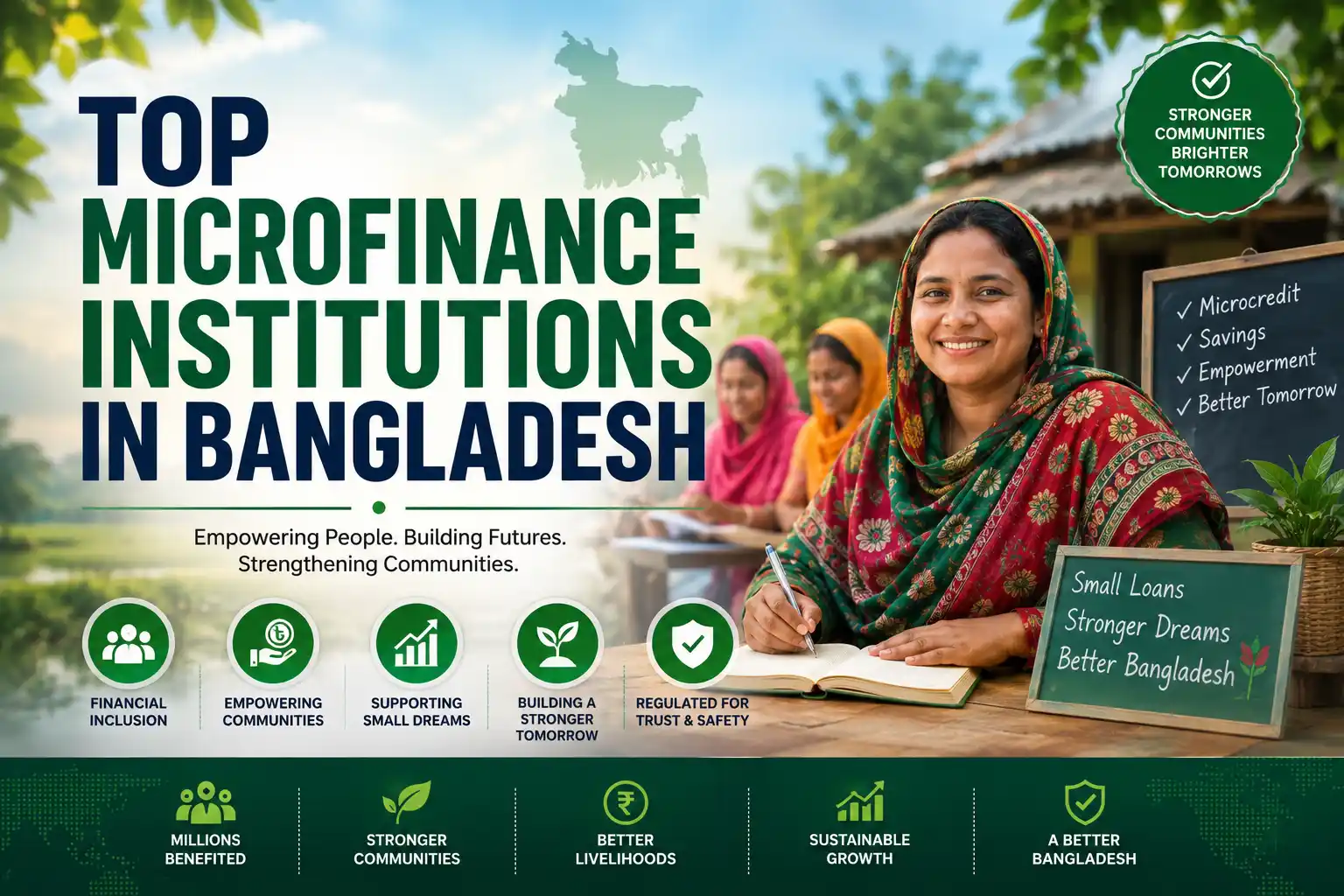
Microfinance is one of Bangladesh’s most recognisable contributions to global development thinking. At its simplest, microfinance means providing small-scale financial services — chiefly small loans, savings, and related support — to people who fall outside the reach of conventional banking. Instead of demanding collateral, land documents, or a salary certificate, microfinance institutions (MFIs) lend on the basis of group membership, trust, and regular repayment discipline.
The role these institutions play in the country is substantial. For decades, they have extended credit to rural households, landless families, small traders, and women who would otherwise have no access to formal finance. The overwhelming majority of microcredit borrowers in Bangladesh are women, and the sector has become a core channel of financial inclusion — funding small businesses, livestock, farming inputs, tailoring, small shops, and household needs across villages where bank branches are scarce.
Microfinance sits within a clear regulatory structure. The Microcredit Regulatory Authority (MRA) was established under the Microcredit Regulatory Authority Act, 2006, and it licenses and supervises NGO-MFIs. Under that Act, no private institution may run microcredit operations without an MRA licence. The MRA sets policy for the sector, inspects institutions, reviews their financial and management reporting, and can act where client interests are not protected. Notably, its board is chaired by the Governor of Bangladesh Bank, linking it to the wider financial system.
There is an important exception worth understanding early: Grameen Bank does not fall under the MRA’s jurisdiction, because it operates under separate legislation of its own. This distinction matters, and it is explained further below.
One clarification before the list: this article is not an official ranking. The institutions below are included based on publicly available information, microfinance services, regulatory presence, operational reach, and public documentation — not on any scoring system, and not on size, loan portfolio, or market position. Inclusion is not an endorsement, and no institution is presented as better than another.
Finally, loan products, terms, service charges, eligibility rules, branch coverage, and regulations all change over time. Always verify the current details directly with the institution and with the MRA before borrowing. Nothing here is financial advice.
How We Selected These Microfinance Institutions
The institutions in this guide were chosen using publicly available information and observable signals, with the goal of helping readers understand Bangladesh’s microfinance landscape. The aim is usefulness, not judgement, and nothing here is a recommendation to borrow.
Selection was based on the following criteria:
- Public institutional presence — the institution is publicly documented and clearly operating in Bangladesh.
- Microfinance services — microcredit and related financial services form a core activity.
- Regulatory presence — noted where publicly documented, such as appearing in MRA-related listings or public reporting on the licensed sector.
- Operational reach — the institution operates beyond a single locality, as publicly documented.
- Range of programmes — publicly referenced services such as microcredit, savings, microenterprise lending, or agricultural loans.
- Public documentation — sufficient publicly available information to describe the institution accurately.
- Overall usefulness — whether the institution is genuinely helpful to include for someone mapping the sector.
To be clear, inclusion in this list is not an endorsement, and it is not a claim that one institution is better than another. Hundreds of licensed MFIs operate across Bangladesh, alongside banks and government programmes offering microcredit, and an institution’s absence does not imply anything negative. Readers should compare options themselves and verify licences and terms directly.
Top Microfinance Institutions in Bangladesh
The institutions below are listed alphabetically. Each description reflects publicly available information. Loan products, service charges, eligibility, terms, and branch availability should always be confirmed directly before borrowing.
ASA
ASA is among the larger microfinance institutions in Bangladesh and appears among the institutions publicly documented in reporting on the MRA-licensed microcredit sector. It operates as an NGO-MFI within the regulatory framework established under the Microcredit Regulatory Authority Act, 2006.
Its microfinance activities publicly include general microcredit for small-scale, self-employment-based activities alongside microenterprise lending. Public information also indicates that ASA disburses loans to individual clients under its microenterprise programme, in addition to group-based approaches.
On coverage, ASA operates across Bangladesh rather than in a single district, and it is publicly associated with an international presence through a separate affiliated entity operating in other countries.
On borrowers, its programmes serve rural and low-income households, small traders, and micro-entrepreneurs, with women forming the large majority of microcredit borrowers sector-wide.
ASA may suit borrowers seeking microcredit or microenterprise finance from a nationwide institution. Before borrowing, verify the current loan products, service charges, repayment terms, eligibility criteria, and branch availability directly with the institution, and confirm its licence status with the MRA. These details and regulations change over time, and the decision to take a loan is yours alone.
BRAC
BRAC is one of Bangladesh’s most widely known development organisations, and its microfinance programme operates as an NGO-MFI within the MRA regulatory framework. It appears among the institutions referenced in public reporting on the licensed microcredit sector.
Its microfinance activities publicly include general microcredit and microenterprise lending, alongside its wider development programmes in areas such as education, health, and social development. Public information indicates BRAC disburses loans to individual clients under its microenterprise programme as well as through group-based lending.
On coverage, BRAC operates nationally across Bangladesh, and it is publicly associated with programmes in other countries through affiliated entities.
On borrowers, its microfinance programmes serve rural and low-income households, women, small traders, and micro-entrepreneurs.
BRAC may suit borrowers seeking microcredit from an institution that combines lending with broader development programmes. Before borrowing, verify the current loan products, service charges, repayment terms, eligibility criteria, and branch availability directly, and confirm licence status with the MRA. Because terms and regulations change over time, direct verification matters — and borrowing decisions should be made on your own assessment of repayment capacity.
BURO Bangladesh
BURO Bangladesh is a microfinance institution operating as an NGO-MFI in Bangladesh, and it appears among the institutions publicly documented in reporting on the MRA-licensed microcredit sector.
Its microfinance activities publicly centre on microcredit and savings services for low-income clients, within the categories the sector broadly covers — including general microcredit, microenterprise loans, and agricultural lending. Confirm which specific products are currently offered directly with the institution.
On coverage, BURO Bangladesh operates across multiple districts rather than in a single locality; confirm current branch presence in your area directly.
On borrowers, its programmes are aimed at rural and low-income households, women, and small entrepreneurs seeking small-scale finance.
BURO Bangladesh may suit borrowers wanting microcredit and savings services from an established NGO-MFI. Before borrowing, verify the current loan products, service charges, repayment schedules, eligibility criteria, and branch availability directly with the institution, and confirm its licence status with the MRA. These details change over time, so never rely on older information — and consider carefully whether the repayment schedule fits your income pattern.
Grameen Bank
Grameen Bank occupies a distinct position in Bangladesh’s microfinance landscape, and understanding why matters. Unlike the NGO-MFIs in this guide, Grameen Bank is a specialised bank established under its own legislation — the Grameen Bank Ordinance, 1983, later replaced by the Grameen Bank Act — rather than an institution licensed by the MRA.
According to Bangladesh Bank’s publicly available information, Grameen Bank falls outside the MRA’s jurisdiction precisely because it operates under this distinct legislation. It is a body corporate created by statute, and public information indicates that the large majority of its equity is held by its borrower-members, with the government holding the remainder.
Its microfinance activities publicly include collateral-free credit for income-generating activities, along with housing loans for members, and it is commonly described in academic and policy literature for its group-based, solidarity lending model.
On coverage, Grameen Bank operates across rural Bangladesh through its own branch network. Its borrowers are predominantly rural, landless, and low-income people, with women forming the overwhelming majority of members.
Grameen Bank may suit borrowers seeking collateral-free rural credit from a statutory bank. Before borrowing, verify current loan products, service charges, terms, membership requirements, and branch availability directly, since these change over time.
Jagorani Chakra Foundation
Jagorani Chakra Foundation (JCF) is a microfinance institution operating as an NGO-MFI in Bangladesh, and it appears among the institutions publicly documented in reporting on the MRA-licensed microcredit sector.
Its microfinance activities publicly fall within the standard categories of the licensed sector, which include general microcredit for self-employment activities, microenterprise loans, agricultural loans, and seasonal lending. Confirm which specific products it currently offers directly with the institution.
On coverage, JCF operates across multiple districts; confirm its current presence in your area directly, since branch networks change over time.
On borrowers, its programmes serve rural and low-income households, women, farmers, and small entrepreneurs.
Jagorani Chakra Foundation may suit borrowers in the areas it serves who are seeking microcredit or agricultural finance. Before borrowing, verify the current loan products, service charges, repayment terms, eligibility criteria, and branch availability directly with the institution, and confirm its licence status with the MRA. Because publicly documented detail is more limited for mid-sized MFIs than for the largest ones, direct verification matters more here, not less.
Paddakhep Manobik Unnayan Kendra
Paddakhep Manobik Unnayan Kendra is a microfinance institution operating as an NGO-MFI in Bangladesh, and it appears among the institutions publicly documented in reporting on the MRA-licensed microcredit sector.
Its microfinance activities publicly fall within the sector’s standard programme categories, including general microcredit, microenterprise lending, and related credit services for low-income clients. Confirm the specific products currently available directly with the institution.
On coverage, it operates across multiple areas of Bangladesh; confirm current branch presence in your locality directly.
On borrowers, its programmes are aimed at rural and low-income households, women, and small entrepreneurs seeking small-scale credit and savings services.
Paddakhep may suit borrowers in its operating areas seeking microcredit from a licensed NGO-MFI. Before borrowing, verify the current loan products, service charges, repayment schedules, eligibility criteria, and branch availability directly with the institution, and confirm its licence status with the MRA. These details and the regulatory framework change over time, so confirm everything directly rather than relying on general information — and be sure the repayment terms are realistic for your circumstances.
Sajida Foundation
Sajida Foundation is a microfinance institution operating as an NGO-MFI in Bangladesh, and it appears among the institutions publicly documented in reporting on the MRA-licensed microcredit sector.
Its microfinance activities publicly fall within the standard categories of the licensed sector, and the foundation is publicly known for combining microfinance with health and social development work. Confirm the specific loan products and programmes currently offered directly with the institution.
On coverage, Sajida Foundation operates across multiple districts; confirm its current presence in your area directly.
On borrowers, its programmes serve rural and urban low-income households, women, and small entrepreneurs.
Sajida Foundation may suit borrowers seeking microcredit from an institution that pairs lending with health and social programmes. Before borrowing, verify the current loan products, service charges, repayment terms, eligibility criteria, and branch availability directly with the institution, and confirm its licence status with the MRA. Because these details change over time, direct verification is essential, and any decision to borrow should rest on your own assessment of whether the repayments are affordable.
Shakti Foundation
Shakti Foundation is a microfinance institution operating as an NGO-MFI in Bangladesh, and it appears among the institutions publicly documented in reporting on the MRA-licensed microcredit sector.
Its microfinance activities publicly fall within the standard programme categories of the sector, and the foundation is publicly associated with a focus on women’s economic empowerment, including urban microfinance. Confirm the specific loan products currently offered directly with the institution.
On coverage, Shakti Foundation operates across multiple areas, including urban settings; confirm current branch presence in your locality directly.
On borrowers, its programmes are particularly associated with women borrowers and low-income households, including urban micro-entrepreneurs and small traders.
Shakti Foundation may suit borrowers — particularly women micro-entrepreneurs — seeking microcredit in the areas it serves. Before borrowing, verify the current loan products, service charges, repayment schedules, eligibility criteria, and branch availability directly with the institution, and confirm its licence status with the MRA. These details and regulations change over time, so confirm them directly rather than assuming.
SSS (Society for Social Service)
SSS, or Society for Social Service, is a microfinance institution operating as an NGO-MFI in Bangladesh, and it appears among the institutions publicly documented in reporting on the MRA-licensed microcredit sector.
Its microfinance activities publicly fall within the standard categories of the licensed sector, which include general microcredit, microenterprise loans, agricultural loans, and seasonal lending. Confirm which specific products are currently available directly with the institution.
On coverage, SSS operates across multiple districts of Bangladesh; confirm its current presence in your area directly, since branch networks change.
On borrowers, its programmes serve rural and low-income households, women, farmers, and small entrepreneurs.
SSS may suit borrowers in its operating areas seeking microcredit or agricultural finance from a licensed NGO-MFI. Before borrowing, verify the current loan products, service charges, repayment terms, eligibility criteria, and branch availability directly with the institution, and confirm its licence status with the MRA. Because terms and the regulatory framework change over time, direct verification is the only reliable approach — and borrowing decisions should be based on your own repayment capacity.
TMSS
TMSS is a microfinance institution operating as an NGO-MFI in Bangladesh, and it appears among the institutions publicly documented in reporting on the MRA-licensed microcredit sector.
Its microfinance activities publicly fall within the standard programme categories of the sector, alongside wider development activities. Public reporting has also referenced TMSS in discussions of client financial literacy in the microfinance sector — a reminder that borrowers should ask questions until terms are genuinely clear.
On coverage, TMSS operates across multiple districts; confirm its current presence in your area directly.
On borrowers, its programmes serve rural and low-income households, women, farmers, and small entrepreneurs.
TMSS may suit borrowers in its operating areas seeking microcredit from an established NGO-MFI. Before borrowing, verify the current loan products, service charges, repayment schedules, eligibility criteria, and branch availability directly with the institution, and confirm its licence status with the MRA. Never hesitate to ask staff to explain the total repayment amount, the schedule, and any charges in plain terms before you sign anything.
Uddipan
Uddipan is a microfinance institution operating as an NGO-MFI in Bangladesh, and it appears among the institutions publicly documented in reporting on the MRA-licensed microcredit sector.
Its microfinance activities publicly fall within the standard categories of the licensed sector, including general microcredit and related credit services for low-income clients. Confirm the specific loan products currently offered directly with the institution.
On coverage, Uddipan operates across multiple areas of Bangladesh; confirm current branch presence in your locality directly.
On borrowers, its programmes are aimed at rural and low-income households, women, and small entrepreneurs seeking small-scale finance.
Uddipan may suit borrowers in its operating areas seeking microcredit from a licensed NGO-MFI. Before borrowing, verify the current loan products, service charges, repayment terms, eligibility criteria, and branch availability directly with the institution, and confirm its licence status with the MRA. These details and the regulatory framework change over time, so confirm everything directly, and take the time to be sure the repayment schedule genuinely fits your income before committing.
Comparison Table
The table below is a general guide based on publicly available information. Programmes vary by institution and change over time, and where information cannot be verified consistently it is marked “Verify.” This table does not rank institutions or compare them by size or portfolio. Always confirm services, licence status, and terms directly before borrowing.
|
Institution |
Microcredit |
Savings Services |
Microenterprise Loans |
Agricultural Loans |
Regulatory Status (if publicly documented) |
|---|---|---|---|---|---|
|
ASA |
✔ |
Verify |
✔ |
Verify |
NGO-MFI within MRA framework (verify) |
|
BRAC |
✔ |
Verify |
✔ |
Verify |
NGO-MFI within MRA framework (verify) |
|
BURO Bangladesh |
✔ |
✔ |
Verify |
Verify |
NGO-MFI within MRA framework (verify) |
|
Grameen Bank |
✔ |
✔ |
Verify |
Verify |
Statutory bank under its own legislation; outside MRA jurisdiction (verify) |
|
Jagorani Chakra Foundation |
✔ |
Verify |
Verify |
Verify |
NGO-MFI within MRA framework (verify) |
|
Paddakhep Manobik Unnayan Kendra |
✔ |
Verify |
Verify |
Verify |
NGO-MFI within MRA framework (verify) |
|
Sajida Foundation |
✔ |
Verify |
Verify |
Verify |
NGO-MFI within MRA framework (verify) |
|
Shakti Foundation |
✔ |
Verify |
Verify |
Verify |
NGO-MFI within MRA framework (verify) |
|
SSS (Society for Social Service) |
✔ |
Verify |
Verify |
Verify |
NGO-MFI within MRA framework (verify) |
|
TMSS |
✔ |
Verify |
Verify |
Verify |
NGO-MFI within MRA framework (verify) |
|
Uddipan |
✔ |
Verify |
Verify |
Verify |
NGO-MFI within MRA framework (verify) |
A ✔ indicates a service the institution is publicly associated with. “Verify” means the detail should be confirmed directly, since programmes vary and change over time. Licence status should always be confirmed against the MRA’s current published information.
Services Typically Offered by Microfinance Institutions
Bangladesh’s microcredit sector broadly covers several categories of credit services, as publicly documented by Bangladesh Bank. Understanding them helps you identify what you actually need.
- General Microcredit. Small loans for small-scale, self-employment-based activities — the core product of the sector, typically without collateral and repaid in regular instalments.
- Microenterprise Loans. Larger loans aimed at small businesses that have outgrown basic microcredit, supporting shops, trading, and small production units.
- Loans for the Ultra Poor. Programmes designed specifically for the poorest households, often combining credit with other support rather than lending alone.
- Agricultural Loans. Credit for farming inputs, cultivation, and related agricultural activities, timed around crop cycles.
- Seasonal Loans. Short-term credit built around seasonal income and expenditure patterns, such as harvest periods or festival trading.
- Loans for Disaster Management. Credit designed to help households recover after floods, cyclones, or other disasters — a meaningful category in a disaster-prone country.
- Savings Services. Many MFIs collect member savings alongside lending, helping households build a buffer against emergencies.
- Financial Literacy and Social Programmes. Some institutions pair finance with training, health, education, or social development work, though the scope varies considerably between organisations.
How to Choose the Right Microfinance Institution
Choosing where to borrow is a significant decision. A few practical considerations make it clearer.
Regulatory licence. This matters most. Confirm the institution holds a current MRA licence — it is illegal for a private institution to run microcredit operations without one. Grameen Bank is the notable exception, operating under its own legislation. Never borrow from an unlicensed lender.
Loan terms. Ask for the full terms in writing: the loan amount, the total repayment, all service charges, the instalment size, and the schedule. If anything is unclear, ask again until it is explained plainly.
Repayment schedule. Match the schedule to how you actually earn. A weekly instalment may suit a daily trader but strain a farmer whose income arrives at harvest. Be realistic rather than optimistic.
Interest and service charges. Charges vary between institutions and products and are set within the regulatory framework, which changes over time. Ask exactly what you will pay in total, and compare between institutions rather than assuming.
Branch accessibility. A nearby branch or field presence makes repayment and communication far easier, particularly in rural areas.
Programme fit. Match the product to the purpose: agricultural loans for cultivation, microenterprise loans for a growing business, seasonal loans for cyclical trading.
Transparency and support. Choose institutions that explain terms clearly, provide documentation, and answer questions patiently. Reluctance to put terms in writing is a warning sign.
Common Mistakes to Avoid
Microcredit can support a livelihood, but it is still debt — and these mistakes cause real hardship.
- Borrowing without understanding the terms. Never accept a loan on verbal explanation alone. Get the total repayment, charges, and schedule in writing, and ask staff to walk you through them.
- Borrowing more than you can repay. A larger loan is not automatically better. Base the amount on realistic income, not best-case hopes, and remember instalments continue even when business is slow.
- Taking loans from multiple institutions at once. Overlapping loans from several MFIs is a well-recognised risk that can trap households in a repayment cycle. Be honest with yourself about total obligations.
- Ignoring licence verification. Borrowing from an unlicensed lender leaves you outside the protections the regulatory framework provides. Confirm MRA licensing first.
- Using loans for consumption rather than income generation. Microcredit is designed largely to support income-generating activity. Borrowing for consumption without an income plan makes repayment harder.
- Not keeping records. Keep your loan documents, passbook, and receipts safely, and check that payments are recorded correctly. Documentation protects you if a dispute arises.
Frequently Asked Questions
What is a microfinance institution?
A microfinance institution provides small-scale financial services — chiefly small, typically collateral-free loans, along with savings and related services — to low-income people who fall outside conventional banking. In Bangladesh, NGO-MFIs are licensed and supervised by the Microcredit Regulatory Authority (MRA) under the Microcredit Regulatory Authority Act, 2006, and they serve rural and low-income households, women, farmers, and micro-entrepreneurs across the country.
Is Grameen Bank a microfinance institution?
Grameen Bank provides microfinance, but it is not an MRA-licensed NGO-MFI. According to Bangladesh Bank’s publicly available information, Grameen Bank operates outside the MRA’s jurisdiction because it was established under distinct legislation — the Grameen Bank Ordinance, 1983, later replaced by the Grameen Bank Act. It is a specialised statutory bank rather than an NGO-MFI, which is why it is described separately in this guide. Verify its current status directly.
Who can take microcredit loans?
Microcredit is generally aimed at low-income people who lack access to conventional bank credit, including rural households, landless people, women, farmers, small traders, and micro-entrepreneurs. Sector-wide, the overwhelming majority of borrowers are women. However, eligibility criteria differ between institutions and programmes and change over time, so confirm the current requirements directly with the institution you are considering.
Are microfinance institutions regulated?
Yes. NGO-MFIs are licensed and supervised by the Microcredit Regulatory Authority under the MRA Act, 2006, and no private institution may legally run microcredit operations without an MRA licence. The MRA sets sector policy, inspects institutions, reviews their reporting, and can act to protect client interests. Because licences can be granted or withdrawn over time, verify an institution’s current licence status with the MRA before borrowing.
What types of loans are available?
Bangladesh Bank’s publicly documented categorisation of microcredit services covers general microcredit for small-scale self-employment activities, microenterprise loans, loans for the ultra poor, agricultural loans, seasonal loans, and loans for disaster management. Many institutions also collect savings. Which specific products any institution currently offers varies, so confirm the available programmes, terms, and eligibility directly before applying.
How do I choose a microfinance institution?
Start by confirming the institution holds a current MRA licence. Then compare loan terms, total repayment and service charges, repayment schedules, branch accessibility, and whether the programme fits your actual purpose. Ask for everything in writing and make sure you understand it. Compare a few institutions rather than accepting the first offer, and borrow only what your realistic income can repay.
Final Thoughts
Bangladesh’s microfinance sector is large, varied, and genuinely consequential — spanning nationwide NGO-MFIs, mid-sized institutions serving particular regions, and a statutory bank with its own distinct legal foundation. That variety means the right institution depends on where you live, what you need the money for, and what you can realistically repay.
The most useful basis for comparison is substance: services, regulatory compliance, loan terms, transparency, and fit with your own needs rather than reputation or size. An institution’s licence status tells you whether it operates within the framework built to protect borrowers, and that is worth checking before anything else.
Before borrowing, verify the latest loan products, service charges, repayment terms, eligibility criteria, branch availability, and regulatory status directly with the institution and with the MRA. These details and the rules around them change over time, and a direct check is the surest way to avoid surprises.
Finally, treat microcredit as what it is: a financial commitment. It can support a livelihood, but repayments continue regardless of how business goes, and over-borrowing causes real hardship. Nothing in this article is financial advice, and no institution here is recommended over another. Read the terms, ask questions until they are clear, borrow only what you can comfortably repay, and make the decision on your own assessment of your circumstances.
Readers looking for microfinance institutions and other financial service providers in Bangladesh can also explore Info Ghor.
Info Ghor is a Bangladesh-focused business directory that publishes practical business guides and informational articles.