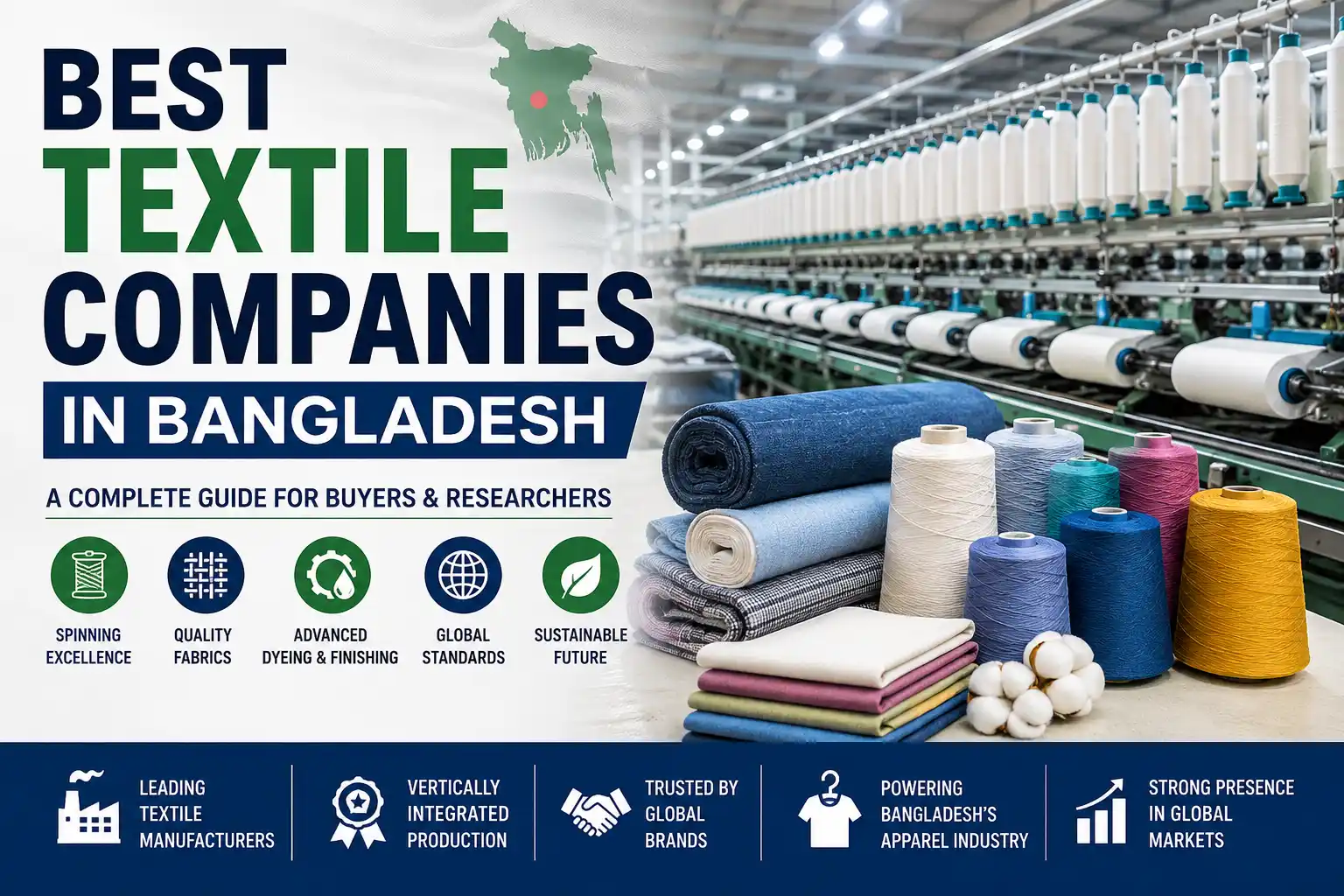
Best Textile Companies in Bangladesh
Bangladesh’s textile industry is the backbone behind one of the world’s largest apparel supply chains. Long before a garment is cut and sewn, it starts as raw fiber that has to be spun into yarn, then knitted or woven into fabric, and then dyed, printed, and finished to the specifications a buyer needs. This textile manufacturing base — spinning, knitting, weaving, dyeing, printing, finishing, denim processing, and home textile production — is what allows Bangladesh’s garment exporters to source fabric domestically instead of relying entirely on imports, and it has become a significant export sector in its own right.
This guide on the best textile companies in Bangladesh looks at notable manufacturers and groups genuinely engaged in textile production — not simply garment assembly — based on publicly available and verifiable information about their manufacturing activities, locations, and product focus. Textile companies differ meaningfully from one another: some specialize narrowly in yarn spinning, others focus on denim fabric or home textiles, and some operate as large, vertically integrated groups spanning several stages of production. Understanding these differences matters for anyone sourcing fabric, researching the industry, or evaluating a potential manufacturing partner.
It’s worth being upfront: the word “best” in this guide’s title reflects the way people commonly search for this information, not an independent determination by Info Ghor that any one company is objectively superior to the others. This is an editorial selection, not an official industry ranking, and the appropriate manufacturer for a given buyer depends on the specific textile product, process, certification requirements, and order volume involved. Company details — including addresses, product ranges, certifications, and export markets — can change over time, so readers should verify current information directly with each company before making sourcing or contracting decisions.
Quick Answer: Bangladesh has several well-established textile manufacturers and groups with genuine spinning, knitting, weaving, dyeing, or denim production activities, including Noman Group, DBL Group, Square Textiles, Envoy Textiles, Viyellatex Group, Beximco Textiles, Akij Textile Mills, Paramount Textile, Epyllion Group, and Saiham Textile Mills. The right company for a given buyer depends on the required textile type, manufacturing process, certifications, minimum order quantity, and sourcing needs — this list does not declare any single company “the best” overall.
Disclaimer: This article is an editorial, informational guide prepared by Info Ghor. It is not an official industry ranking, and inclusion in this list does not constitute an endorsement by Info Ghor. Company operations, addresses, certifications, production capacity, export markets, buyers, and product ranges can change over time. Businesses should independently verify current information before making sourcing, procurement, investment, or contracting decisions.
Notable Textile Companies in Bangladesh
1. Noman Group
Commonly known for: A large, vertically integrated textile group spanning spinning, weaving, knitting, dyeing, and home textiles Head Office: Adamjee Court Main Building, 115-120, Motijheel Commercial Area, Dhaka-1000, Bangladesh
Noman Group was founded in 1997 and has grown into a well-established vertically integrated textile group, built around dozens of subsidiary mills covering spinning, weaving, fabric processing, and home textile production. According to publicly available information, the group’s product range includes yarns, woven and knit fabrics, denim, terry towels, and home textile items such as bed linens, curtains, and quilt covers, produced across a large number of factories, most concentrated around Gazipur and greater Dhaka. According to the company, it is export-oriented, with reported customers including major international retailers, and industry sources have described it among Bangladesh’s largest exporters by turnover. Because export figures and buyer relationships can change, readers should confirm current details directly with the company.
Commonly associated with: Yarn, woven and knit fabric, denim, and home textile production at scale May suit: Buyers seeking a large, multi-mill group covering several stages of textile production under one umbrella
🔗 INFO GHOR LISTING: View Noman Group on Info Ghor
2. DBL Group
Commonly known for: Vertically integrated knit fabric manufacturing, including in-house dyeing, printing, and finishing Head Office: South Avenue Tower, House #50 (6th Floor), Road #03, Gulshan Avenue, Dhaka-1212, Bangladesh
DBL Group, originally established in 1991 as Dulal Brothers Limited, has grown into a diversified conglomerate whose core business remains knit textile and apparel manufacturing. The group’s textile operations include knitting, dyeing, printing, and finishing of fabric, supported by an in-house testing laboratory and backward-linkage facilities such as embroidery and screen printing. According to the company, DBL supplies fabric and finished knitwear to a number of internationally recognized retail and fashion brands, with main export markets in Europe, the United States, and Canada. DBL has also published sustainability reporting since 2014 in line with Global Reporting Initiative (GRI) guidelines and describes its activities as aligned with UN Sustainable Development Goals, according to the company’s own materials.
Commonly associated with: Knit fabric production, dyeing, printing, and finishing May suit: Buyers sourcing knit fabric or knitwear with an interest in documented sustainability reporting
🔗 INFO GHOR LISTING: View DBL Group on Info Ghor
3. Square Textiles PLC
Commonly known for: Cotton yarn spinning for the hosiery and knitwear export sector Head Office: Anita Center, Square Textiles Division, Uttara, Dhaka-1230, Bangladesh
Square Textiles PLC is the textile division of Square Group, a diversified Bangladeshi business group. The company was established with its first spinning unit in 1994, expanding with additional units in 1998 and 2000, and is publicly listed on the Dhaka and Chittagong Stock Exchanges. According to the company, Square Textiles focuses primarily on producing 100% cotton ring-spun yarn for the export-oriented hosiery and knitwear industry, operating multiple spinning units with a combined spindle capacity built up over its several expansion phases. As a spinning-focused operation, Square Textiles generally supplies yarn to downstream knitting and weaving mills rather than producing finished fabric or garments itself.
Commonly associated with: Cotton ring-spun yarn for hosiery and knitwear manufacturers May suit: Knitting and weaving mills or buyers sourcing cotton yarn as a raw material input
🔗 INFO GHOR LISTING: View Square Textiles on Info Ghor
4. Envoy Textiles Limited
Commonly known for: Denim fabric manufacturing with backward-integrated spinning and weaving Head Office: Envoy Tower, 18/E, Lake Circus, Kalabagan, West Panthapath, Dhaka-1205, Bangladesh Manufacturing Location: Bhaluka, Mymensingh, Bangladesh
Envoy Textiles Limited began commercial production in 2008. The company was listed on the Dhaka Stock Exchange and Chittagong Stock Exchange in June 2012. The company operates a denim fabric plant in Bhaluka, Mymensingh, that includes its own spinning and weaving facilities. It operates integrated denim manufacturing facilities that include rope-dyeing technology. According to the company, its Bhaluka facility has received LEED Platinum certification, alongside additional certifications such as ISO 9001, ISO 14001, and OEKO-TEX for specific products. Envoy states that it uses sustainable fiber sourcing and water-saving finishing processes, including an on-site effluent treatment plant, though readers should confirm current certification status directly with the company.
Commonly associated with: Denim fabric, including rope-dyed and sustainably finished variants May suit: Denim brands and manufacturers seeking a vertically integrated, certification-focused Bangladeshi denim mill
🔗 INFO GHOR LISTING: View Envoy Textiles on Info Ghor
5. Viyellatex Group
Commonly known for: Composite knit textile manufacturing, including spinning, knitting, and dyeing Head Office: Le Méridien Dhaka (6th Floor), 79/A Commercial Area, Airport Road, Nikunja-2, Dhaka-1229, Bangladesh
Viyellatex Group began as a small knit apparel business in 1996 and has since grown into a multi-dimensional conglomerate, formally organized as VIYELLATEX Group in 2002. Its core textile operations run through business units including Viyellatex Limited (composite knit apparel and textile manufacturing) and Viyellatex Spinning Limited, which the company describes as one of Bangladesh’s lower carbon-emission spinning mills. According to the company, its integrated setup covers the process from raw cotton import through knitting, dyeing, washing, cutting, and finishing. Viyellatex has stated a strong focus on corporate sustainability and has received recognition for environmental and social performance, according to the company’s own published materials; readers seeking specific current certifications should confirm these directly with the company.
Commonly associated with: Composite knit fabric production, including spinning and dyeing May suit: Buyers seeking a vertically integrated knit textile supplier with a stated sustainability focus
🔗 INFO GHOR LISTING: View Viyellatex Group on Info Ghor
6. Beximco Textiles (Bextex Limited)
Commonly known for: Large-scale composite textile manufacturing, including spinning, weaving, dyeing, and denim finishing Head Office: Beximco Industrial Park, Sarabo, Kashimpur, Gazipur, Bangladesh
Bextex Limited, operating as part of the BEXIMCO Textiles and Apparel Division, is based at the Beximco Industrial Park in Gazipur. According to the company, its operations include a cotton and polyester-blended yarn-spinning mill, a weaving section using air-jet looms, and a dyeing and finishing section producing both knit and woven fabrics, along with specialized denim fabric finishes. BEXIMCO describes its Industrial Park as a self-contained facility with access to captive power generation, water purification, and wastewater treatment infrastructure. As with other large diversified groups, buyers should confirm which specific Beximco textile entity and facility is relevant to their sourcing needs, since certifications and capacity can vary by unit.
Commonly associated with: Blended yarn spinning, woven and knit fabric, and denim finishing May suit: Buyers sourcing from a large, infrastructure-backed composite textile facility
🔗 INFO GHOR LISTING: View Beximco Textiles on Info Ghor
7. Akij Textile Mills Limited
Commonly known for: Yarn-dyed and solid-dyed woven fabric manufacturing Head Office: Akij House, 198 Bir Uttam Mir Shawkat Sarak, Tejgaon, Dhaka-1208, Bangladesh Manufacturing Location: Golora, Charkhanda, Manikganj, Bangladesh
Akij Textile Mills Limited (ATML) is a textile manufacturing concern of Akij Group, one of Bangladesh’s larger industrial conglomerates with interests spanning textiles, food and beverage, cement, ceramics, and other sectors. The company has been in operation since 1998 and, according to its own published information, specializes in producing yarn-dyed and solid-dyed woven fabrics for export-oriented garment manufacturers, alongside a spinning division producing ring, autocoro, and rotor yarns. ATML states that its production equipment is sourced from established international textile machinery manufacturers and that it maintains in-house yarn and fabric testing capabilities. As with any capacity-related figures, readers should confirm current production volumes directly with the company.
Commonly associated with: Yarn-dyed and solid-dyed woven fabrics, plus cotton yarn spinning May suit: Garment manufacturers sourcing yarn-dyed woven fabric or cotton yarn
🔗 INFO GHOR LISTING: View Akij Textile Mills on Info Ghor
8. Paramount Textile PLC
Commonly known for: Cotton yarn-dyed and solid-dyed woven fabric manufacturing Head Office: House 22, Road 113/A, Gulshan Circle 2, Dhaka-1212, Bangladesh Manufacturing Location: Gilarchala, Sreepur, Gazipur, Bangladesh
Paramount Textile PLC was incorporated in 2006 and began commercial production in 2008, and is publicly listed on Bangladesh’s stock exchanges. According to the company, its Gazipur manufacturing plant produces cotton yarn-dyed woven fabrics, solid-dyed woven fabrics, and dyed yarns used in knitwear and sweaters, along with printing capabilities including digital printing. Paramount Textile states that it has received Bangladesh’s National Export Trophy on multiple occasions and describes ongoing investment in environmentally focused production measures. The company’s core focus remains woven, yarn-dyed fabric rather than garment assembly, positioning it as a fabric supplier to downstream apparel manufacturers.
Commonly associated with: Yarn-dyed and solid-dyed woven fabric, plus dyed yarn for knitwear May suit: Buyers and garment manufacturers sourcing yarn-dyed woven fashion fabric
🔗 INFO GHOR LISTING: View Paramount Textile on Info Ghor
9. Epyllion Group
Commonly known for: Vertically integrated knit textile manufacturing, including knitting, dyeing, and finishing Head Office: NINAKABBO, 227/A Tejgaon-Gulshan Link Road, Dhaka-1208, Bangladesh Manufacturing Location: Textile unit in Gazipur, Bangladesh (via Epyllion Knitex Limited and Epyllion Fabrics Limited)
Epyllion Group’s textile operations began in 1994 and have since expanded into a group of specialized units supporting a vertically integrated knit textile business. According to the company, its Gazipur-based textile unit — comprising Epyllion Knitex Limited and Epyllion Fabrics Limited — carries out knitting, dyeing, yarn dyeing, and finishing, supported by an in-house testing laboratory and an effluent treatment plant. Epyllion states that its research and development activities focus on fabrics designed to reduce environmental impact. The group also operates separate garment manufacturing units, but its textile-specific activity is centered on the knitting, dyeing, and finishing operations described here.
Commonly associated with: Knit fabric production, yarn dyeing, and fabric finishing May suit: Buyers sourcing knit fabric from a vertically integrated group with in-house testing capabilities
🔗 INFO GHOR LISTING: View Epyllion Group on Info Ghor
10. Saiham Textile Mills Limited
Commonly known for: Cotton and blended yarn spinning Head Office: Saiham Tower, House-34, Road-136, Gulshan-1, Dhaka-1212, Bangladesh Manufacturing Location: Noyapara, Saiham Nagar, Madhabpur, Habiganj, Bangladesh
Saiham Textile Mills Limited, a concern of Saiham Group established in the early 1980s, is a publicly listed spinning company based in Dhaka with its manufacturing plant located in Habiganj district. According to the company, Saiham Textile Mills produces cotton and blended yarns, including melange yarn varieties, supplying manufacturers who convert yarn into finished fabric. The Saiham Group’s broader textile operations include sister companies such as Faisal Spinning Mills and Saiham Denim Limited, which the group describes as covering additional spinning, denim, and composite knitting capacity. As a primarily yarn-focused manufacturer, Saiham Textile Mills’ core business sits earlier in the textile value chain than fabric or garment production.
Commonly associated with: Cotton and blended yarn spinning, including melange yarns May suit: Knitting and weaving mills or buyers sourcing yarn as a raw material
🔗 INFO GHOR LISTING: View Saiham Textile Mills on Info Ghor
Comparison of Textile Companies in Bangladesh
|
Company |
Main Textile Activities |
Main Products |
Manufacturing Location |
Export Focus |
|---|---|---|---|---|
|
Noman Group |
Spinning, weaving, knitting, dyeing, home textiles |
Yarn, woven/knit fabric, denim, home textiles, towels |
Gazipur and greater Dhaka |
According to the company, it is export-oriented |
|
DBL Group |
Knitting, dyeing, printing, finishing |
Knit fabric and knitwear |
Gazipur and Dhaka area |
Company states exports mainly to Europe, US, Canada |
|
Square Textiles PLC |
Cotton yarn spinning |
100% cotton ring-spun yarn |
Uttara, Dhaka (multiple units) |
Supplies export-oriented knitwear manufacturers |
|
Envoy Textiles Limited |
Spinning, weaving, denim dyeing/finishing |
Denim fabric |
Bhaluka, Mymensingh |
100% export-oriented, per the company |
|
Viyellatex Group |
Spinning, knitting, dyeing |
Composite knit fabric and apparel |
Gazipur area |
Export-oriented knit textile and apparel |
|
Beximco Textiles (Bextex) |
Spinning, weaving, dyeing, denim finishing |
Blended yarn, woven/knit fabric, denim |
Beximco Industrial Park, Gazipur |
Domestic and export markets |
|
Akij Textile Mills |
Spinning, yarn/solid dyeing |
Yarn-dyed and solid-dyed woven fabric, yarn |
Manikganj |
Export-oriented garment manufacturers |
|
Paramount Textile PLC |
Weaving, yarn dyeing, printing |
Yarn-dyed and solid-dyed woven fabric |
Sreepur, Gazipur |
Export-oriented fabric supply |
|
Epyllion Group |
Knitting, dyeing, finishing |
Knit fabric |
Gazipur |
Supplies group’s own and other garment exporters |
|
Saiham Textile Mills Limited |
Cotton/blended yarn spinning |
Cotton and melange yarn |
Madhabpur, Habiganj |
Supplies domestic and export-oriented fabric mills |
This table summarizes company-reported and publicly documented information for general orientation only. Details such as certifications, capacity, and export markets can change, so readers should confirm current information directly with each company.
Bangladesh Textile Industry at a Glance
Bangladesh’s textile sector sits alongside, and largely feeds into, its much larger ready-made garment (RMG) export industry. Textile manufacturing in Bangladesh spans several distinct stages: spinning turns raw cotton or synthetic fiber into yarn; weaving and knitting turn yarn into fabric using two different mechanical processes; and dyeing and finishing add color, texture, and performance properties to the fabric before it is cut and sewn into garments or used for home textile products.
Many of Bangladesh’s larger textile operations are located in industrial clusters around Dhaka, Gazipur, Narayanganj, and Chattogram, close to the country’s major garment manufacturing hubs and ports. This proximity supports what the industry calls “backward linkage” — domestic textile mills supplying fabric and yarn to domestic garment factories, reducing reliance on imported fabric and shortening lead times for export orders. Bangladesh’s textile and RMG sectors are closely intertwined, and many of the country’s larger business groups operate across both.
Textile Company vs Garment Manufacturer: What Is the Difference?
These two terms are often used loosely, but they describe genuinely different activities. A textile company generally creates yarn, fabric, or other processed textile material — through spinning, knitting, weaving, dyeing, printing, or finishing. A garment manufacturer, by contrast, takes finished fabric and converts it into wearable clothing through cutting, sewing, and assembly.
Many Bangladeshi business groups are vertically integrated, meaning they operate both textile mills and garment factories under the same corporate umbrella. This article focuses specifically on the textile manufacturing side of these operations — spinning, knitting, weaving, dyeing, and related processes — rather than on companies whose activities are limited to garment assembly alone.
What Does a Vertically Integrated Textile Company Mean?
A vertically integrated textile company is one that controls multiple stages of the production chain within its own group, rather than relying entirely on outside suppliers for each step. A typical sequence might run from spinning (turning fiber into yarn), through knitting or weaving (turning yarn into fabric), to dyeing and finishing (adding color and performance properties), and in some cases through to garment manufacturing itself.
Vertical integration can offer businesses advantages such as tighter coordination between production stages, more control over lead times, and easier quality tracing from raw material to finished product. However, vertical integration does not automatically mean a company’s output is of higher quality than a specialized, single-stage manufacturer — a spinning-only mill or a dedicated dyeing house can be highly capable within its specific process. Buyers should evaluate a company’s actual capabilities for the specific product or process they need, rather than assuming size or integration alone determines suitability.
How to Choose a Textile Manufacturer in Bangladesh
Identify the Required Textile Product
Start by defining exactly what you need — yarn, knit fabric, woven fabric, denim, or a home textile product — since this will immediately narrow which manufacturers are relevant.
Check Manufacturing Capabilities
Confirm that a company’s actual manufacturing processes (spinning, knitting, weaving, dyeing, finishing) match what your product requires, rather than assuming a large or well-known group covers every process you need.
Verify Certifications
Ask which specific facility or product line holds any certification you require (such as OEKO-TEX, GOTS, or an ISO standard), since certifications frequently apply to a specific site or process rather than an entire company or group.
Review Minimum Order Requirements
Textile manufacturers often have minimum order quantities (MOQs) that vary significantly by process and product; confirm these early to avoid mismatched expectations.
Request Product Samples
Request physical samples of yarn or fabric before committing to a larger order, so you can assess quality, color consistency, and hand-feel directly.
Confirm Quality-Control Procedures
Ask how a manufacturer tests and inspects its output at each production stage, and whether independent testing reports are available for review.
Check Lead Times and Production Capacity
Confirm realistic lead times for your order size, and clarify whether the manufacturer has available capacity within your required timeframe.
Verify Export and Compliance Requirements
If you are importing fabric or yarn, confirm the manufacturer’s export documentation capabilities and compliance with your destination market’s import requirements.
Confirm Commercial Terms in Writing
Ensure pricing, payment terms, delivery terms, and specifications are documented in a written agreement before production begins.
What to Verify Before Working With a Textile Manufacturer
Before entering a sourcing or contracting relationship, buyers should verify:
- The manufacturer’s legal company identity and registration
- The actual factory location where production will occur
- Product specifications, including fabric or yarn composition
- GSM (grams per square meter) or yarn count, where relevant
- Color and finish requirements
- Relevant certifications, confirmed at the facility or product level
- Minimum order quantity (MOQ)
- Availability and cost of samples
- Realistic lead time for the order
- Production capacity relative to your order size
- The manufacturer’s quality-control process
- Payment terms
- Delivery terms and logistics arrangements
- Export documentation requirements
This list is general guidance for business sourcing decisions and is not legal advice; buyers with significant commercial exposure should consider working with a qualified trade or legal professional for contract terms.
Common Textile Certifications and Standards
Several certifications commonly appear in discussions of Bangladeshi textile manufacturing. It’s worth understanding what each generally covers, while keeping in mind that not every company in this guide holds every certification — and that certifications typically apply to specific facilities or product lines rather than to an entire company or group:
- OEKO-TEX: A testing and certification system focused on limiting harmful substances in textile products.
- GOTS (Global Organic Textile Standard): A standard covering organic fiber content along with environmental and social criteria across the supply chain.
- GRS (Global Recycled Standard): A standard verifying recycled material content and tracing it through the supply chain.
- ISO standards (such as ISO 9001 and ISO 14001): International standards covering quality management and environmental management systems, respectively.
- LEED (Leadership in Energy and Environmental Design): A green building certification system that can apply to a factory building’s design and operations, where a specific facility has pursued and achieved it.
Sustainability in Bangladesh’s Textile Industry
Sustainability performance varies significantly across Bangladesh’s textile sector, and it should be evaluated company by company and facility by facility rather than assumed for the industry as a whole. Relevant factors include energy efficiency in production processes, water use and conservation (particularly in dyeing and finishing, which are typically water-intensive), wastewater treatment through effluent treatment plants (ETPs), use of recycled or more sustainably sourced fibers, and green-building design for factory facilities.
Some Bangladeshi textile manufacturers have invested in more sustainable processes, water-saving finishing technologies, and formal environmental certifications, while practices and investment levels vary considerably elsewhere in the sector. Buyers with sustainability requirements should ask for specific, current, and verifiable evidence — such as a named certification tied to a specific facility — rather than relying on general marketing statements about a company’s environmental commitment.
Frequently Asked Questions
What are some well-known textile companies in Bangladesh?
Companies with genuine textile manufacturing operations frequently referenced in industry discussions include Noman Group, DBL Group, Square Textiles, Envoy Textiles, Viyellatex Group, Beximco Textiles, Akij Textile Mills, Paramount Textile, Epyllion Group, and Saiham Textile Mills. This is not an exhaustive or official list.
What is the difference between a textile company and a garment company?
A textile company produces yarn, fabric, or processed textile materials through processes like spinning, knitting, weaving, dyeing, and finishing. A garment company converts finished fabric into wearable clothing through cutting and sewing.
Which textile products are manufactured in Bangladesh?
Bangladesh manufactures a wide range of textile products, including cotton and blended yarn, knit and woven fabrics, denim fabric, and home textile products such as towels, bed linens, and curtains.
Does Bangladesh manufacture denim?
Yes. Several Bangladeshi companies, including Envoy Textiles and Beximco Textiles, operate dedicated denim fabric manufacturing facilities that include spinning, weaving, and dyeing processes.
What is a vertically integrated textile company?
A vertically integrated textile company controls multiple stages of production — such as spinning, knitting or weaving, and dyeing or finishing — within its own group, rather than relying entirely on external suppliers for each stage.
How can I verify a textile manufacturer in Bangladesh?
You can check a company’s official website, registration and business filings, industry association membership (such as BTMA), and, for publicly listed companies, filings with the Dhaka or Chittagong Stock Exchanges.
What certifications should textile buyers check?
Depending on the product, relevant certifications may include OEKO-TEX, GOTS, GRS, or ISO 9001/14001. Buyers should confirm which specific facility or product line a certification applies to.
Do Bangladeshi textile companies export fabrics?
Yes. Many Bangladeshi textile manufacturers are export-oriented, supplying fabric and yarn both to domestic garment factories and to buyers in other countries, though specific export markets vary by company.
How do I choose a textile supplier in Bangladesh?
Identify your required product and process, verify the manufacturer’s actual capabilities and certifications, request samples, and confirm minimum order quantities, lead times, and commercial terms in writing before proceeding.
Final Thoughts
There is no single textile company in Bangladesh that is objectively “best” for every buyer or use case. The right manufacturer depends on factors such as the required product (yarn, knit fabric, woven fabric, denim, or home textiles), the specific manufacturing process needed, certification requirements, minimum order quantities, available production capacity, lead times, factory location, and commercial terms. This guide is intended as a starting point for identifying companies with genuine, verifiable textile manufacturing activity in Bangladesh — not as a final recommendation. Readers are encouraged to verify all company details independently before making sourcing or contracting decisions.
Useful Textile Industry Resources
- Bangladesh Textile Mills Association (BTMA) — the national trade body representing textile mills and manufacturers in Bangladesh
- Bangladesh Garment Manufacturers and Exporters Association (BGMEA) — the trade association for the ready-made garment sector, relevant given the close relationship between textiles and garments
- Bangladesh Knitwear Manufacturers and Exporters Association (BKMEA) — the trade association representing knitwear exporters
- Export Promotion Bureau (EPB), Bangladesh — the government body overseeing export promotion and export data
- Ministry of Textiles and Jute, Government of Bangladesh — the ministry responsible for textile sector policy
- Bangladesh Investment Development Authority (BIDA) — the national investment promotion authority
Editorial Note
This article is an editorial informational guide prepared by Info Ghor. It is not an official ranking of Bangladesh’s textile companies, and inclusion does not mean endorsement by Info Ghor. Company details were prepared using publicly available and verifiable information, including official company sources, regulatory or industry information, public filings, and other reliable references available at the time of writing. Business details, manufacturing operations, certifications, locations, and product ranges may change. Readers should verify current information directly with each company before making sourcing or contracting decisions.
Last Updated
This guide was last reviewed and updated in August 2026 to reflect the latest publicly available information on Bangladesh’s textile industry. As company information, manufacturing operations, certifications, and product offerings may change over time, readers should verify the latest details directly with each company before making any sourcing or contracting decisions.