
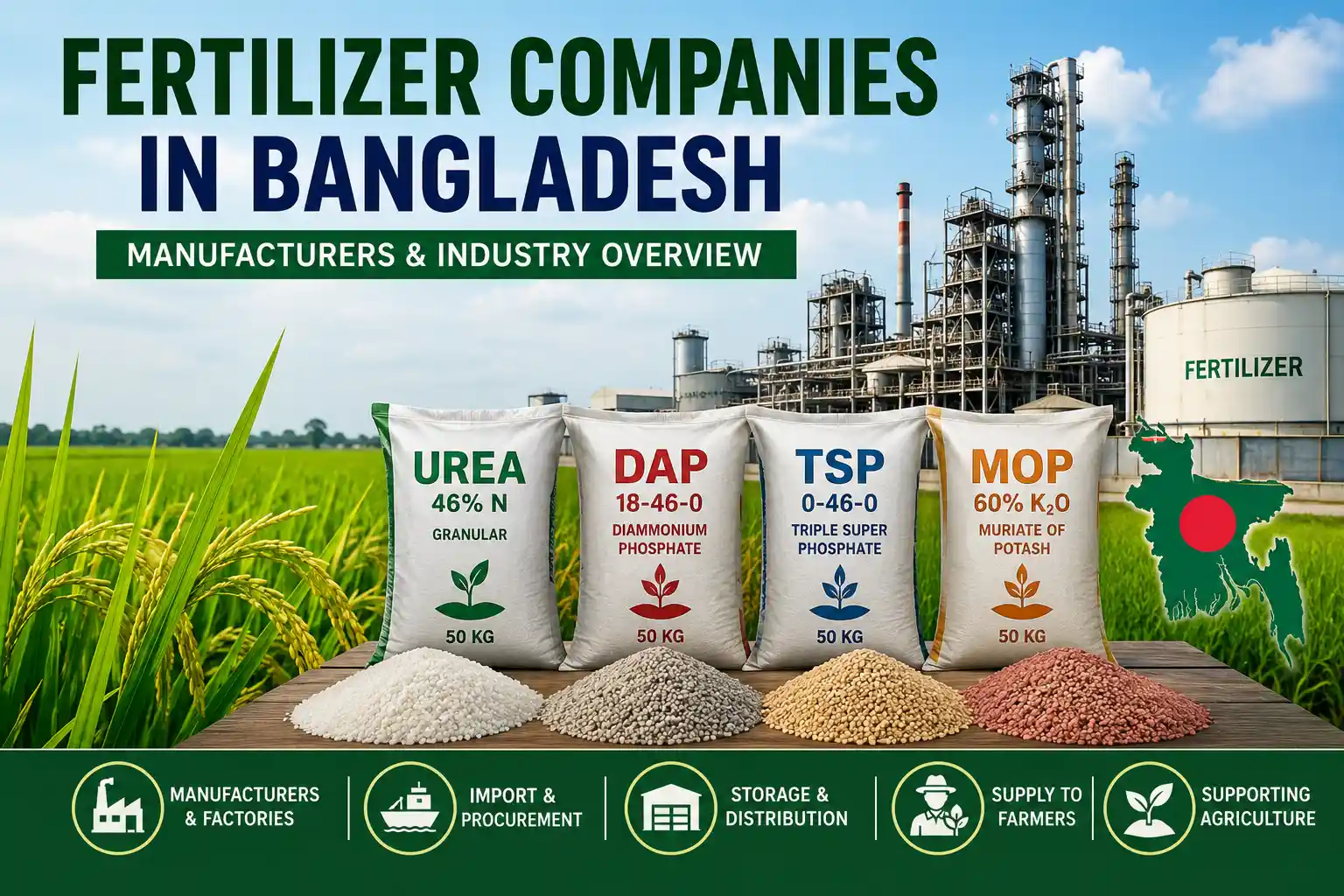
Fertilizer Companies in Bangladesh: Manufacturers & Industry Overview
Bangladesh’s fertilizer industry includes government-owned manufacturing plants under the Bangladesh Chemical Industries Corporation (BCIC), the Karnaphuli Fertilizer Company Limited (KAFCO) joint venture, private-sector fertilizer businesses, and a government-coordinated procurement and distribution system.
Bangladesh produces several important fertilizers domestically, particularly urea, while DAP and phosphate fertilizers also have domestic production facilities. At the same time, imports remain an important part of the country’s fertilizer supply system, especially for non-urea fertilizers and when domestic production is insufficient.
This guide provides an overview of major fertilizer companies and manufacturing facilities in Bangladesh, their products and stated production capacities where reliable information is available, and the roles of BCIC and BADC in the fertilizer industry.
Fertilizer Industry in Bangladesh
Fertilizer plays an important role in Bangladesh’s agricultural production. Major crops such as rice, wheat, maize, potato, vegetables and fruits require appropriate nutrient management, while agricultural authorities also promote balanced fertilizer application based on crops and soil conditions.
Major fertilizer categories used in Bangladesh include:
- Urea
- DAP (Diammonium Phosphate)
- TSP (Triple Superphosphate)
- MOP (Muriate of Potash)
- Gypsum
- Zinc and other micronutrient fertilizers
- NPK and NPKS fertilizer products
Bangladesh has domestic fertilizer manufacturing capacity, particularly for urea. It also has state-owned facilities producing DAP and phosphate fertilizer. However, imports continue to play an important role in meeting fertilizer requirements.
It is difficult to state a single current percentage of national fertilizer demand met by domestic production without using a specific fiscal-year dataset. Production can also change significantly when factories experience gas shortages, maintenance shutdowns or other operational interruptions.
For this reason, this article does not present an unverified FY 2025–26 national production or demand figure. The Ministry of Agriculture reported fertilizer demand of approximately 6.8425 million tonnes for FY 2023–24, but that historical figure should not be treated as the demand figure for FY 2025–26.
Several government organizations have roles in the fertilizer sector. The Ministry of Industries oversees BCIC and its enterprises, while the Ministry of Agriculture and organizations under it have important responsibilities relating to agricultural inputs, fertilizer procurement, distribution and farmer support.
Major Fertilizer Companies and Manufacturers in Bangladesh
This list is provided for informational purposes and is not an official ranking or endorsement. Company operations, production status, products and capacities may change. Readers should verify current information with the respective company or relevant government authority.
The organizations below include major state-owned fertilizer enterprises, a joint-venture producer, and selected private-sector fertilizer businesses.
Government-Owned BCIC Fertilizer Companies
Ghorashal-Polash Fertilizer PLC (GPFPLC)
Overview: Ghorashal-Polash Fertilizer PLC is a BCIC enterprise in Polash, Narsingdi. It was formed through the merger of the former Urea Fertilizer Factory Limited and Polash Urea Fertilizer Factory Limited in 2021.
Location: Polash, Narsingdi.
Ownership/parent organization: Government-owned enterprise under BCIC.
Main fertilizer product: Granular urea.
Production/manufacturing role: GPFPLC is an important part of Bangladesh’s domestic urea-production infrastructure.
Production capacity: The company’s official stated design capacity is approximately 2,800 metric tonnes per day, equivalent to approximately 924,000 metric tonnes per year. This is rated production capacity and should not be interpreted as guaranteed actual annual output.
Important factual note: Actual production can differ from rated capacity depending on operating days, gas availability, maintenance and other conditions. Current output should therefore be checked against dated company or BCIC information.
Shahjalal Fertilizer Company Limited (SFCL)
Overview: Shahjalal Fertilizer Company Limited is a BCIC granular-urea plant located at Fenchuganj in Sylhet.
Location: Fenchuganj, Sylhet.
Ownership/parent organization: Government-owned enterprise under BCIC.
Main fertilizer product: Granular urea.
Production/manufacturing role: SFCL contributes to Bangladesh’s domestic urea manufacturing capacity.
Production capacity: Its official installed capacity is approximately 1,760 metric tonnes per day, or approximately 580,800 metric tonnes per year.
Important factual note: Rated capacity does not necessarily represent actual annual production. Current production and regional distribution should be confirmed from current SFCL or BCIC information.
Jamuna Fertilizer Company Limited (JFCL)
Overview: Jamuna Fertilizer Company Limited is a BCIC urea manufacturing enterprise.
Location: Tarakandi, Sarishabari, Jamalpur.
BCIC information places the factory approximately 10 kilometres from the Jamuna River.
Ownership/parent organization: Government-owned enterprise under BCIC.
Main fertilizer product: Urea.
Production/manufacturing role: JFCL forms part of Bangladesh’s domestic urea-production system.
Production capacity: BCIC states an annual capacity of approximately 561,000 metric tonnes of urea.
Important factual note: Like other gas-dependent fertilizer factories, production may be interrupted. Any claim about a particular shutdown, restart date or current production status should be checked against dated official information.
Chittagong Urea Fertilizer Limited (CUFL)
Overview: Chittagong Urea Fertilizer Limited is a BCIC enterprise and one of Bangladesh’s established urea manufacturing facilities.
Location: Rangadia, Anwara, Chattogram.
The historical company name retains the word “Chittagong,” although the current English name of the district is Chattogram.
Ownership/parent organization: Government-owned enterprise under BCIC.
Main fertilizer product: Urea.
Production/manufacturing role: CUFL contributes to Bangladesh’s domestic urea manufacturing infrastructure.
Production capacity: BCIC states CUFL’s annual urea capacity at approximately 561,000 metric tonnes.
Important factual note: CUFL has experienced operational interruptions, including gas-related disruptions. Because operating status can change, readers should use current BCIC or CUFL information rather than assume that the plant is continuously operating at rated capacity.
Ashuganj Fertilizer and Chemical Company Limited (AFCCL)
Overview: Ashuganj Fertilizer and Chemical Company Limited is an established BCIC urea manufacturing enterprise.
Location: Ashuganj, Brahmanbaria.
Ownership/parent organization: Government-owned enterprise under BCIC.
Main fertilizer product: Urea.
Production/manufacturing role: AFCCL forms part of BCIC’s urea manufacturing network.
Production capacity: BCIC’s current factory listing states an annual urea capacity of approximately 528,000 metric tonnes.
This is important because some older sources cite different capacity figures. The current BCIC-listed figure is preferable when describing the plant’s stated capacity.
History: BCIC information identifies AFCCL as having been established in 1981.
Important factual note: Actual output may differ from rated capacity. Current production and operating status should be checked with AFCCL or BCIC.
DAP Fertilizer Company Limited (DAPFCL)
Overview: DAP Fertilizer Company Limited is a BCIC enterprise producing diammonium phosphate fertilizer.
Location: Rangadia, Anwara, Chattogram.
Ownership/parent organization: Government-owned enterprise under BCIC.
Main fertilizer product: Diammonium phosphate (DAP).
Production/manufacturing role: DAPFCL is Bangladesh’s state-owned DAP manufacturing plant.
Official BCIC/DAPFCL information identifies it as the state DAP facility. However, describing it simply as the “only DAP manufacturer in Bangladesh” would require confirmation that no other registered private producer currently exists.
Production capacity: DAPFCL’s official information states a production capacity of approximately 800 metric tonnes per day.
The daily capacity should not automatically be converted into guaranteed annual production because actual output depends on operating days and other conditions.
Important factual note: Bangladesh also imports DAP. The exact share supplied by domestic production versus imports varies and should be calculated only from a current official production-and-demand dataset.
TSP Complex Limited
Overview: TSP Complex Limited is BCIC’s phosphate-fertilizer manufacturing enterprise in Chattogram.
Location: North Patenga, Chattogram.
Ownership/parent organization: Government-owned enterprise under BCIC.
Main fertilizer product: Phosphate fertilizer, including TSP.
Production/manufacturing role: TSP Complex is Bangladesh’s major state-owned TSP/phosphate-fertilizer manufacturing facility.
BCIC describes TSP Complex as the country’s only phosphate-fertilizer factory. However, Root Group separately states that its Gram Bangla operation includes a private-sector TSP unit. Because these two descriptions create uncertainty about nationwide exclusivity, this article does not describe TSP Complex as the only TSP producer in Bangladesh.
Production capacity: BCIC’s current profile states an annual capacity of approximately 100,000 metric tonnes.
Older capacity figures should not be treated as current without supporting technical documentation.
Important factual note: Current product range and production levels should be confirmed from the latest TSP Complex or BCIC information.
Private-Sector and Joint-Venture Fertilizer Businesses
Karnaphuli Fertilizer Company Limited (KAFCO)
Overview: Karnaphuli Fertilizer Company Limited is a multinational joint-venture fertilizer company.
Location: Rangadia, Karnaphuli, Chattogram, beside the Karnaphuli River.
Ownership: The joint venture involves the Government of Bangladesh/BCIC and investors from Japan, Denmark and the Netherlands. BCIC’s official listing records a 43.15% interest.
Main products: Granular urea and anhydrous ammonia.
KAFCO’s official company information confirms these products.
Production/manufacturing role: KAFCO operates an integrated ammonia, urea and granulation complex.
KAFCO supplies urea to Bangladesh’s domestic market through BCIC procurement and may also serve export markets. However, the exact current domestic-versus-export allocation should not be stated without current KAFCO or BCIC sales/procurement data.
Important factual note: Some media reports provide annual domestic-supply estimates for KAFCO, but this article does not use those figures because they were not verified against a current official annual statement.
ACI Fertilizer
ACI Fertilizer is part of ACI’s agribusiness activities and markets fertilizer and biological products in Bangladesh.
Parent organization: ACI PLC.
Documented products: ACI’s published information includes Ratno NPKS, slow-release NPK products and biofertilizer products such as ACI Bumper Tricho.
An important distinction is necessary when describing ACI as a fertilizer company.
ACI’s own information identifies Mazim Agro Industries as the manufacturer of Ratno, while ACI is involved in marketing and distribution of the finished product. Therefore, ACI should not automatically be described as the physical manufacturer of all fertilizer products marketed under its fertilizer business.
For this reason, ACI is included here as an important fertilizer-sector business rather than being presented as a primary fertilizer manufacturer comparable with BCIC’s industrial plants.
Gram Bangla NPK Fertilizer & Agro Industries (Pvt.) Ltd.
Gram Bangla NPK Fertilizer & Agro Industries is associated with Root Group.
According to Root Group’s own corporate information, Gram Bangla produces NPKS fertilizer and its second unit is a private-sector TSP facility.
Root Group reports production capacities of approximately:
- 54,000 tonnes per year for NPKS
- 99,000 tonnes per year for TSP
However, these are company-reported figures and were not independently verified against current government production or regulatory records.
Therefore, these figures should not be interpreted as independently confirmed actual production.
The company’s TSP claim is also one reason this article avoids stating that TSP Complex is unquestionably Bangladesh’s only TSP producer.
Role of BCIC in Bangladesh’s Fertilizer Industry
The Bangladesh Chemical Industries Corporation (BCIC) is a government-owned corporation under the Ministry of Industries.
BCIC should not be confused with an individual fertilizer factory. It administers and coordinates multiple industrial enterprises, including fertilizer companies.
Within the fertilizer sector, BCIC oversees its fertilizer enterprises and participates in fertilizer production, procurement and distribution arrangements.
Examples of fertilizer enterprises associated with BCIC include:
- Ghorashal-Polash Fertilizer PLC
- Shahjalal Fertilizer Company Limited
- Jamuna Fertilizer Company Limited
- Chittagong Urea Fertilizer Limited
- Ashuganj Fertilizer and Chemical Company Limited
- DAP Fertilizer Company Limited
- TSP Complex Limited
These individual enterprises should not be treated as simply different names for BCIC.
Role of BADC in Fertilizer Distribution
The Bangladesh Agricultural Development Corporation (BADC) is a government organization under the Ministry of Agriculture.
BADC is not a primary fertilizer manufacturer. Its fertilizer-related role includes procurement/import, storage, allocation and distribution of non-urea fertilizers under government policy.
Official information also supports BADC’s role in importing non-urea fertilizers through government arrangements and supporting their storage and distribution.
Exact procurement responsibilities can vary by season and government decision, so current arrangements should be checked against current BADC and Ministry of Agriculture information.
Major Types of Fertilizer in Bangladesh
Urea
Urea is a nitrogen fertilizer widely used in Bangladesh agriculture.
Bangladesh has domestic urea manufacturing through BCIC enterprises as well as KAFCO. Imports can also supplement domestic supply.
Because individual plants may experience operational interruptions, total domestic urea production can vary from year to year.
DAP
DAP stands for Diammonium Phosphate. It provides phosphorus and nitrogen and is used in crop nutrient management.
Bangladesh has domestic DAP production through the state-owned DAP Fertilizer Company Limited.
Imports supplement domestic DAP supply. The exact domestic-versus-imported share should be determined from current official data rather than assumed.
TSP
TSP stands for Triple Superphosphate and is a phosphorus fertilizer.
Bangladesh has state-owned TSP/phosphate-fertilizer production at TSP Complex Limited.
Root Group also reports private-sector TSP manufacturing through Gram Bangla. Because that claim was not independently confirmed through current government production records in the material reviewed, nationwide producer counts should be treated cautiously.
MOP
MOP stands for Muriate of Potash and provides potassium.
Bangladesh’s current fertilizer-supply system relies on imports for MOP. BADC has an official role in non-urea fertilizer imports and supply arrangements.
This article does not make a separate claim about Bangladesh’s geological potash reserves because that claim was not supported by a current authoritative geological source in the material reviewed.
Other Fertilizers
Other fertilizer and nutrient products used in Bangladesh include micronutrients and blended fertilizer products such as NPK and NPKS.
The appropriate fertilizer and application rate depend on crop requirements, soil conditions and agricultural recommendations.
Fertilizer Manufacturing vs Importing vs Distribution
The terms manufacturer, importer and dealer should not be used interchangeably.
Manufacturer: A company or enterprise that physically manufactures fertilizer or fertilizer products.
Importer: An organization or business that brings fertilizer or fertilizer inputs into Bangladesh under applicable rules and procurement arrangements.
Government procurement: Fertilizer may be procured through government agreements, tenders or other approved mechanisms to support national supply.
Distributor/dealer: An authorized participant in the fertilizer distribution system that supplies fertilizer further through the approved market or distribution network.
This distinction is particularly important when evaluating private companies. A company that markets or distributes a fertilizer product should not automatically be described as its manufacturer.
How Fertilizer Reaches Farmers in Bangladesh
At a high level, fertilizer moves from domestic factories or import points through government-controlled storage, allocation and distribution channels before reaching authorized dealers and retail points.
However, the precise distribution framework should be described according to the current government policy.
The Ministry of Agriculture lists the Integrated Fertilizer Dealer Appointment and Distribution Policy 2025, including a revised version. Therefore, the dealer system should no longer be described as merely “under review” based on late-2025 reports.
Because dealer structure, agency responsibilities and allocation arrangements can change under policy implementation, farmers and businesses should consult current Ministry of Agriculture, BADC or other applicable government information when they need operational details.
Choosing a Fertilizer Supplier or Dealer
Farmers and other fertilizer buyers should take practical precautions before purchasing:
- Verify that the seller is authorized under the currently applicable fertilizer dealer framework.
- Check the fertilizer bag and product labeling carefully.
- Confirm that the fertilizer type and grade match what you intend to purchase.
- Check current officially notified prices where applicable.
- Be cautious about suspicious, damaged, poorly labelled or potentially adulterated products.
- Ask for an appropriate receipt or invoice for the purchase.
- Seek guidance from the relevant agricultural authority when uncertain about fertilizer selection or use.
Fertilizer dealer authorization should be verified under the currently applicable government policy and through the relevant government authority. Dealer appointment, licensing or authorization procedures should not be assumed solely on the basis of fertilizer type, as responsibilities and procedures may change under government policy.
Fertilizer Prices in Bangladesh
Bangladesh has used government-administered fertilizer prices and subsidies as part of its agricultural-input policy.
However, fertilizer prices can change through government decisions. For this reason, a current article should not present an old government price notification as though it were the price in August 2026.
For historical context, the Ministry of Agriculture published farmer-level fertilizer prices in 2023, but those figures should be treated as historical, not as current prices.
Anyone seeking current fertilizer prices should check the latest Ministry of Agriculture or other applicable government notification.
Challenges Facing Bangladesh’s Fertilizer Industry
Bangladesh’s fertilizer sector faces several interconnected challenges.
Dependence on Imports
Domestic manufacturing does not eliminate the need for fertilizer imports. Non-urea fertilizer procurement in particular remains an important part of the national supply system.
The exact level of import dependence changes over time and should be calculated from current official production, procurement and demand data rather than a fixed percentage.
Natural Gas Availability
Natural gas is an important input for gas-based fertilizer production.
Gas availability can therefore affect factory operations and domestic fertilizer output. Any claim that a particular plant is currently closed or operating should be supported by a dated notice because factory status can change.
Production Interruptions
Maintenance requirements, equipment conditions, raw-material availability and energy supply can interrupt fertilizer production.
Older factories may also require rehabilitation and maintenance to sustain production.
Global Supply and Import Costs
Dependence on imported fertilizer and production inputs can expose Bangladesh to international price movements, shipping conditions and supply disruptions.
Distribution
A nationwide fertilizer distribution system requires procurement, storage, allocation and coordination between government organizations and authorized market participants.
Changes in dealer and distribution policy can also affect how the system operates.
Balanced Fertilizer Use
The challenge is not only ensuring adequate fertilizer supply. Appropriate and balanced fertilizer use is also important for crop production and soil management.
Farmers should follow suitable agricultural recommendations rather than assuming that applying more fertilizer necessarily produces better results.
Future of the Fertilizer Industry in Bangladesh
Bangladesh’s fertilizer industry is likely to continue balancing three major priorities: domestic production, reliable imports and efficient fertilizer use.
Modern production facilities can improve domestic manufacturing capability, but rated capacity alone does not guarantee annual production. Energy availability, maintenance, feedstock supply and plant operating conditions remain important.
Government procurement and storage systems will also continue to matter where domestic production cannot meet requirements.
At the farm level, balanced nutrient management, appropriate fertilizer selection and agricultural extension support can help improve fertilizer-use efficiency.
Because the fertilizer sector is affected by production conditions, procurement decisions and policy changes, long-term forecasts about self-sufficiency or exact future production should be treated cautiously unless supported by official plans and current data.
Frequently Asked Questions
Which companies manufacture fertilizer in Bangladesh?
Bangladesh has fertilizer manufacturing through government-owned BCIC enterprises such as Ghorashal-Polash Fertilizer PLC, Shahjalal Fertilizer Company Limited, Jamuna Fertilizer Company Limited, Chittagong Urea Fertilizer Limited, Ashuganj Fertilizer and Chemical Company Limited, DAP Fertilizer Company Limited and TSP Complex Limited. KAFCO is a major joint-venture producer. Private-sector businesses also participate in fertilizer production, formulation, marketing and distribution, but each company’s exact manufacturing role should be verified individually.
Who produces urea fertilizer in Bangladesh?
Bangladesh has domestic urea production through BCIC fertilizer enterprises and the KAFCO joint venture. The current operating status and actual output of individual plants can vary, so rated capacity should not be confused with current production.
What is BCIC?
BCIC stands for Bangladesh Chemical Industries Corporation. It is a government-owned corporation under the Ministry of Industries that administers and coordinates multiple industrial enterprises, including fertilizer companies. BCIC itself is not a single fertilizer factory.
What is the role of BADC in fertilizer distribution?
BADC is a government agricultural-input organization under the Ministry of Agriculture. Its fertilizer-related activities include procurement or import, storage, allocation and distribution of non-urea fertilizers under government policy. BADC is not a primary fertilizer manufacturer.
Which fertilizers are commonly used in Bangladesh?
Common fertilizer categories in Bangladesh include urea, DAP, TSP and MOP, along with micronutrient and blended fertilizer products such as NPK and NPKS.
Is fertilizer manufactured in Bangladesh?
Yes. Bangladesh has domestic manufacturing of urea as well as DAP and phosphate fertilizers. However, domestic production is supplemented by imports, and actual production can vary depending on factory operations and input availability.
Does Bangladesh import fertilizer?
Yes. Fertilizer imports are an important part of Bangladesh’s supply system, particularly for non-urea fertilizers and when domestic production is insufficient. The exact quantity and share vary by year and fertilizer type.
What is DAP fertilizer?
DAP stands for diammonium phosphate. It is a fertilizer that supplies phosphorus and nitrogen. Bangladesh has state-owned domestic DAP production through DAP Fertilizer Company Limited, while imports also contribute to supply.
What is TSP fertilizer?
TSP stands for triple superphosphate and is a phosphorus fertilizer. Bangladesh has state-owned TSP/phosphate-fertilizer production through TSP Complex Limited. Root Group also reports private-sector TSP production through Gram Bangla, although that claim should be distinguished as company-reported unless confirmed through current regulatory production records.
How can farmers identify authorized fertilizer dealers?
Farmers should verify that a seller is authorized under the currently applicable fertilizer dealer policy, inspect product labeling and packaging, check applicable officially notified prices, and obtain a proper receipt or invoice. For current dealer authorization information, the relevant government agricultural authority should be consulted.
Conclusion
Bangladesh’s fertilizer industry combines domestic manufacturing, government procurement and imports, storage and distribution systems, and private-sector participation.
BCIC oversees several major state-owned fertilizer enterprises, including urea, DAP and phosphate-fertilizer facilities. KAFCO operates as an important joint-venture producer, while private companies participate in different parts of the market, including fertilizer products, formulation, marketing and reported private manufacturing activities.
One important point when comparing fertilizer companies in Bangladesh is that rated capacity, actual production and current operating status are different things. A factory may have a substantial installed capacity but produce less in a particular year because of gas supply, maintenance or other operational conditions.
Likewise, company-reported manufacturing claims should be distinguished from independently verified government production data.
For current production status, dealer authorization, fertilizer prices or procurement arrangements, readers should rely on the latest information from the relevant government authority or company rather than historical figures.