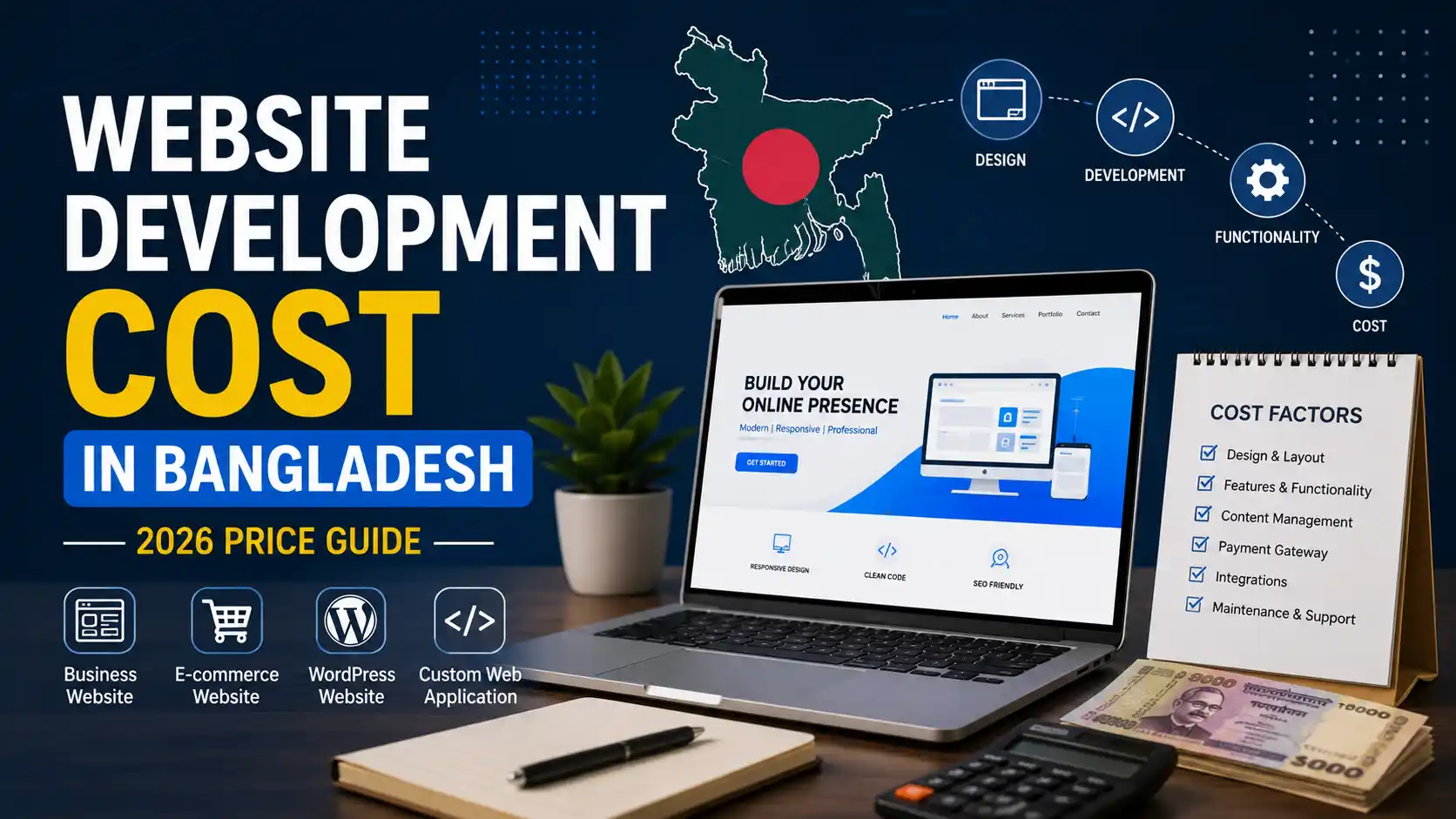
Website Development Cost in Bangladesh 2026
If you have started researching website development cost in Bangladesh, you have probably already noticed something confusing: one developer quotes ৳8,000, another quotes ৳80,000, and a third quotes over ৳3,00,000 — all for what sounds like “a website.” This wide gap is not a sign that someone is overcharging or undercharging. It reflects the fact that “a website” can mean a single-page portfolio built in an afternoon, or a full e-commerce platform with payment gateways, inventory management, and custom features built over several months.
This guide breaks down website development cost in Bangladesh by website type, the factors that push prices up or down, the difference between one-time and recurring costs, and how to evaluate a quotation so you are not surprised later. All figures mentioned here are approximate market estimates meant to give you a general sense of range — not fixed or official pricing. Costs change over time and vary between developers and agencies, so always confirm current pricing directly with any provider you are considering before making a decision.
Quick Answer: How Much Does Website Development Cost in Bangladesh?
In general, website development cost in Bangladesh can range from a few thousand taka for a very simple site to several lakh taka for a complex, custom-built platform. The table below gives a rough overview by website type. Treat these as starting-point estimates only — always request a detailed quotation based on your specific requirements.
| Website Type | Approximate Cost Range (BDT) | Typical Use |
|---|---|---|
| Basic/Personal Website | ৳5,000 – ৳25,000 | Portfolio, resume/CV site, personal blog, simple landing page |
| Small Business Website | ৳15,000 – ৳80,000 | Local shops, service providers, small businesses with a handful of pages |
| Corporate Website | ৳40,000 – ৳1,50,000+ | Established companies needing a multi-page brand presence |
| E-commerce Website | ৳60,000 – ৳3,00,000+ | Online stores with product catalogs, cart, and checkout |
| Custom Web Application | ৳1,50,000 – ৳10,00,000+ | Booking systems, SaaS products, marketplaces, custom platforms |
Note: WordPress is not listed as a separate row here because it is a content management system (CMS), not a distinct website type — a WordPress-based project can fall into the small business, corporate, or e-commerce categories above depending on what’s built. See the WordPress-specific section further down for typical WordPress cost ranges.
These ranges reflect general market tendencies rather than fixed pricing. For basic/personal and small business websites, the lower end is generally associated with simple freelancer or template-based projects, while more customized, agency-built websites tend to start higher. For e-commerce, very simple freelancer or template-based stores may sometimes cost less than ৳60,000, but this range is a more useful general budgeting estimate for a properly developed store with the features most businesses need. For custom web applications, very simple custom tools may sometimes fall below ৳1,50,000, though projects with meaningful custom functionality tend to start around or above that figure.
Because pricing depends heavily on project scope, design complexity, required features, integrations, and the individual developer or agency, these ranges should be treated as approximate budgeting estimates rather than fixed prices. Actual website development costs can vary significantly from one project or provider to another, so always request a detailed quotation based on your specific requirements before making a purchasing decision.
Website Development Cost in Bangladesh by Website Type
Basic or Personal Website
A basic or personal website is usually a small number of static pages — home, about, contact, maybe a portfolio or resume section. These are common among freelancers, students, consultants, and individuals who want a simple online presence.
Common features include a homepage, an about page, a contact form, and sometimes a photo gallery or blog section. Because there is little custom functionality involved, cost considerations mainly come down to design template usage, number of pages, and whether any custom graphics are needed. Prices tend to rise if you request custom illustration or photography, multiple design revisions, or additional pages beyond a basic set.
Small Business Website
A small business website typically serves local shops, restaurants, salons, tutoring centers, and similar service-based businesses. The goal is usually to establish credibility, list services, and make it easy for customers to get in touch.
Typical features include a homepage, service or product pages, a contact/location page, and possibly a simple inquiry form or WhatsApp/phone integration. Cost tends to increase with the number of pages, any custom design work, image sourcing, and basic SEO setup such as meta descriptions and page titles. Adding a blog section or multilingual content (Bangla and English, for example) can also add to the price.
Corporate Website
Corporate websites are built for established companies that need a more polished, structured, multi-page presence — often including sections for company history, leadership, services or products, careers, press or news, and detailed contact information across multiple locations.
Because corporate sites usually involve custom design work, brand-consistent visuals, more detailed content, and sometimes integration with internal systems (such as a careers portal or newsletter signup), the price is generally higher than a small business site. Costs can rise further with animation, custom illustrations, multiple language versions, and more extensive content writing or copyediting.
WordPress Website
WordPress is one of the most widely used platforms for business and blog websites in Bangladesh because it balances affordability with flexibility. A WordPress website can range from a simple theme-based setup to a heavily customized design.
Cost depends on whether a free or premium theme is used, whether page builders like Elementor are involved, how many plugins are required, and whether any custom development is needed beyond what the theme and plugins offer. Ongoing costs for premium themes, plugin licenses, and maintenance are separate from the initial development cost and should be budgeted for independently.
E-commerce Website
E-commerce websites are built to sell products or services online and are generally more expensive than informational websites because of the additional functionality involved — product catalogs, shopping cart, checkout flow, payment gateway integration, and order management.
Cost considerations include the size of the product catalog, whether the store is built on WooCommerce, Shopify, or a fully custom platform, the number of payment gateways and courier services integrated, and whether features like customer accounts, wishlists, or discount/coupon systems are needed. Larger catalogs, custom checkout experiences, and integrations with inventory or accounting systems tend to push costs higher.
Custom Website/Web Application
A custom web application goes beyond a typical website and usually involves building software-like functionality — booking systems, membership platforms, marketplaces, dashboards, or SaaS products. These projects involve custom backend development, databases, user roles, and often ongoing feature development.
Because custom applications are effectively software projects, cost is driven by the complexity of the features, the number of user roles and workflows, third-party integrations (such as SMS gateways, payment systems, or mapping APIs), and the level of testing and security required. These projects typically involve the widest price range and the most variation between providers.
What Determines Website Development Cost in Bangladesh?
Several factors influence the final price of a website project, regardless of website type. Understanding these can help you interpret why two quotations for what seems like a similar project can differ significantly.
- Number of pages — More pages generally mean more design, content, and development time.
- Custom vs. template design — A fully custom design costs more than adapting an existing template or theme.
- WordPress vs. custom development — Custom-coded websites typically cost more than CMS-based builds due to the additional development work involved.
- E-commerce functionality — Adding a store, cart, and checkout system increases scope significantly.
- Payment gateway integration — Each payment gateway added requires setup, testing, and sometimes compliance work.
- User registration/login systems — Account creation, password recovery, and user dashboards add development complexity.
- Booking or appointment systems — Calendar logic, availability management, and notifications require custom functionality.
- API/third-party integrations — Connecting to services like CRMs, SMS gateways, or delivery/courier APIs adds development and testing time.
- Content creation — Professional copywriting, photography, or video production is often priced separately from development.
- SEO setup — Basic on-page SEO may be included, while deeper technical or content SEO work is often a separate service.
- Security requirements — SSL setup, secure forms, and protection against common vulnerabilities may add to scope, especially for e-commerce or applications handling sensitive data.
- Mobile responsiveness — Most modern websites need to work well on phones and tablets, which is generally standard practice but still requires design and testing effort.
- Multilingual functionality — Supporting Bangla and English (or additional languages) adds translation and technical work.
- Developer/agency experience — More experienced developers and established agencies often charge more, reflecting their track record, support capacity, and reliability.
- Ongoing maintenance — Whether maintenance is bundled into the initial cost or billed separately affects the total cost of ownership over time.
Domain and Hosting Costs in Bangladesh
Website development quotations do not always include domain and hosting. Some providers bundle these into their packages, while others treat them as entirely separate purchases that you manage yourself. This is worth clarifying upfront, since it directly affects how you compare quotations.
Typical items to check for include:
- Domain registration — the cost of registering your website address (e.g., a .com or .com.bd domain), usually billed annually.
- Shared hosting — entry-level hosting suitable for smaller websites with moderate traffic.
- VPS or cloud hosting — more powerful and scalable hosting. Many smaller e-commerce websites can initially operate on suitable shared or managed WordPress hosting, while VPS or cloud hosting may become beneficial as traffic, resource requirements, or application complexity grows.
- SSL certificate — required for secure (HTTPS) browsing; some hosting providers include a free SSL option, while others charge separately.
- Email hosting — professional email addresses tied to your domain, which may be bundled with hosting or purchased separately.
- Renewal costs — domain and hosting are typically annual, recurring expenses rather than one-time purchases.
Because exact current pricing for domains and hosting changes over time and varies between providers, it is best to check current rates directly with domain registrars and hosting companies rather than relying on older figures. When comparing two website development quotations, always confirm whether domain and hosting are included, and for how long, since this can make an otherwise “cheaper” quote more expensive over time.
WordPress Website Development Cost in Bangladesh
WordPress remains a popular choice in Bangladesh because it offers a reasonable balance of cost, flexibility, and ease of future updates. That said, “WordPress website” can mean very different things depending on how it is built.
Free vs. premium themes and plugins: A free theme keeps initial costs lower but may offer limited design flexibility or support. Premium themes and plugins usually come with a license fee (often annual) but provide more features, better support, and more polished design options.
Custom design on WordPress: Even within WordPress, a business can choose a mostly template-based design or invest in custom design work layered on top of the CMS, which increases both design and development time.
Page builders (Gutenberg, Elementor, and similar tools): Page builders make it easier to update content without coding knowledge, which is a common reason businesses choose WordPress. Complex layouts and interactive elements built with page builders can still add to development time.
WooCommerce: For WordPress-based e-commerce, WooCommerce is a common choice. It adds functionality but also adds cost, since it typically requires additional plugins for payment gateways, shipping calculations, and inventory management.
Plugin licensing: Many premium plugins (for SEO, forms, security, backups, or page building) charge annual license fees. These are recurring costs separate from the one-time development fee.
Maintenance: WordPress websites need regular updates to the core software, theme, and plugins to stay secure and functional. Some developers offer maintenance packages, while others leave this to the client to manage or arrange separately.
As a general approximate range, WordPress website development cost in Bangladesh often falls somewhere between ৳20,000 and ৳1,20,000+, though this is not a strict boundary. Template-based projects with limited customization tend to sit toward the lower end, while more customized business websites — with custom design, added functionality, or WooCommerce integration — can cost substantially more. Not every WordPress project will fall neatly within this range, so it’s still worth getting a project-specific quotation.
It’s worth clearly separating the one-time development cost from these recurring software, domain, and hosting costs when budgeting, since the true cost of a WordPress website includes both.
E-commerce Website Development Cost in Bangladesh
E-commerce websites generally cost more than basic informational websites because they involve significantly more moving parts — both in terms of features and ongoing operational needs.
Key cost factors include:
- Product catalog size — a store with a handful of products is simpler to build than one with hundreds or thousands of SKUs, especially if products have variants (size, color, etc.).
- Platform choice — WooCommerce (WordPress-based), Shopify, or a fully custom-built platform each come with different cost and flexibility trade-offs.
- Shopping cart and checkout — building a smooth, reliable checkout experience takes careful design and testing.
- Payment gateway integration — connecting to one or more local or international payment gateways involves setup, testing, and sometimes ongoing transaction fees charged by the gateway provider (separate from development cost).
- Courier/delivery integration — many Bangladeshi e-commerce sites integrate with courier services for order tracking and fulfillment, which adds development work.
- Inventory and order management — systems to track stock levels and manage orders add backend complexity.
- Customer accounts — features like order history, saved addresses, and wishlists add to scope.
- Security — handling customer data and payments requires stronger security practices than a typical informational website.
- Maintenance — e-commerce sites often need more frequent updates and monitoring than static websites, given the higher stakes of downtime or bugs.
Because of this added complexity, e-commerce projects tend to have wider price ranges and higher costs overall compared to basic or small business websites, and the final cost depends heavily on how many of these features are genuinely needed versus optional.
Freelancer vs Web Development Company in Bangladesh
Both freelancers and web development companies are common options in Bangladesh, and neither is automatically the better choice — it depends on your budget, project size, timeline, and support expectations.
|
Factor |
Freelancer |
Web Development Company |
|---|---|---|
|
Cost |
Often lower, especially for smaller projects |
Often higher, reflecting overhead and team resources |
|
Communication |
Usually direct, one-on-one |
May go through a project manager or account handler |
|
Project capacity |
Best suited to smaller or simpler projects |
Often better equipped for larger, more complex projects |
|
Specialization |
May cover multiple roles (design, development, content) |
Often has separate specialists for design, development, QA, etc. |
|
Support |
Availability can vary; may be a single point of failure |
Typically has more continuity if one team member is unavailable |
|
Maintenance |
May or may not offer ongoing maintenance |
More likely to offer structured maintenance packages |
|
Accountability |
Depends on individual reliability and reputation |
Often backed by contracts, processes, and a business entity |
The comparison above reflects general market tendencies rather than universal rules. Individual freelancer pricing, quality, and reliability vary widely, and not every web development company automatically provides better support or accountability than every experienced freelancer.
For a simple personal or small business website with a limited budget, a freelancer can be a practical option. For larger, more complex, or business-critical projects — especially e-commerce or custom applications — a company’s broader team and structured processes may offer more reliability. In both cases, checking past work, communication style, and reviews (where available) matters more than the label “freelancer” or “company.”
One-Time vs Recurring Website Costs
A common source of confusion is not distinguishing between what you pay once and what you will keep paying. It helps to separate these clearly when budgeting.
Possible one-time costs:
- Design work
- Development/coding
- Initial website setup
- Content migration (if moving from an old site)
- Initial integrations (payment gateway setup, API connections, etc.)
Possible recurring costs:
- Domain renewal (typically annual)
- Hosting fees (monthly or annual)
- Premium theme/plugin licenses
- Ongoing maintenance
- Security monitoring
- Backup services
- Technical support
Some providers bundle certain recurring items (like the first year of hosting) into the initial project cost, while others charge for them separately from day one. Always ask specifically which category each line item falls into before agreeing to a quotation.
Hidden or Often-Overlooked Website Costs
Beyond the obvious development, domain, and hosting costs, a few expenses are commonly overlooked when budgeting for a website:
- Revisions beyond the agreed scope — most quotations include a limited number of revision rounds; additional changes may be billed separately.
- Premium plugins or add-ons — features that seem “included” may actually require paid plugins with their own licensing costs.
- Paid third-party APIs — services like SMS gateways, mapping tools, or advanced analytics often charge based on usage.
- Payment gateway charges — gateways typically charge a percentage per transaction, separate from the development cost.
- Additional storage or bandwidth — high-traffic or media-heavy websites may require hosting upgrades over time.
- Content updates — ongoing changes to text, images, or products may not be included in the original package.
- Security enhancements — firewalls, malware scanning, or advanced protection are sometimes offered as add-ons.
- Backup services — automated backups are not always included by default and may need separate setup.
- Maintenance retainer — some developers charge a recurring fee for keeping the site updated and functioning smoothly.
- Future feature development — adding new functionality after launch is typically a new project or change request, not a free addition.
Asking about each of these directly before signing a contract can prevent surprises later.
How to Get an Accurate Website Development Quote
The more clearly you can describe your project, the more accurate and comparable the quotations you receive will be. Before reaching out to developers or agencies, it helps to prepare:
- Website purpose — what the site needs to achieve (sales, information, bookings, branding, etc.)
- Required pages — a rough list of the pages or sections you expect to need
- Required features — functionality like contact forms, e-commerce, booking systems, or user accounts
- Design preference — whether you want a custom design or are open to adapting an existing template
- Examples/references — websites you like the look or functionality of, to help communicate your vision
- Content requirements — whether you will supply text and images, or need help creating them
- Integrations — any third-party tools, payment gateways, or systems you need connected
- Expected timeline — when you need the website live
- Maintenance needs — whether you want ongoing support after launch
- Approximate budget — even a rough range helps developers propose realistic options
Sharing this information upfront generally leads to quotations that are easier to compare apples-to-apples, rather than vague estimates that leave out important scope details.
Questions to Ask a Web Developer Before Hiring
Before committing to a developer or agency, it’s worth clarifying a few practical points that can significantly affect your experience and costs down the line:
- Who will own the domain and hosting account — you or the developer?
- Will you receive full ownership of the source code?
- Will you have admin/CMS access to update content yourself?
- Is the design responsive across mobile, tablet, and desktop?
- Are basic SEO practices (page titles, meta descriptions, clean URLs) included?
- What security measures are included, and are backups handled automatically?
- How many revision rounds are included in the quoted price?
- What is the expected project timeline, and what could cause delays?
- Is post-launch support included, and for how long?
- Are there any recurring fees beyond the initial development cost?
Getting clear answers to these questions in writing — ideally as part of a contract or written agreement — helps avoid misunderstandings later.
How to Choose the Right Website Development Option
The right approach depends heavily on who you are and what you need the website to do:
- Personal portfolio — a simple, template-based site is usually sufficient; there is little reason to invest in complex custom development.
- Small local business — a small business website with clear service/contact information and basic SEO is often enough to establish an online presence.
- Professional/service business — a slightly more polished design with dedicated service pages and possibly a booking or inquiry system can add real value.
- Established company — a corporate website with strong branding, multiple sections, and possibly multilingual support better reflects the scale of the business.
- E-commerce business — investing in reliable cart, checkout, payment, and courier integration is worth prioritizing over purely visual extras.
- Custom platform/startup — if your business model depends on unique functionality (a marketplace, booking platform, or SaaS product), custom development is often necessary, and budget should be planned accordingly from the start.
In general, it’s worth matching your spending to your actual needs rather than assuming that more expensive automatically means better for your situation.
Is a Cheap Website Worth It?
This depends entirely on what “cheap” means in context. There is a meaningful difference between a low-cost website, a good-value website, and a poorly built website — and price alone does not tell you which one you’re getting.
A low-cost website can be a perfectly reasonable choice if your needs are simple and the developer delivers clean, functional, secure work within that budget. Good value means you are getting reliable results appropriate to what you paid, even if the price is modest. The concern arises with poor-quality development — regardless of price — where issues like weak security practices, poor performance, difficulty making future updates, unclear ownership of your domain/hosting/code, or a lack of post-launch support can end up costing more in the long run through lost time, security incidents, or the need to rebuild the site sooner than expected.
Rather than assuming every inexpensive website is a bad choice, it’s more useful to evaluate any quotation — cheap or expensive — against the questions and hidden-cost factors outlined earlier in this guide.
Website Development Cost Example Scenarios
The following are hypothetical examples meant to illustrate how different requirements might affect cost — they are not real quotations from any specific provider and should not be treated as guaranteed pricing.
Example 1: Small service business website A local tutoring center wants a five-page website (home, about, services, testimonials placeholder, contact) with a simple template-based design and a contact form. This type of project would generally fall on the lower end of the small business website range, since it involves limited custom design and no complex functionality.
Example 2: Professional portfolio A freelance graphic designer wants a personal portfolio site with a project gallery, about page, and contact form, built on a clean, somewhat custom design. This would likely sit in the basic-to-small-business range, depending on how much custom visual design work is involved.
Example 3: Corporate website A mid-sized company wants a ten-page website with custom branding, a careers section, multiple service pages, and bilingual (Bangla/English) content. This would typically fall into the corporate website range, reflecting the additional content, design, and multilingual work involved.
Example 4: Small e-commerce store A small business wants to sell around 50 products online, with one payment gateway and one courier integration, built on WooCommerce. This would generally fall into the e-commerce range, with cost influenced heavily by the number of integrations and any custom design requested.
Example 5: Feature-heavy custom platform A startup wants to build a booking platform with user accounts, an admin dashboard, SMS notifications, and payment processing. Because this involves custom backend development and multiple integrations, it would fall into the custom web application range, with cost varying significantly based on the exact feature set and complexity.
Final Thoughts
Website development cost in Bangladesh varies widely because “a website” can describe projects with very different scope, features, and complexity. Rather than choosing based solely on the lowest quotation, it’s worth evaluating the total value being offered — design quality, functionality, ownership terms, security practices, and post-launch support — against your actual business needs.
Because pricing changes over time and differs between individual developers and agencies, treat every figure in this article as an approximate market estimate rather than a fixed price. Before making a purchasing decision, obtain current, detailed quotations directly from the developers or agencies you are considering, and make sure each quotation clearly states what is and is not included.
Frequently Asked Questions
How much does website development cost in Bangladesh?
It depends on the type of website and features required, ranging from a few thousand taka for a very basic site to several lakh taka for a complex e-commerce or custom platform. Always request a detailed quotation based on your specific requirements.
How much does a basic website cost in Bangladesh?
A basic or personal website with a small number of pages and a template-based design generally falls on the lower end of the cost spectrum, though exact pricing varies by developer.
How much does a WordPress website cost in Bangladesh?
WordPress website costs vary based on theme choice (free vs. premium), design customization, and plugins used, and typically fall in a mid-range compared to fully custom-coded websites.
How much does an e-commerce website cost in Bangladesh?
E-commerce websites generally cost more than informational websites due to features like product catalogs, payment gateways, and courier integrations, with price scaling based on catalog size and functionality.
What factors affect website development cost?
Key factors include number of pages, custom vs. template design, e-commerce functionality, integrations, content creation needs, SEO setup, security requirements, and the developer’s experience level.
Is domain and hosting included in website development cost?
Not always. Some providers bundle domain and hosting into their packages, while others treat them as separate purchases. Always confirm this before comparing quotations.
Is WordPress cheaper than custom website development?
Generally, WordPress-based websites tend to be more cost-effective than fully custom-coded websites for standard business needs, though highly customized WordPress projects can approach custom development costs.
Should I hire a freelancer or web development company?
It depends on your project size, budget, and support needs. Freelancers can be cost-effective for smaller projects, while companies often offer more structured support for larger or more complex projects.
How much does website maintenance cost in Bangladesh?
Maintenance costs vary depending on what’s included — updates, backups, security monitoring, and content changes — and whether it’s billed as a one-time fee, monthly retainer, or included in the original package.
How long does it take to develop a website in Bangladesh?
Timelines vary based on complexity — a basic website might take a few days to a couple of weeks, while e-commerce or custom platforms can take several weeks to a few months, depending on scope, content readiness, revisions, and integrations.
Editorial Note: All prices mentioned in this article are approximate market estimates intended for general guidance only. Info Ghor does not guarantee, endorse, or verify quotations from any individual developer, freelancer, or agency. Actual website development costs vary based on project requirements, features, design complexity, and the specific provider you choose. Readers are encouraged to obtain current, detailed quotations directly from relevant providers before making any purchasing decision.
Last Updated: August 2026