How to Find Trusted Manufacturing Companies in Bangladesh 2026
Sourcing from overseas always carries some uncertainty, and Bangladesh’s manufacturing sector is no exception — production quality, communication, and reliability can vary significantly from one factory to the next. This is exactly why learning how to find trusted manufacturing companies in Bangladesh matters so much for business owners, importers, exporters, procurement managers, and startups building a new supply chain.
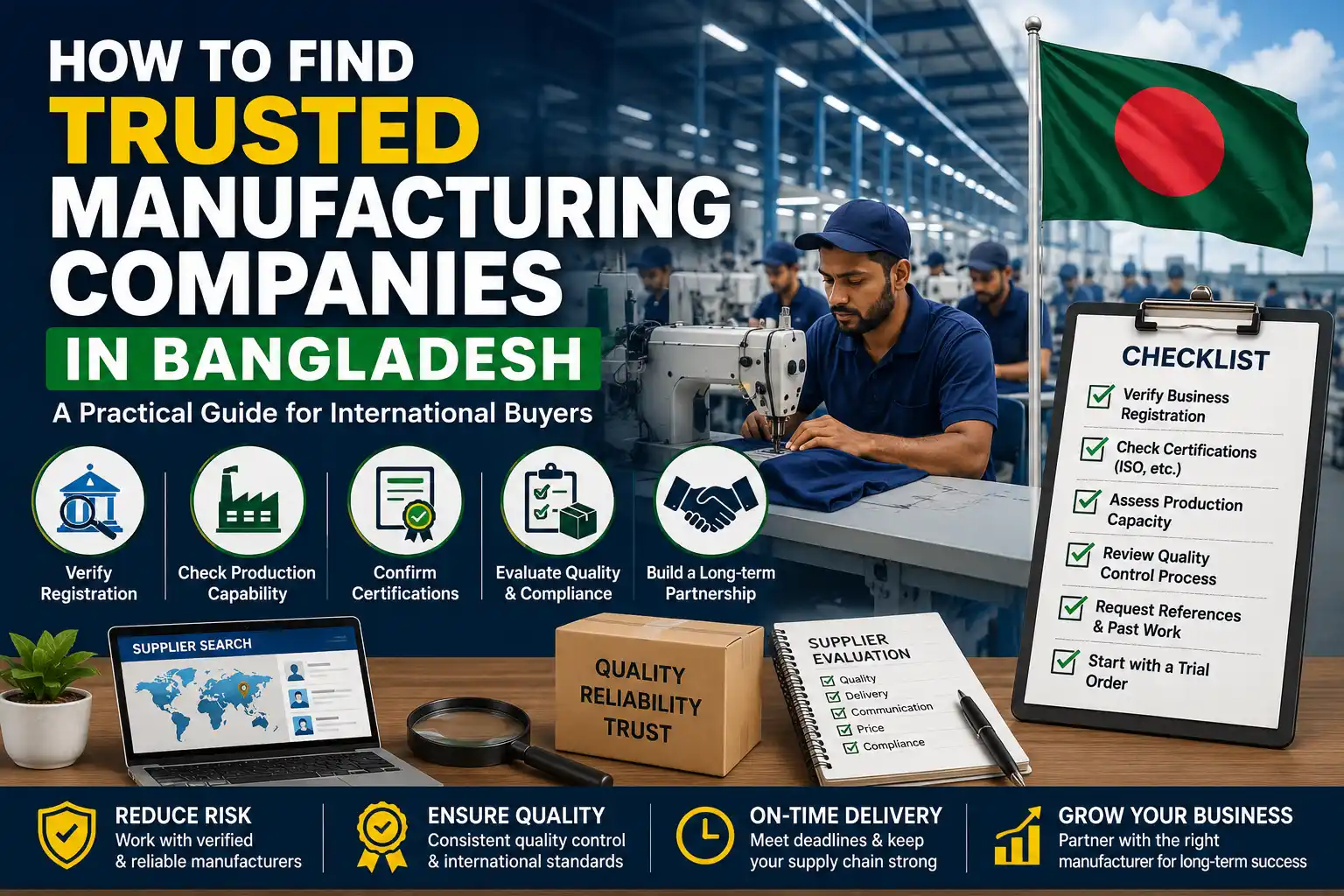
Rather than relying on a company’s own claims, experienced buyers combine several verification steps: checking legal registration, confirming real production capacity, reviewing certifications with the issuing body, and testing the relationship with a small trial order before committing to bulk production. This guide walks through that process in practical detail — where to search, how to verify a manufacturer, which questions to ask, and which warning signs suggest it’s time to walk away — so you can build sourcing relationships in Bangladesh with more confidence and considerably less risk.
Why Choosing the Right Manufacturing Company Matters
Bangladesh has built a significant manufacturing base, particularly in ready-made garments, textiles, leather goods, footwear, ceramics, light engineering, and agro-processing. This makes it an attractive sourcing destination for many international buyers. But manufacturing capacity varies widely between companies, and so does reliability.
Choosing the wrong manufacturer can lead to missed delivery deadlines, inconsistent product quality, compliance violations that affect a buyer’s own supply chain obligations, and financial losses from failed orders or disputes. For businesses that depend on consistent supply, a single unreliable partner can disrupt production schedules, damage customer relationships, and create costly rework.
Taking time upfront to properly evaluate a manufacturer is far less expensive than dealing with the consequences of a poor sourcing decision after an order has already been placed.
What Makes a Manufacturing Company Trustworthy?
Trustworthiness in a manufacturing partner is not a single attribute — it is a combination of factors that, together, indicate a company operates professionally and can be relied upon.
Business registration. A legitimate manufacturer should typically be registered with the Registrar of Joint Stock Companies and Firms (RJSC), Bangladesh’s official company registration authority under the Ministry of Commerce. Registration confirms the company is a recognized legal entity rather than an informal or unregistered operation.
Manufacturing capability. This includes actual production capacity, machinery, workforce size, and the specific product categories the factory is equipped to handle. A company that subcontracts most of its work to unnamed third parties presents more risk than one with direct, verifiable production capability.
Certifications (ISO, etc.). Depending on the industry, relevant certifications might include ISO 9001 (quality management), ISO 14001 (environmental management), or industry-specific certifications such as those covering social compliance or product safety. Certifications should be verifiable, not just claimed.
Export experience. A track record of exporting to international markets suggests familiarity with international quality standards, documentation, customs procedures, and buyer expectations.
Factory facilities. The physical condition of a factory — building safety, working conditions, machinery maintenance, and organization of the production floor — reflects operational discipline and can be assessed through site visits or third-party audits.
Quality control. Trustworthy manufacturers have documented quality control processes at different stages of production, not just a final inspection before shipment.
Client references. Willingness to provide verifiable references from past or current clients, particularly international ones, is a meaningful signal of confidence in their own track record.
Compliance. This covers labor law compliance, workplace safety standards, and adherence to relevant environmental regulations — all of which matter both ethically and for a buyer’s own due diligence obligations.
Sustainability. A growing number of international buyers factor in energy use, waste management, and broader environmental practices when selecting manufacturing partners, particularly in sectors like garments and textiles.
Communication. Clear, responsive, and professional communication — especially across time zones and language differences — is often an early indicator of how a working relationship will function.
Delivery performance. A consistent history of meeting agreed deadlines, or transparently communicating delays when they occur, is one of the most practical measures of reliability.
Step-by-Step Guide to Finding Trusted Manufacturing Companies in Bangladesh
1. Start with targeted Google searches
Use specific search terms that combine your product category with location and sourcing intent (for example, “cotton knitwear manufacturer Bangladesh” rather than a generic search). Review company websites for details on production capacity, certifications, and export markets, but treat website claims as a starting point rather than confirmed fact.
2. Use established business directories
Business directories that list company registration details, contact information, and industry categories may help narrow down a list of manufacturers to research further.
3. Check relevant trade associations
Trade associations often maintain member directories and can confirm whether a company is an active, dues-paying member in good standing, which is a useful verification step.
- BGMEA (Bangladesh Garment Manufacturers and Exporters Association) represents ready-made garment exporters and maintains a membership directory.
- BKMEA (Bangladesh Knitwear Manufacturers and Exporters Association) represents the knitwear segment of the garment industry specifically.
- BSCIC (Bangladesh Small and Cottage Industries Corporation) supports small and cottage-scale industries and can be a useful reference point for smaller manufacturers.
4. Consult government organizations
The Export Promotion Bureau (EPB), a government agency under the Ministry of Commerce, works to promote Bangladesh’s export industries and maintains trade information resources, including its Trade Information Centre, that can help buyers understand sector-level export data and connect with promotional events such as trade fairs.
5. Use the Bangladesh Trade Portal
The Bangladesh Trade Portal, a government-supported resource, provides information on trade regulations, procedures, and documentation requirements, which is useful for understanding the regulatory context a manufacturer operates within.
6. Search LinkedIn
LinkedIn can help verify that a company has an active professional presence, and allows buyers to review the backgrounds of company representatives, connect directly with sales or export teams, and sometimes find mutual connections who can offer informal references.
7. Attend or review trade fairs
Trade fairs such as the Dhaka International Trade Fair (DITF), organized annually by the Federation of Bangladesh Chambers of Commerce and Industry (FBCCI) with support from relevant government agencies including the Ministry of Commerce and the Export Promotion Bureau (EPB), and sector-specific exhibitions bring manufacturers together in one place, making it easier to compare multiple companies, see product samples in person, and ask questions directly.
8. Contact the Chamber of Commerce
Chambers of commerce, including the Federation of Bangladesh Chambers of Commerce and Industry (FBCCI) and the Dhaka Chamber of Commerce and Industry (DCCI), as well as bilateral chambers connecting Bangladesh with specific countries, can sometimes assist with introductions and provide general guidance on doing business with local companies.
9. Seek industry referrals
Referrals from other businesses that have already sourced from Bangladesh — including sourcing agents, freight forwarders, or industry peers — are often among the most reliable ways to identify manufacturers with a proven track record, since the recommendation comes with firsthand experience attached.
How to Verify a Manufacturer Before Working Together
Even after identifying a promising manufacturer, verification should happen before any significant commitment is made.
- Confirm company registration. Request the company’s RJSC registration details and cross-check them where possible, either directly or through a local legal or corporate service provider.
- Verify the factory address. Confirm that the address provided corresponds to an actual manufacturing facility, not just a sales office, using tools such as satellite mapping as an initial check.
- Review the website critically. A professional, detailed, and regularly updated website is a positive sign, but should not be treated as sufficient verification on its own.
- Check certifications directly. Where possible, verify certifications with the issuing certification body rather than relying solely on documents provided by the manufacturer.
- Request sample orders. A trial order, even a small one, is one of the most effective ways to assess actual product quality, packaging, and adherence to specifications before committing to a larger order.
- Request a video inspection. A live video walkthrough of the factory floor can help confirm that production facilities match what has been described, particularly when an in-person visit isn’t immediately possible.
- Consider a factory audit. Third-party audit services can independently verify production capacity, working conditions, and compliance status — a worthwhile investment for larger or long-term sourcing relationships.
- Ask for customer references. Reach out to referenced clients directly, where possible, rather than relying solely on testimonials provided by the manufacturer.
- Review export records. Where available, information on shipping history or past export activity can help confirm genuine international trading experience.
- Plan for payment safety. Use secure payment methods such as letters of credit or staged payments tied to production milestones, rather than paying the full amount upfront, particularly for new supplier relationships.
Why Sample Orders Matter
A sample order is one of the cheapest forms of due diligence available to a buyer. It lets you see, physically, whether the manufacturer can actually meet your specifications — material quality, stitching or finishing standards, dimensions, and packaging — rather than relying on a factory’s description of its own capabilities. Samples also reveal how a manufacturer communicates during a live order: whether they ask clarifying questions, meet the agreed timeline, and respond constructively if the first sample isn’t quite right. Buyers who skip this step and move straight to a bulk order are effectively testing the relationship with their full budget on the line, rather than a small, controlled amount.
Why a Written Agreement Matters
Verbal understandings and email threads are not a substitute for a signed manufacturing agreement or purchase contract. A written agreement should clearly set out product specifications, quality tolerances, delivery timelines, payment terms and milestones, responsibility for defects or delays, and the process for resolving disputes. Having these terms in writing does not guarantee a smooth order, but it gives both sides a clear reference point if something goes wrong, and it signals to the manufacturer that the buyer is approaching the relationship professionally. For larger or recurring orders, having the contract reviewed by a lawyer familiar with Bangladeshi commercial law, or an international trade lawyer, is a reasonable precaution.
Red Flags to Watch Out For
- Reluctance to share verifiable business registration or factory address details
- Prices significantly below typical market rates for the product category, without a clear explanation
- Refusal to allow factory visits, video inspections, or third-party audits
- Certifications that cannot be verified with the issuing body
- Pressure to make large upfront payments before any sample or trial order
- Inconsistent or vague answers to specific technical or production questions
- No verifiable references or export history
- Communication that is consistently unclear, evasive, or slow to respond to reasonable questions
- Use of unsupported superlative claims (such as being the “best” or “largest” in an industry) without any evidence to back them up
Questions You Should Ask Before Choosing a Manufacturer
- What is your registered business name, and can you provide RJSC registration details?
- What is your current production capacity, and how much of that capacity is already committed to other clients?
- Which certifications do you hold, and can you provide documentation for direct verification?
- Can you share references from clients in markets similar to mine?
- What is your typical production lead time, and how do you handle unexpected delays?
- What quality control checks take place during production, not just before shipment?
- Do you subcontract any part of production, and if so, to whom?
- What payment terms and methods do you typically work with?
- How do you handle disputes over quality or delivery issues?
- Can I arrange a factory visit or a live video walkthrough before placing an order?
Tips for International Buyers
Buyers based outside Bangladesh face some additional considerations. Time zone differences can slow communication, so setting clear expectations about response times and preferred communication channels early on helps avoid misunderstandings.
Language differences, while often manageable given widespread English proficiency in export-oriented businesses, can still lead to miscommunication on technical specifications — putting critical details in writing, with clear diagrams or samples where possible, reduces this risk.
Understanding basic import regulations in your own country, as well as export documentation requirements in Bangladesh, helps avoid customs delays. Working with a freight forwarder or customs broker experienced in Bangladesh sourcing can simplify this process considerably.
For first-time sourcing relationships, consider working with a reputable sourcing agent or inspection company based in Bangladesh, particularly if an in-person visit isn’t feasible. Their local knowledge and ability to conduct physical checks can reduce risk significantly.
Understand Incoterms Before You Negotiate Price
International shipping terms, or Incoterms, determine who is responsible for freight, insurance, and risk at each stage of the shipment, and misunderstanding them is a common source of disputes. Under EXW (Ex Works), the buyer takes responsibility for goods from the manufacturer’s factory gate onward, including all transport and export formalities. Under FOB (Free on Board), the manufacturer handles export clearance and delivery to the port, with the buyer taking responsibility once goods are loaded onto the shipping vessel.
Under CIF (Cost, Insurance, and Freight), the manufacturer arranges and pays for shipping and insurance to the destination port, though risk still transfers to the buyer once goods are loaded. Buyers should confirm which Incoterm a quoted price is based on, since the same unit price can represent very different total costs and responsibilities depending on the term used.
Prepare for Shipping Documentation
Standard export documentation typically includes a commercial invoice, packing list, bill of lading or airway bill, and a certificate of origin, along with any product-specific certificates required by the destination country. Confirming in advance which documents the manufacturer will provide, and in what format, helps avoid delays when goods arrive at customs.
Arrange Quality Inspections Before Shipment
A pre-shipment inspection, conducted either by the buyer’s own representative or a third-party inspection company, checks that the finished goods match the agreed specifications and quantities before they leave the factory. This is a more reliable safeguard than relying on post-arrival inspection alone, since resolving quality issues before shipment is generally faster and less costly than after goods have already crossed international borders.
Account for Customs Considerations
Import duties, tariff classifications, and documentation requirements vary by destination country and product category, so buyers should confirm these requirements with their own customs broker or relevant authority before finalizing an order. Errors in tariff classification or incomplete documentation are common causes of customs delays, and working with a freight forwarder experienced in Bangladesh-origin shipments can help avoid unnecessary hold-ups.
Finally, building a relationship gradually — starting with smaller trial orders before scaling up — allows both sides to establish trust and work out any process issues before larger volumes and greater financial exposure are involved.
Common Mistakes to Avoid
- Relying solely on a company’s website or self-provided documents without independent verification.
- Choosing a manufacturer based only on price, without weighing quality, compliance, and reliability.
- Skipping sample orders and moving directly to bulk production.
- Failing to put agreements in writing, including specifications, timelines, and payment terms.
- Paying the full amount upfront, which increases financial exposure if problems arise.
- Overlooking compliance and labor standards, which can create reputational and legal risks for the buyer as well.
- Not planning for communication gaps, such as time zone differences or unclear points of contact.
- Assuming all manufacturers in a given industry offer the same capabilities, rather than evaluating each company on its specific strengths and limitations.
- Misunderstanding Incoterms, which can lead to disputes over who is responsible for freight costs, insurance, and risk during shipping.
- Underestimating lead times, particularly during peak production seasons or around public holidays, which can delay delivery if not planned for well in advance.
- Not accounting for minimum order quantities (MOQs) early in discussions, which can lead to mismatched expectations between buyer and manufacturer later in the process.
- Neglecting to clarify who owns tooling, molds, or product designs, especially for custom or OEM products, which can create disputes if the relationship ends or a buyer wants to switch manufacturers.
- Failing to plan for quality variance across production runs, since even a manufacturer that produced a strong sample can have inconsistent output across a larger batch without proper in-process quality checks.
- Assuming English-language communication guarantees full understanding of technical specifications, when in fact translation gaps or unfamiliar terminology can still cause errors — confirming specifications with diagrams, measurements, or physical references reduces this risk.
Frequently Asked Questions
How can I verify if a Bangladeshi manufacturer is legally registered?
You can request the company’s RJSC (Registrar of Joint Stock Companies and Firms) registration details and, where possible, verify them independently through the RJSC’s official portal or with the help of a local legal or corporate service provider.
Is it necessary to visit the factory in person?
An in-person visit is not strictly necessary but is one of the most reliable verification methods. When a visit isn’t feasible, a live video walkthrough or a third-party factory audit can serve as reasonable alternatives.
What certifications should I look for in a Bangladeshi manufacturer?
Relevant certifications vary by industry but commonly include ISO 9001 for quality management, ISO 14001 for environmental management, and sector-specific social compliance or safety certifications. Always verify certifications directly with the issuing body.
How do trade associations like BGMEA and BKMEA help buyers?
These associations maintain membership directories for their respective sectors (ready-made garments and knitwear), which can help confirm that a company is an active, recognized member of the industry association relevant to its product category.
What is the safest way to pay a Bangladeshi manufacturer?
Payment methods such as letters of credit or staged payments tied to production milestones are generally safer than paying the full order value upfront, particularly for new supplier relationships.
How long does it typically take to build a reliable sourcing relationship?
This varies by industry and order complexity, but most experienced buyers recommend starting with smaller trial orders and gradually increasing volume as trust and process reliability are established over multiple orders.
Can I find trusted manufacturers through LinkedIn?
LinkedIn can be a useful tool for verifying a company’s professional presence, reviewing the backgrounds of its representatives, and making direct contact, though it should be used alongside other verification methods rather than as a standalone source of trust.
What should I do if a manufacturer refuses a factory audit?
Reluctance to allow a factory audit, video inspection, or in-person visit is generally considered a red flag and warrants caution before proceeding with a significant order.
Final Thoughts
Finding trusted manufacturing companies in Bangladesh is a process, not a single decision. It involves researching through multiple channels — from trade associations and government resources to direct referrals — combined with a systematic verification process that includes registration checks, sample orders, and, where possible, factory visits or audits.
No single step guarantees a successful sourcing relationship, but combining several of these methods significantly reduces risk. Buyers who take the time to verify a manufacturer’s registration, capabilities, certifications, and track record — rather than relying on marketing claims alone — are far better positioned to build sourcing relationships in Bangladesh that are reliable over the long term.
Before contacting a single manufacturer, put the essentials in place: a clear product specification, a short list of verification steps you will not skip, and a plan for a trial order. Treat the first sample and the first contract as the real test of the relationship, not a formality on the way to a bulk order. A manufacturer that performs well under that scrutiny — and is transparent when questioned — is a far stronger long-term bet than one chosen on price or promises alone.
Info Ghor regularly covers business and industry topics relevant to Bangladesh, including guidance for buyers and businesses navigating the country’s manufacturing sector.