Auto Rickshaw Battery Price in Bangladesh 2026
Battery-powered auto rickshaws — commonly called easy bikes — have become one of the most common sights on Bangladesh’s roads, from busy city streets in Dhaka and Chattogram to small-town and village routes where they now serve as an everyday form of local transport. At the heart of every one of these vehicles sits its battery, since it’s the battery that actually stores and delivers the power driving the motor. Because the battery is both the most expensive component to replace and the part that wears out fastest, understanding auto rickshaw battery price in Bangladesh matters a great deal to drivers, small fleet owners, and anyone thinking about buying or replacing one.
Prices for these batteries vary quite a bit, and for good reason. Batteries differ by underlying technology (lead-acid, tubular, maintenance-free, or the newer lithium-ion packs used in some electric vehicles), by voltage and amp-hour (Ah) capacity, by brand and manufacturing quality, and by warranty terms. Where you buy also matters — dealer markups, regional availability, and seasonal demand all shift what you’ll actually pay at the counter.
This guide walks through the main battery types used in Bangladeshi auto rickshaws, general price ranges you’re likely to encounter, a look at some of the country’s established battery brands, the factors that push prices up or down, and practical advice on choosing, maintaining, and eventually replacing your battery. The goal is to help you buy with confidence rather than pushing you toward any single brand or model.
Quick Answer: Auto rickshaw battery prices in Bangladesh vary widely depending on battery technology, voltage, amp-hour (Ah) rating, warranty length, manufacturer, dealer, and region. Lead-acid and tubular batteries commonly used in easy bikes tend to be more affordable than newer lithium-ion packs, though lithium options can offer a longer usable lifespan. There is no single fixed nationwide price — buyers should compare specifications and get a current quotation from a local dealer rather than relying on any one figure.
Disclaimer: Battery prices in Bangladesh change frequently due to raw material costs, import conditions, and market demand, and they can vary noticeably between retailers and regions. The price ranges in this guide are general estimates for informational purposes only. Always confirm current prices, warranty terms, and specifications directly with a dealer or manufacturer before making a purchase.
Types of Auto Rickshaw Batteries
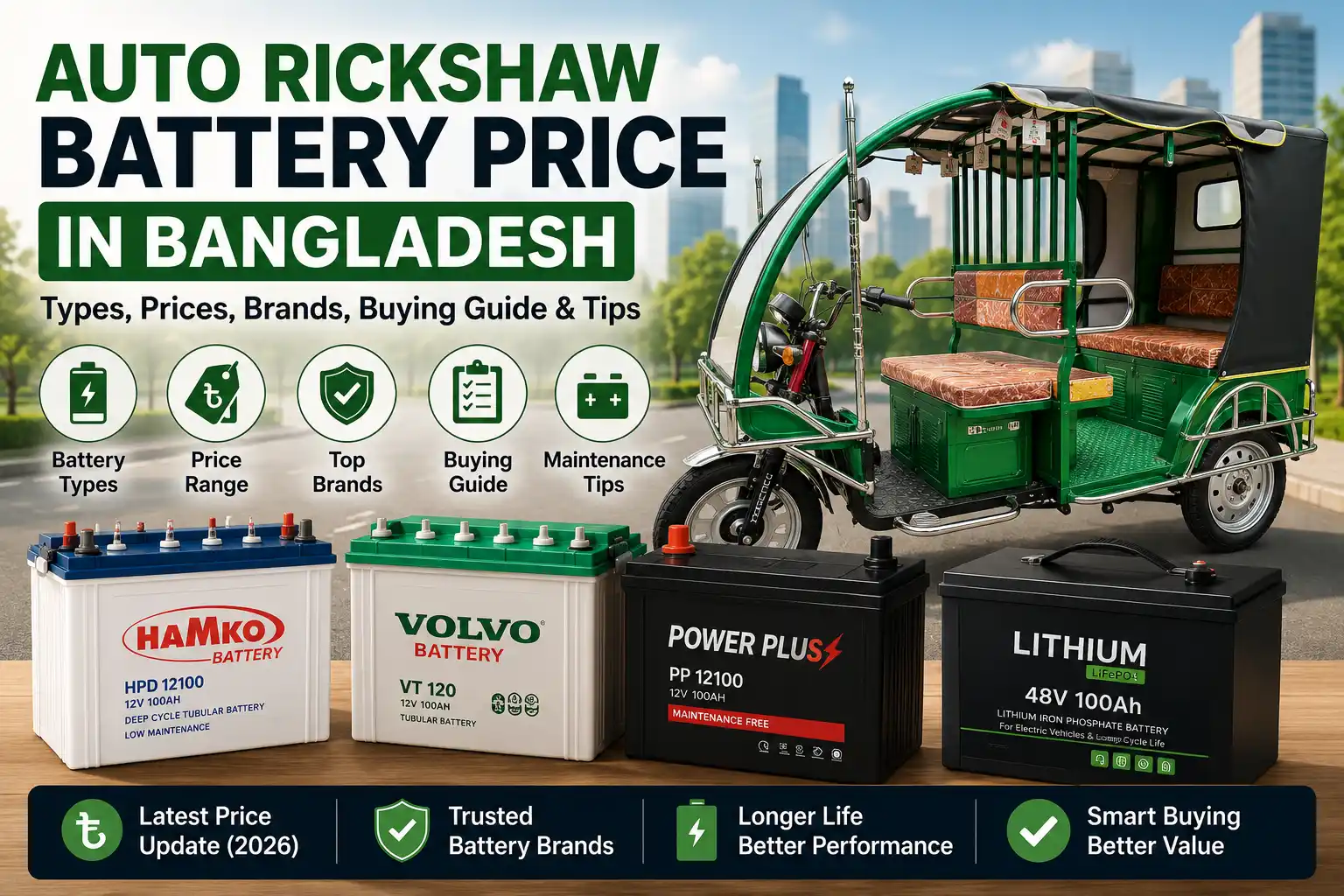
Most battery-powered auto rickshaws in Bangladesh use multiple 12-volt batteries wired together to form common 36V or 48V systems, often in sets of four or more depending on the vehicle design. Within that broad lead-acid category, there are a few common variations, along with a newer lithium-ion option that’s slowly gaining ground.
Lead-acid (flooded) batteries are the traditional, most widely used option. They’re relatively inexpensive and can be repaired or refilled with distilled water when acid levels drop, but they need regular maintenance and can be damaged by deep discharging or neglect. Typical lifespan is often in the range of one to two years under regular daily use, though this depends heavily on charging habits and usage patterns.
Tubular batteries are a type of lead-acid battery built with tubular positive plates rather than flat plates. According to manufacturers, this design generally holds up better under repeated deep discharge and recharge cycles — which is exactly the kind of heavy daily use an auto rickshaw battery goes through. Tubular batteries tend to cost more than basic flooded batteries but are often marketed as lasting somewhat longer under similar conditions.
Maintenance-free (sealed) batteries are designed so the user doesn’t need to check or top up acid or water levels. They can be more convenient for drivers who don’t want to handle regular upkeep, though they are generally less tolerant of overcharging and may be less repairable than a traditional flooded battery once they start to degrade.
Lithium-ion batteries are a newer option increasingly discussed for electric auto rickshaws and easy bikes in Bangladesh. Compared to lead-acid options, lithium packs are typically lighter, can offer a meaningfully longer usable lifespan, and often charge faster. However, they generally come with a substantially higher upfront cost, and the local supply, service, and repair ecosystem for lithium packs is still less developed than it is for lead-acid batteries. Buyers considering lithium should factor in this higher initial investment against the potential for lower long-term replacement costs, and should confirm servicing and warranty support is genuinely available in their area before committing.
Auto Rickshaw Battery Price in Bangladesh
The table below gives general, indicative price ranges based on common battery types and capacities available in the Bangladeshi market. These are not fixed, guaranteed prices — actual prices depend on the specific brand, model, dealer, and current market conditions at the time of purchase.
|
Battery Type |
Voltage |
Typical Capacity (Ah) |
Typical Price Range (BDT, per unit) |
Typical Warranty |
|---|---|---|---|---|
|
Flooded lead-acid |
12V |
100–130 Ah |
Roughly ৳8,000–13,000 |
Around 3–6 months |
|
Tubular lead-acid |
12V |
130–200 Ah |
Roughly ৳12,000–20,000 |
Around 6–12 months, sometimes up to 2 years |
|
Maintenance-free (sealed) |
12V |
100–150 Ah |
Roughly ৳9,000–16,000 |
Around 6–12 months |
|
Lithium-ion pack (EV/easy bike) |
Varies (often 36V–48V system) |
Varies by pack design |
Significantly higher upfront cost than lead-acid; local retail pricing varies widely depending on voltage, capacity, battery chemistry, and supplier |
Varies by manufacturer, often 6 months to 1 year |
Note that auto rickshaws typically require multiple batteries wired together (commonly three or four 12V units), so the total replacement cost for a full battery set is generally several times the per-unit price shown above. Prices can also shift with import costs, raw material (lead) prices, seasonal demand, and promotional offers from dealers, so treat these figures as a general starting point rather than a quote.
Popular Auto Rickshaw Battery Brands in Bangladesh
The brands below are established Bangladeshi battery manufacturers with product lines that are genuinely relevant to auto rickshaws, easy bikes, or similar electric three-wheelers. This is not a ranking, and it does not cover every brand available in the market.
Rahimafrooz
Rahimafrooz is a long-established Bangladeshi business group, and its battery business is among the country’s best-known lead-acid battery manufacturers. Rahimafrooz Batteries Ltd. operates a large lead-acid battery manufacturing facility and produces batteries across several categories, including passenger car, commercial vehicle, IPS/UPS, solar, and industrial batteries. The company also markets a dedicated electric vehicle and e-rickshaw battery line, which it describes as using a tubular positive plate design intended to perform well under the repeated deep-discharge cycles typical of rickshaw use. As with any manufacturer, warranty terms and specific model availability should be confirmed with an authorized dealer, since these can vary by product line and location.
Battery types offered: Lead-acid, including tubular EV/e-rickshaw batteries May suit: Buyers looking for a long-established Bangladeshi manufacturer with a dedicated e-rickshaw battery line
Hamko
Hamko is one of Bangladesh’s larger and more widely available battery brands, offering batteries for a broad range of uses including IPS/UPS systems, solar setups, motorcycles, cars, trucks, and generators. Hamko batteries are sold in several lead-acid product lines, and some retailers describe certain models as maintenance-free. Buyers should confirm the maintenance requirements for the specific battery model before purchase. Hamko is commonly cited by retailers and dealers as a widely available option in the general lead-acid battery market that auto rickshaw owners and workshops draw on, alongside its more clearly documented product lines for vehicles, IPS systems, and solar applications. Buyers specifically seeking an auto rickshaw or easy bike battery should confirm with a Hamko dealer which current models are suited to that use. For a closer look at Hamko’s pricing across its different battery lines, see our Hamko Battery Price in Bangladesh guide.
Battery types offered: Lead-acid batteries across several general vehicle and backup-power categories May suit: Buyers prioritizing wide local availability and dealer support
Rimso
Rimso Batteries Co. is a Bangladeshi manufacturer known for tubular lead-acid batteries, including models marketed specifically for IPS/UPS use as well as dedicated “easy bike” and electric vehicle battery models. Rimso’s easy bike-oriented batteries are typically sold in capacities in the range of roughly 125Ah to 225Ah, and the company states its standard tubular batteries carry a manufacturer’s replacement guarantee against manufacturing faults, with terms that vary by product line. As a brand more specifically associated with rickshaw and easy bike battery models compared to some larger general battery manufacturers, Rimso is a name that shows up often among dealers serving this segment specifically.
Battery types offered: Tubular lead-acid batteries, including dedicated easy bike/EV models May suit: Buyers specifically looking for a battery model marketed for easy bike or auto rickshaw use
Navana Battery
Navana Batteries Limited, a concern of Navana Group, has been operating since 2002. Navana Group is a diversified Bangladeshi business group with a long history in the automobile and industrial sectors. Navana Batteries manufactures a range of battery types, including passenger car, commercial vehicle, motorcycle, industrial, marine, solar, and IPS/inverter batteries. According to the company, its product range also includes dedicated electric tricycle/rickshaw batteries and electric vehicle (EV) or easy bike batteries, alongside tall tubular and maintenance-free options. As with other manufacturers, buyers should confirm current models, capacities, and warranty terms with an authorized Navana dealer.
Battery types offered: Lead-acid batteries, including dedicated electric tricycle/rickshaw and EV/easy bike lines May suit: Buyers wanting a manufacturer with an explicitly stated rickshaw and easy bike battery product line
Factors That Affect Auto Rickshaw Battery Prices
Several factors influence what you’ll actually pay for a battery:
- Battery capacity (Ah rating): Higher amp-hour ratings generally cost more, since they use more raw material and are designed to deliver power for longer between charges.
- Technology: Basic flooded lead-acid batteries tend to be the least expensive option, tubular designs typically cost more, and lithium-ion packs carry a significantly higher price than either.
- Warranty: Longer or more comprehensive warranty coverage is often reflected in a higher purchase price.
- Manufacturing quality: Build quality, plate design, and the grade of raw materials used can all affect both price and expected lifespan.
- Raw material costs: Lead is the primary raw material in lead-acid batteries, and its price on international markets directly affects manufacturing costs.
- Dealer pricing: Retail markups vary by dealer and location, so the same battery model can be priced differently from shop to shop.
- Imported vs. locally manufactured: Imported batteries or those relying heavily on imported components may carry additional costs tied to import duties and currency exchange rates.
- Seasonal demand: Demand for batteries can rise during certain periods (for example, before major holidays when transport demand increases), which can affect pricing and availability.
How to Choose the Right Auto Rickshaw Battery
Check Voltage Requirements
Confirm the voltage system your specific auto rickshaw or easy bike uses (commonly a combination of 12V batteries wired to reach 36V or 48V) before buying, since using the wrong configuration can damage your vehicle’s electrical system.
Select the Correct Capacity
Choose an amp-hour (Ah) capacity suited to your typical daily distance and load. A higher-capacity battery can extend range between charges but adds weight and cost, so match capacity to your actual usage pattern rather than simply choosing the highest number available.
Compare Warranty
Look closely at what’s actually covered under the warranty — some cover only manufacturing defects, while others may include broader replacement terms. A longer warranty period is generally a meaningful sign of manufacturer confidence, but read the specific terms rather than assuming all warranties are equivalent.
Buy from an Authorized Dealer
Purchasing from an authorized dealer or directly from the manufacturer reduces the risk of receiving a counterfeit, mislabeled, or old-stock battery, and it generally makes warranty claims easier to process if something goes wrong.
Check Manufacturing Date
Batteries degrade even in storage, so check the manufacturing date (often stamped or printed on the battery) before buying, and avoid batteries that have been sitting unsold for an extended period.
Avoid Counterfeit Batteries
Counterfeit or mislabeled batteries are a real risk in any market with strong demand for affordable parts. Buy from dealers you can verify as authorized, and be cautious of prices that seem unusually low compared to the general market range for a given specification.
Compare Total Value Rather Than Lowest Price
The cheapest battery on offer isn’t necessarily the best value once you account for expected lifespan, warranty coverage, and how well it holds up under your actual daily usage. Comparing total expected cost over the battery’s life, not just the sticker price, generally leads to a better long-term decision.
How to Extend Battery Life
A few consistent habits can meaningfully extend how long an auto rickshaw battery lasts:
- Follow good charging habits: Charge fully but avoid leaving batteries on charge far beyond the recommended time, and try to charge at consistent, moderate intervals rather than irregularly.
- Avoid deep discharge: Running a battery down to very low charge repeatedly tends to shorten its usable life; try to recharge before it’s fully depleted whenever practical.
- Clean terminals regularly: Corrosion or dirt buildup on battery terminals can reduce charging efficiency and cause connection problems; clean and check terminals periodically.
- Monitor water levels (for flooded batteries): For batteries that require it, check acid/water levels regularly and top up with distilled water as needed — never tap water, which can introduce impurities.
- Inspect batteries regularly: Periodically check for swelling, leakage, unusual heat, or reduced performance, and address issues early rather than waiting for a full failure.
- Store properly when not in use: If a vehicle will be idle for an extended period, store the battery in a cool, dry place and maintain periodic charging to prevent it from fully discharging.
Signs Your Auto Rickshaw Battery May Need Replacement
Watch for these practical warning signs:
- Noticeably shorter driving range or run-time between charges compared to when the battery was new
- Slower acceleration or reduced power, especially when carrying a full load or going uphill
- Longer charging times than usual, or the battery reaching full charge unusually quickly without holding it
- Visible swelling, bulging, leakage, or corrosion around the battery casing or terminals
- Unusual heat during charging or use
- Frequent need to recharge during a single day’s operation
- Visible cracks or damage to the battery casing
If you notice several of these signs together, it’s generally a good idea to have the battery tested by a qualified technician or dealer rather than waiting for a complete failure.
Auto Rickshaw Battery Buying Checklist
- Confirm the voltage and wiring configuration your vehicle requires
- Choose an amp-hour capacity matched to your typical daily usage
- Compare price across at least two or three dealers for the same specification
- Check the warranty terms in writing, not just what’s advertised verbally
- Verify the manufacturing date before purchase
- Buy from an authorized dealer or the manufacturer directly
- Ask whether the battery is genuinely new stock, not old inventory
- Confirm what maintenance (if any) the battery requires
- Keep your receipt and any warranty documentation
- Ask about after-sales service and where you can get support if something goes wrong
Frequently Asked Questions
What is the average auto rickshaw battery price in Bangladesh?
There is no single fixed nationwide price. Prices vary by battery type, capacity, brand, and dealer, generally ranging from around ৳8,000 to ৳20,000 or more per 12V unit, with auto rickshaws typically requiring multiple units wired together.
Which battery brand is popular?
Several established Bangladeshi brands are commonly associated with auto rickshaw and easy bike batteries, including Rahimafrooz, Hamko, Rimso, and Navana. This is not a ranking, and the right choice depends on your specific needs and local dealer availability.
How long does an auto rickshaw battery last?
Typical lead-acid batteries used in easy bikes often last around one to two years under regular daily use, though this varies significantly based on charging habits, load, and maintenance. Lithium-ion options are generally marketed as offering a longer usable lifespan, though local, real-world data is still more limited than for lead-acid batteries.
Which battery capacity should I choose?
Capacity should be matched to your typical daily distance and load rather than simply choosing the highest available Ah rating. A local dealer or technician familiar with your specific vehicle model can help recommend an appropriate capacity.
Are lithium batteries worth buying?
Lithium-ion batteries generally cost significantly more upfront than lead-acid options but can offer a longer usable lifespan and lighter weight. Whether this trade-off makes sense depends on your budget, expected usage, and whether reliable servicing is available in your area.
How often should batteries be replaced?
Replacement frequency depends on battery type, usage intensity, and maintenance quality. As a general estimate, many lead-acid batteries used in easy bikes are replaced roughly every one to two years, but this is not a guaranteed lifespan — actual replacement timing varies by battery and usage. Watch for the performance warning signs described earlier in this guide rather than relying on a fixed timeline alone.
Can I use a car battery?
Car batteries are generally designed for short bursts of high current (to start an engine) rather than the sustained deep-discharge cycles an auto rickshaw motor requires, so they are not typically recommended as a substitute for a purpose-built rickshaw or EV battery. Consult a qualified technician before considering this.
Where can I buy genuine batteries?
Genuine batteries are best purchased from authorized dealers, manufacturer showrooms, or established battery markets and retailers, rather than from unverified sellers offering unusually low prices.
Final Thoughts
There’s no single “right” battery or brand for every auto rickshaw owner in Bangladesh. The best choice depends on your vehicle’s voltage requirements, your typical daily distance and load, your budget, how much maintenance you’re willing to do, and the warranty and after-sales support available from a given dealer in your area. Lead-acid and tubular batteries remain the dominant, most affordable option for most drivers today, while lithium-ion technology is a developing alternative worth watching as it becomes more established locally. Whatever you choose, buying from an authorized dealer and comparing total value — not just sticker price — will generally serve you better in the long run.
Useful Resources
- Bangladesh Road Transport Authority (BRTA) — the national authority overseeing motor vehicle registration in Bangladesh; registration requirements and enforcement for battery-powered auto rickshaws and easy bikes vary by area and are still evolving
- Bangladesh Standards and Testing Institution (BSTI) — for general product quality and standards information
- Local battery markets and authorized dealer networks — for comparing current prices and warranty terms directly
Editorial Note
This article is an editorial informational guide prepared by Info Ghor. It is not an official price list or an endorsement of any specific battery brand. Information was prepared using publicly available and verifiable sources, including official company information and general market observations, at the time of writing. Battery prices, specifications, and brand availability can change. Readers should verify current prices and product details directly with a dealer or manufacturer before making a purchase.
Last Updated
This guide is periodically reviewed to reflect changes in battery prices, brand availability, technology, and market conditions in Bangladesh.