
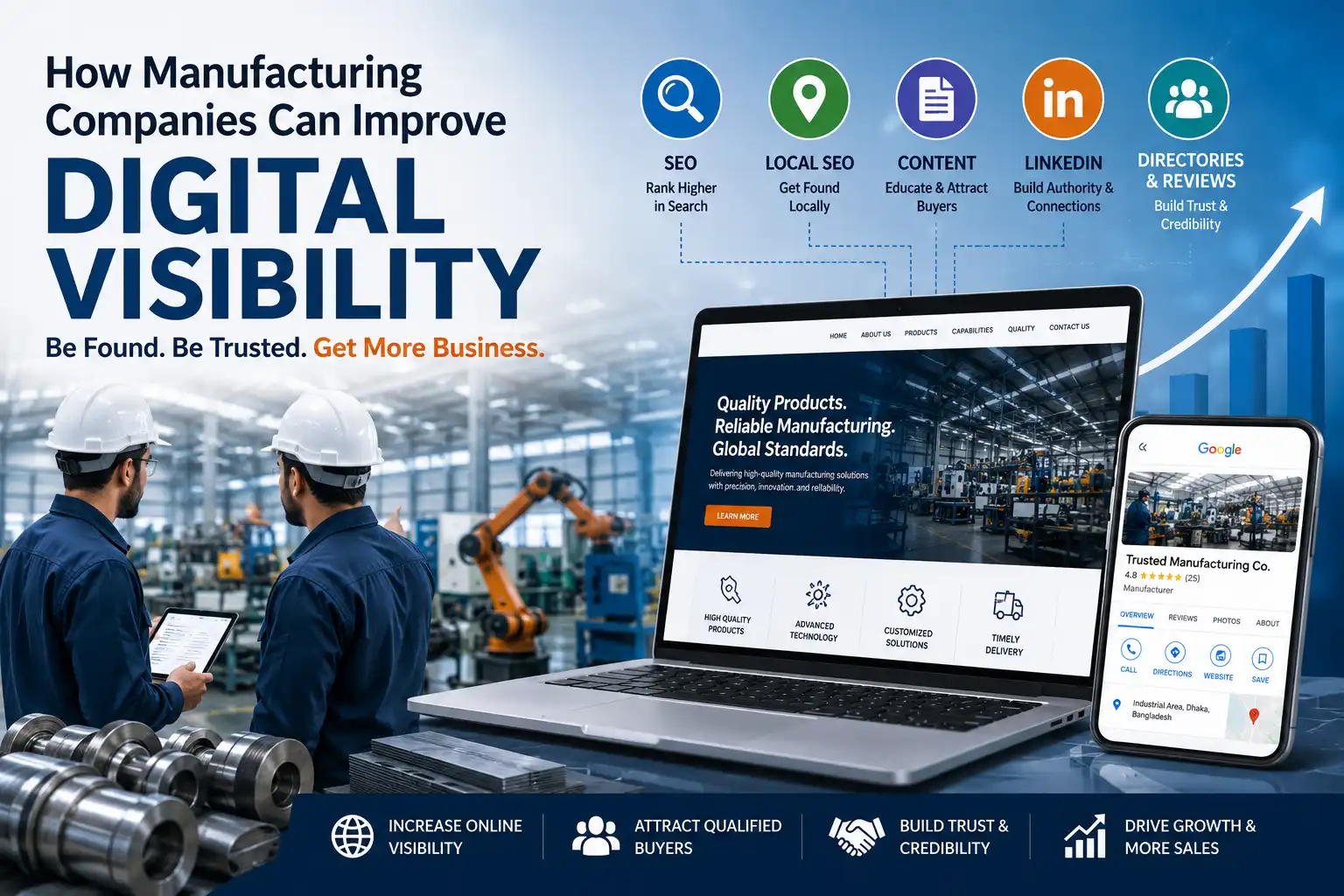
How Manufacturing Companies Can Improve Digital Visibility
Manufacturing companies build real things — garments, steel, furniture, food products, machinery. Yet many excellent manufacturers remain nearly invisible in the place where modern buyers actually look for suppliers: online. A procurement manager searching for a packaging supplier, an international buyer researching factories, a distributor comparing brands — all of them start with a search engine, and increasingly with AI-powered search tools. If your company does not appear, credible, and findable in those moments, the order quietly goes to a competitor who does.
This guide explains how manufacturing companies can improve digital visibility using practical, widely accepted strategies — from website fundamentals and SEO to content, directories, and the newer disciplines of AI search optimisation. It is written for factory owners, exporters, industrial marketers, and decision-makers who want a clear roadmap rather than jargon. No tools or agencies are recommended or ranked here; the focus is on principles any manufacturer can apply.
What Is Digital Visibility?
Digital visibility is how easily your company can be found, recognised, and trusted online by the people looking for what you make. It is broader than having a website. A digitally visible manufacturer:
- Appears in search results when buyers search for its products, industry, or location
- Shows up with accurate information — name, location, contact details, product range — everywhere it is listed
- Looks credible on arrival, with a professional website, real photos, and evidence of capability
- Is referenced by others, through directories, industry coverage, customer reviews, and links
- Surfaces in newer channels, including AI-generated answers, map results, and social platforms where buyers research
Think of digital visibility as your factory’s signage, reputation, and salesforce combined — operating around the clock, in every market your buyers search from.
Why Digital Visibility Is Important for Manufacturing Businesses
Online credibility. B2B buyers verify before they call. A manufacturer with a professional web presence, consistent information, and visible track record passes that silent inspection; one with a dead website or no presence at all raises doubts regardless of factory quality.
Lead generation. Search-driven enquiries are among the most valuable leads a manufacturer can receive, because the buyer arrives with intent — they were already looking for your product when they found you.
B2B buyer research. Industrial purchasing decisions typically involve extensive online research and comparison before any supplier is contacted. Your digital presence participates in — or is absent from — every one of those evaluations.
Export opportunities. For exporters, digital visibility is the storefront international buyers see first. Foreign buyers who cannot visit your factory this week can visit your website, your listings, and your LinkedIn page today.
Competitive advantage. In many manufacturing niches, digital marketing maturity is still low — which means the companies that invest early capture disproportionate attention while competitors remain invisible.
Brand awareness. Consistent visibility across search, directories, and social platforms builds recognition over time, so that when a buyer finally needs your product category, your name is already familiar.
Trust building. Reviews, case studies, certifications displayed online, and years of consistent presence accumulate into something no advertisement can buy: a verifiable public track record.
Common Challenges Manufacturing Companies Face Online
Most manufacturers share a familiar set of digital weaknesses:
- Limited online presence — no website at all, or only a Facebook page created years ago
- Outdated websites — old designs, broken pages, product ranges that no longer match reality
- Poor SEO fundamentals — pages that search engines cannot properly read, index, or rank
- Low search rankings — invisible for the exact terms buyers use to find their products
- Lack of content — a five-page brochure site with nothing that answers buyer questions
- Weak social media presence — inactive accounts that signal neglect rather than build confidence
- Few customer reviews — no public evidence of satisfied clients
- Inconsistent business information — different names, addresses, or phone numbers across the web, which confuses both buyers and search engines
The encouraging news: every one of these is fixable with ordinary effort, and the strategies below address them in order of foundation to refinement.
Practical Strategies to Improve Digital Visibility
Build a Professional Website First
Your website is the foundation everything else points to. For a manufacturer, it should clearly present who you are, what you make, your production capability, certifications, and how to contact you — with real photographs of your facility and products rather than stock images. Keep it current: an outdated site actively damages credibility.
Get Technical SEO Right
Technical SEO ensures search engines can find, read, and rank your pages. The widely accepted fundamentals include: fast loading pages, mobile-friendly design, secure HTTPS, clean page structure with descriptive titles and headings, and no broken links. These are one-time and periodic engineering tasks that quietly determine whether everything else works.
Invest in Local SEO
Buyers often search with location intent — a product plus a city or country. Local SEO means optimising for those searches: including your locations naturally in your website content, maintaining consistent name-address-phone details everywhere, and building presence in local listings. For manufacturers serving domestic industrial buyers, local visibility often delivers the most immediate results.
Claim and Maintain Your Google Business Profile
A Google Business Profile puts your company on Google Search and Maps with your address, hours, photos, and reviews. For manufacturers it is free, quick to set up, and frequently the first thing a buyer sees. Keep it accurate, add real photos, and respond to reviews. Remember, though, that a business profile or directory listing is not proof of legal registration — serious buyers will still verify, so make verification easy by keeping all public information consistent.
Publish Content That Answers Buyer Questions
Content marketing for manufacturers is not lifestyle blogging — it is answering the questions your buyers actually search: material comparisons, specification guides, production process explanations, compliance topics, and how-to-choose guides in your category. Each well-answered question is a doorway through which search engines and AI tools can send you exactly the right visitor.
Create Industry-Specific Landing Pages
If you serve multiple industries — say, packaging for food companies and for pharmaceuticals — create a dedicated page for each. Industry-specific pages rank for industry-specific searches and speak the buyer’s language, converting far better than one generic capabilities page.
Showcase Case Studies
Case studies are manufacturing’s most persuasive content: a real problem, your solution, and the result, with the customer’s permission. They simultaneously build trust with human buyers and provide the experience-based content that modern search quality standards reward.
Build Proper Product Pages
Every significant product or product line deserves its own page with specifications, applications, quality standards, and photos. Thin product listings — a name and one image — are invisible to search and unconvincing to buyers.
Maintain a Manufacturing Blog
A modest but consistent blog — industry updates, technical explainers, factory milestones — keeps your site fresh, expands the searches you can appear for, and demonstrates that the company is active and knowledgeable.
Use Video Where It Shines
Nothing communicates manufacturing capability like footage of production. Facility tours, process videos, and product demonstrations work across your website, YouTube, and LinkedIn — and video builds a kind of confidence text cannot, especially with distant international buyers.
Take LinkedIn Seriously
For B2B manufacturing, LinkedIn is typically the most relevant social platform: buyers, importers, and industry professionals are there in a business mindset. Maintain an updated company page, share real updates — new machinery, certifications, shipments, milestones — and have leadership participate visibly.
Use Email Marketing for Relationships
A simple newsletter to customers and prospects — product updates, capacity announcements, useful content — keeps your company present between orders. Email is owned communication: no algorithm decides whether your message is seen.
List in Online Business Directories
Reputable business directories help buyers discover you and help search engines confirm you exist, with consistent details reinforcing your legitimacy. List your company in relevant general and industry directories, keep every listing accurate and identical, and treat directories as part of your discoverability infrastructure — while remembering buyers will still verify credentials directly.
Pursue Digital PR
Coverage in industry publications, trade portals, and business media earns both visibility and authoritative links to your website. Newsworthy angles manufacturers often overlook: export achievements, sustainability initiatives, technology adoption, and community impact.
Collect and Display Customer Reviews
Ask satisfied customers for reviews on your Google Business Profile and relevant platforms, and display testimonials with permission on your site. Reviews influence both buyer decisions and local search visibility — and responding professionally to all feedback, positive or negative, is itself a public trust signal.
Implement Structured Data (Schema Markup)
Schema markup is code that helps search engines understand your pages explicitly — identifying your organisation, products, FAQs, and locations in a machine-readable way. It is a widely accepted technical practice that supports richer search results and clearer machine understanding of who you are, which grows more valuable as AI systems increasingly consume structured information.
Keep Performance and Mobile Experience Sharp
Slow, clunky sites lose visitors and rank poorly. Compress images, use decent hosting, and test your site on an ordinary smartphone regularly — a large share of your visitors, including international buyers, will arrive on mobile.
Optimise for AI Search, GEO, and AEO
Search behaviour is shifting toward AI-generated answers — in chat assistants, answer engines, and AI-augmented search results. Generative Engine Optimization (GEO) and Answer Engine Optimization (AEO) are emerging concepts in the SEO industry that focus on making your content easier for AI-driven and answer-based search systems to understand, trust, and potentially reference. The widely accepted principles overlap heavily with good content practice:
- Answer specific questions directly and factually, close to the top of the page
- Use clear headings that match how people ask questions
- Keep facts about your company consistent and unambiguous across the entire web
- Use structured data so machines understand your entities — company, products, locations
- Build genuine authority signals: accurate directory presence, coverage, reviews, and expert content
AI systems draw on both structured and unstructured web data when generating answers, which means every consistency and clarity improvement you make serves human readers, search engines, and AI tools simultaneously.
Digital Marketing Channels Manufacturing Companies Should Prioritize
|
Channel |
Primary role |
Cost pattern |
Time to results |
Priority for most manufacturers |
|---|---|---|---|---|
|
Website + SEO |
Foundation; captures buyer search intent |
Investment upfront, low ongoing |
Months, compounding |
Essential — first |
|
Google Business Profile |
Local discovery and credibility |
Free |
Weeks |
Essential — immediate |
|
Business directories |
Discoverability and consistency signals |
Free to low |
Weeks to months |
High — early |
|
|
B2B relationships and brand presence |
Time cost mainly |
Months |
High for B2B/exporters |
|
Content marketing |
Answers buyer questions; feeds SEO and AI visibility |
Time and modest cost |
Months, compounding |
High — ongoing |
|
Video / YouTube |
Capability demonstration and trust |
Moderate |
Months |
Medium-high |
|
Email marketing |
Retention and repeat business |
Low |
Immediate to months |
Medium |
|
Paid ads (PPC) |
Fast targeted traffic for specific goals |
Ongoing spend |
Days |
Optional — tactical |
SEO vs PPC vs Social Media at a Glance
|
Factor |
SEO |
PPC (paid ads) |
Social media |
|---|---|---|---|
|
Cost model |
Effort now, free traffic later |
Pay per click, stops when budget stops |
Mostly time, optional ad spend |
|
Speed |
Slow build, durable results |
Immediate |
Gradual |
|
Trust effect |
High — earned visibility |
Lower — marked as ads |
Medium — depends on content quality |
|
Fit for manufacturers |
Core long-term channel |
Launches, campaigns, testing demand |
Relationship and brand building |
The honest guidance: build the durable owned assets first — website, SEO, profiles, directories, content — and treat paid channels as accelerators for specific goals, not substitutes for foundations.
Measuring Digital Visibility Success
What gets measured improves. Track a small set of meaningful indicators:
- Organic traffic — visitors arriving from unpaid search, the core visibility signal, viewable in standard analytics tools
- Keyword rankings — where you appear for the product and industry terms buyers actually use
- Leads and enquiries — form submissions, calls, emails, and quote requests attributable to digital channels; ask every new enquiry how they found you
- Conversion rate — the share of visitors who take a meaningful action, revealing whether the site persuades as well as attracts
- Google Business Profile insights — views, searches, calls, and direction requests from your profile
- Backlinks — the number and quality of external sites linking to yours, a long-standing authority signal
- Brand searches — people searching your company by name, the clearest sign your visibility work is creating recognition
Review monthly, judge trends over quarters, and resist vanity metrics: a hundred visitors who are genuine industrial buyers beat ten thousand random ones.
Common Mistakes to Avoid
- Building a website and abandoning it. Digital visibility is gardening, not construction — untended sites decay in both rankings and credibility.
- Chasing every channel at once. Thin presence everywhere loses to strong presence in the three or four channels your buyers actually use.
- Publishing content for search engines instead of buyers. Keyword-stuffed pages fail with modern search systems and with humans alike; genuinely helpful content wins with both.
- Inconsistent business information. Mismatched names, addresses, and numbers across the web quietly erode both machine trust and human confidence.
- Ignoring reviews. Unanswered negative reviews — or no reviews at all — shape buyer perception whether you participate or not.
- Expecting overnight results. Organic visibility compounds over months and years; abandoning the effort at month two forfeits the payoff.
- Treating digital as the marketing department’s hobby. Visibility reflects the whole company — production capability, certifications, customer results — and needs leadership attention like any business asset.
Future Trends
AI search. More buyer questions are being answered directly by AI assistants and AI-augmented search results. Manufacturers whose information is clear, structured, consistent, and genuinely authoritative are the ones these systems can confidently reference.
Voice search. Voice queries tend to be conversational questions — another reason content structured as direct questions and answers keeps gaining value.
Zero-click search. Search platforms increasingly answer queries on the results page itself. Visibility strategy adapts by aiming to be the cited answer and by strengthening brand recognition, so buyers seek you out by name.
Entity SEO. Search systems increasingly understand the web as entities — companies, products, places — and their relationships. Consistent naming, structured data, and authoritative mentions help establish your company as a clearly defined entity machines can trust.
E-E-A-T. Google’s emphasis on Experience, Expertise, Authoritativeness, and Trustworthiness rewards exactly what manufacturers can genuinely demonstrate: real facilities, real expertise, real customers, real track records. Showing your evidence is now an SEO strategy, not just good salesmanship.
First-party data. As privacy changes limit third-party tracking, the customer relationships you own — email lists, enquiry records, direct audiences — become steadily more valuable. Build them deliberately.
The throughline of every trend: authenticity, clarity, and consistency are becoming the ranking factors that matter most — which favours real manufacturers with real capabilities over anyone gaming the system.
Frequently Asked Questions
Where should a manufacturing company with no online presence start?
Start with three foundations in order: a professional website with accurate company and product information, a Google Business Profile, and listings in reputable business directories with identical details everywhere. These establish findability and credibility before any advanced tactics.
How long does it take to see results from SEO?
Organic visibility typically builds over months rather than weeks, with results compounding as content, authority, and consistency accumulate. Some elements — like a Google Business Profile — produce visibility faster, which is why foundations and quick wins are pursued together.
Do B2B manufacturers really need social media?
Selectively, yes. LinkedIn is generally the most relevant platform for B2B manufacturers, supporting buyer relationships and brand credibility. One well-maintained platform serves better than five neglected ones — choose where your actual buyers spend professional time.
What content works best for manufacturing companies?
Content that answers real buyer questions: product specification guides, material and process explainers, industry-specific pages, case studies with results, and facility videos. Helpfulness to a genuine buyer is the test every piece should pass.
What is Generative Engine Optimization (GEO) in simple terms?
GEO means making your content and company information easy for AI systems to understand, trust, and cite when generating answers. In practice it overlaps with good fundamentals: direct answers to specific questions, clear structure, consistent facts across the web, and structured data.
How do online directories help a manufacturer’s visibility?
Reputable directories make your company discoverable to buyers searching by category or location, and consistent listings reinforce your legitimacy to search engines and AI systems. They complement — never replace — your own website, and buyers should always be able to verify your credentials directly.
How much should a manufacturer budget for digital visibility?
There is no universal figure, and this guide avoids inventing one. The foundational layer — website upkeep, profiles, directories, and consistent content — is modest in cost and largely a matter of sustained effort; paid advertising is optional and tactical. Scale investment as measured results justify it.
Final Thoughts
Digital visibility is not a marketing trick — it is the modern extension of what good manufacturers have always done: make quality visible, be easy to find, and give buyers reasons to trust you. The companies winning online are rarely the ones with the biggest budgets; they are the ones that built solid foundations, told the truth about their capabilities clearly and consistently, and kept at it while competitors waited for a shortcut. Start with the website, the profile, and the listings; add content that answers real questions; measure what matters; and let the compounding begin. In an era when buyers, search engines, and AI systems all reward the same thing — clear, consistent, credible information — the manufacturer who provides it holds the advantage.
Readers who want to learn more about manufacturing businesses, industrial suppliers, exporters, and related companies in Bangladesh can explore additional educational resources and relevant business listings available on Info Ghor. These resources are intended to support supplier research, industry discovery, and informed business decision-making.