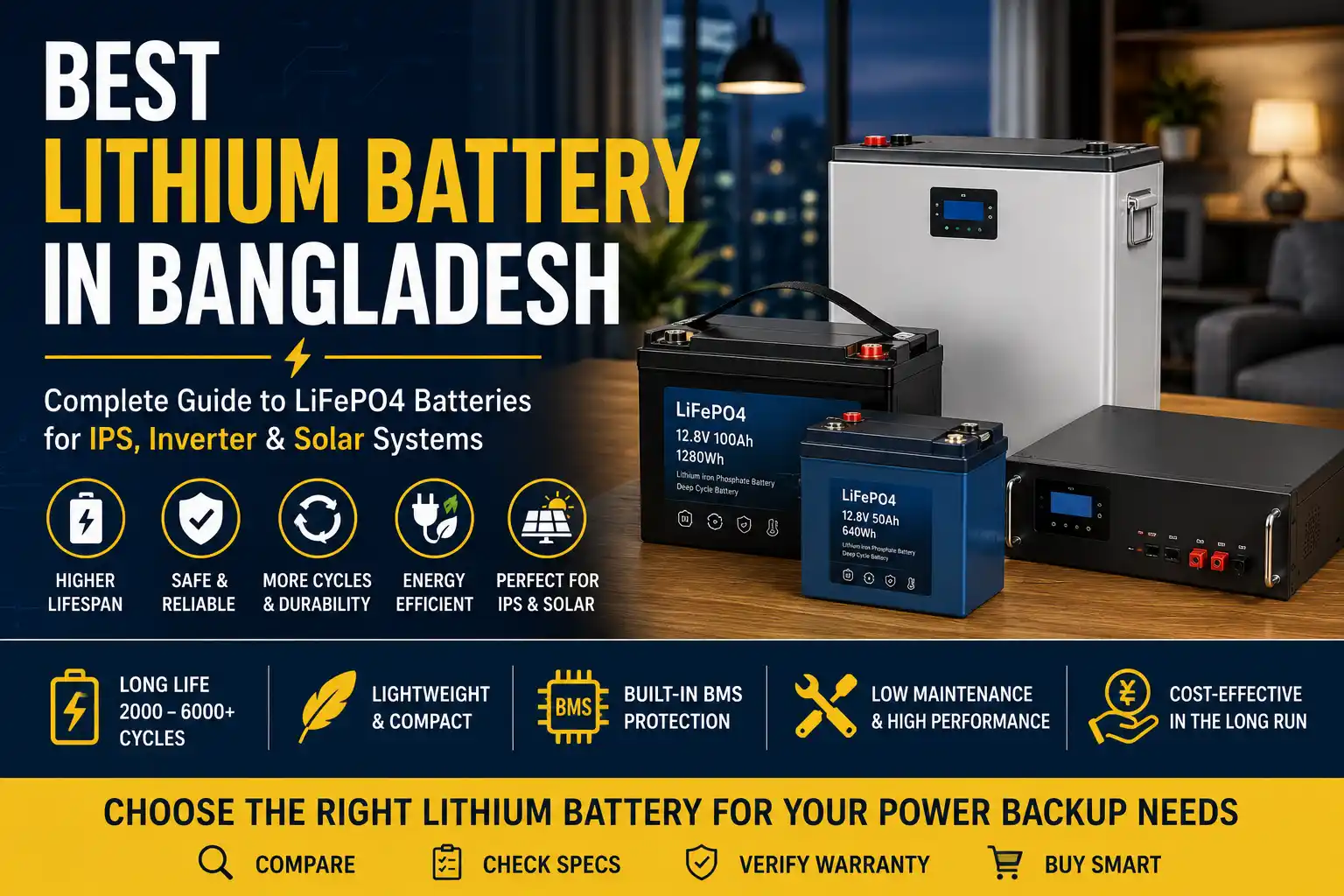
Best Lithium Battery in Bangladesh 2026
Power outages remain a regular part of daily life in many parts of Bangladesh, and that has kept demand for backup power steady for decades. For years, lead-acid batteries were the default choice for IPS (Instant Power Supply) and inverter systems in Bangladeshi homes and shops. That is changing.
Lithium batteries, and specifically Lithium Iron Phosphate (LiFePO4) batteries, have become widely available across Dhaka’s Nawabpur market, online electronics retailers, and dedicated solar shops in recent years. Buyers now search for the “best lithium battery in Bangladesh,” but the honest answer is that no single product fits every household or business.
LiFePO4 is widely used for stationary backup and solar-storage applications because of characteristics such as cycle-life potential and relatively high thermal stability. It is generally more thermally stable than common NMC/NCA lithium chemistries, but prolonged exposure to high temperatures can still shorten battery life; correct installation, ventilation, charging limits, and temperature management remain important. LiFePO4 is not the same thing as generic “lithium-ion,” and the two terms should not be used interchangeably.
This guide looks at established lithium battery brands genuinely available in Bangladesh, based on official manufacturer pages, retailer listings, and other publicly available sources. It also explains capacity, voltage, cycle life, BMS, IPS and solar compatibility, and pricing, so readers can compare options against their own backup needs. Specifications, warranty terms, and prices differ from model to model and change over time; this article does not name one “best” product.
Quick Answer: There is no single best lithium battery for every buyer in Bangladesh. Established options with verifiable local availability include Rahimafrooz’s Solar Hybrid IPS range (its official listing describes a built-in lithium-ion battery, which some retailers identify more specifically as LiFePO4), Walton’s “arc” LiFePO4 battery models (WLFP series), HiTHIUM Bangladesh’s HeroEE and MaxPower LiFePO4 systems, and imported LiFePO4 brands such as LVTOPSUN, SAKO, and Genix Green that are listed by multiple Bangladeshi solar and electronics retailers. The right choice depends on required backup capacity, system voltage, inverter compatibility, warranty, and budget rather than brand name alone.
Disclaimer: This is an editorial, informational guide published by Info Ghor. It is not an official ranking, comparison score, or endorsement of any brand or seller. Prices, specifications, warranty terms, distributor status, and stock availability can change at any time and may vary by seller. Whether a specific battery suits a given household or business depends on the application, required backup duration, and compatibility with the existing (or planned) inverter, IPS, or solar charge controller. Readers should verify current specifications, warranty terms, and prices directly with the manufacturer or seller before purchasing.
Well-Known Lithium Batteries Available in Bangladesh
The brands below were selected because their lithium products could be verified through official manufacturer pages, established Bangladeshi retailers, or multiple independent sellers with consistent specifications. This is not an exhaustive list, and inclusion here is not an endorsement.
Rahimafrooz
Rahimafrooz (Bangladesh) Ltd. is one of the country’s oldest battery manufacturers, founded in 1954 and headquartered in Dhaka. It has long been a familiar name in lead-acid IPS and automotive batteries, and it now also offers lithium-based products.
Rahimafrooz’s official RZS-3.75KVA listing describes a built-in lithium-ion battery. Some Bangladesh retailer listings identify the chemistry more specifically as LiFePO4, so buyers should confirm the current battery chemistry from Rahimafrooz’s technical documentation before purchase.
Retailer listings describe the battery as rated for 4,000-plus cycles at 80% depth of discharge, with an integrated BMS, pure sine wave output, MPPT solar charging, and Wi-Fi app monitoring. These figures come from retailer product pages rather than an independently verified manufacturer datasheet.
Rahimafrooz operates official sales and service channels in Bangladesh. Buyers should confirm the exact RZS-3.75KVA warranty period and lithium-model service coverage directly with Rahimafrooz. This may suit buyers who want an integrated solar-plus-battery-plus-inverter package from an established Bangladeshi brand, rather than assembling components separately.
Walton
Walton is a well-known Bangladeshi electronics and appliance conglomerate, with its own manufacturing base at Kaliakair, Gazipur, through Walton Digi-Tech Industries. It has been expanding into solar and lithium battery products alongside its established lead-acid battery lines.
Walton’s ARC Solar Hybrid IPS range includes configurations using the officially listed WLFP12100 (LiFePO4, 12.8V, 100Ah, 1,280Wh) and WLFP24100 (LiFePO4, 25.6V, 100Ah, 2,560Wh) batteries, confirmed on the company’s own product pages and described by Walton as “Smart Battery” units. Not every ARC configuration necessarily uses these specific LiFePO4 models, so buyers should check the exact model number before purchase.
Walton has established manufacturing, retail, and service operations in Bangladesh, but the manufacturing origin of the WLFP battery cells and complete battery packs should be confirmed from model-specific documentation. Walton’s official pages list a 36-month battery warranty for the relevant ARC models, though this should be confirmed for the exact configuration purchased. This may suit buyers who prefer a Walton-branded product supported by local retail and service channels through the countrywide Walton Plaza network.
HiTHIUM Bangladesh
HiTHIUM is a global LiFePO4 cell and energy storage manufacturer established in 2019, according to company information. HiTHIUM Bangladesh operates an active Bangladesh-based sales and service platform offering HiTHIUM-branded products; its exact corporate or distributor relationship with the global manufacturer should be independently confirmed. Its LiFePO4 IPS and power-station products are also listed by established Bangladeshi electronics retailer Star Tech, which supports third-party verification of local availability.
Its HeroEE series combines a LiFePO4 battery with an integrated inverter in a single portable unit. HiTHIUM HeroEE Light 1 is listed with approximately 1,004.8Wh capacity, while HeroEE 1 is separately marketed as a 1kWh-class LiFePO4 power station; buyers should use the exact model name and specification when comparing products, since the two are not the same item. HiTHIUM Bangladesh states that its products use “Grade-A” LiFePO4 cells, a marketing/product-description term rather than an independent certification.
Some of HiTHIUM Bangladesh’s marketing claims, such as an advertised 11,000-cycle figure for the HeroEE 2 under specified test conditions, are manufacturer claims rather than independently verified results and should not be read as a guaranteed real-world lifespan. Cycle life is not the same as calendar life, so a high cycle-count figure does not automatically translate into a fixed number of years.
HiTHIUM Bangladesh advertises warranty and after-sales support, but the exact warranty period, exclusions, service coverage, and delivery terms should be confirmed for the specific model. This may suit buyers wanting a ready-to-use lithium IPS or power station rather than a standalone pack.
LVTOPSUN
LVTOPSUN is a Chinese LiFePO4 battery manufacturer headquartered in Dongguan, according to the company’s own website, with a stated focus on residential, commercial, and telecom energy storage. Its products are sold in Bangladesh through several independent retailers, including Solar BD, Solar House BD, and other Nawabpur-area and online sellers, with broadly consistent model numbers and specifications across listings.
Commonly listed models include 12.8V and 25.6V packs around 100Ah, and higher-voltage 51.2V packs up to roughly 300Ah. Retailer listings show model-specific cycle-life claims that can extend into several thousand cycles. These figures vary by model and test conditions, including depth of discharge, temperature, C-rate, and end-of-life threshold, so buyers should check the exact manufacturer’s datasheet before comparing products.
LVTOPSUN’s official LVTS-512300 page lists a five-year warranty. Warranty terms on Bangladesh retailer listings may differ, so buyers should obtain model-specific written warranty terms rather than assuming a single warranty length applies across the range. This may suit buyers wanting a range of voltage and capacity options from a dedicated LiFePO4 specialist, listed by multiple Bangladesh retailers.
SAKO
SAKO is another LiFePO4 brand with a consistent presence across multiple independent Bangladeshi sellers, including BDStall, Solar BD, and Solar House BD. Its Li-Sun and Li-Max series appear repeatedly with matching voltage and capacity figures, which supports genuine local availability rather than a single seller’s marketing claim.
Listed models include a 25.6V 100Ah (roughly 2.56kWh) pack and larger 51.2V units at 100Ah and 300Ah. Retailer spec sheets describe a smart BMS with overcharge, over-discharge, and short-circuit protection. Published SAKO cycle-life claims vary by model and test conditions, so buyers should compare the stated depth of discharge, temperature, C-rate, and end-of-life capacity for the exact product rather than assuming one figure applies across the range.
SAKO markets both LiFePO4 batteries and off-grid hybrid inverters, but products from the same brand should not automatically be assumed compatible; buyers should confirm voltage, charge/discharge limits, and BMS communication compatibility for the exact battery and inverter models. This may suit buyers assembling a mid-to-large 51.2V lithium bank for a bigger home, shop, or office.
Genix Green
Genix Green is a LiFePO4 brand sold in Bangladesh through several independent retailers, including BDShop, Solar BD, Solar House BD, and IPS Bazar, again with broadly consistent specifications across listings. Its product line centers on 51.2V rack or wall-mountable batteries in several capacities.
Verified models include a 100Ah (roughly 5.12kWh) unit and a 314Ah (roughly 16kWh) unit for larger installations; other capacities mentioned in some listings could not be reliably confirmed as currently available and are not covered here. Some listings reference certifications such as UN38.3 (transport testing for lithium batteries), IEC 62619 (safety requirements for stationary lithium cells and batteries), and UL 1973 (a certification scope covering stationary and certain motive applications).
These are distinct standards, not interchangeable labels, and a certification claim should only be treated as valid for the exact model it names. Genix Green publishes model-specific cycle-life, warranty, and certification information, so buyers should verify the exact datasheet and certificate — including whether it covers the cell, the module, or the complete battery pack — for the model being considered.
Warranty terms vary by listing and should be confirmed directly with the retailer for the specific model. This may suit buyers needing larger single-unit capacity for bigger homes, small commercial premises, or heavier loads such as refrigerators or water pumps.
How to Choose a Lithium Battery in Bangladesh
Choosing a lithium battery starts with understanding what you need it to power, and for how long. A few technical basics make that comparison easier.
Chemistry matters because LiFePO4 and other lithium-ion chemistries behave differently under heat and repeated cycling. For stationary backup in Bangladesh’s climate, LiFePO4 is the chemistry most commonly marketed by local sellers.
Voltage and Ah capacity need to match your inverter or IPS. A 12.8V battery is not interchangeable with a 51.2V system without the right inverter or charge controller.
Wh or kWh capacity tells you how much total energy the battery stores, which is more useful for comparing batteries at different voltages than Ah alone. Usable capacity is also lower than the rated capacity once you account for the manufacturer’s recommended depth of discharge.
BMS quality matters because a Battery Management System may provide protections such as overcharge, over-discharge, overcurrent, short-circuit, and temperature protection, depending on the specific battery’s design — not every BMS includes identical functions. Buyers should pay particular attention to BMS specifications when considering cheaper or lesser-known battery products, since protection features and implementation quality can vary significantly between models.
Cycle life and depth of discharge (DoD) are usually quoted together, such as “6,000 cycles at 80% DoD.” Cycle life is the number of charge/discharge cycles a battery completes under defined test conditions, which is different from calendar life — how a battery ages over time regardless of how often it is cycled. A high cycle-life figure does not automatically guarantee a specific number of years of use, and these figures come from manufacturer testing under specific conditions, so real-world results can vary.
Charging and inverter compatibility should be confirmed before buying, since not every lead-acid inverter or IPS is designed to properly charge a lithium battery. Solar compatibility, warranty terms, and after-sales support are equally important, especially outside Dhaka.
Finally, weigh price against lifecycle value rather than upfront cost alone. Lithium batteries generally have a higher upfront cost, and their long-term value depends on usable energy, cycling frequency, efficiency, degradation, warranty, installation cost, and whether the existing inverter or charging equipment needs to be replaced.
LiFePO4 vs Lead-Acid Battery
Both chemistries remain in active use in Bangladesh, and neither is automatically right for every buyer. The comparison below is general; always check the manufacturer’s spec sheet for a specific product.
|
Factor |
LiFePO4 (Lithium) |
Lead-Acid (Tubular/Flat Plate) |
|---|---|---|
|
Typical weight |
For similar usable energy, often considerably lighter than lead-acid, though the exact difference depends on the model, enclosure, and design |
Heavier for similar rated capacity |
|
Usable capacity |
Higher usable percentage of rated capacity |
Lower usable percentage; deep discharge shortens life |
|
Cycle life |
Many manufacturers publish figures in the thousands, but exact values depend on DoD, temperature, C-rate, BMS settings, and the capacity threshold used to define end of life |
Varies widely by flooded, tubular, AGM, gel, or traction type, and by DoD, charging conditions, and temperature |
|
Charging time |
Generally faster, per manufacturer specifications |
Generally slower |
|
Maintenance |
Sealed, maintenance-free designs are common |
Flooded types need periodic water top-up |
|
Upfront cost |
Higher purchase price |
Lower purchase price |
|
Long-term cost |
Depends on usable energy, cycling frequency, efficiency, degradation, warranty, and installation costs — not guaranteed to be lower |
Lower unit cost, but often needs more frequent full replacement |
|
Safety considerations |
Generally more thermally stable than NMC/NCA lithium chemistries, but not fireproof, explosion-proof, or risk-free; safety depends on cell quality, BMS design, installation, wiring, charging conditions, temperature, and physical protection |
Well-understood risks (acid, gas venting); requires ventilation and careful handling |
|
Typical applications |
Home IPS, solar storage, telecom, portable power stations |
Home IPS, automotive, budget backup systems |
Lead-acid remains reasonable for buyers prioritizing lower upfront cost or replacing an existing system without changing the charging setup. Lithium is often chosen by buyers who cycle daily, want a lighter unit, or are pairing backup with solar. No lithium battery should be treated as automatically safe for indoor use; correct installation, a well-designed BMS, proper wiring, and adequate ventilation remain important regardless of chemistry.
Understanding Lithium Battery Capacity
Battery capacity in Bangladesh is usually advertised in Ah (ampere-hours), but Ah alone cannot fairly compare two batteries at different voltages.
The more useful figure is energy capacity, in Wh (watt-hours) or kWh (kilowatt-hours), which combines voltage and Ah. The basic relationship is:
Wh = Voltage × Ah
For example, a 12.8V, 100Ah LiFePO4 battery stores roughly 1,280Wh (1.28kWh), while a 51.2V, 100Ah battery of the same Ah rating actually stores roughly 5,120Wh (5.12kWh), four times more energy. This is why comparing two batteries by Ah rating alone, without checking voltage, can be misleading.
Usable energy is also typically lower than the rated Wh/kWh figure, since manufacturers recommend keeping some charge in reserve to protect battery life, even though LiFePO4 tolerates deeper discharge than lead-acid.
Lithium Battery for IPS and Inverter
Not every lithium battery is automatically compatible with every existing IPS or inverter. Compatibility depends on the inverter’s charging profile, supported voltage range, and, in some cases, whether it can communicate with the battery’s BMS.
Some lithium batteries are drop-in replacements for a specific voltage class (commonly 12V equivalents), while higher-voltage packs, such as 51.2V systems, require an inverter or charge controller rated for that voltage. Mixing an unverified combination can cause poor charging, reduced battery life, or the BMS repeatedly cutting the connection.
Buyers should also check the maximum charge and discharge current the battery supports, since undersized wiring or excess current draw can trip protection circuits or cause premature wear. When in doubt, confirm compatibility with the seller or a qualified technician before connecting a new lithium battery to an existing inverter.
Lithium Battery for Solar Systems
Lithium batteries are commonly paired with solar panels in Bangladesh to store daytime generation for use at night or during outages. This works only when the battery, charge controller, and inverter are all compatible in voltage and communication protocol.
Daily cycling is normal in a solar setup, since the battery charges from panels by day and discharges in the evening. This is one reason LiFePO4’s higher cycle-life ratings, compared with lead-acid, are attractive for solar use, though real-world lifespan still depends on climate, load, and charging behavior.
Correct sizing depends on daily energy consumption, the number of sunless or low-output days the system needs to cover, and the loads being powered. A capable BMS matters particularly in a solar setup, since it manages charging from a variable power source. Given the electrical safety risks in solar and battery wiring, professional installation is strongly encouraged, especially for higher-voltage systems.
Lithium Battery Price in Bangladesh
Lithium battery prices in Bangladesh vary widely based on chemistry, voltage, capacity, brand, BMS quality, warranty length, and the seller or importer involved. Grey-market or unbranded imports are often cheaper but may lack proper certification, a clear warranty, or reliable after-sales support.
The table below shows specific prices found on Bangladeshi seller listings at the time of writing. Where stock, VAT, delivery, or installation terms were not clearly shown, the table says “Confirm with seller” rather than guessing. These are point-in-time figures likely to change; always confirm the current price and terms directly before purchasing.
|
Seller |
Model |
Voltage / capacity |
Listed price |
Checked |
Stock / VAT / delivery / installation |
Warranty source |
|---|---|---|---|---|---|---|
|
Rahimafrooz official e-store |
RZS 3.75 KVA Smart Solar IPS |
3,000W inverter, built-in lithium battery (chemistry disputed — see Rahimafrooz section above) |
৳190,900 |
August 2026 |
Confirm with seller |
Confirm with Rahimafrooz |
|
HiTHIUM Bangladesh (hithiumbd.com, current and archived pages) |
HeroEE Light 1 |
~1,004.8Wh |
৳49,500–57,800 (current and archived pages show conflicting figures) |
August 2026 |
Confirm with seller |
Confirm with seller |
|
BDStall.com |
SAKO Li-Sun 51.2V 100Ah |
51.2V / 100Ah (~5.1kWh) |
৳98,000 |
August 2026 |
Confirm with seller |
Confirm with seller |
|
Bangladesh retailer listings (seller varies) |
SAKO Li-Sun 51.2V 300Ah |
51.2V / 300Ah |
৳225,000–270,000, or more depending on seller and promotion |
August 2026 |
Confirm with seller |
Confirm with seller |
This is an observed retailer range rather than a fixed national market price, and it can vary by seller, stock, and promotion. A reliable current price for the Genix Green 314Ah model could not be confirmed with clear stock, VAT, and warranty terms, so it is not listed here; buyers interested in that model should request a live quotation directly from the seller.
Bangladesh retailer listings show lithium battery prices across a very wide range. Smaller packs can sometimes be listed below ৳30,000, while large-capacity energy-storage systems may exceed ৳300,000. These figures are indicative only and vary substantially by voltage, energy capacity, BMS, brand, warranty, seller, and installation requirements.
Benefits and Limitations of Lithium Batteries
LiFePO4 batteries offer real advantages over lead-acid for many Bangladeshi buyers, but they are not without trade-offs.
Potential advantages:
- Lighter weight for a given capacity, easier to install or relocate
- Higher usable capacity relative to rated capacity
- Longer cycle-life potential, according to manufacturer specifications
- Generally faster charging than comparable lead-acid batteries
- Lower routine maintenance, with most models sealed and maintenance-free
Potential limitations:
- Higher upfront purchase price than lead-acid equivalents
- Not automatically compatible with every existing inverter or charger
- Performance and safety depend heavily on BMS quality, which varies by brand
- Repairs can be more complex, and full replacement cost is higher
- Quality varies significantly between established brands and unbranded imports
- Correct installation and wiring matter more than with simple lead-acid setups
Buyers should weigh these factors against their own budget, backup needs, and how long they plan to keep the system before deciding.
Lithium Battery Buying Checklist
- Verify the battery chemistry (LiFePO4 vs other lithium-ion types)
- Check the nominal voltage and confirm it matches your inverter/IPS
- Check both Ah and Wh/kWh capacity, not Ah alone
- Review the BMS specifications and protection features
- Confirm inverter or IPS compatibility before purchase
- Check maximum charge and discharge current limits
- Get the warranty terms in writing, including what voids it
- Confirm the seller’s or distributor’s identity and contact details
- Check whether local after-sales support and service exist in your area
- Ask for manufacturing and model information, not just a generic “lithium battery” label
- Compare usable energy (Wh/kWh) across brands rather than Ah alone
- Get professional installation advice, especially for solar or higher-voltage systems
FAQ
Which lithium battery is suitable for IPS in Bangladesh?
Suitability depends on your IPS or inverter’s supported voltage, charging profile, and required backup capacity rather than a single “best” brand. Established options sold in Bangladesh include Rahimafrooz, Walton, HiTHIUM Bangladesh, LVTOPSUN, SAKO, and Genix Green, each offering different voltage and capacity configurations.
Is LiFePO4 better than lead-acid for IPS?
LiFePO4 generally offers lighter weight, higher usable capacity, and longer cycle-life potential than lead-acid, according to manufacturer specifications. Lead-acid remains cheaper upfront and may suit buyers who cycle their battery less often or want to avoid changing their existing inverter.
How long does a lithium battery last?
Lifespan depends on the battery, its BMS, depth of discharge, temperature, and cycling frequency. Manufacturers commonly quote cycle-life figures in the thousands, but these are typically based on lab conditions, and real-world results in Bangladesh’s climate can vary.
What does 100Ah mean on a lithium battery?
Ah, or ampere-hours, indicates how much current the battery can theoretically supply over time, but it does not account for voltage. A 100Ah battery at 12.8V stores far less total energy than a 100Ah battery at 51.2V, since energy in Wh equals voltage multiplied by Ah.
Can I replace my lead-acid IPS battery with a lithium battery?
Sometimes, but not automatically. Many basic lead-acid inverters are not designed to properly charge a lithium battery, so compatibility should be confirmed with the seller or a technician before switching.
Can lithium batteries be used with solar panels?
Yes, lithium batteries, especially LiFePO4, are commonly paired with solar systems in Bangladesh to store daytime solar energy for later use. The battery, charge controller, and inverter all need to be compatible in voltage and communication protocol for this to work properly.
What is BMS in a lithium battery?
BMS stands for Battery Management System, the electronics inside the battery. A BMS may provide protections such as overcharge, over-discharge, overcurrent, short-circuit, and temperature protection, depending on the specific battery’s design — not every BMS includes identical functions. BMS quality varies significantly between brands and is one of the most important factors in a lithium battery’s safety and longevity.
How many cycles does a LiFePO4 battery provide?
Many LiFePO4 manufacturers publish cycle-life figures in the thousands, but there is no single cycle number that applies to every battery. The figure depends on the model, depth of discharge, temperature, charge/discharge rate, BMS settings, and the manufacturer’s end-of-life definition, and cycle life is not the same as calendar life, which is how a battery ages over time regardless of cycle count.
What should I check before buying a lithium battery in Bangladesh?
Confirm the chemistry, voltage, Ah and Wh/kWh capacity, BMS specifications, inverter/IPS compatibility, written warranty terms, and the seller’s after-sales support before purchasing. Comparing usable energy across brands, rather than price or Ah rating alone, gives a clearer picture of value.
Final Thoughts
There is no single lithium battery that is objectively “best” for every buyer in Bangladesh. The right choice depends on required backup duration, system voltage, usable energy needed, compatibility with an existing or planned inverter, warranty terms, after-sales support, and budget.
Established Bangladeshi companies such as Rahimafrooz and Walton offer lithium-based solar IPS options through their local sales and support channels, though buyers should confirm the exact battery chemistry, specifications, warranty, and service coverage for the specific model they choose. Brands such as HiTHIUM Bangladesh, LVTOPSUN, SAKO, and Genix Green offer standalone LiFePO4 packs across different voltages and capacities, listed by multiple independent Bangladeshi retailers.
Comparing usable energy (Wh/kWh), cycle-life claims, BMS quality, warranty terms, and after-sales support will generally lead to a more informed decision than choosing by price or brand recognition alone.
Useful Resources
- Bangladesh Standards and Testing Institution (BSTI) — for product standards and certification queries
- Sustainable and Renewable Energy Development Authority (SREDA) — for information on Bangladesh’s renewable energy policy
- Official manufacturer product pages and datasheets for the specific battery model under consideration
- Official inverter/IPS manufacturer documentation, to confirm lithium-charging compatibility before purchase
Listing BSTI and SREDA here is for reference only. It does not imply that any specific product named in this guide currently holds BSTI approval or any other Bangladesh regulatory certification; that status should be confirmed separately with the manufacturer or seller.
Editorial Note
Info Ghor does not rank, certify, or endorse any lithium battery brand or product mentioned in this article. Company and product information was checked against publicly available manufacturer pages and retailer listings at the time of writing. Specifications, pricing, availability, warranty terms, and distributor status can change, and readers should verify current details directly with the manufacturer or seller before purchasing.
Last Updated
This article was last updated in August 2026. It is periodically reviewed to reflect changes in lithium battery products, specifications, pricing, warranty information, availability, and Bangladesh’s energy-storage market.