How AgriTech Is Transforming Agriculture in Bangladesh 2026
Agriculture has always been more than an economic sector in Bangladesh — it is the backbone of rural life and a major source of employment for tens of millions of people. Rice, jute, vegetables, fish, and livestock farming shape the daily rhythm of the countryside. Agriculture contributes approximately 11% of Bangladesh’s GDP and employs around 40% of the national workforce. Yet farmers today face a demanding mix of pressures: unpredictable weather linked to climate change, recurring floods and droughts, shrinking arable land due to urbanization, rising input costs, and a shortage of agricultural labor as younger generations move toward cities or overseas work.
At the same time, digital technology is reaching further into rural Bangladesh than ever before. Mobile phone penetration, expanding internet access, and falling smartphone prices have opened the door to tools once out of reach for smallholder farmers — from SMS-based weather alerts to mobile apps that connect growers directly with buyers. This is the backdrop against which AgriTech, or agricultural technology, is gaining attention as a practical response to the country’s food security and productivity challenges. It will not solve every problem on its own, but it offers real tools for using land, water, and labor more efficiently at a time when the margin for error is shrinking.
This article looks at what AgriTech means in the Bangladesh context, the technologies being adopted, the benefits and challenges involved, and the organizations working to bring digital tools closer to the farmer.
What Is AgriTech?
AgriTech, short for agricultural technology, refers to the use of digital tools, data, and modern engineering to improve how crops and livestock are grown, monitored, managed, and brought to market. It is a broad category that spans everything from simple mobile advisory services to advanced systems such as satellite crop monitoring and artificial intelligence.
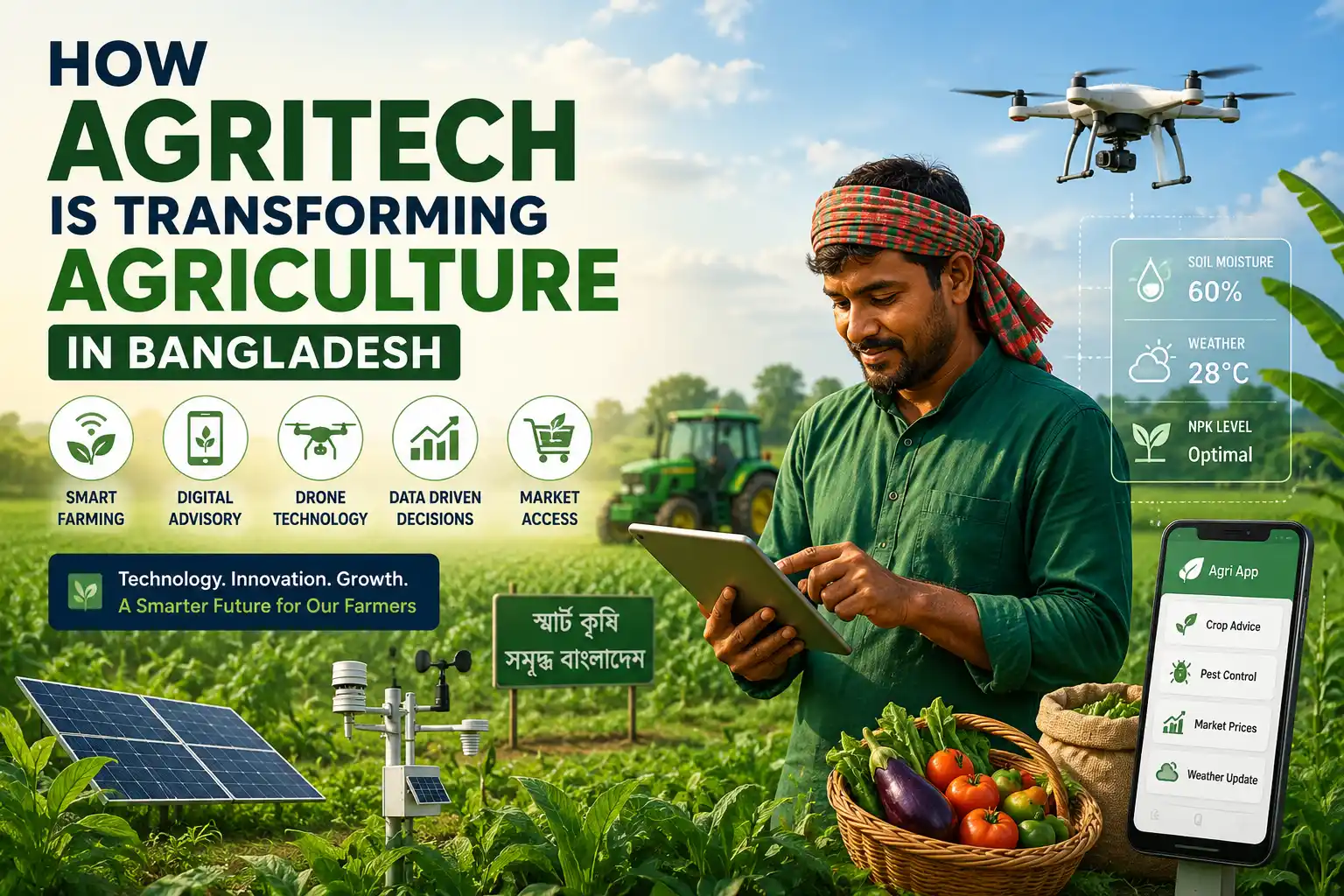
Key technologies commonly grouped under AgriTech include mobile applications for farm advisory and market access, sensors that track soil and weather conditions, drones for aerial crop assessment, satellite and geographic information system (GIS) mapping, farm management software, and digital marketplaces that connect producers with buyers. Artificial intelligence is increasingly used for tasks such as identifying crop diseases from images or forecasting yields based on historical and real-time data.
AgriTech matters because agriculture worldwide is under pressure to produce more food with fewer resources, while also adapting to a changing climate. Globally, precision agriculture, farm robotics, and data-driven advisory platforms have moved from pilot projects to mainstream tools on many commercial farms, particularly in North America, Europe, and parts of East Asia.
In Bangladesh, the picture is more varied. Large-scale, capital-intensive systems such as autonomous farm robots remain rare, largely because the country’s agricultural sector is dominated by smallholders who farm relatively small plots of land. However, lighter-touch technologies — mobile advisory apps, SMS alerts, digital marketplaces, and drone-based spraying services — are gradually finding a foothold, often introduced through government extension programs, development-funded pilots, or private startups rather than large-scale commercial rollouts. Adoption levels vary significantly by region, crop type, and access to infrastructure, and remain concentrated in areas with better connectivity and extension support.
Why Bangladesh Needs AgriTech
Several structural challenges make the case for wider AgriTech adoption in Bangladesh.
Climate change is increasingly affecting cropping patterns, with more erratic rainfall, rising temperatures, and increased salinity intrusion in coastal areas, requiring better forecasting and adaptive planning tools.
Floods and droughts remain recurring threats in different parts of the country, often within the same cropping season. Real-time weather and water-level information can help farmers time planting, irrigation, and harvesting decisions more precisely.
Soil health is a growing concern in areas of intensive rice cultivation, where continuous cropping and heavy fertilizer use over decades have affected fertility in some regions. Data-driven soil testing can help farmers apply fertilizer more precisely rather than by habit.
Labor shortages are becoming more noticeable as younger rural workers migrate to cities or seek overseas employment, pushing up the cost and availability of farm labor during peak seasons.
Increasing food demand, driven by population growth and changing diets, means the country needs to raise productivity on largely fixed or shrinking arable land.
Rising production costs, including fuel, fertilizer, and irrigation expenses, are squeezing farmer margins, making efficient input use more important than ever.
Efficient resource management — of water, fertilizer, and labor — is where many AgriTech tools offer the most immediate, practical value, since they help farmers use existing inputs more precisely rather than requiring entirely new resources.
Technologies Transforming Agriculture in Bangladesh
Precision Agriculture uses data on soil variability, moisture, and crop condition to apply seeds, water, and fertilizer only where and when they are needed. In Bangladesh, this remains mostly in pilot and research stages, most often applied at a smaller scale, such as zone-specific fertilizer recommendations, rather than through fully automated precision equipment.
Smart Irrigation systems use soil moisture sensors or scheduling software to reduce water waste, an important consideration where groundwater extraction for dry-season rice (boro) irrigation is a significant concern in some regions. Adoption in Bangladesh is still at an early stage, largely confined to pilot and demonstration projects.
IoT Sensors placed in fields or storage facilities track variables such as soil moisture, temperature, and humidity, feeding real-time data to farmers or advisors so decisions are based on current field conditions. Use of these sensors in Bangladesh is still largely limited to research and early-adoption projects rather than widespread farm-level deployment.
Drones are used for aerial crop health assessment and targeted pesticide or fertilizer spraying. Government-linked projects, including drone deployment under agricultural extension initiatives, have piloted drone-based spraying to improve accuracy and reduce farmers’ direct exposure to chemicals, though this use remains concentrated in research, demonstration, and pilot projects rather than widespread farmer adoption.
Satellite Monitoring allows large areas of cropland to be assessed for vegetation health, moisture stress, or flood extent using satellite imagery, particularly useful for a low-lying, flood-prone country.
GIS Mapping helps agencies and researchers visualize where specific crops, soil types, or climate risks are concentrated, supporting more targeted extension services and disaster response planning.
AI-powered Crop Monitoring applies machine learning to images or sensor data to detect early signs of pest infestation or disease, allowing farmers to intervene before a problem spreads. In Bangladesh, these applications are primarily pilot projects, research initiatives, or limited deployments rather than tools in widespread farmer use.
Mobile Farming Apps give farmers access to advisory content, weather forecasts, market prices, and sometimes direct links to buyers or input suppliers, often in Bengali and designed for basic smartphones.
Weather Forecasting tools, including SMS-based alerts, help farmers plan planting, spraying, and harvesting around expected rainfall or temperature extremes.
Farm Management Software helps farmers or agribusinesses track inputs, expenses, yields, and schedules in one place, supporting more consistent record-keeping than paper-based methods. Its use in Bangladesh remains at an early-adoption stage, concentrated among larger farms and agribusinesses rather than smallholders.
Digital Marketplaces connect farmers directly with institutional or retail buyers, aiming to reduce reliance on multiple layers of intermediaries and improve price transparency, though results vary by platform and region.
Supply Chain Technology supports traceability and logistics — tracking produce from farm to buyer, reducing spoilage, and helping businesses source directly from farmers rather than through informal, multi-step trading chains.
Benefits of AgriTech for Farmers
When adopted appropriately, AgriTech tools offer several potential benefits. Higher productivity can result from better-timed inputs and interventions, while lower production costs are possible when fertilizer, water, and pesticide use is guided by data rather than routine. Better crop monitoring allows farmers to catch problems early, and AI-based disease detection tools can flag issues before they spread widely across a field.
Water conservation is a meaningful benefit in areas dependent on groundwater irrigation, where smart irrigation scheduling can reduce unnecessary pumping. Improved fertilizer management, guided by soil data, can reduce both cost and environmental impact from over-application, and better market access through digital platforms can help farmers reach buyers beyond their immediate local area, though outcomes depend on the platform’s reach and reliability.
Reduced post-harvest losses are possible when supply chain and cold storage technology shortens the time between harvest and sale — an important consideration given the perishability of many Bangladeshi crops. Finally, data-driven decision making, even at a basic level such as tracking which inputs led to better yields, can help farmers make more informed choices over time.
These benefits are not automatic or guaranteed; they depend on the quality of the technology, how well it fits local farming conditions, and whether farmers receive adequate training and support to use it effectively.
Challenges of AgriTech Adoption in Bangladesh
Despite its promise, AgriTech adoption in Bangladesh faces real obstacles. High initial investment for equipment such as sensors, drones, or farm management systems can be out of reach for many smallholders without financing support, and limited digital literacy among some farmers, especially older generations in remote areas, can slow adoption even when tools are made available.
Internet connectivity remains inconsistent in parts of rural Bangladesh, limiting the usefulness of tools that depend on real-time data access. Small farm sizes — a majority of Bangladeshi farmers cultivate less than one hectare of land — make some large-scale precision agriculture equipment economically impractical, which is why many AgriTech solutions in the country focus on advisory or aggregation rather than automated field machinery.
Financing for AgriTech adoption is often limited, since formal lenders have historically viewed smallholder agriculture as high-risk, leaving many farmers dependent on informal credit sources. Maintenance of technical equipment requires local capacity that is not always available outside major towns, and technical support in the local language, tailored to farmer needs, remains a gap for many platforms.
Government and Private Sector Initiatives
Several public institutions are involved in agricultural research, extension, and technology promotion in Bangladesh, though the extent of digital integration varies by program.
The Department of Agricultural Extension (DAE), under the Ministry of Agriculture, is the primary government body responsible for delivering agricultural advisory services and has been involved in projects incorporating digital and precision farming tools, including drone-based spraying pilots under climate-focused agricultural projects.
The Bangladesh Agricultural Research Institute (BARI) and the Bangladesh Rice Research Institute (BRRI) are among the country’s main public research bodies for crop varieties and agronomic practices, and their findings often form the scientific basis for extension advice delivered through both traditional and digital channels.
Agricultural universities, including Bangladesh Agricultural University, contribute research and training relevant to digital agriculture, and some have partnered with development organizations on pilot projects involving sensors, drones, or data platforms.
a2i (Aspire to Innovate), a government digital transformation initiative, supports digital service delivery, including efforts to bring agricultural information closer to citizens, but it is not the primary agricultural policy or extension agency — that role belongs to bodies such as the Ministry of Agriculture and the DAE. a2i’s role sits within a broader digital governance mandate rather than agriculture alone.
On the private side, a small but growing number of AgriTech startups have entered the market over the past several years, often with support from local and international investors and development finance institutions. Their contributions remain modest relative to the scale of Bangladesh’s agricultural sector, and most are still in early or growth stages rather than operating at nationwide scale.
Real Examples of AgriTech in Bangladesh
A number of Bangladeshi startups have built platforms around specific parts of the agricultural value chain.
iFarmer is a digital agriculture platform, founded in 2017, that connects farmers with financing, quality inputs, advisory services, and market access, while enabling individual and institutional sponsors to invest in farming and livestock enterprises. It has grown into one of the more prominent agritech companies operating in the country, with services spanning multiple districts.
Agroshift, founded in 2021, works on the output side of the value chain, sourcing produce such as vegetables, fruits, and grains directly from farmers and traders and distributing it to businesses, including garment factories and micro-retailers, through what the company describes as a “phy-gital” model combining physical logistics with digital ordering.
Khamar-e, founded in 2020, has focused on traceability and supply chain infrastructure, particularly for dairy and livestock products, working as an aggregator connecting farm-level supply with retail demand.
Other startups active in the space, according to industry coverage, include iPage (Integrated Precision Agriculture and Engineering), which focuses on IoT-based precision agriculture alongside input access and microcredit partnerships for farmers, Fashol, a wholesale marketplace for fruits and vegetables founded in 2016, and Nagarkrishi, which focuses on urban and rooftop farming services. Industry observers have noted that Bangladesh’s agritech startup sector remains relatively small, with most companies still working through the operational and financing challenges of scaling agricultural technology in a smallholder-dominated market.
Future of AgriTech in Bangladesh
Looking ahead, several directions may shape how AgriTech develops in Bangladesh, though the pace and scale of change will depend on infrastructure and investment.
AI applications for crop disease detection and yield forecasting could expand as more image and sensor data become available and as mobile-based AI tools become easier to deploy on ordinary smartphones. Robotics and automation remain a longer-term prospect given the dominance of small landholdings, though targeted automation—such as drone spraying—may become more practical sooner than fully autonomous field equipment under Bangladesh’s current farming conditions. Digital advisory services, delivered through mobile apps and SMS, may continue to expand as smartphone penetration grows in rural areas.
Broader smart farming and sustainable agriculture practices, including precision input use and water-efficient irrigation, are increasingly relevant given climate pressures and resource constraints. Finally, export competitiveness for Bangladeshi agricultural and agro-processed products may benefit from better traceability and quality assurance systems, which are often prerequisites for accessing certain international markets.
None of these developments are guaranteed outcomes; they represent plausible directions based on current trends in technology adoption, government programs, and private investment, rather than confirmed future events.
Frequently Asked Questions
What is AgriTech?
AgriTech refers to the use of digital tools, data, and technology — such as mobile apps, sensors, drones, and software — to improve farming practices, from planting and irrigation to marketing and supply chain management.
Why is AgriTech important in Bangladesh?
Bangladesh faces challenges including climate change, flooding, shrinking arable land, and rising production costs. AgriTech offers tools to help farmers use land, water, and other resources more efficiently in response to these pressures.
How does AI help farmers?
AI is used mainly for tasks such as detecting crop diseases from images, forecasting weather-related risks, and analyzing patterns in farm data to support more informed decisions. In Bangladesh, these applications are primarily pilot projects, research initiatives, or limited deployments rather than tools in widespread farmer use.
What are the biggest challenges to AgriTech adoption?
Key challenges include high upfront costs, limited digital literacy among some farmers, inconsistent internet connectivity in rural areas, small average farm sizes, and limited access to financing and technical support.
Which AgriTech companies operate in Bangladesh?
Companies operating in this space include iFarmer, Agroshift, Khamar-e, and several smaller startups working on input access, market linkages, and supply chain traceability. Most are still in relatively early stages of growth.
What is the future of AgriTech in Bangladesh?
Growth may occur in areas such as AI-based advisory tools, drone-assisted farming, and digital marketplaces, though the pace will depend on improvements in rural connectivity, farmer training, and access to financing.
Final Thoughts
AgriTech offers Bangladesh a practical set of tools for addressing some of its most pressing agricultural challenges — from climate-related uncertainty to resource constraints and market inefficiencies. Technologies such as mobile advisory apps, drone-based spraying, satellite monitoring, and digital marketplaces are already being used in various forms across the country, even if adoption remains uneven and concentrated in certain regions or crop types.
Realizing the full potential of AgriTech will depend on more than the technology itself. Reliable rural internet infrastructure, farmer training and digital literacy programs, accessible financing, and ongoing collaboration between farmers, private companies, research institutions such as BARI and BRRI, and government bodies like the Department of Agricultural Extension will all play a role in determining how widely and effectively these tools are used. Approached carefully, AgriTech can support a more productive, resilient, and sustainable agricultural sector for Bangladesh in the years ahead.
Info Ghor regularly covers technology and business developments relevant to Bangladesh, including the tools and platforms shaping the country’s agricultural sector.