Future of AI Search and Local Business Discovery in Bangladesh
For two decades, finding a local business online meant one thing: typing words into a search box and scanning a list of results. That model is now changing. AI-powered search — assistants that answer questions directly, summaries that appear above traditional results, chat tools that recommend options conversationally — is reshaping how people research what to buy and whom to hire. The future of AI search and local business discovery in Bangladesh is therefore a practical question, not a futuristic one: how will nearby customers find businesses as these tools spread, and what should businesses realistically do about it?
This guide answers that question with evidence rather than hype. It explains what AI search actually is, how it differs from traditional search, what is genuinely known about how AI systems gather business information, and what remains uncertain. It then translates that into realistic preparation for businesses in Bangladesh — preparation that, notably, overlaps almost entirely with the fundamentals that already work: accurate information, consistent presence, genuine reviews, and content that helps. No predictions are presented as certainties here, and no one — this guide included — can guarantee any business’s appearance in AI-generated answers. What can be offered is a clear picture of the direction of change and the preparation that holds up regardless of its pace.
Who Should Read This Guide?
This guide is written for people making practical decisions about local business visibility:
- Small business owners in Bangladesh wondering whether AI search changes what they should be doing online.
- Service providers and online sellers whose customers research before contacting — research that increasingly involves AI tools.
- Marketers and freelancers advising local businesses and needing a hype-free picture of what’s changing.
- Consumers curious about how the tools answering their questions actually gather business information.
- Anyone planning digital strategy in Bangladesh who wants realistic guidance rather than predictions dressed as facts.
No technical background is assumed. Where the honest answer is “this is still evolving,” this guide says so.
What Is AI Search?
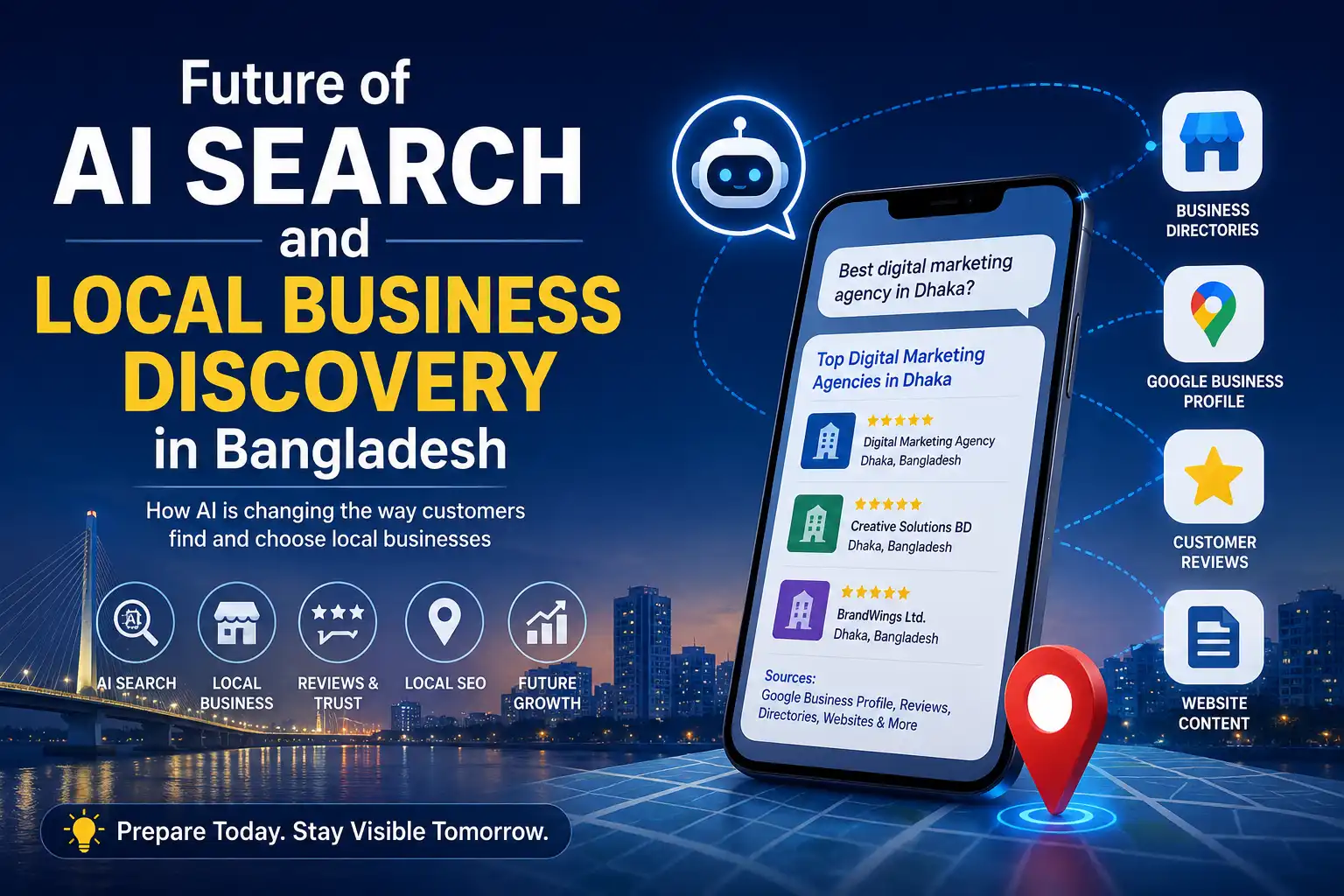
What is AI Search? AI search refers to tools that use artificial intelligence to answer questions directly — chat assistants, AI-generated summaries above search results, and answer engines — rather than only listing links. These systems draw on both structured and unstructured web information to generate responses, including business details, reviews, articles, and listings.
AI search is an umbrella term for a family of tools that answer rather than merely list:
- AI assistants — conversational tools such as ChatGPT, Gemini, and Claude — that respond to questions in natural language, and in many cases can search the web to inform their answers.
- AI-generated summaries in search engines — such as AI Overviews — that synthesize an answer above the traditional results.
- Answer engines — tools such as Perplexity — built around generating cited answers from web sources.
What unites them is the shift in output: instead of ten links to evaluate, the user receives a composed answer — sometimes with sources, sometimes with recommendations, often with the option to ask follow-up questions.
Two facts about these systems matter most for local businesses:
- They draw on the existing web. AI search systems use both structured and unstructured web information — websites, business profiles, directory listings, reviews, articles, and other sources — when describing businesses. They do not conjure business information; they assemble it from what is published and findable.
- They are evolving. How these systems select, weight, and cite sources continues to change, and no one outside these companies — and arguably no one at all — can guarantee what any given answer will include. Every honest statement about AI search carries that caveat.
How AI Search Is Changing Business Discovery
The change is best understood as a shift in where evaluation happens.
Traditional discovery: a person searches, receives a list, and does the evaluating themselves — opening profiles, comparing options, reading reviews, forming a shortlist.
AI-influenced discovery: part of that evaluation moves into the answer itself. A person asks a question — “good catering services for a small wedding in Dhaka?” — and receives a synthesized response that may already name options, summarize their apparent strengths, and cite sources.
The practical consequences, stated carefully:
- The answer layer becomes a new surface. Businesses may be mentioned, summarized, or omitted in AI-generated responses — a form of visibility that didn’t exist a few years ago and that no business directly controls.
- Consistency gets machine-read at scale. AI systems assembling business descriptions from multiple sources reward the same thing careful human buyers do: information that agrees with itself everywhere. Conflicting details risk misdescription or omission.
- Underlying sources still matter — arguably more. Because AI answers are assembled from the web, the quality of a business’s presence across websites, profiles, listings, and reviews becomes the raw material of how it gets described.
- Traditional search continues alongside. AI search is changing discovery, not replacing search wholesale. People still use conventional search, maps, and social platforms — the new tools are being added to the mix, not substituted for it.
The realistic summary: AI assistants increasingly influence customer research, and the influence flows through the same information businesses already publish. That continuity — not disruption — is the most useful fact in this entire topic.
Current State of AI Search in Bangladesh
An honest snapshot of where things stand, without invented numbers:
Adoption is growing, unevenly. AI assistants and AI-augmented search are increasingly available to Bangladeshi users — on the same smartphones that already dominate internet access — but usage varies widely by age, profession, language comfort, and urban-rural context. Early adopters — students, professionals, tech-comfortable urban users — are already asking AI tools the kinds of questions that once went straight to a search box.
Mobile-first behavior shapes everything. Bangladesh’s internet use is overwhelmingly mobile, which historically favored apps, maps, and social platforms for discovery. AI assistants fit that pattern naturally — conversational tools suit small screens and voice input — which may support their adoption for everyday questions, including local ones.
Business information readiness is mixed. Many Bangladeshi businesses maintain accurate profiles, websites, and listings; many others exist online only as a social page with inconsistent details. That readiness gap matters more in an AI era: systems assembling answers from the web can only describe what the web legibly says. The information-consistency challenge documented across this series — and the case for organized data layers made in why Bangladesh needs trusted business directories — becomes an AI-readiness issue as well.
Language is a live variable. Local business questions in Bangladesh are asked in Bangla, English, and Banglish. AI systems’ handling of Bangla-language queries and sources continues to improve and evolve — another reason clear, consistent business information in the languages customers actually use is prudent preparation.
The honest bottom line: AI search in Bangladesh is early, growing, and uneven — significant enough to prepare for, too early for anyone to characterize with precise figures, and moving in a direction that rewards preparation businesses should be doing anyway.
How Consumers May Discover Local Businesses in the Future
Framed as informed possibilities — not certainties:
Conversational research may become routine. Instead of three searches and ten tabs, a consumer may describe their need once — budget, area, preferences — and refine through follow-up questions. Discovery becomes a dialogue, with the AI assembling and re-assembling options.
Answers may arrive pre-compared. AI responses often summarize and contrast options. The comparison work consumers now do manually — the side-by-side evaluation taught in guides like finding verified businesses online — may increasingly arrive partially done, with the consumer verifying rather than assembling.
Verification habits will still matter — perhaps more. AI answers can be incomplete, outdated, or simply wrong; systems themselves advise checking important details. The consumer habits this site teaches — cross-checking details, confirming contacts, reading feedback patterns before paying, as laid out in choosing a trusted business in Bangladesh — apply to AI-recommended businesses exactly as they do to any others. A recommendation is a starting point; verification remains the buyer’s step.
Voice and multimodal discovery may grow. Asking aloud, photographing a product to find sellers, sharing a location for nearby options — interaction modes beyond typed text suit mobile-first users and may broaden who discovers businesses through AI tools.
Traditional Discovery vs AI Discovery
|
Aspect |
Traditional Discovery |
AI-Influenced Discovery |
|---|---|---|
|
Output |
List of links and listings |
Composed answer, possibly with named options |
|
Evaluation |
Done by the user across tabs |
Partially embedded in the answer |
|
Refinement |
New searches |
Follow-up questions in conversation |
|
Source visibility |
User sees each source directly |
Sources summarized; sometimes cited |
|
Verification |
User’s responsibility |
Still the user’s responsibility |
Google Search vs AI Search
How is AI Search different from Google Search? Traditional Google Search returns ranked links and listings for the user to evaluate; AI search tools generate composed answers, sometimes naming and summarizing options directly. Both draw on web information, and both currently coexist — AI search is changing discovery patterns, not replacing traditional search outright.
The comparison, kept precise:
|
Aspect |
Google Search (traditional) |
AI Assistants / AI Search |
|---|---|---|
|
Result format |
Ranked links, map pack, snippets |
Generated answers, summaries, recommendations |
|
Local business surface |
Listings, profiles, websites |
Mentions and descriptions within answers |
|
User effort |
Evaluate sources directly |
Ask, receive, refine — then verify |
|
Information basis |
Indexed web + business profiles |
Both structured and unstructured web data |
|
Business control |
Optimize presence; rankings not guaranteed |
Maintain presence; inclusion not guaranteed |
|
Current status |
Dominant and evolving (including AI Overviews) |
Growing alongside, not replacing |
Two claims this guide deliberately avoids, because the evidence doesn’t support them: that AI search will replace Google completely, and that traditional SEO is dead. What is observable is convergence — traditional search adding AI layers, AI tools adding search capabilities — with both running on the same underlying web information businesses publish. That shared foundation is why preparation for one is largely preparation for both.
The Role of Google Business Profile
The Google Business Profile remains an important local asset in the AI era — arguably the single most consequential piece of structured information most local businesses maintain.
Why it holds its place:
- It is structured, first-party, and widely read. A complete profile presents a business’s core facts — name, category, location, hours, services, photos, reviews — in exactly the organized form machine systems parse most reliably.
- It anchors the local ecosystem. Maps results, local listings, and much of local discovery already flow through profile data; AI layers built on or alongside search inherit that foundation.
- It carries the review record. For most local businesses, the profile holds their largest public review history — trust evidence that both human readers and automated systems encounter.
The boundaries, stated with equal clarity: a Google Business Profile alone guarantees nothing — not rankings, not AI recommendations, not inclusion in any generated answer. It is necessary-level infrastructure, not a sufficient condition. The practical standard is the one covered fully in how local SEO helps small businesses grow: claimed, verified, truthfully complete, consistent with everything else the business publishes, and maintained as details change.
Business Directories in the AI Era
Do business directories still matter? Yes, in a bounded way. Directories contribute structured citation information — consistent, organized business details that both search and AI systems can crawl. They support the cross-source consistency these systems reward, and can produce direct referrals. No directory guarantees rankings or AI visibility; accuracy and consistency create their value.
Directories occupy a specific niche in the AI era: they are part of the structured data layer that answer systems read.
What holds up:
- Structured citations still corroborate. AI systems assembling business descriptions from multiple sources benefit from — and appear to reward — agreement across those sources. Accurate directory listings add organized sources that agree with a business’s website and profile, the same citation logic detailed in how business directories help local SEO.
- Organized data is machine-legible. Directory listings present business information in labeled, consistent formats — the kind of input automated systems parse most reliably. For Bangladesh, locally focused platforms — Info Ghor being one Bangladesh-focused business directory among the sources a business might maintain — contribute to that local data layer.
- Human browsing continues. Category browsing remains a real discovery behavior independent of any AI effect, with the realistic benefits and limits already documented in our guide to the benefits of listing your business on Info Ghor.
What doesn’t hold up — and never did: volume strategies. Mass listings on careless platforms create exactly the cross-source inconsistency that machine assembly penalizes. And the standing boundary applies with extra force in this context: business directories alone cannot guarantee AI visibility — no source alone can. Their contribution is input quality, not output control.
Customer Reviews and Digital Trust
Can AI recommend local businesses? AI tools can and do mention or describe local businesses in their answers, drawing on web information including profiles, listings, articles, and reviews. What no one can guarantee is inclusion: how AI systems select and present businesses continues to evolve, and recommendations should be verified like any other lead.
Reviews carry into the AI era with their importance intact — and possibly amplified.
Reviews are trust evidence machines can read. Genuine customer feedback — accumulated over time, specific, spread across platforms — is among the unstructured web information AI systems draw on when characterizing businesses. A business’s review record contributes trust signals to human readers and automated summarizers alike; the full dynamics are covered in why customer reviews matter for businesses.
The honesty incentive strengthens. Fake and manipulated reviews were always detectable by pattern — bursts, generic wording, empty accounts. Systems that read review corpora at scale make pattern detection the default condition, and consumers cross-checking AI recommendations add another layer of scrutiny. The sustainable strategy hasn’t changed: earn reviews genuinely, respond professionally, never fabricate.
Digital trust becomes composite. In an AI-mediated landscape, a business’s public character is assembled from everything findable: reviews, responses, consistency of details, published policies, complaint handling. Consumers are simultaneously being taught — including by guides on avoiding online business scams in Bangladesh — to verify whatever any tool tells them. Businesses whose footprint survives that verification are prepared for both audiences: the machines that summarize and the humans who check.
Reviews contribute trust signals — they are not a direct ranking guarantee in traditional search, and they are not a guaranteed ticket into AI answers. They are, however, among the few forms of evidence a business cannot simply write for itself, which is precisely why every evaluating system — human or machine — pays attention to them.
Structured Data, Entity SEO and AI Understanding
Behind the buzzwords sits one practical idea: helping machines understand, unambiguously, what your business is.
Entities, plainly. To modern search and AI systems, a business is ideally an entity — a distinct, recognized thing with attributes: this name, this category, this location, these contacts, this website. Entity consistency means every source describing your business describes the same entity the same way. When sources conflict — variant names, old addresses, mismatched numbers — systems face ambiguity, and ambiguity degrades how (and whether) a business gets represented.
Structured data, plainly. Structured data markup (such as schema markup on a website) labels information explicitly for machines: this text is the business name, this is the address, these are the hours. It removes guesswork from machine reading. Alongside it, structured sources — Google Business Profile, directory listings — present business facts in inherently labeled formats.
What this means in practice, without the jargon:
- One canonical identity — exact name, address, phone, category — used verbatim everywhere.
- A website whose contact and about information is clear, current, and (where feasible) marked up with basic structured data.
- Profiles and listings that agree with the website and each other.
- Content that describes what the business actually does, in the natural language customers use — in Bangla and English as appropriate.
SEO vs GEO vs AEO
|
Discipline |
Focus |
Practical Core |
|---|---|---|
|
SEO (Search Engine Optimization) |
Visibility in traditional search results |
Relevant content, sound site, credible presence |
|
AEO (Answer Engine Optimization) |
Being the source direct answers draw on |
Clear, direct, well-structured answers to real questions |
|
GEO (Generative Engine Optimization) |
Being usable by AI systems generating responses |
Consistent entities, citable content, machine-legible facts |
The overlap among the three columns is the point: they are lenses on one discipline. Clear, consistent, helpful, machine-legible information serves all of them — which is why chasing each acronym separately is unnecessary, and why none of them offers guarantees.
Common Mistakes Businesses Should Avoid
|
Mistake |
Why It Hurts in the AI Era |
|---|---|
|
Waiting for certainty before acting |
The preparation that matters — accuracy, consistency, reviews — pays off under every scenario; delay only defers its compounding |
|
Chasing “AI optimization” shortcuts |
No service can guarantee inclusion in AI answers; money spent on such guarantees buys the promise, not the result |
|
Letting information drift |
Conflicting details across sources always cost trust; machine assembly makes the cost systematic |
|
Keyword-stuffing and manipulation |
Systems reading language at scale are harder, not easier, to fool — and manipulated content reads worse to the humans who verify |
|
Faking reviews |
Pattern detection at scale plus verification-minded consumers make fabrication a compounding liability |
|
Abandoning fundamentals for novelty |
The Google Business Profile, website, listings, and reviews remain the raw material AI systems read — neglecting them to chase trends removes the input |
|
Publishing nothing |
A business invisible to the web is invisible to systems that assemble answers from it; a minimal accurate presence beats none |
|
Treating AI answers as unaccountable |
Businesses can and should check how they’re being described — searching themselves, asking assistants, correcting the underlying sources when descriptions are wrong |
Preparing Your Business for AI Search
The realistic preparation list — notable for how little of it is new:
1. Fix the entity first. Write down your canonical details — exact name, full address, primary phone, precise category — and make every public source agree: website, Google Business Profile, directories, social pages. Entity consistency is the single highest-leverage preparation.
2. Maintain the Google Business Profile as living infrastructure. Claimed, verified, complete, truthful, current — including hours, services, and photos. It remains the most consequential structured source most local businesses control.
3. Keep a real website, even a simple one. A clear site stating what you do, where, for whom, with current contact details — and basic structured data where feasible — gives every system a first-party reference point. The full owner’s checklist lives in the local SEO guide linked earlier; the verification-readiness standard — being the business whose details check out — is the same one buyers apply in verifying a company before buying services.
4. Earn and answer genuine reviews continuously. Ask every real customer; respond to everything professionally; never fabricate. The review record is trust evidence for every audience that will ever evaluate you.
5. Maintain a few credible listings. Selected directories with real usage and standards, completed fully, kept current — structured citations that corroborate rather than contradict.
6. Publish genuinely helpful content where you have something to say. Answers to the questions your customers actually ask, in the language they ask them — the raw material of being quotable, for snippets and generated answers alike.
7. Audit how you appear — everywhere. Periodically search your business, check your listings, and ask AI assistants about your category and area. Where descriptions are wrong, fix the sources they draw from.
8. Ignore guarantees. From anyone. The systems evolve, inclusion cannot be promised, and every hour not spent on guaranteed shortcuts is available for the fundamentals that compound.
Business Prepared for AI vs Business Not Prepared
|
Aspect |
Prepared |
Not Prepared |
|---|---|---|
|
Identity |
One canonical entity, consistent everywhere |
Variant names, conflicting details |
|
Profile |
Complete, current, maintained |
Unclaimed or stale |
|
Website |
Clear, accurate, machine-legible |
Absent, outdated, or ambiguous |
|
Reviews |
Genuine, accumulated, answered |
Sparse, ignored, or manufactured |
|
Listings |
Few, credible, consistent |
Mass-submitted or abandoned |
|
Content |
Helpful answers in customers’ language |
Nothing citable |
|
Result |
Legible to humans and machines alike |
Ambiguous to both — and describable by neither |
What the Future May Look Like
Informed possibilities, explicitly not certainties:
Discovery may become more conversational and more assisted — needs described once, options refined through dialogue, comparisons arriving partially assembled. The consumer’s role may shift from searching to verifying.
The information layer may matter more than the interface. Interfaces will keep changing — search boxes, assistants, voice, whatever follows. What persists underneath is the web of business information those interfaces draw on. Businesses and platforms that keep that layer accurate may find themselves prepared for interfaces that don’t exist yet.
Trust may become the differentiator machines can read. As generated answers proliferate, the question “which sources deserve weight?” grows more important, not less. Consistent entities, genuine review records, and verifiable details are the machine-readable forms of trustworthiness — and businesses that have them may be structurally favored by systems trying to avoid recommending badly.
Bangladesh’s trajectory may hinge on its data layer. A growing digital economy, mobile-first users, and improving Bangla-language AI capability point one direction; uneven business-information readiness points another. Which effect dominates may depend substantially on how many businesses, and platforms, treat accurate information as infrastructure — the same conclusion this series has reached from every angle.
And uncertainty is the honest baseline. How fast adoption spreads, how AI systems will weight sources next year, which tools Bangladeshi consumers will favor — no one knows, and this guide won’t pretend otherwise. The strategy that requires no prediction is the one already described: be accurate, be consistent, be genuinely reviewed, be helpful, everywhere you appear.
Key Takeaways
- AI search — assistants, AI Overviews, answer engines — is changing how discovery works, moving part of the evaluation into generated answers; it is growing alongside traditional search, not replacing it.
- AI systems assemble business descriptions from both structured and unstructured web information — profiles, websites, listings, reviews, articles — making the quality and consistency of that information the raw material of AI-era visibility.
- The Google Business Profile remains an important local asset; directories contribute structured citations; reviews contribute trust signals — and none of them, alone or together, guarantees inclusion in AI answers.
- Entity consistency — one canonical identity, agreed upon by every source — is the highest-leverage preparation, for machines and careful humans alike.
- The mistakes to avoid are the old ones amplified: information drift, manipulation, fake reviews, shortcut-chasing, and neglecting fundamentals for novelty.
- The future should be planned as informed possibility, not certainty — and the preparation that holds up under every scenario is accurate information, genuine trust, consistent presence, and helpful content.
The most useful thing about the AI search era may be what it doesn’t change. Every scenario in this guide — fast adoption or slow, this interface or the next — rewards the same underlying work: business information kept accurate, customer trust earned genuinely, presence maintained consistently, and content that actually helps the people it reaches. That work was worth doing before AI search existed, it is worth doing now, and it will be worth doing under whatever comes next — because it is not optimization for a technology, but honesty at scale about what a business is.
Prepare for the future of search the way trustworthy businesses have always prepared for anything: by being easy to find, easy to check, and worth recommending — to humans and machines alike.
Frequently Asked Questions
Will AI search replace Google in Bangladesh?
There is no evidence supporting complete replacement. What is observable is coexistence and convergence: traditional search adding AI layers such as AI Overviews, and AI assistants adding web-search capabilities — both drawing on the same underlying web information. Businesses should prepare for a mixed landscape rather than betting on any single interface.
Will AI replace Local SEO?
No — the more accurate framing is that AI search extends what local SEO fundamentals feed. AI systems draw on the same profiles, websites, listings, and reviews that local SEO maintains, so the work overlaps almost entirely. Traditional SEO is not dead; it is one lens on the same discipline of accurate, consistent, helpful presence.
Can my business appear in ChatGPT, Gemini, or Perplexity answers?
Businesses can be mentioned in AI-generated answers when these tools draw on web information about them — but no business, agency, or platform can guarantee inclusion. What is controllable is the input: a consistent entity, a complete profile, credible listings, genuine reviews, and clear content. Treat any guaranteed-AI-visibility offer as the red flag it is.
How do AI tools get information about local businesses?
From the existing web, using both structured and unstructured sources: business websites, Google Business Profiles, directory listings, structured data markup, articles, and customer reviews. This is why cross-source consistency matters — systems assembling a description from multiple sources represent consistent businesses more reliably than contradictory ones.
What should a small business in Bangladesh do first to prepare?
Fix entity consistency: write down your canonical name, address, phone, and category, then make your Google Business Profile, website, listings, and social pages agree exactly. It is free, owner-doable, and the single preparation that serves traditional search, AI systems, and verification-minded customers simultaneously.
Do business directories help with AI visibility?
They contribute — as structured, crawlable sources that corroborate a business’s details — but they cannot guarantee AI visibility, and no source can. A few credible, fully completed, well-maintained listings support the consistency AI systems reward; mass submissions create the contradictions they penalize.
Do customer reviews affect how AI describes a business?
Reviews are among the unstructured web information AI systems draw on, and they contribute trust signals to how a business may be characterized — without being a guaranteed lever. The durable guidance is unchanged: earn reviews genuinely, respond professionally, and never fabricate, since pattern-level detection only strengthens as systems read at scale.
Should businesses write content differently for AI search?
Not fundamentally. Content that answers real customer questions clearly, directly, and in the language customers use — Bangla, English, or both — serves featured snippets, AI-generated answers, and human readers with the same qualities. Manipulative or keyword-stuffed writing performs worse across all three.
Is AI search safe for consumers choosing businesses?
AI tools are useful research aids, but their answers can be incomplete, outdated, or wrong — so the standing consumer rule applies: verify before paying. Treat an AI recommendation as a starting point, then confirm details, cross-check sources, and read feedback exactly as you would for a business found any other way.
When will AI search become the main way people find businesses in Bangladesh?
No honest answer includes a date. Adoption is growing but uneven, the technology and its sources continue to evolve, and behavior shifts at its own pace. The practical response is preparation that doesn’t depend on timing: accurate, consistent, trustworthy presence pays off now in traditional search — and positions the business for whatever share of discovery AI tools ultimately take.