Why Bangladesh Needs Trusted Business Directories
Bangladesh’s digital economy has grown faster than the systems people use to judge who they are dealing with. New shops, pages, and service providers appear online daily; buyers compare and pay across platforms; and business information sits scattered across websites, social pages, and search results of very uneven reliability. Understanding why Bangladesh needs trusted business directories starts with that gap — between how quickly commerce has moved online and how hard it still is to find accurate, organized, checkable information about the businesses behind it.
A trusted business directory addresses that gap in a specific, limited, and genuinely useful way: it organizes business information — names, categories, locations, contact details — in a consistent, maintained format that consumers can check, businesses can be found through, and search systems can read. This guide explains what a trusted directory actually is, why the need for them in Bangladesh is growing, how they help consumers and businesses realistically, and how to tell a reliable directory from a careless one — with honest boundaries throughout, because a directory is one source of business information, not absolute proof of anything.
Who Should Read This Guide?
This guide is relevant to everyone who participates in Bangladesh’s growing digital marketplace:
- Consumers who shop, order, and hire online and want organized, checkable information before spending money.
- Business owners deciding where their business should be visible and how organized presence supports credibility.
- Service seekers comparing providers — from repair technicians to agencies — across scattered sources.
- Marketers and freelancers managing online presence for local businesses.
- Anyone thinking about digital trust in Bangladesh — students, researchers, and professionals interested in how a fast-growing online economy builds reliable information infrastructure.
If you have ever struggled to confirm whether an online business is real, or struggled to make your real business findable — this topic is about the missing layer between those two problems.
What Is a Trusted Business Directory?
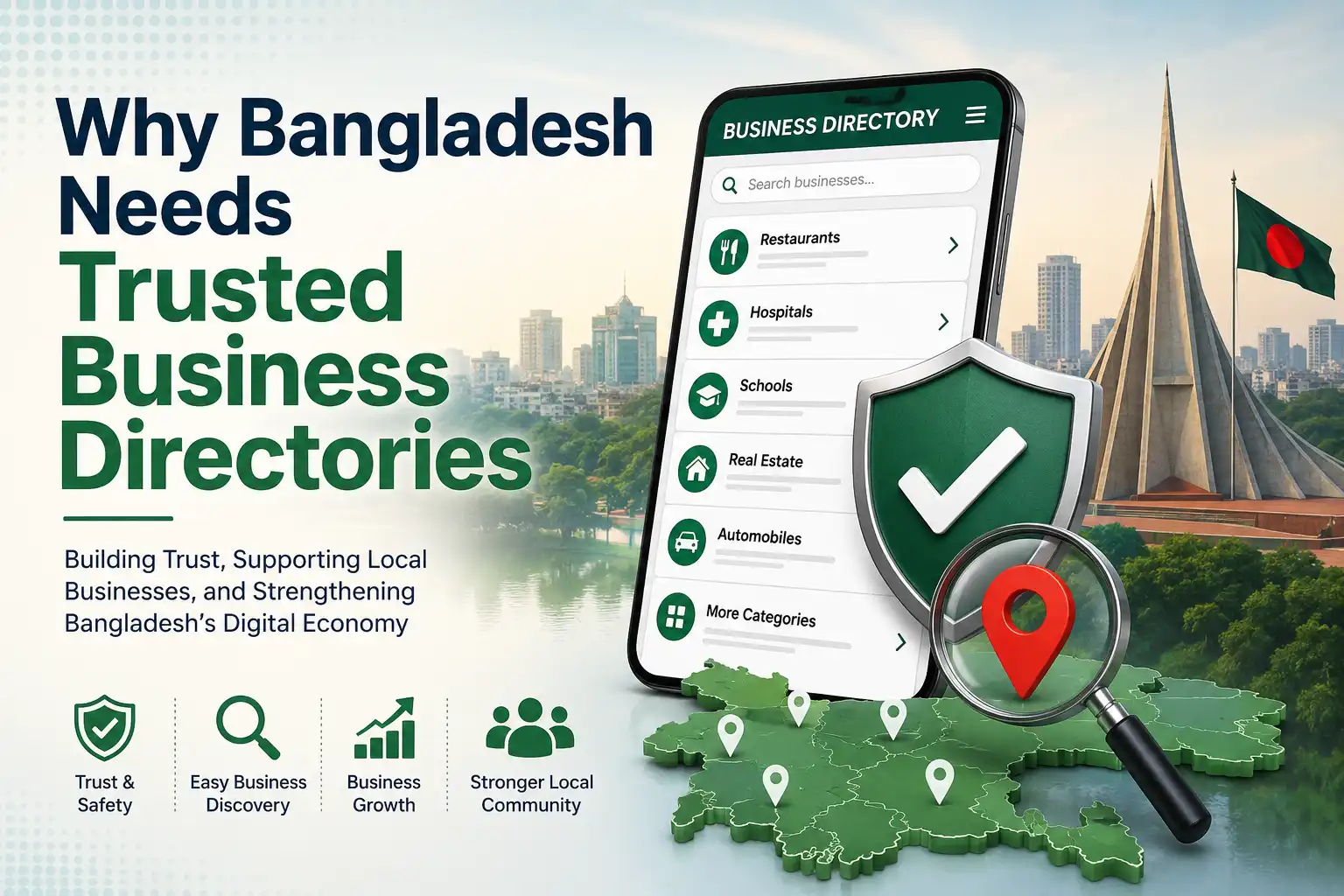
What is a trusted business directory? A trusted business directory is an organized platform listing businesses with structured, maintained information — name, category, location, and contact details — under editorial standards that keep listings accurate and remove spam. It helps people discover and cross-check businesses, while remaining one source of information rather than absolute proof of legitimacy.
A business directory, at its core, is organized business information: listings presented in a consistent format, grouped by category and location, designed for discovery and comparison.
What makes a directory trusted is not the concept but the standards behind it:
- Accuracy discipline: listings reflect real, current details — and outdated or false information gets corrected or removed.
- Editorial standards: submissions are reviewed; spam, duplicates, and fake listings are filtered rather than accepted wholesale.
- Maintenance: the platform treats listings as living information, not a one-time data dump.
- Honest framing: the directory is transparent about what a listing means — organized information, and where applicable, a defined verification process — rather than implying that every listed business is endorsed.
That last point deserves emphasis because it separates trustworthy platforms from misleading ones: a directory listing is a statement about a business, not a certification of it. A trusted directory earns its name by keeping its statements accurate and its limits clear — not by promising more than any directory can deliver.
Trusted Directory vs Unmanaged Directory
|
Aspect |
Trusted Directory |
Unmanaged Directory |
|---|---|---|
|
Listings |
Reviewed, maintained, corrected |
Accepted wholesale, left to decay |
|
Information quality |
Consistent, structured, current |
Stale details, duplicates, spam |
|
Categories |
Precise and usable |
Cluttered or meaningless |
|
Framing |
Honest about what listings prove |
Implies endorsement it can’t support |
|
Value to users |
A reliable starting point for checks |
Noise that wastes verification time |
Why Bangladesh Needs Trusted Business Directories
The need is the product of several converging realities in Bangladesh’s digital market:
1. Commerce moved online faster than trust infrastructure. A large share of buying and selling now begins on the internet — much of it through social media pages that can be created, renamed, or abandoned in a day. The traditional trust anchors of Bangladeshi commerce — a known shop, a familiar neighborhood, a reputation among neighbors — don’t transfer automatically to a page seen for the first time.
2. Business information is fragmented. A single business’s details may be scattered across a website, a Facebook page, a map listing, and old posts — often inconsistently. For buyers, assembling a reliable picture from fragments takes effort; for honest businesses, fragmentation means their accurate information competes with their own outdated traces.
3. Fraud exploits the information gap. Fake shops, impersonation pages, and advance-payment schemes thrive precisely where buyers cannot easily check who they’re dealing with — a landscape covered in our guide to avoiding online business scams in Bangladesh. Organized, checkable business information doesn’t eliminate fraud, but it shrinks the ambiguity fraud depends on.
4. Small businesses need affordable visibility. Bangladesh’s economy runs substantially on small and informal businesses — most of which cannot outspend larger competitors on advertising. Structured, low-cost presence in organized platforms is one of the few visibility channels where completeness and accuracy compete on equal terms with budget.
5. Search and AI systems reward organized data. Both traditional search and newer AI answer systems assemble their picture of businesses from what the web consistently says. Markets whose business information is well-organized get represented more accurately in those systems; markets whose information is chaotic get represented chaotically.
Trusted directories are not the whole answer to any of these — no single platform is. They are a missing layer: organized, maintained, structured business information that consumers, businesses, and machines can all rely on as a starting point.
How Trusted Directories Help Consumers
How do business directories support customers? Directories support customers by organizing business information for discovery and comparison: browsing options by category, viewing structured profiles, and checking contact details in one place. They provide concrete, testable details as a starting point for verification — while customers should still confirm important details independently before paying.
For consumers, a trusted directory improves three moments of the buying journey:
Discovery. Instead of relying on ads, algorithmic feeds, or whatever ranks first, a consumer can browse a category deliberately — seeing multiple options in a consistent format. Deliberate browsing surfaces businesses that advertising budgets would otherwise bury.
Comparison. Side-by-side, structured profiles make differences visible: which businesses publish full addresses, working contacts, and clear descriptions — and which don’t. Transparency gaps that hide in scattered sources become obvious in an organized one.
Verification starting points. Every detail in a listing is testable — a number to call, an address to map, a name to search. Consumer guides on finding verified businesses online treat directory listings as exactly this: reliable starting points that make a buyer’s own checks faster. The habits that complete those checks — cross-referencing details, reading feedback patterns, confirming registration for significant purchases — are covered step by step in our guide to choosing a trusted business in Bangladesh.
The honest boundary, stated as clearly for consumers as anywhere: a directory helps you check — it does not check for you. Important details should still be verified independently before paying, and a listing should never substitute for the verification a significant purchase deserves.
Benefits for Consumers vs Benefits for Businesses
|
For Consumers |
For Businesses |
|---|---|
|
Deliberate discovery by category and location |
Visibility among comparison-stage, high-intent browsers |
|
Structured, comparable profiles |
Presence that rewards completeness over budget |
|
Concrete, testable details for verification |
A consistent citation supporting the wider footprint |
|
One organized starting point instead of fragments |
Referral opportunities depending on demand and traffic |
|
Reduced ambiguity in an uneven landscape |
Credibility through organized, checkable presentation |
How Trusted Directories Help Businesses
For legitimate businesses, trusted directories offer benefits that are modest individually and meaningful collectively:
Visibility with intent. Directory browsers are looking for something in a category — comparison-stage attention that advertising must otherwise pay for.
Presence that rewards accuracy. In a structured format, a complete, precise, well-maintained listing stands out against careless neighbors — one of the few competitive arenas where a small business’s diligence matters more than a large one’s budget.
A consistent citation. Each accurate listing adds one more credible source agreeing with the business’s website and Google Business Profile — feeding the cross-source consistency that both careful buyers and search systems check.
Referral opportunities. Listings may generate calls, visits, or clicks depending on category demand, listing quality, and platform traffic — direct outcomes independent of any ranking effect.
Alignment with where buyers are heading. As consumers grow more verification-minded, businesses whose information is organized and checkable benefit structurally. A maintained directory presence is part of being the business that verifies cleanly.
The realistic framing a trusted platform owes its listed businesses: no directory guarantees customers, rankings, or growth. What a listing provides is organized presence — and what the business does with accuracy, service, and reputation determines the rest. A fuller, honest treatment of these benefits and limits appears in our guide to the benefits of listing your business on Info Ghor, written about one Bangladesh-focused business directory but applicable in principle to any credible platform.
Business Verification and Customer Trust
Do business directories verify every business? No — and trustworthy directories are clear about this. A listing is organized business information, not proof of legitimacy. Some platforms operate verification processes and identify verified businesses accordingly, where applicable; other listings present business-provided details. Customers should always verify important details independently before making significant payments.
The relationship between directories and verification deserves precision, because overselling it is exactly what an untrustworthy platform would do:
What directories contribute to verification: structure. A listing gathers a business’s core claims — name, category, location, contact — in one organized, testable place. Cross-checking those claims against the business’s website, Google Business Profile, and social pages is the heart of practical verification, and organized information makes that cross-checking faster.
What directories do not do: certify. Listing on a platform — any platform — does not prove registration, guarantee conduct, or replace due diligence. Where a directory operates a verification process, verified businesses are identified accordingly where applicable; even then, verification processes have defined scopes, and a badge is a signal to weigh, not a substitute for judgment.
What remains the customer’s job: the checks themselves. Confirming that details hold consistent across sources, reading feedback for patterns, and — for significant transactions — substantiating registration and getting terms in writing, as laid out in our complete guide to verifying a company before buying services.
Verified Information vs Unverified Information
|
Aspect |
Verified Information |
Unverified Information |
|---|---|---|
|
Source |
Confirmed against independent sources or documentation |
Self-declared, unchecked |
|
Consistency |
Holds across website, profiles, and listings |
Untested — may conflict across sources |
|
Weight for decisions |
A signal that supports confidence |
A claim awaiting your checks |
|
Customer’s role |
Reduced effort, not eliminated judgment |
Full verification before significant payment |
Trust, ultimately, is built the same way everywhere in this series: multiple independent signals agreeing. Trusted directories add one organized, checkable signal to that system — which is genuinely valuable, and genuinely limited.
Business Directories and Local SEO
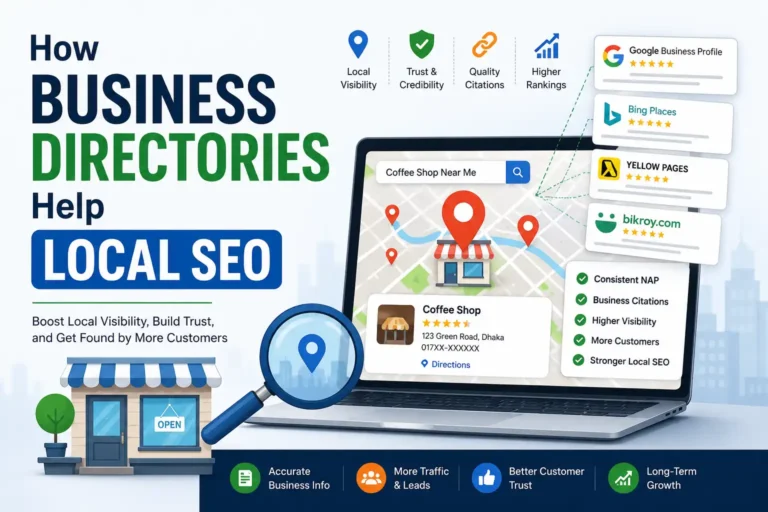
Can directories help Local SEO? Directory listings can contribute to local SEO as structured citations — consistent published mentions of a business’s name, address, and phone. Local search visibility depends on many signals, with Google describing local ranking around relevance, distance, and popularity (commonly called prominence). Listings support that footprint; they cannot guarantee rankings.
The local SEO connection, kept accurate:
- Citations corroborate. Search systems assemble each business’s picture from many sources; accurate directory listings add structured sources that agree with the business’s website and Google Business Profile. Consistency across sources supports confidence in the data.
- Local ranking draws on many signals. Google describes local ranking around relevance, distance, and popularity — the factor the SEO community commonly calls prominence — and no single signal, directory listings included, determines outcomes.
- Directory pages can carry visibility. Category-and-location pages from directories can appear in search results, and listed businesses share in that exposure where it occurs.
- Quality beats volume. A few accurate listings on credible platforms serve a business better than mass submissions, which create the inconsistency this whole system penalizes.
The mechanics in full — citations, NAP consistency, selection, optimization, and measurement — are covered in our dedicated guide to how business directories help local SEO, and the broader owner’s playbook in how local SEO helps small businesses grow. The one-line summary both guides share: directories are a supporting signal within local SEO — never a guarantee, and never a substitute for an accurate profile, a real website, and genuine reviews.
Business Directories and AI Search
A newer dimension of the same need: the systems answering consumers’ questions are changing, and organized business information matters to them too.
AI search systems — AI overviews, chat assistants, answer engines — use both structured and unstructured web data when describing businesses: directory listings, structured data markup, websites, articles, reviews, and other trusted sources. When someone asks an AI tool about businesses in a category and area, the answer reflects what the web consistently and legibly says.
The implications, bounded honestly:
- Structured directories contribute crawlable, organized data — one input among many that these systems draw on.
- Consistency remains the currency. Businesses described identically across sources give AI systems coherent material; conflicting details risk misdescription or omission.
- No platform can guarantee AI visibility. How AI systems select and weight sources continues to evolve, and any directory claiming to control AI results is overclaiming. What businesses and platforms control is the quality of the input — complete, accurate, consistent information.
For Bangladesh specifically, this raises the stakes of the information gap: as more consumer questions get answered by AI systems, markets with organized, maintained business data will be represented more accurately than markets without it. Trusted directories are part of building that data layer.
Common Misconceptions About Business Directories
|
Misconception |
Reality |
|---|---|
|
A directory listing proves a business is legitimate. |
A listing is organized information, not certification. Verification processes, where they exist, have defined scopes — and customers should still verify important details independently. |
|
Directories guarantee customers or rankings. |
No directory guarantees outcomes. Listings support discovery, citations, and credibility; demand, service, and reputation produce the results. |
|
All directories are basically the same. |
Editorial standards, maintenance, and honest framing separate trusted directories from unmanaged ones — and determine whether listings help or add noise. |
|
Directories are obsolete now that Google exists. |
Google Business Profile is the priority asset, but directories still serve deliberate category browsing, contribute citations, and add organized data that search and AI systems read. |
|
Listing everywhere is better than listing selectively. |
Quality and consistency create value; mass listings on careless platforms create inconsistency and maintenance burden. |
|
Reviews on a page make a directory unnecessary. |
Reviews and structured listings answer different questions — what customers experienced versus what the business’s organized details are. Careful buyers use both, as our guide on why customer reviews matter for businesses explains. |
How to Choose a Reliable Business Directory
Whether you’re a consumer deciding how much weight to give a listing, or a business deciding where to be present, the same filters apply:
- Real usage. Do the directory’s pages appear in relevant searches? Do listings look visited and current? A directory nobody uses helps nobody.
- Editorial standards. Is there evidence of review and cleanup — or does it accept anything? Spam-heavy categories answer the question.
- Information quality. Open several listings: are details complete, specific, and plausible? Are duplicates common?
- Maintenance. Do listings reflect current reality — or are closed businesses and dead numbers still listed?
- Honest framing. Does the platform present listings as organized information and clearly explain any verification process — or does it imply endorsement of everything listed? Overselling is disqualifying.
- Control for businesses. Can a business claim, correct, and update its listing? Uncorrectable listings become liabilities the first time details change.
- Local relevance. For Bangladesh’s market, Bangladesh-focused platforms that organize local businesses by familiar categories and locations serve local discovery best.
Business Directory Checklist
|
Check |
What Good Looks Like |
|---|---|
|
Usage |
Pages appear in searches; listings look active |
|
Standards |
Spam filtered; duplicates rare |
|
Quality |
Complete, specific, current details |
|
Maintenance |
Stale listings corrected or removed |
|
Framing |
Honest about what listings prove |
|
Control |
Businesses can claim and update |
|
Relevance |
Serves your country, city, or industry |
Future of Trusted Business Directories in Bangladesh
A balanced look ahead — grounded in visible trends rather than predictions:
The trust demand is rising. Consumer verification habits are spreading — through experience, through education, and through the simple accumulation of cautionary stories. Buyers who check before paying need organized places to check; that demand favors platforms with real standards.
The data demand is rising too. Search and AI systems increasingly mediate discovery, and they run on consistent, structured information. Bangladesh’s businesses will be represented in those systems as well or as poorly as the underlying data allows — a quiet but significant reason the information layer matters.
Standards will separate platforms. As directories multiply, the difference between maintained, honest platforms and careless ones will grow more visible — to users burned by stale listings and to systems that learn which sources to trust. The directories that matter long-term will be those that treat accuracy as the product.
The challenges are real. Keeping information current at scale, filtering fake listings, sustaining editorial standards, and staying honest about limits — these are ongoing costs, not solved problems. Directories that shortcut them will discredit themselves; the need is specifically for directories that don’t.
The realistic conclusion: Bangladesh’s digital economy will keep growing either way. Whether the information layer beneath it grows equally — organized, accurate, honest — depends on platforms choosing standards over shortcuts, businesses maintaining their own information, and consumers rewarding both by using and checking what they publish.
Key Takeaways
- Bangladesh’s commerce moved online faster than its trust infrastructure; trusted directories address the resulting gap with organized, maintained, checkable business information.
- A trusted directory is defined by standards — accuracy, editorial review, maintenance, and honest framing — not by the concept of listing businesses.
- A listing is one source of business information, never absolute proof; customers should verify important details independently before significant payments.
- For consumers, directories support discovery, comparison, and verification starting points; for businesses, they offer intent-driven visibility, consistent citations, and presence that rewards accuracy over budget.
- Local SEO depends on many signals, and AI search draws on both structured and unstructured data — directories contribute structured citation data to both, guaranteeing neither rankings nor AI visibility.
- Choose directories — as a user or a listed business — by usage, standards, information quality, maintenance, and honesty about limits.
Trusted business directories earn their place in Bangladesh’s digital economy by doing something unglamorous well: keeping organized business information accurate, current, and honestly framed. Used properly, they make informed decisions easier — a reliable starting point where consumers can discover and cross-check businesses, and where legitimate businesses can be found on the strength of complete, true information.
The operative words are starting point. Use directories as one verification source alongside official websites, Google Business Profiles, customer reviews, and other trusted references — and let agreement across those sources, not any single one, carry your confidence. That habit protects consumers, rewards honest businesses, and pushes the whole information layer toward the standard Bangladesh’s growing digital market needs. In the end, a directory’s real contribution is not telling people whom to trust — it is keeping business information accurate enough that trust can be checked.
Frequently Asked Questions
What makes a business directory “trusted”?
Standards, not size: listings that are reviewed and maintained rather than accepted wholesale, spam and duplicates filtered, details kept current, and honest framing about what a listing proves. A trusted directory presents organized business information and is clear about its limits — including that listing is not certification.
Are business directories still relevant in Bangladesh?
Yes, for bounded reasons. Deliberate category browsing remains a real discovery behavior; structured listings contribute citations that search systems corroborate; and AI answer systems draw on organized web data. Directories serve these roles as a supporting layer alongside Google Business Profile, business websites, and reviews — not as a replacement for them.
Can I trust a business just because it’s listed in a directory?
No. A listing means organized information exists about the business — which speeds up your checks but doesn’t complete them. Test the listed details, cross-check them against the business’s website and profiles, read independent reviews, and for significant payments, verify registration and get terms in writing.
Do directories verify the businesses they list?
Practices vary by platform. Some directories operate defined verification processes and identify verified businesses accordingly where applicable; many listings on any platform present business-provided information. Trustworthy directories are transparent about which is which — and no verification process replaces a customer’s own due diligence for important transactions.
How do business directories help small businesses specifically?
They offer one of the few visibility arenas where completeness competes with budget: a small business’s precise, well-maintained listing sits in the same format beside larger competitors’. Listings also add consistent citations to the business’s footprint and may generate direct referrals depending on category demand, listing quality, and platform traffic.
Does listing in a directory improve Google rankings?
Not as a guaranteed lever. Local search visibility depends on many signals — Google describes local ranking around relevance, distance, and popularity (commonly called prominence) — and accurate listings contribute supporting citation data to that picture. Treat directories as reinforcement around a complete Google Business Profile, a real website, and genuine reviews.
How many directories should a business list in?
A small, credible, relevant set: platforms with real usage and standards that serve your country, city, or industry — each listing completed fully and kept current. Selective, maintained presence outperforms mass submissions, which create the inconsistency that undermines citation value.
What information should a good directory listing contain?
The business’s exact canonical name, full specific address, working primary phone, precise category, a natural specific description, and a website link where one exists — identical to the details on the business’s website and Google Business Profile. Completeness and consistency are what give a listing its value.
How are business directories connected to AI search tools?
AI search systems use both structured and unstructured web data when describing businesses — and directory listings are among the structured sources they can crawl. Consistent listings contribute coherent input to those systems. No directory can guarantee AI visibility; what’s controllable is the accuracy and consistency of the information itself.
What should I do if a directory listing turns out to be wrong?
As a consumer: trust your direct checks over the listing, and report the inaccuracy where the platform allows. As a business: claim and correct the listing if possible, and audit your details everywhere else — a wrong listing is usually a symptom of information drift across multiple platforms, best fixed from one canonical record applied everywhere.