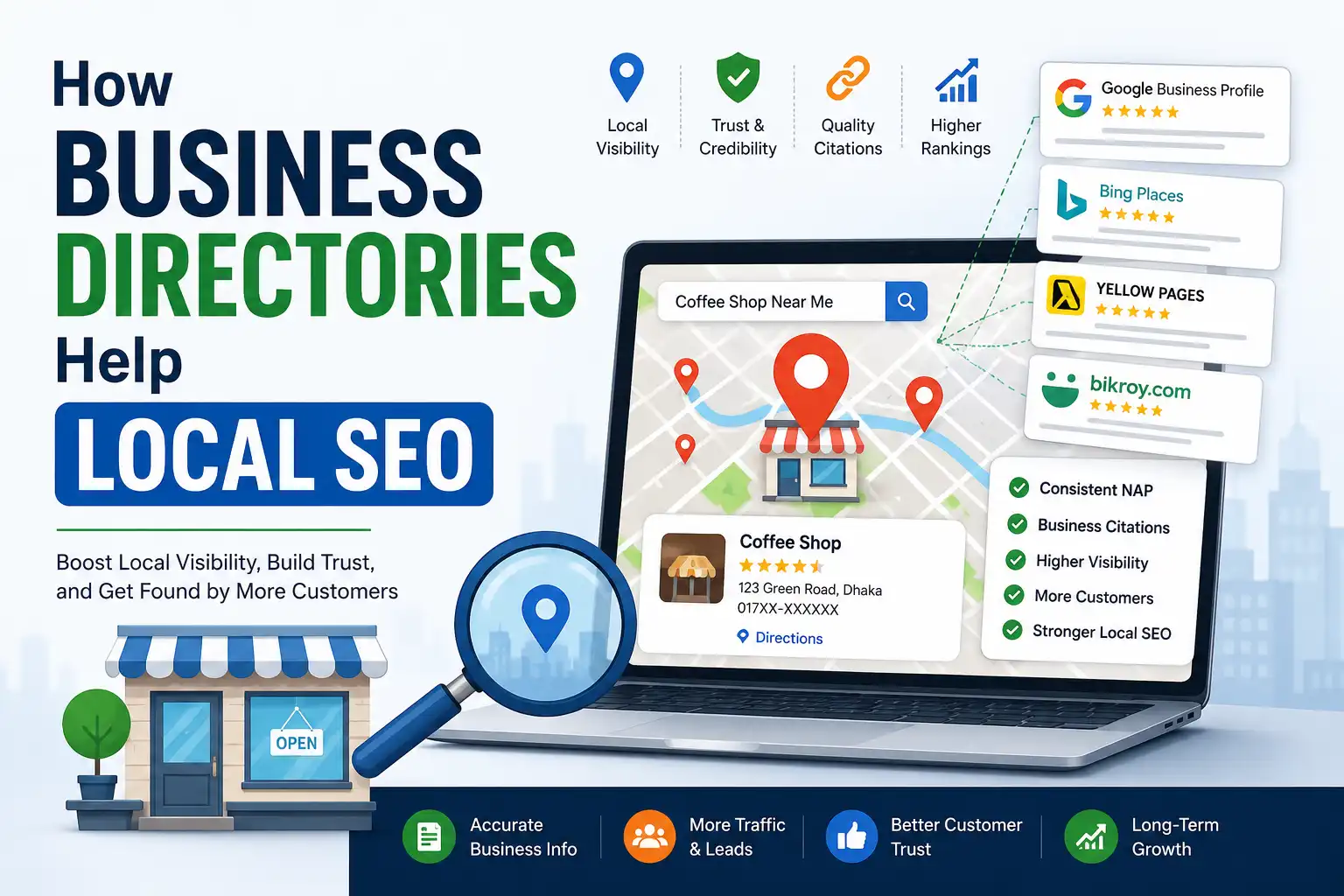
How Business Directories Help Local SEO
When someone searches for “pharmacy near me” or “web design agency in Dhaka,” search engines have to decide — in a fraction of a second — which local businesses deserve to appear. They make that decision based on signals, and business directories supply some of the oldest and most practical signals available: consistent business information, published across credible, organized sources.
That is the core of this guide. Business directories help local SEO not through tricks, but through consistency and presence: they confirm to search engines that a business exists, where it operates, how to contact it, and what category it belongs to. Done well, directory listings can support local visibility, referral traffic, and customer trust. Done carelessly — with mismatched names, dead phone numbers, and abandoned profiles — they can quietly work against all three.
This guide explains how the mechanics actually work: what local SEO is, what business citations and NAP consistency mean, how directories relate to Google Business Profile, how to choose and optimize listings, and how to measure whether any of it is making a difference. It is written for business owners first — no jargon assumed.
Who Should Read This Guide?
This guide is written for anyone responsible for a local business’s online visibility:
- Small business owners — shops, restaurants, clinics, salons, coaching centers — who want to appear when nearby customers search.
- Local service providers — electricians, repair technicians, tutors, designers — whose customers find them through search rather than storefronts.
- Marketing staff and freelancers managing listings and local presence for clients.
- New businesses in Bangladesh building their first online footprint, often starting from a Facebook page and a Google Business Profile.
- Established businesses whose information has drifted — old addresses, changed numbers, renamed brands — and who need to clean up what the internet says about them.
If customers in a specific area need to find your business online, this guide applies to you.
What Is Local SEO?
Local SEO (local search engine optimization) is the practice of improving a business’s visibility in location-based search results — the searches people make when they want something nearby: “restaurant in Dhanmondi,” “AC repair near me,” “printing press Chattogram.”
Local search results typically appear in two places:
- The map results — the map with accompanying business listings that appears for location-based queries, drawing largely on Google Business Profile data.
- The standard organic results — regular web results, where location-relevant pages (including directory listings and business websites) can rank.
Google currently describes local ranking in terms of three broad factors: relevance (how well a listing matches the search), distance (how far the business is from the searcher or searched location), and popularity (how well-known the business appears, based on information from across the web). The SEO community commonly refers to this popularity factor as prominence.
That third factor — popularity drawn from across the web — is where business directories enter the picture. A business that exists consistently in multiple credible places looks, to a search engine, more established than one that exists in only one place or contradicts itself across sources.
Local SEO, then, is not a single tactic. It is the combined effect of a well-maintained Google Business Profile, a coherent website, genuine customer reviews, and consistent business information across directories and other citations — all pointing to the same real business.
What Is a Business Directory?
What is a business directory? A business directory is an organized online platform that lists businesses with structured information — typically name, address, phone number, category, and description. Directories help customers discover and compare local businesses, and they give search engines consistent, verifiable signals about a business’s existence, location, and category.
A business directory is best understood as the modern descendant of the printed phone book — reorganized for search. Each listing presents a business in a structured format: name, address, phone number, website, category, hours, description, and often photos and customer reviews.
Directories serve two audiences at once:
- People use directories to discover and compare businesses by category and location — which is why directory listings often include the details buyers check first, as covered in our guide to finding verified businesses online.
- Search engines read directories as structured, third-party statements about a business: it exists, it is located here, it belongs to this category, it can be contacted this way.
Directories range from broad general platforms covering every category, to Bangladesh-focused directories organizing local businesses for local audiences, to niche directories serving a single industry. Info Ghor, for example, operates as a Bangladesh-focused business directory where users browse categories and view business profiles — the same structured information that, from the business’s side, functions as a citation.
One important distinction: a directory listing is a statement about a business, not a certification of it. Directories help discovery and visibility; verification remains the customer’s step, and quality remains the business’s job.
Why Business Directories Matter for Local SEO
How do business directories help local SEO? Business directories support local SEO by creating consistent citations — third-party mentions of a business’s name, address, and phone number — that help search engines confirm the business’s existence, location, and category. They can also drive direct referral traffic and support the prominence signals used in local ranking.
Directories matter for local SEO through four practical mechanisms:
1. They corroborate your business’s existence and location. Search engines are cautious about information they can’t confirm. When your name, address, and phone number appear identically on your website, your Google Business Profile, and several credible directories, the information corroborates itself. Consistency across independent sources is easier for algorithms to trust.
2. They contribute citations. In local SEO, a citation is any published mention of your business’s core details. Directory listings are among the most structured and crawlable citations available — more on this in the citations section below.
3. They can bring direct referral traffic. Directories have their own visitors: people actively browsing a category with intent to buy or hire. A well-completed listing can produce calls, visits, and website clicks entirely independent of ranking effects — often the most measurable benefit.
4. They occupy search results in your name. When someone searches your business name, directory listings frequently appear alongside your own website. Complete, accurate listings mean that whichever result a customer clicks, they find correct information — and, where listings carry reviews, social proof as well.
The honest framing: directories are a supporting element of local SEO, not its foundation. The foundation is a real, well-run business with an accurate Google Business Profile, a functional website, and genuine reviews. Directories reinforce that foundation; they cannot replace it.
How Business Directories Improve Local Search Visibility
Visibility improvements from directories arrive through several routes, each worth understanding separately:
Consistency strengthens trust in your data. Search engines assemble a picture of each business from many sources. When those sources agree, confidence in the data rises; when they conflict — two addresses, three phone numbers, a renamed brand — confidence falls, and confused data can surface for customers. Directory maintenance is largely the work of keeping the web’s picture of your business coherent.
Category and description data improve relevance matching. Directories ask you to classify your business and describe it. Accurate categories and naturally written descriptions help your listing match the searches your customers actually make — “furniture showroom,” “diagnostic center,” “event photographer” — in both the directory’s internal search and general web search.
Directory pages themselves can rank. For many category-plus-location searches, directory pages appear in organic results. A business listed (and well-presented) on a page that ranks inherits visibility from it — an indirect but real route to being found.
Reviews on listings add prominence and persuasion. Where directories or profiles carry customer reviews, they contribute to how established a business appears — to search engines evaluating prominence and to customers comparing options using the habits described in our guide to choosing a trusted business in Bangladesh. Reviews are also the element businesses least control, which is exactly why they carry weight.
Links and mentions accumulate. Some directory listings include a link to the business website. Individually, such links are modest; collectively, alongside mentions across the web, they contribute to the overall footprint that prominence reflects. This is a gradual, cumulative effect — not a lever that produces sudden ranking jumps.
Notice what all five routes share: they reward accurate, complete, consistent information — and punish shortcuts. That theme continues in the next two sections, which cover the two technical terms every local business owner should know.
NAP Consistency Explained
What is NAP consistency? NAP stands for Name, Address, Phone number. NAP consistency means presenting these three details identically everywhere your business appears online — website, Google Business Profile, directories, and social pages. Consistent NAP helps search engines confirm your business information and prevents customers from encountering outdated or conflicting details.
NAP consistency is the discipline at the center of directory-based local SEO.
Why it matters: search engines cross-reference your business details across the web. Consistent details corroborate each other; conflicting details create doubt about which version is correct. Customers face the same problem more painfully — an old address on a forgotten listing sends a real person to the wrong place.
What counts as consistent: the goal is that every source clearly describes the same business the same way. Trivial formatting differences (e.g., “Road” vs “Rd”) are generally less of a concern than substantive conflicts — different names, different numbers, different addresses.
NAP Consistency Examples
|
Element |
Consistent |
Inconsistent |
|---|---|---|
|
Name |
“Rahman Furniture” everywhere |
“Rahman Furniture” / “Rahman Furniture BD” / “Rahman Furnitures & Decor” across different sites |
|
Address |
Same full address on website, profile, and directories |
Old showroom address still live on two directories after relocation |
|
Phone |
One primary number everywhere |
Different numbers on website, listing, and Facebook page, some no longer active |
Common causes of inconsistency:
- Relocation or rebranding without updating old listings
- Different staff creating listings at different times with different wording
- Changed phone numbers, with old numbers left published
- Listings created automatically by platforms from outdated data, never claimed or corrected
The practical routine: decide the canonical version of your name, address, and phone — write it down — and use it verbatim everywhere. Then, once or twice a year, search your own business name and audit what appears. NAP consistency is not glamorous work, but it is some of the highest-value maintenance a local business can do, because every other signal builds on top of it.
Business Citations and Local SEO
How do citations improve local rankings? A citation is any online mention of a business’s name, address, and phone number, with or without a link. Accurate citations on credible platforms help search engines corroborate a business’s existence, location, and category — supporting the prominence and trust signals that local ranking draws on. Quality and consistency matter more than volume.
A business citation is any published mention of your business’s core details. Citations come in two forms:
- Structured citations: formal listings on directories, maps platforms, and review sites — data in labeled fields that machines parse easily.
- Unstructured citations: mentions in articles, blog posts, news items, or event pages — your business named in ordinary text.
Directory listings are the workhorse of structured citations, which is why directories and citations are discussed together.
Good Citation vs Poor Citation
|
Aspect |
Good Citation |
Poor Citation |
|---|---|---|
|
Accuracy |
Matches your canonical NAP exactly |
Old address, wrong number, variant name |
|
Platform |
Credible, maintained, relevant directory |
Abandoned or spam-heavy listing site |
|
Completeness |
Category, description, hours, photos filled in |
Name and number only, everything else blank |
|
Ownership |
Claimed and controlled by the business |
Auto-generated, unclaimed, uncorrectable |
|
Duplication |
One listing per business per platform |
Multiple conflicting duplicates |
Three principles govern citation work:
Quality over quantity. A modest number of accurate citations on credible platforms serves you better than a mass of low-quality listings. Bulk-submission services that blast your details to hundreds of obscure directories tend to create exactly the inconsistency and clutter this entire system penalizes.
Consistency over cleverness. Citations work by agreement. Every variant name or leftover old address weakens the corroboration effect.
Maintenance over accumulation. Citations age. Numbers change, businesses move, categories evolve. An annual audit of your existing citations is worth more than another round of new submissions.
Google Business Profile vs Business Directories
These two are complements, not competitors — but they play different roles and deserve different priorities.
A Google Business Profile is your business’s presence within Google Search and Google Maps: the panel and map listing customers see, with your details, photos, reviews, and posts. For most local businesses, it is the single most visible local asset and the first thing to set up and maintain — while noting, as explained in our company verification guide, that a profile is a visibility tool, not proof of legal registration.
Business directories are independent platforms with their own audiences, their own category pages, and their own citation value.
|
Aspect |
Google Business Profile |
Business Directories |
|---|---|---|
|
Primary role |
Visibility in Google Search and Maps |
Discovery, comparison, citations, referral traffic |
|
Audience |
People searching on Google |
People browsing categories with intent |
|
Control |
Claimed and managed by the business |
Claimed listings; formats vary by directory |
|
Reviews |
Central feature |
Varies by platform |
|
Citation value |
The reference point others are checked against |
Corroborating sources across the web |
|
Priority |
First — foundational |
After the profile and website are solid |
The practical sequence for a local business: first, a complete, accurate Google Business Profile; second, an accurate website (even a simple one); third, consistent directory listings that corroborate both. Directories amplify a solid foundation — they cannot substitute for a missing one.
Industry-Specific vs General Business Directories
Directories divide into two broad types, and a sensible local SEO approach usually uses both:
|
Aspect |
General Directory |
Industry-Specific (Niche) Directory |
|---|---|---|
|
Coverage |
All business categories |
One industry or profession |
|
Audience |
Broad — anyone searching locally |
Narrow — buyers already in your category |
|
Competition within listing pages |
Mixed categories |
Direct competitors side by side |
|
Relevance signal |
Location-focused |
Category-focused |
|
Typical value |
Citations, broad discovery |
Higher-intent referrals, category authority |
General directories — including Bangladesh-focused platforms that organize local businesses across categories — provide the citation breadth and everyday discovery: someone browsing for a nearby service finds you where they are already looking.
Niche directories — for clinics, law firms, wedding vendors, IT companies, and similar — concentrate high-intent visitors. A listing surrounded by direct competitors forces your profile to compete on completeness and reviews, which is uncomfortable and useful in equal measure.
For most businesses, the right mix is: the widely used general platforms relevant to your country and city, plus the one or two niche directories your actual customers consult. More than that adds maintenance burden faster than it adds value.
How to Choose the Right Business Directories
Not every directory deserves your time. Apply these filters before creating any listing:
- Real usage. Does the directory appear in search results for your category and area? Do its pages look visited and maintained? A directory nobody uses provides neither traffic nor meaningful citation value.
- Relevance. Does it cover your location or your industry? A Dhaka retailer gains little from an unrelated foreign directory; a Bangladesh-focused business directory is directly relevant.
- Editorial standards. Directories that review submissions and remove spam maintain the credibility that gives listings their value. Directories that accept anything, dilute everything.
- Control. Can you claim, edit, and update your listing? An uncorrectable listing becomes a liability the first time your details change.
- Reasonable terms. Free listings and clearly priced featured options are normal. Pressure tactics, ranking guarantees, or demands for irrelevant information are signals to walk away.
- A working page for you. Before listing, look at existing listings in your category: do they load properly, present businesses well, and appear in search? What the directory does for others, it will do for you.
A short list of good directories, fully maintained, outperforms a long list of mediocre ones every time.
How to Optimize Your Business Directory Listings
Creating a listing takes minutes; making it work takes intention. Optimize each listing you control:
|
Optimization Step |
What to Do |
|---|---|
|
Claim the listing |
Take ownership wherever the directory allows, so you control edits |
|
Use canonical NAP |
Your exact standard name, address, and phone — verbatim, every time |
|
Choose precise categories |
The most specific category that truly fits; secondary categories only if accurate |
|
Write a real description |
Natural, specific, customer-focused — what you do, for whom, where; no keyword stuffing |
|
Add authentic photos |
Real premises, real products, real work — not stock images |
|
Complete every field |
Hours, website, services, payment options — completeness is a quality signal to both users and platforms |
|
Keep hours current |
Including holidays and seasonal changes; wrong hours actively cost customers |
|
Link to the right page |
Your homepage or relevant location page, tested and working |
|
Encourage genuine reviews |
Invite real customers to share honest feedback where the platform supports it — never fabricate or incentivize dishonestly |
|
Respond professionally |
Reply to reviews and questions, especially critical ones — publicly visible conduct is part of the listing |
Two cautions worth making explicit:
- Write descriptions for people. Cramming keywords into a description reads badly to customers and adds nothing with modern search systems. Specific, natural language about what you actually do serves both audiences.
- Never buy or fake reviews. Beyond platform penalties, fabricated reviews are precisely what informed customers — and guides like our company reviews resources — teach people to detect. The reputational downside dwarfs any short-term lift.
Common Business Directory Mistakes
|
Mistake |
Why It Hurts |
|---|---|
|
Inconsistent NAP across listings |
Undermines the corroboration that gives citations value; misleads customers |
|
Creating listings and abandoning them |
Details go stale; stale details are worse than no listing |
|
Duplicate listings on one platform |
Splits reviews and confuses both algorithms and customers |
|
Wrong or over-broad categories |
Surfaces the business for the wrong searches and buries it for the right ones |
|
Keyword-stuffed names or descriptions |
Reads as spam to users; violates many platforms’ guidelines |
|
Mass submission to hundreds of directories |
Creates low-quality, uncontrolled citations that are painful to correct later |
|
Ignoring reviews on listings |
Unanswered complaints become the listing’s most memorable content |
|
Never auditing old listings |
Relocations and number changes leave a trail of wrong information working against you |
Nearly every mistake on this list is a variation of the same root error: treating listings as a one-time task instead of published information that must stay true.
Do Business Directories Still Matter?
Do business directories still work for SEO? Yes, with realistic expectations. Directories are no longer a dominant ranking tactic, but accurate listings on credible platforms still provide citation consistency, referral traffic, review visibility, and brand-search presence. They work as a supporting layer of local SEO — reinforcing a solid Google Business Profile and website, not replacing them.
It is a fair question. Search has changed: map results dominate local queries, AI-generated answers summarize options, and low-quality directories from an earlier era of SEO have faded. So do directories still earn their maintenance time?
The evidence-based answer is yes — for specific, bounded reasons:
- Citation consistency still matters. Search engines still corroborate business data across sources, and directories remain the most structured sources available.
- People still browse them. Category-and-location discovery is a persistent behavior, particularly where a directory serves a local market well. That traffic converts regardless of algorithms.
- Brand searches surface listings. Your customers will see directory pages when they search your name; accurate ones help you, stale ones hurt you — that choice remains yours.
- AI search draws on the wider web. AI search systems use both structured and unstructured web data — including business directories, structured data markup, news articles, and other trusted online sources — when describing businesses. Coherent, consistent listings feed the same accuracy that has always mattered, now consumed by new audiences.
What directories no longer do: deliver rankings by volume. The era when a hundred listings moved positions is over, and services still selling that idea are selling the past. The modern value is narrower and steadier — consistency, presence, and referrals from a curated set of credible platforms.
How to Measure Results
Directory work should be judged by evidence, not impressions. Practical measurements:
- Referral traffic. Website analytics show visits arriving from each directory. This is the most direct measure of a listing’s audience value.
- Calls and actions from listings. Where platforms provide listing analytics — views, calls, direction requests, clicks — track them over months. Google Business Profile offers this for its own listing; some directories do as well.
- Ask customers. “How did you find us?” remains underrated. A simple tally at the counter or on inquiry forms attributes what analytics miss.
- Local visibility spot-checks. Periodically search your main category and area (in a clean or private browser session) and note what appears — your profile, your site, directory pages listing you. Track direction over months, not day-to-day movement.
- Citation audit results. Count the listings that carry your correct canonical NAP versus those with errors. Rising accuracy is itself a measurable outcome — and usually precedes the others.
Set expectations accordingly: directory effects are gradual and cumulative. Measure quarterly, look for trends, and weight direct evidence (referrals, calls, customer answers) above assumptions about rankings.
Local SEO Checklist for Business Directories
Work through this checklist to put the whole guide into practice:
Foundation
- Canonical NAP written down — exact name, address, phone
- Google Business Profile claimed, complete, and accurate
- Website (or primary page) shows the same canonical details
Directory Selection
- Relevant general directories identified (country- and city-relevant)
- One or two niche directories for your industry identified
- Each directory checked for real usage, editorial standards, and claimable listings
Listing Quality
- Every listing claimed where possible
- Canonical NAP used verbatim on every listing
- Precise categories selected
- Natural, specific descriptions written — no keyword stuffing
- Real photos added; all fields completed
- Website links tested and pointing to the right pages
Reputation
- Genuine customer reviews invited where platforms support them
- Reviews and questions answered professionally, especially critical ones
Maintenance
- Old and duplicate listings found and corrected or removed
- Details updated everywhere after any move, rebrand, or number change
- Audit scheduled — every 6 to 12 months
- Results tracked: referrals, calls, customer attribution
Business Directory Best Practices
The durable principles, stated plainly:
- Decide your canonical details once; repeat them everywhere. Consistency is the entire game.
- Prefer few and credible over many and random. Every listing you create is information you must keep true.
- Complete listings fully. Half-empty profiles signal neglect to customers and platforms alike.
- Write for the customer reading, not the crawler indexing. Modern search rewards the same clarity people do.
- Treat reviews as part of the listing. Earn them honestly, answer them professionally.
- Update before you expand. Fix what exists before adding new listings.
- Audit on a schedule. Business details drift; only deliberate maintenance keeps the web’s picture of you accurate.
- Judge by evidence. Keep the directories that demonstrably send customers or hold your correct citation; let the rest go.
Common Myths About Business Directories
|
Myth |
Reality |
|---|---|
|
More listings always mean better rankings. |
Quality and consistency drive value. Mass low-quality listings create clutter and inconsistency that work against you. |
|
Directories are obsolete because of Google. |
Google Business Profile is the priority, but directories still provide citations, referral traffic, and brand-search presence — a supporting role, not an obsolete one. |
|
A directory listing guarantees local visibility. |
No listing guarantees rankings. Directories corroborate and amplify a solid foundation; the foundation must exist. |
|
Set-and-forget is fine — listings don’t change. |
Your details change: moves, numbers, hours, branding. Unmaintained listings decay into misinformation published under your name. |
|
Keyword-stuffing the business name boosts results. |
Manipulated names violate platform guidelines, confuse citations, and read as spam to the customers you want to convince. |
|
Paid listings always outperform free ones. |
Payment buys placement on that platform, not search rankings. Judge paid options by the referral traffic they demonstrably deliver. |
Before Optimization vs After Optimization
|
Before Directory Optimization |
After Directory Optimization |
|---|---|
|
Business details differ across the web |
One canonical NAP repeated everywhere |
|
Unclaimed, auto-generated listings with stale data |
Claimed listings the business controls and updates |
|
Blank fields, no photos, generic descriptions |
Complete profiles with real photos and specific descriptions |
|
Old addresses and dead numbers still published |
Audited citations — corrected, deduplicated, current |
|
Reviews unanswered on scattered platforms |
Reviews invited honestly and answered professionally |
|
No idea whether listings produce anything |
Referrals, calls, and attribution tracked quarterly |
|
Directory work done once, years ago |
Maintenance on a schedule, judged by evidence |
Key Takeaways
- Business directories support local SEO through consistent citations, referral traffic, review visibility, and presence in brand searches — a reinforcing layer, not a foundation.
- Google currently frames local ranking around relevance, distance, and popularity (commonly called prominence in the SEO community); consistent information across credible sources feeds the trust behind those signals.
- NAP consistency — identical name, address, and phone everywhere — is the discipline on which all citation value rests.
- Choose few, credible, relevant directories; claim, complete, and maintain every listing you create.
- Avoid the classic failures: mass submissions, keyword-stuffed listings, duplicates, and set-and-forget neglect.
- Measure by evidence — referral traffic, calls, and customer attribution — and expect gradual, cumulative results.
Frequently Asked Questions
What is a business citation in local SEO?
A citation is any online mention of a business’s core details — name, address, and phone number — with or without a link. Structured citations appear as formal listings on directories and maps platforms; unstructured citations appear as mentions in articles or posts. Accurate citations on credible platforms help search engines corroborate a business’s existence, location, and category.
How many business directories should a business be listed in?
There is no fixed number. A practical approach is the widely used general platforms relevant to your country and city, plus one or two niche directories your customers actually consult — each fully completed and maintained. A small, accurate, credible set outperforms mass submissions, which tend to create inconsistency and maintenance burden.
Do directory listings directly improve Google rankings?
Not as a direct lever. Consistent, accurate listings contribute to the broader corroboration and prominence signals that local ranking draws on, and directory pages themselves can appear in search results. Treat listings as supporting infrastructure around a strong Google Business Profile and website — helpful in combination, not decisive alone.
What does NAP stand for, and why does it matter?
NAP stands for Name, Address, Phone number. It matters because search engines cross-reference these details across the web: agreement between sources builds confidence in the data, while conflicts create doubt. Customers face the same issue directly — outdated details on a forgotten listing send real people to wrong places and dead numbers.
Are paid directory listings worth it?
Sometimes — judge them as advertising, not as an SEO purchase. A paid or featured listing buys placement and visibility within that directory; it does not buy search rankings. If a directory demonstrably sends your business referral traffic or calls, a featured position there may be worth testing. Measure the results and decide on evidence.
Can wrong directory information actually hurt a business?
Yes, in two ways. Practically, wrong addresses, hours, or numbers send customers astray and cost real sales. Algorithmically, conflicting details across the web weaken the consistency that makes citations valuable. This is why auditing and correcting old listings often delivers more benefit than creating new ones.
Should a new business in Bangladesh start with directories or Google Business Profile?
Start with a complete, accurate Google Business Profile — it is typically the most visible local asset. Ensure your website or primary page carries the same canonical details. Then add consistent listings on relevant Bangladesh-focused general directories and one or two niche directories for your industry. Directories corroborate the foundation; build the foundation first.
How often should directory listings be updated?
Immediately whenever anything changes — address, phone, hours, name, or ownership — and audited on a schedule of every six to twelve months even without changes. Listings decay quietly: platforms merge data, duplicates appear, and old details resurface. Scheduled audits catch drift before customers do.
Is it okay to add keywords to my business name in listings?
No. Your listing name should be your real business name. Adding extra keywords (“Rahman Furniture – Best Cheap Furniture Dhaka”) violates most platforms’ guidelines, creates citation inconsistency with your registered and displayed name, and reads as spam to customers. Put descriptive language in the description field, written naturally.
How long does it take to see results from directory listings?
Expect gradual, cumulative effects over months rather than immediate movement. Referral traffic from a well-placed listing can begin as soon as the listing is live; citation-consistency benefits build as platforms recrawl and data settles. Measure quarterly — referrals, calls, and customer attribution — and evaluate trends rather than daily fluctuations.