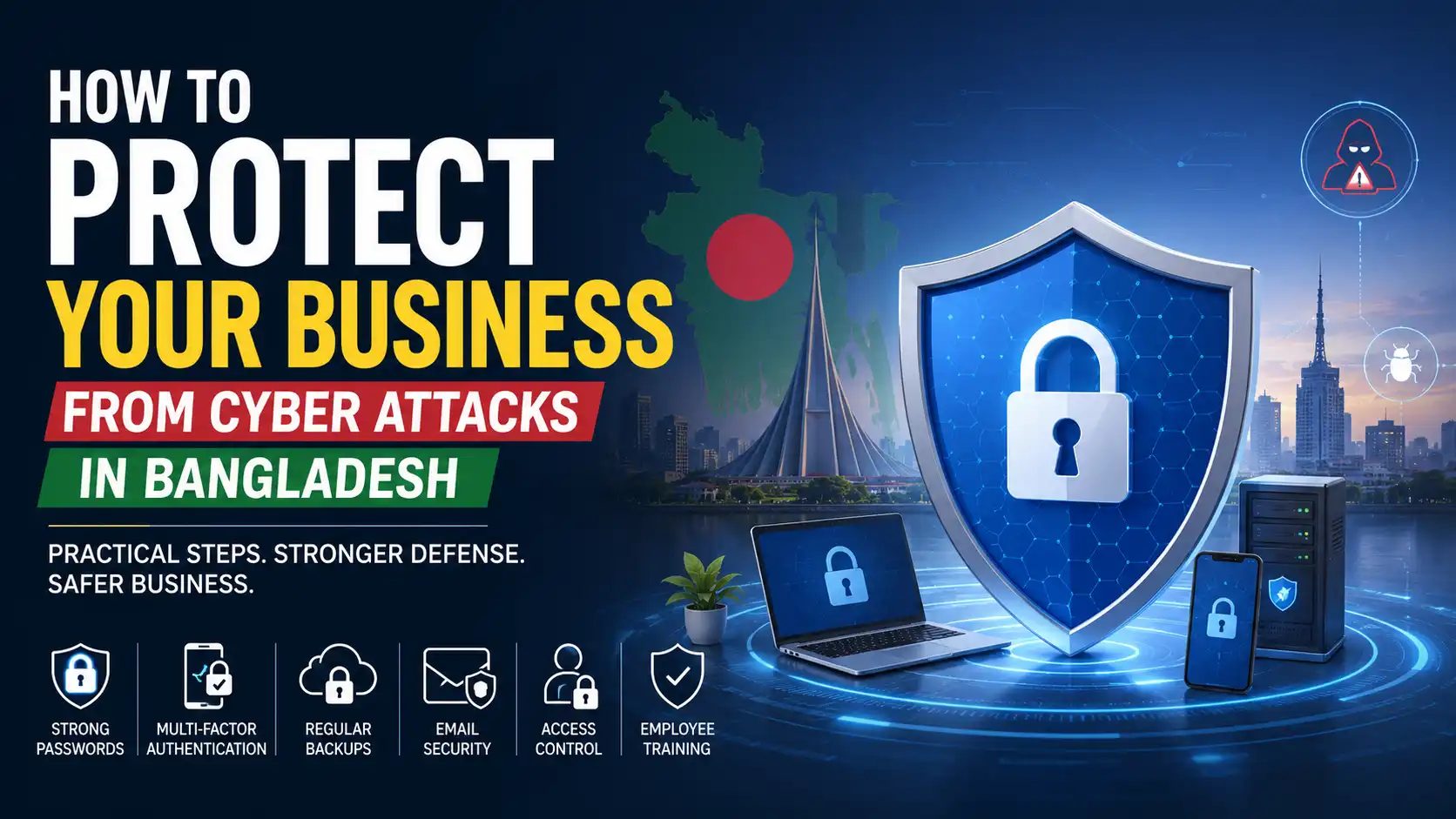
How to Protect Your Business from Cyber Attacks in Bangladesh
A decade ago, cybersecurity felt like a concern for banks and big corporations. Today, a small online clothing shop in Dhaka, a logistics company in Chattogram, and a coaching centre selling courses through Facebook all run on the same fragile foundation: email accounts, mobile financial services, customer databases, and cloud tools. When any of these is compromised, the damage is immediate — stolen money, lost customer trust, leaked data, and days of disrupted operations.
This guide explains how to protect your business from cyber attacks in Bangladesh using practical, mostly low-cost measures that any organisation can implement. It is written for business owners and managers, not IT specialists, though technical teams will find it useful as a checklist.
One principle shapes everything that follows: prevention is far cheaper than recovery. Restoring systems after a ransomware attack, rebuilding customer trust after a data leak, or recovering money sent to a fraudster is difficult, slow, and sometimes impossible. Most successful attacks exploit basic weaknesses — weak passwords, unpatched software, untrained staff — that cost little to fix in advance.
By the end of this guide, you will understand what cyber attacks are, which threats most commonly target Bangladeshi businesses, how to defend against them step by step, and what to do if an incident happens anyway.
What Is a Cyber Attack?
A cyber attack is any deliberate attempt to access, damage, disrupt, or steal from computer systems, networks, devices, or data without authorisation. The attacker’s goal is usually one of four things: money (through theft, fraud, or extortion), data (customer records, financial information, trade secrets), access (using your systems to attack others), or disruption (taking your operations offline).
Common attack methods include:
- Deceiving people — fake emails, messages, or calls that trick staff into revealing passwords or sending money
- Malicious software — programs that infect devices to steal data, spy on activity, or lock files for ransom
- Exploiting technical weaknesses — attacking outdated software, misconfigured websites, or unsecured networks
- Abusing stolen credentials — logging in with passwords leaked or guessed from elsewhere
For a business, the effects go beyond the immediate incident. A cyber attack can mean direct financial loss, operational downtime, permanent loss of data, damaged customer relationships, regulatory complications, and — in serious cases — the closure of the business itself. Importantly, attackers do not only target large companies; automated attacks scan the internet for any vulnerable target, which means small businesses are attacked constantly whether they realise it or not.
Why Bangladeshi Businesses Are Increasingly Targeted
Several structural shifts have expanded the “attack surface” of businesses in Bangladesh — the number of ways an attacker can reach them.
Digital transformation. Businesses that once ran on paper ledgers now depend on accounting software, cloud documents, and digital communication. Every new system is a new potential entry point if not secured properly.
E-commerce growth. Online stores, Facebook-based sellers, and marketplace merchants handle customer data and digital payments daily — exactly the assets financially motivated attackers want.
Online banking and mobile financial services. Business transactions increasingly flow through internet banking and mobile financial services. Fraudsters follow the money, targeting both the systems and — more often — the people who operate them.
Cloud adoption. Cloud tools bring enormous benefits, but a single compromised account can now expose files, emails, and customer records that once sat safely inside an office.
Remote and hybrid work. Staff working from home networks and personal devices operate outside the office’s controlled environment, creating security gaps that attackers exploit.
SME digitalisation. Thousands of small and medium enterprises have gone digital rapidly — often without any security budget, dedicated IT staff, or formal policies. Attackers know that smaller organisations tend to be the least defended.
None of this means going digital is a mistake. It means security must grow alongside digital adoption — which, as this guide shows, is achievable at every budget level.
Most Common Cyber Threats Facing Businesses
Understanding the threats is the first defence. Here are the attack types businesses in Bangladesh — and worldwide — most commonly face.
Phishing
Phishing is the practice of sending fraudulent messages — usually emails, but also SMS and messaging apps — designed to trick recipients into revealing passwords, clicking malicious links, or opening infected attachments. A typical example: an email that looks like it came from your bank, a courier service, or a software provider, urging you to “verify your account” through a fake login page. Phishing is consistently described by security organisations worldwide as one of the most common ways attacks begin.
Ransomware
Ransomware is malicious software that encrypts your files — making them unusable — and demands payment for their release. Modern ransomware groups often also steal data before encrypting it, threatening to publish it if the ransom is not paid. Ransomware can halt an entire business overnight, and payment offers no guarantee of recovery, which is why backups and prevention matter so much.
Malware
Malware is the umbrella term for all malicious software: viruses, spyware that records what you type, trojans disguised as legitimate programs, and more. Malware commonly arrives through email attachments, pirated software, infected USB drives, and compromised websites.
Business Email Compromise (BEC)
BEC is a targeted fraud in which attackers impersonate — or actually take over — a trusted email account, such as a company director’s or a supplier’s, and use it to request payments or sensitive information. A classic scenario: your regular supplier “emails” new bank account details for an upcoming payment. The email looks authentic; the account belongs to a fraudster. BEC attacks succeed through trust, not technology, and cause severe financial losses globally.
Password Attacks
Attackers guess weak passwords, try passwords leaked from other websites (since people reuse them), or use automated tools to test thousands of combinations. A single reused or weak password on an important account — email, banking, admin panels — can undo every other security measure.
Insider Threats
Not all threats come from outside. A disgruntled employee, a careless staff member, or a departing worker who retains access to systems can leak data or cause damage — intentionally or accidentally. Access control and offboarding procedures exist precisely for this risk.
Social Engineering
Social engineering is the manipulation of people rather than machines: a phone call pretending to be from “IT support” asking for a password, someone impersonating a bank officer requesting an OTP, or an urgent message pressuring a junior employee to bypass procedure. The defining feature is psychological pressure — urgency, authority, fear, or helpfulness.
Data Breaches
A data breach is any incident in which confidential information — customer details, payment records, employee files — is accessed or exposed without authorisation. Breaches result from many of the attacks above, as well as from simple misconfiguration, such as an unsecured database left open on the internet.
Fake Websites and Pages
Attackers create lookalike websites, Facebook pages, and apps that imitate legitimate businesses — including yours — to defraud customers or harvest credentials. Monitoring for impersonation of your own brand protects both your customers and your reputation.
Supply Chain Attacks
Instead of attacking you directly, attackers compromise a vendor you trust — a software provider, an IT contractor, an agency with access to your systems — and reach you through them. This is why vetting vendors and limiting third-party access are recognised security practices worldwide.
Quick Comparison: Phishing vs Business Email Compromise
|
Aspect |
Phishing |
Business Email Compromise (BEC) |
|---|---|---|
|
Scale |
Mass — sent to many targets |
Targeted — aimed at specific companies or roles |
|
Method |
Fake links, attachments, login pages |
Impersonation of trusted people and payment fraud |
|
Goal |
Credentials, malware installation |
Direct financial transfer or sensitive data |
|
Best defences |
Email filtering, staff training, MFA |
Payment verification procedures, call-back confirmation |
How to Protect Your Business from Cyber Attacks
The following measures form a layered defence. No single measure is sufficient — and nothing is “100% secure” — but together they block the majority of common attacks.
1. Enforce Strong, Unique Passwords
Require long passwords (passphrases of multiple words work well) and — critically — a different password for every account. Password reuse is what turns one leaked account into ten compromised ones.
2. Use a Password Manager
Nobody can remember dozens of unique passwords. A reputable password manager generates and stores them securely, so staff only remember one master password. This single tool eliminates most password-related risk at low or no cost.
3. Turn On Multi-Factor Authentication (MFA)
MFA requires a second proof of identity — a code from an app, an SMS, or a security key — in addition to the password. Even if a password is stolen, MFA usually stops the attacker. Enable it first on email, banking, social media business pages, and admin accounts. Authenticator apps are generally considered stronger than SMS codes, though any MFA is far better than none.
4. Keep Software Updated
Updates fix security holes that attackers actively exploit. Enable automatic updates on operating systems, browsers, plugins, and business software — including your website’s CMS and extensions. Avoid pirated software entirely: it cannot be updated safely and frequently arrives pre-infected.
5. Train Your Employees
Most successful attacks begin with a human decision — a clicked link, a shared OTP, an approved fake invoice. Regular, simple awareness training teaches staff to recognise phishing, verify unusual requests, and report suspicious activity without fear of blame. Security-aware employees are the strongest defence any business has.
6. Secure Your Wi-Fi
Change default router passwords, use modern Wi-Fi encryption (WPA2 or WPA3), keep router firmware updated, and separate guest Wi-Fi from the network your business systems use.
7. Back Up Your Data — Properly
Backups are your insurance against ransomware, theft, fire, and simple hardware failure. A widely recommended approach is the 3-2-1 rule:
|
Rule |
Meaning |
Example |
|---|---|---|
|
3 copies |
Your working data plus two backups |
Office computer + external drive + cloud |
|
2 different media |
Don’t keep all copies on the same type of storage |
Hard drive and cloud storage |
|
1 offsite |
At least one copy away from your premises |
Cloud backup or a drive stored elsewhere |
Crucially, test your backups periodically by restoring files — an untested backup is a hope, not a plan — and keep at least one backup disconnected from your network so ransomware cannot encrypt it too.
8. Install Endpoint Protection
Use reputable antivirus/anti-malware protection on every computer and, where practical, mobile devices used for business. Keep it updated and don’t disable it for convenience.
9. Strengthen Email Security
Email is the front door for most attacks. Use a business email service with strong spam and phishing filtering, enable MFA on all accounts, and — for companies with their own domain — ask your IT provider about email authentication standards (SPF, DKIM, and DMARC), which help prevent criminals from spoofing your domain.
10. Apply Access Control
Give each employee access only to the systems and data their job requires — the principle of least privilege. Use individual accounts rather than shared logins, review access periodically, and revoke it immediately when someone leaves.
11. Encrypt Devices
Enable built-in disk encryption on laptops and phones so that a lost or stolen device does not become a data breach. Modern operating systems include this at no extra cost.
12. Secure Your Website
If you run a website — especially an e-commerce site — keep its platform, themes, and plugins updated; use strong admin passwords with MFA; remove unused plugins; and take regular site backups. Web application firewalls and security plugins add further protection.
13. Use SSL/TLS Everywhere
Ensure your website uses HTTPS with a valid SSL/TLS certificate, which encrypts data between your visitors and your site. This protects customer information, builds trust, and is expected by browsers and search engines alike.
14. Choose Secure Hosting
Host your website and applications with a reputable provider that offers regular backups, malware scanning, firewall protection, and responsive support. The cheapest hosting is rarely the safest place for a business that depends on its website.
15. Conduct Regular Security Audits
Periodically review your security posture: who has access to what, which software is outdated, whether backups are working, and how staff respond to simulated phishing. Growing businesses should consider professional security assessments of their systems and websites.
16. Prepare an Incident Response Plan
Decide before an incident: who is contacted first, how systems are isolated, where backups are, who informs customers, and who speaks for the company. Even a one-page plan turns panic into procedure. The section below on responding to attacks provides a starting framework.
Cybersecurity Best Practices for Small Businesses in Bangladesh
Small businesses often assume security requires big budgets. In reality, the highest-impact measures are affordable or free:
- Start with the free essentials: MFA on all important accounts, automatic updates, unique passwords via a password manager, and device encryption — all achievable at little or no cost.
- Protect the money first. Secure the accounts connected to banking, mobile financial services, and payment platforms before anything else, and establish a strict rule: any change in payment details or any unusual payment request is verified by phone call to a known number — never by replying to the email or message itself.
- Protect your Facebook page and business accounts. For many Bangladeshi SMEs, the Facebook page is the business. Enable MFA, add more than one trusted admin, and never enter your page credentials through links received in messages — a common local scam pattern.
- Use business-grade email. Free personal email accounts for business invite impersonation; a proper business email on your own domain costs little and significantly improves security and credibility.
- Back up what you cannot afford to lose. Customer lists, accounts, designs, and documents — automated cloud backup for these costs less than one day of lost business.
- Train your team in one hour. A simple session covering phishing, OTP scams, and payment verification — repeated a couple of times a year — prevents the most common incidents.
- Know where to get help. Identify a trustworthy local IT service provider before you need one urgently.
Common Cybersecurity Mistakes Businesses Make
- “We’re too small to be targeted.” Automated attacks target everyone; small businesses are often hit precisely because they are less defended.
- Reusing one password everywhere. One leak elsewhere then opens every account you own.
- Sharing accounts among staff. Shared logins make MFA impossible, access control meaningless, and incidents untraceable.
- Ignoring updates. Postponed updates leave known, publicly documented holes open for attackers.
- Backups that were never tested — or that sit permanently connected to the same network ransomware will encrypt.
- Using pirated software. It cannot be safely updated and is a common malware carrier.
- No offboarding process. Former employees retaining access to email, pages, and systems is an entirely avoidable risk.
- Trusting caller ID and email display names. Both can be faked; verification must use independently known contact details.
- Buying tools instead of building habits. Software helps, but no product compensates for untrained staff and absent procedures.
What to Do If Your Business Is Attacked
Despite best efforts, incidents happen. A calm, ordered response limits the damage.
1. Isolate affected systems. Disconnect compromised computers from the network and internet (unplug the cable, disable Wi-Fi) to stop the attack spreading. Do not immediately wipe or reset devices — evidence of what happened may be needed.
2. Activate your incident response. Bring in your IT support or a professional security service to assess what was compromised, how, and whether the attacker still has access.
3. Reset credentials. Change passwords on affected and connected accounts — starting with email, banking, and admin accounts — from a clean, uncompromised device, and re-enable or strengthen MFA.
4. Contact your bank or payment provider immediately if money was transferred fraudulently or financial credentials were exposed. Speed matters in any attempt to stop or trace transactions.
5. Assess and restore from backups. Once systems are cleaned or rebuilt, restore data from backups made before the compromise — this is where tested, offline backups prove their worth, particularly against ransomware. Paying a ransom is widely discouraged by security authorities, as it funds criminals and guarantees nothing.
6. Communicate honestly with affected customers. If customer data was exposed, informing those affected promptly and clearly — what happened, what you’re doing, what they should do — protects them and preserves more trust than silence ever does.
7. Report the incident. In Bangladesh, cyber incidents can be reported to the relevant authorities, including specialised cybercrime units of Bangladesh Police, and nationally significant incidents are handled within the framework of the national computer incident response arrangements (see the note on laws and agencies below). Businesses should verify the latest reporting channels, contact points, and reporting procedures through official Bangladesh Police communications, as these may change over time. Reporting creates an official record and may assist investigation.
8. Learn and strengthen. After recovery, conduct a review: how did the attack succeed, and which of the measures in this guide would have prevented it? An incident survived should leave the business more secure than before.
A Note on Laws and Agencies in Bangladesh
Bangladesh maintains national cybersecurity institutions, including the Bangladesh e-Government Computer Incident Response Team (BGD e-GOV CIRT), operating under the Bangladesh Computer Council as the national CERT, which publishes security advisories and best-practice guidance. Businesses are encouraged to follow the security advisories and best-practice guidance published by BGD e-GOV CIRT alongside globally recognised cybersecurity resources.
On the legal side, Bangladesh’s cybersecurity legal framework has evolved in recent years, with legislation being revised and replaced more than once; readers should verify the latest legal position through official government publications and qualified legal professionals rather than relying on general articles — including this one.
Banks and financial institutions additionally operate under sector-specific ICT security requirements set by their regulator; businesses operating in regulated financial sectors should consult the latest Bangladesh Bank circulars, cybersecurity frameworks, and regulatory guidance for current compliance requirements.
Future of Cybersecurity in Bangladesh
AI-powered attacks. Attackers increasingly use AI to write convincing phishing messages — including fluent Bangla — clone voices, and automate attacks at scale. The era of spotting scams by their bad grammar is ending, making verification procedures more important than ever.
AI-powered defence. The same technology strengthens defence: modern security tools use machine learning to detect unusual behaviour, filter sophisticated phishing, and respond to threats faster than human teams alone.
Zero Trust. Global security practice is shifting toward Zero Trust — the principle of “never trust, verify always,” where every access request is verified regardless of whether it comes from inside or outside the network. Elements of this approach, such as MFA everywhere and least-privilege access, are already practical for Bangladeshi businesses today.
Cloud security maturity. As more Bangladeshi businesses move to cloud services, securing cloud configurations, accounts, and data-sharing settings will become as fundamental as locking the office door.
Growing awareness and skills. Cybersecurity awareness, professional training, and institutional capacity in Bangladesh are all developing, supported by national initiatives and a growing local security community — a trend that benefits every business able to tap into it.
Digital business growth. With the continued expansion of e-commerce, digital payments, and online services, cybersecurity is becoming a business fundamental in Bangladesh — not an IT afterthought but a component of customer trust, and increasingly a competitive advantage.
Frequently Asked Questions
What is the most common way businesses get hacked?
Deception-based attacks — phishing emails, fake messages, and social engineering — are consistently identified by security organisations as the most common starting point, because tricking a person is easier than breaking technology.
My business is small. Do I really need cybersecurity?
Yes. Automated attacks target every internet-connected system regardless of size, and small businesses often suffer more from incidents because they lack recovery resources. The essentials — MFA, updates, backups, unique passwords — cost little.
What is multi-factor authentication and why does it matter?
MFA adds a second verification step (such as an app code) beyond the password. It matters because it usually stops attackers even when they have stolen a password — making it one of the highest-impact single protections available.
How often should I back up my business data?
Frequently enough that losing the data since the last backup would be tolerable — daily for most active businesses. Follow the 3-2-1 approach, keep one copy offline or disconnected, and test restores periodically.
What should I do first if I receive a suspicious email?
Do not click links or open attachments. Verify the request through an independent channel — a known phone number, not contact details in the email — and report it to whoever handles IT in your business.
Should a business ever pay a ransomware ransom?
Security authorities worldwide generally discourage paying: it funds criminal operations and provides no guarantee of data recovery. Reliable offline backups are the real protection. Businesses facing this situation should seek professional incident response help.
How can I protect my business Facebook page from hackers?
Enable MFA on every admin’s account, maintain more than one trusted admin, never enter credentials through links received in messages, and be sceptical of “copyright violation” or “page verification” messages — common credential-theft lures.
Where can businesses report cyber incidents in Bangladesh?
Incidents can be reported to specialised cybercrime units of Bangladesh Police, and national-level incident response operates through BGD e-GOV CIRT under the Bangladesh Computer Council. For financial fraud, contact your bank or payment provider immediately as well.
Is antivirus software enough to protect my business?
No single tool is enough. Antivirus is one layer; effective protection combines it with MFA, updates, backups, access control, email security, and — above all — trained, alert staff.
How much should a small business spend on cybersecurity?
There is no universal figure, but the most effective early measures — MFA, password managers, automatic updates, cloud backup, and staff training — are free or inexpensive. Spend first on these fundamentals, then scale protection as the business and its risks grow.
Final Thoughts
Cybersecurity is not a product you buy once — it is a culture your business builds. Software and tools matter, but the businesses that stay safe are the ones where staff verify unusual requests, updates are never postponed, backups are tested, access is controlled, and security is discussed as naturally as sales targets. Start with the fundamentals in this guide, improve one step at a time, and revisit your defences as your business grows — because in a digital economy, protecting your systems is simply part of protecting your business.
Readers looking for IT service providers, hosting companies, and other verified technology businesses in Bangladesh can explore Info Ghor’s business directory, a Bangladesh-focused business directory that also publishes informational articles and guides like this one.