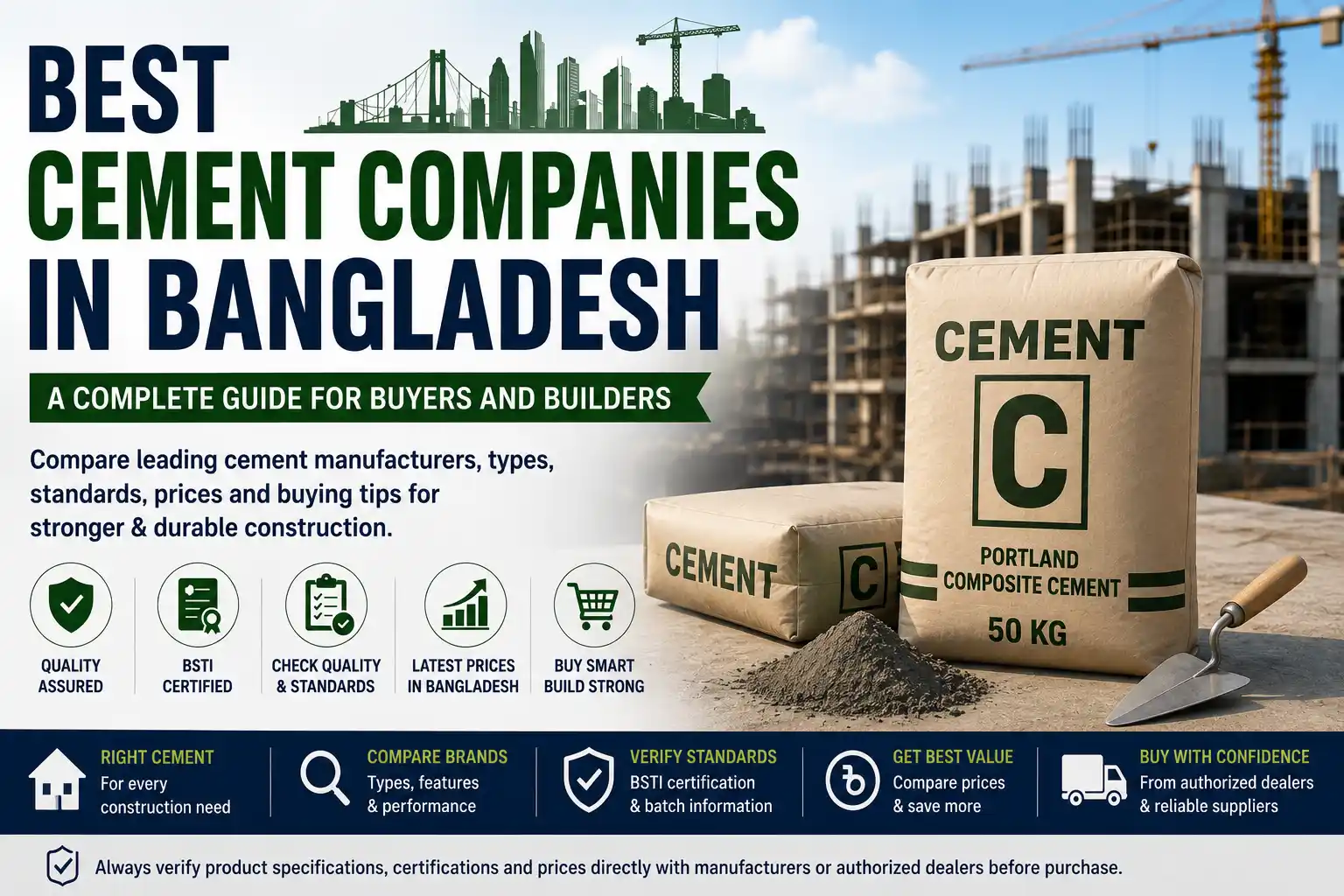
Best Cement Companies in Bangladesh: A Complete Guide for Buyers and Builders
Bangladesh’s construction sector has grown steadily over the past two decades, and choosing among the Best Cement Companies in Bangladesh is a decision that affects durability, safety, and long-term value for any building project. The country’s cement market includes both long-established domestic manufacturers and multinational-affiliated producers, each offering different product lines suited to residential, commercial, and infrastructure work. Cement products can differ in composition, specifications, manufacturing date, and intended application, which is why buyers should compare verified product information rather than relying on brand names alone.
This guide is designed to help builders, homeowners, and procurement teams navigate the Bangladesh cement market with more confidence. It covers how the industry operates, the types of cement commonly available, how to verify quality and standards compliance, and what practical steps to take before placing an order — whether for a small residential build or a larger commercial project.
Quick Answer: Bangladesh’s cement market includes established manufacturers such as Shah Cement, Crown Cement, Premier Cement, Bashundhara Cement, LafargeHolcim Bangladesh, and others. Buyers should verify BSTI certification and product specifications directly before purchase.
Bangladesh Cement Industry: An Overview
Cement production in Bangladesh is primarily a grinding and blending industry rather than full clinker manufacturing from raw ore. Bangladesh’s cement sector relies heavily on imported clinker and domestic grinding/blending. Clinker and key raw materials are substantially imported, then processed domestically by manufacturers into finished cement products.
The sector has expanded alongside Bangladesh’s construction boom, driven by residential housing demand, commercial development, and government infrastructure projects. Multiple domestic conglomerates and multinational-affiliated companies operate cement grinding and blending plants across the country.
The market includes Portland Composite Cement (PCC) and Ordinary Portland Cement (OPC). PCC is commonly used for many construction applications in Bangladesh, although suitability depends on project requirements. Because manufacturing processes, raw material sourcing, and quality control practices can differ between companies, product performance is not necessarily uniform across brands, which underscores the importance of checking standards compliance rather than relying on brand reputation alone.
Best Cement Companies in Bangladesh
The companies below are documented in public industry sources and are recognized as operating in Bangladesh’s cement sector. This list is not an official ranking, and inclusion does not constitute an endorsement of any company or product. No company on this list should be understood as ranked #1 or as the “best” in any verified sense — the word “best” reflects common search intent rather than an evaluative claim made by this article. Company information, product availability, certifications, and operations can change over time. Buyers should independently verify current product specifications, certifications, pricing, and availability directly with each manufacturer or an authorized dealer before purchasing.
Crown Cement PLC
Crown Cement PLC is a Bangladeshi cement manufacturer operating under the Crown Cement brand. Its current official information confirms composite cement products, and a verified facility is located in West Mukterpur, Munshiganj. Buyers should verify current product specifications, certifications, and availability directly with the company.
Premier Cement Mills PLC
A publicly listed Bangladeshi cement company operating under the Premier Cement brand, with a public market presence. Buyers should verify current product types, facility details, and certifications directly with the company at premiercement.com.
Bashundhara Cement
A cement brand operating in Bangladesh. Buyers should verify current company information, product types, specifications, facility locations, and certifications directly through official sources before purchasing.
LafargeHolcim Bangladesh PLC
LafargeHolcim Bangladesh PLC is a publicly listed cement company in Bangladesh and, according to its official corporate information, operates as a joint venture of Holcim and Molins. Buyers should verify current cement products, specifications, and certifications directly with the company at lafargeholcim.com.bd.
Confidence Cement PLC
A publicly listed Bangladeshi cement company operating under the Confidence Cement brand, with a factory located at Madambibirhat, Bhatiary, Sitakunda, Chattogram-4314. Buyers should verify current product types and certifications directly with the company at confidencecement.com.bd.
Shah Cement Industries Ltd.
A cement company operating as a concern of Abul Khair Group under the Shah Cement brand. Buyers should verify current product types, facility locations, and certifications directly with the company at shahcement.com.
Akij Cement
A cement brand operating in Bangladesh. Buyers should verify current company information, product types, facility details, and certifications directly through official sources.
Mir Cement Ltd.
A cement manufacturer operating in Bangladesh. Buyers should verify current company information, product types, facility details, and certifications directly through official sources.
Seven Rings Cement (Seven Circle Bangladesh Ltd.)
Seven Rings Cement is a brand of Seven Circle Bangladesh Ltd., a Bangladesh operating company under Shun Shing Group. The company currently markets Portland Composite Cement and Portland Cement products and operates plants in Dhaka, Khulna, and Chattogram. Buyers should verify current specifications and certifications directly with the company at sevenringscement.com.
Meghna Cement Mills PLC
Meghna Cement Mills PLC is a cement manufacturer under Bashundhara Group. According to the company’s official information, it is listed on both the Dhaka and Chittagong stock exchanges. Buyers should verify current product types, specifications, and certifications directly with the company.
Fresh Cement
A cement brand operating in Bangladesh. Buyers should verify current company information, product types, facility details, and certifications directly through official sources.
Aramit Cement
A cement brand operating in Bangladesh. Buyers should verify current company information, product types, facility details, and certifications directly through official sources.
Manufacturer Comparison Table
|
Company/Brand |
Parent Company |
Main Cement Types |
Bangladesh Facility/Location |
Standards/Certifications |
Official Website |
|---|---|---|---|---|---|
|
Crown Cement |
Crown Cement PLC |
Composite Cement |
West Mukterpur, Munshiganj |
Not publicly confirmed |
Not publicly confirmed |
|
Premier Cement |
Premier Cement Mills PLC |
Not publicly confirmed |
Not publicly confirmed |
Not publicly confirmed |
premiercement.com |
|
Bashundhara Cement |
Bashundhara Group |
Not publicly confirmed |
Not publicly confirmed |
Not publicly confirmed |
Not publicly confirmed |
|
LafargeHolcim Bangladesh |
Holcim and Molins joint venture |
Not publicly confirmed |
Not publicly confirmed |
Not publicly confirmed |
lafargeholcim.com.bd |
|
Confidence Cement |
Confidence Cement PLC |
Not publicly confirmed |
Madambibirhat, Bhatiary, Sitakunda, Chattogram-4314 |
Not publicly confirmed |
confidencecement.com.bd |
|
Shah Cement |
Abul Khair Group |
Not publicly confirmed |
Not publicly confirmed |
Not publicly confirmed |
shahcement.com |
|
Akij Cement |
Not publicly confirmed |
Not publicly confirmed |
Not publicly confirmed |
Not publicly confirmed |
Not publicly confirmed |
|
Mir Cement |
Not publicly confirmed |
Not publicly confirmed |
Not publicly confirmed |
Not publicly confirmed |
Not publicly confirmed |
|
Seven Rings Cement |
Shun Shing Group (Seven Circle Bangladesh Ltd.) |
Portland Composite Cement, Portland Cement |
Dhaka, Khulna, Chattogram |
Not publicly confirmed |
sevenringscement.com |
|
Meghna Cement Mills |
Bashundhara Group |
Not publicly confirmed |
Not publicly confirmed |
Not publicly confirmed |
meghnacement.com |
|
Fresh Cement |
Not publicly confirmed |
Not publicly confirmed |
Not publicly confirmed |
Not publicly confirmed |
Not publicly confirmed |
|
Aramit Cement |
Not publicly confirmed |
Not publicly confirmed |
Not publicly confirmed |
Not publicly confirmed |
Not publicly confirmed |
Cement is a standards-controlled product in Bangladesh; buyers should request current certification documentation directly from each manufacturer or dealer.
Types of Cement Available in Bangladesh
Portland Composite Cement (PCC) is a blended cement that combines clinker with supplementary materials, depending on the product specification. PCC is commonly used for general construction, but suitability depends on project requirements.
Ordinary Portland Cement (OPC) generally contains a higher clinker proportion than composite cements. OPC may be used for structural applications when specified by the engineer or design documents.
Some manufacturers may offer additional or specialized cement products; availability and suitability should be confirmed directly with the manufacturer and a qualified engineer.
PCC vs OPC Cement
|
Factor |
Portland Composite Cement (PCC) |
Ordinary Portland Cement (OPC) |
|---|---|---|
|
Composition |
Clinker blended with supplementary materials, depending on the specific product |
Higher clinker proportion with gypsum |
|
Common applications |
Commonly used for general construction, depending on project requirements |
May be specified for structural work where the engineer or project specification requires it |
|
Heat of hydration |
Generally lower |
Generally higher |
|
Strength development |
Often more gradual |
Often faster early strength gain |
|
Typical considerations |
Suitability depends on project specification and exposure conditions |
Suitability depends on project specification and structural design |
These characteristics can vary by manufacturer and specific product grade. Cement selection depends on project specification, exposure conditions, required performance, and engineering design — not on either cement type being inherently superior to the other.
How to Choose the Right Cement
Selecting cement for a project involves several factors:
- Construction type — residential, commercial, or infrastructure projects may call for different cement types.
- Cement grade/type — PCC, OPC, or other products depending on structural need.
- Structural requirements — foundations, columns, and load-bearing elements may require specific cement grades as determined by a structural engineer.
- Standards compliance — confirm the product carries valid BSTI certification.
- Manufacturing date — cement performance can degrade over time, so check production dates.
- Storage condition — verify the product has been stored properly before purchase.
- Packaging — intact, correctly labeled bags with visible batch information.
- Supplier/dealer reliability — buy from authorized, verifiable dealers.
- Engineer recommendations — structural cement selection should always follow qualified engineering advice specific to the project.
Cement Standards and Quality Verification in Bangladesh
Cement is a standards-controlled product in Bangladesh and must comply with applicable BSTI requirements. The Bangladesh Standards and Testing Institution (BSTI) is the national body responsible for developing Bangladesh Standards (BDS) and operating the Certification Mark (CM) scheme. Cement sold in Bangladesh must comply with applicable BSTI standards and certification requirements.
Buyers should check for the BSTI mark and clear batch/manufacturing information on the bag. For important structural or bulk procurement, relevant documentation and laboratory testing provide stronger compliance verification than visual inspection alone.
How to Check Cement Quality Before Buying
Basic consumer-level checks can help identify obvious problems, but they cannot replace laboratory testing or professional quality assurance for structural work. Buyers can:
- Check the manufacturing/packing date and avoid old stock
- Avoid bags containing hard lumps
- Check packaging for damage, moisture exposure, or signs of resealing
- Confirm the BSTI mark and manufacturer details are printed clearly
- Verify batch/manufacturing information
A fine, free-flowing texture can be used only as a basic warning check; it does not prove cement quality or standards compliance. For structural or large-scale projects, laboratory testing conducted by an accredited facility remains the reliable method for confirming compliance with the applicable Bangladesh Standard.
Cement Price in Bangladesh
Cement prices in Bangladesh are not fixed and can vary because of brand, product type, transportation costs, dealer margin, order size, raw-material costs, and broader market conditions. Because prices can shift frequently due to these variables, this guide does not list specific figures. Buyers should obtain current quotations directly from authorized dealers or manufacturers before finalizing a purchase decision.
Buying Cement for a Construction Project
Small residential projects typically involve smaller, phased purchases, making dealer reliability and product freshness particularly important since bags may sit in storage longer before use.
Larger projects often involve bulk purchases directly from manufacturers or authorized distributors, which can allow for better batch consistency and pricing, but require more careful delivery and storage planning.
Bulk purchases should include a check on manufacturing dates across the batch to avoid mixing significantly different-aged stock.
Dealer verification — confirm the dealer is authorized to sell the brand and can provide manufacturer contact information if needed.
Delivery and storage planning — coordinate delivery timing with actual usage to minimize prolonged storage, especially in humid conditions.
Cement Storage Best Practices
- Store cement in a dry, covered area
- Keep bags on raised, dry platforms
- Keep bags away from damp walls and other moisture sources
- Use older stock first (first-in, first-out)
- Inspect for damaged or torn bags before use
Cement may lose effectiveness over time, particularly if exposed to moisture or stored poorly.
Common Mistakes When Buying Cement
- Choosing cement based only on price without considering type or certification
- Ignoring the difference between PCC and OPC for the intended application
- Not checking manufacturing dates or batch information
- Poor storage after purchase, leading to quality degradation
- Buying from unverified or unauthorized sellers
- Disregarding project-specific engineering specifications
- Mixing different cement products or batches without technical justification
Red Flags When Buying Cement
- Damaged, torn, or resealed packaging
- Missing or unclear manufacturer information
- Absence of BSTI certification marks where required
- Prices significantly below typical market levels without explanation
- Poor storage conditions observed at the dealer’s premises
- Sellers unwilling to provide manufacturer or batch information
- Inability to verify the dealer’s authorization to sell the brand
Questions to Ask a Cement Supplier
- Is this product BSTI-certified, and can you show the certification mark?
- What is the manufacturing date of this batch?
- Is this cement PCC, OPC, or another type?
- How has this cement been stored prior to sale?
- Are you an authorized dealer for this brand?
- Can you provide the manufacturer’s contact information if needed?
- What storage period and storage conditions does the manufacturer recommend for this product?
- Do you have documentation for bulk order batch consistency?
- What are the current delivery timelines for the quantity I need?
- Can pricing be confirmed in writing before delivery?
Cement Buying Checklist
- Confirmed cement type (PCC, OPC, or other) matches project requirement
- Verified BSTI certification mark on packaging
- Checked manufacturing date and batch information
- Confirmed dealer authorization
- Inspected packaging for damage or moisture exposure
- Reviewed pricing and delivery terms in writing
- Planned storage conditions before delivery
- Consulted a qualified engineer for structural applications
Frequently Asked Questions
1. Which cement companies operate in Bangladesh?
Bangladesh has several active cement manufacturers, including domestic and publicly listed producers. Buyers should verify current company and product information through official manufacturer websites, regulatory sources, and stock-exchange disclosures where applicable.
2. Which type of cement is commonly used for construction in Bangladesh?
PCC is commonly used for many general construction applications in Bangladesh, while OPC is also commercially available and may be specified where project requirements call for it.
3. What is the difference between PCC and OPC?
PCC is a blended cement, while OPC is a Portland cement with a higher clinker content. Which one is appropriate depends on the project specification, exposure conditions, and engineering design.
4. How can I check whether cement meets Bangladesh standards?
Check for a valid BSTI certification/mark where applicable, verify batch and manufacturing details, and for important structural work rely on relevant documentation and laboratory testing rather than packaging alone.
5. How do I choose cement for building a house?
Choose cement based on the project specification, intended use, BSTI compliance, manufacturing date, storage condition, packaging integrity, and the guidance of a qualified engineer for structural elements.
6. Does cement have a shelf life?
Cement can lose effectiveness over time, especially if it is exposed to moisture or stored poorly. Check the manufacturing date and avoid old, moisture-damaged, or improperly stored stock.
7. Why do cement prices vary in Bangladesh?
Cement prices can vary because of brand, product type, transportation costs, dealer margin, order size, raw-material costs, and broader market conditions.
Key Takeaways
- Bangladesh’s cement sector relies heavily on imported clinker and domestic grinding/blending.
- Multiple domestic and publicly listed companies operate in the market, including Crown Cement PLC, Premier Cement Mills PLC, Confidence Cement PLC, LafargeHolcim Bangladesh PLC, Shah Cement Industries Ltd., and Seven Circle Bangladesh Ltd. (Seven Rings Cement), among others.
- PCC is commonly used for many general construction applications, while OPC may be specified for structural work when required by project design.
- Cement is a standards-controlled product, and buyers should verify BSTI certification and batch/manufacturing information directly.
- Cement prices vary based on multiple market factors and should be confirmed directly with dealers rather than assumed from published figures.
- Proper storage and timely use are essential to maintaining cement quality after purchase.
- Structural cement decisions should always follow qualified engineering advice and project specifications.
Official and Industry Resources
- Bangladesh Standards and Testing Institution (BSTI) — bsti.gov.bd
- Ministry of Industries, Government of Bangladesh
- Official manufacturer websites and public company disclosures, where available
Final Thoughts
There is no single cement product or brand that qualifies as universally “best” for every construction project in Bangladesh. The right choice depends on the specific requirements of the project, applicable engineering specifications, and verified compliance with Bangladesh Standards. Buyers should verify certification, manufacturing information, and product suitability directly with manufacturers or authorized dealers rather than relying solely on brand reputation or price. For any structural application, decisions should be guided by a qualified engineer, and price alone should never be the deciding factor in cement selection.