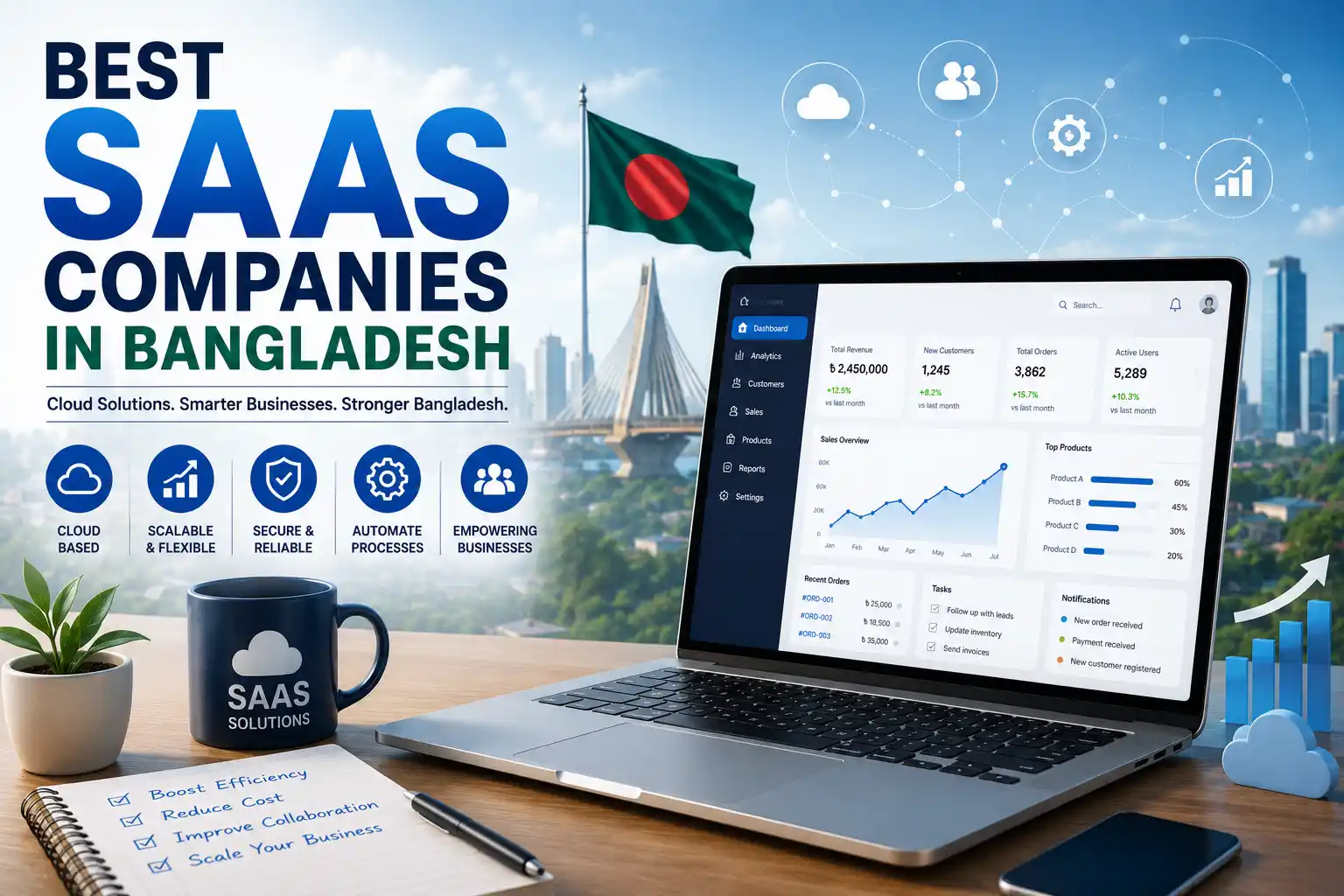
Best SaaS Companies in Bangladesh 2026
Software as a Service, commonly known as SaaS, is a way of delivering software over the internet instead of installing it on a local computer or server. Rather than buying a licence and maintaining hardware, a business simply subscribes to an application, logs in through a browser or app, and the provider takes care of hosting, updates, and security in the background.
In Bangladesh, this model is becoming increasingly common. Rising smartphone penetration, more affordable internet access, growing digital payment adoption, and a young, tech-comfortable workforce have all created favorable conditions for cloud-based business tools. Retailers want point-of-sale systems they can check from their phones. Garment factories want production and inventory data available in real time. Government agencies and financial institutions want secure digital platforms for millions of citizens. Small trading businesses want simple accounting software that doesn’t require an in-house IT team.
SaaS helps organizations of every size address these needs without heavy upfront investment. A startup can launch with a monthly subscription instead of buying servers. A small or medium enterprise (SME) can automate payroll, inventory, or customer management without hiring a large technical staff. A large enterprise can connect multiple departments, branches, or factories through a single cloud-based system, often alongside custom-built software for more specialized requirements.
Before going further, a few things are worth clarifying. This article is not an official ranking, and it does not declare any company to be the “best,” “largest,” or “most trusted” in the market. The companies mentioned below are included based on publicly available information about their SaaS products, business adoption, and general presence in Bangladesh’s software industry. Software features, pricing, integrations, and availability change frequently, so anything mentioned here should be verified directly with the company before making a decision.
How We Selected These SaaS Companies
Putting together a list like this requires a clear and honest selection process, especially in a market where marketing language often overstates a company’s position. The companies featured in this guide were considered based on the following criteria:
- Public business presence – the company has a verifiable website, business registration information, or public profile (for example, on LinkedIn, industry directories, or media coverage).
- SaaS product portfolio – the company offers at least one genuine cloud-based, subscription-style software product, not only custom development or one-off project work.
- Business software innovation – the company has built tools that address real operational needs such as HR, ERP, POS, CRM, or customer engagement.
- Cloud-based solutions – the core offering (or a significant part of it) is accessible over the internet rather than requiring on-premise installation only.
- Industry adoption, where this is publicly documented through case studies, client mentions, or media coverage.
- Consumer or business usefulness – the product solves a genuine, common problem for Bangladeshi businesses.
- Overall usefulness to the wider SME and enterprise ecosystem in Bangladesh.
Being included in this list is not an endorsement. It simply means the company has a public, verifiable SaaS presence in Bangladesh at the time of writing. Readers should always do their own due diligence, request demos, and compare multiple vendors before committing to any software solution.
Best SaaS Companies in Bangladesh
The following companies are listed in alphabetical order, not by ranking, size, or performance.
Alice Labs (MyAlice)
Alice Labs is a Dhaka-founded technology company behind MyAlice, a customer service and social commerce SaaS platform built for e-commerce and direct-to-consumer businesses. The company was founded in 2018 and has since grown into a subscription-based software provider serving online merchants across South Asia, the Middle East, and Southeast Asia.
MyAlice’s core product is a unified inbox that brings together social messaging channels such as Facebook, Instagram, and WhatsApp, live chat, and multilingual chatbot automation into a single dashboard. It also connects with e-commerce platforms to keep customer data, orders, and inventory information in one place, allowing support and sales teams to manage conversations without switching between apps.
The platform is aimed primarily at online retailers, direct-to-consumer brands, and businesses that rely heavily on social and messaging channels for sales and support. Publicly available information indicates Alice Labs has worked with brands in the FMCG, beauty, and retail sectors, and has received seed funding from investors including Anchorless Bangladesh, HOF Capital, and Startup Bangladesh Limited.
Because MyAlice is a cloud-hosted SaaS product with subscription-based access, businesses considering it should directly verify current integrations (such as which e-commerce platforms and messaging channels are supported), pricing tiers, and feature availability, since SaaS products in the customer engagement space evolve quickly.
AmarSolution
AmarSolution is a Bangladeshi software provider focused on point-of-sale (POS), billing, and inventory management systems for retail and wholesale businesses. The company positions itself as a cloud-accessible solution provider for shop owners who need to track sales, stock, and customer information without relying on paper-based systems.
Its core offering covers POS billing, inventory tracking, VAT calculation suited to Bangladeshi tax requirements, and reporting tools that give shop owners visibility into daily sales and stock levels. Rather than being a pure SaaS subscription provider, AmarSolution offers cloud-enabled POS and business management software alongside other deployment options, and the company also markets industry-specific variants of its software, including tools designed for tailoring shops and general retail businesses, along with add-on modules for customer and supplier management.
AmarSolution primarily serves small and medium-sized retail businesses, including general stores, boutiques, and specialty shops, rather than large enterprise clients. Its publicly listed features include cloud access, meaning business owners can check reports remotely rather than being tied to a single in-store computer.
As with any POS or inventory SaaS provider, exact hardware compatibility, supported payment methods, and current pricing plans should be confirmed directly with AmarSolution, since these details are often adjusted as the software is updated and as new integrations become available.
Bdtask
Bdtask is a Bangladeshi software company that has been operating for more than a decade, offering a large portfolio of ready-made and customizable software products across many industries. Rather than focusing on a single niche, Bdtask has built dozens of software solutions covering business management, hospitality, healthcare, education, e-commerce, and more.
Among its notable SaaS-style products is Sales ERP, a cloud-accessible enterprise resource planning tool aimed at small and medium businesses that need to manage sales, billing, inventory, accounting, and a basic CRM from one dashboard. Some of Bdtask’s offerings are cloud-accessible, SaaS-style solutions, while others are delivered as self-hosted or custom deployments depending on the client’s needs. Bdtask also offers a hospital management system, hotel and restaurant management tools, an HR manager product, and e-commerce solutions, among many others listed on its own website.
The company’s public materials describe its client base as spanning multiple countries, and it has publicly listed government and private-sector clients in Bangladesh in areas such as health, water supply, and manufacturing. Bdtask has also referenced ISO certification for quality management in its public profile.
Because Bdtask maintains a very large product catalogue that spans both true SaaS offerings and custom development work, prospective users should clarify with the company directly which specific products are delivered as ongoing cloud subscriptions versus one-time custom builds, and confirm current pricing and support terms before signing up.
BizMotion Limited
BizMotion Limited is a Dhaka-based software company that specializes in Sales Force Automation (SFA) solutions. Its core products, commonly referred to as MR Pro and SR Pro, are built for companies that need to track and manage field representatives, particularly in the pharmaceutical, FMCG, and consumer goods sectors.
The company’s SaaS-based tools allow businesses to digitize the daily activities of medical representatives and sales staff working in the field, using features such as geo-tracking, automated reporting, customer journey management, and analytical dashboards. This helps companies gain visibility into how their field teams are performing without relying on manual paperwork or spreadsheets.
BizMotion primarily serves pharmaceutical companies and FMCG or consumer goods businesses that rely on large field sales forces spread across different regions of Bangladesh. According to public business directories, the company has been operating in this space for several years and is registered as a SaaS provider with Bangladesh’s software industry association, BASIS.
As with any specialized SaaS product, businesses interested in BizMotion’s field automation tools should request a direct demo to confirm which features, device compatibility, and reporting capabilities are currently available, since sales automation software is often updated to reflect changing field operations needs.
Brain Station 23
Brain Station 23 is one of Bangladesh’s more established software companies, founded in the mid-2000s and now operating with a large team of engineers serving clients both locally and internationally. It is primarily a software development and digital transformation company, delivering custom-built platforms, mobile apps, and enterprise systems for clients across banking, e-commerce, healthcare, and other sectors. Alongside this core custom development work, the company also offers some SaaS-style and cloud-based business solutions.
Publicly documented projects include CityTouch, a digital banking platform built in partnership with a private commercial bank, and enterprise e-commerce platforms developed for large retail clients in Bangladesh. The company has also written publicly about offering small business SaaS tools covering sales, purchasing, and accounting modules, aimed at helping local SMEs move away from manual, spreadsheet-based processes.
Brain Station 23 holds certifications including CMMI Level 3 and ISO 27001, and has publicized partnerships with major technology vendors such as Microsoft, Amazon Web Services, Google, and Odoo. Its client list, according to its own public materials, includes both Bangladeshi and international organizations across banking, telecom, and retail.
Because Brain Station 23 is primarily a software development and digital transformation company, with SaaS and cloud-based tools representing only part of its overall business, prospective clients should clarify directly with the company which engagement model — custom development, subscription-based SaaS, or a hybrid — best fits their specific requirements, along with current costs and delivery timelines.
Mediasoft Data Systems Limited
Mediasoft Data Systems Limited is a long-running Bangladeshi software company, established in the late 1990s, that focuses on retail and business software solutions. Its product range covers point-of-sale (POS) systems, VAT and accounting tools, payroll, ERP, inventory management, e-commerce, and specialized POS variants for restaurants, pharmacies, and hospitals.
The company publicly describes its software as available in both on-premise and cloud-based deployment options, giving businesses flexibility depending on their infrastructure and internet reliability. This makes Mediasoft relevant to a wide range of business types, from single-location retail shops to multi-branch chains that need centralized reporting.
Mediasoft’s client base, based on publicly shared testimonials, includes retail shops, restaurants, and multi-branch operations across Bangladesh. The company markets itself as one of the more established retail software providers in the country, with decades of continuous operation in the sector.
Because Mediasoft offers both cloud and on-premise deployment models, and because pricing and available modules vary by industry (retail, restaurant, pharmacy, hospital, and more), interested businesses should contact the company directly to confirm which specific version of the software applies to their sector, along with current pricing and support terms.
PiHR
PiHR is a Bangladeshi HR and payroll management platform delivered as a SaaS-based solution, meaning businesses access it through a monthly subscription rather than installing software locally. Since its introduction around 2016, PiHR has focused specifically on automating HR processes for small, medium, and larger organizations in Bangladesh.
Its core feature set, based on the company’s own public materials, includes employee attendance management, payroll processing, leave management, tax management, shift management, and expense management. The platform also supports biometric and mobile-based attendance tracking, which is particularly relevant for organizations with field staff or multiple office locations.
PiHR markets itself toward businesses across various sectors that need to formalize HR and payroll operations, and its public materials reference client organizations in retail and other service industries. The company has publicized different subscription packages aimed at organizations of different sizes, from small teams to larger corporations.
As HR software often needs to reflect current labour law and tax requirements specific to Bangladesh, businesses evaluating PiHR should confirm directly with the company that its compliance features, pricing tiers, and available modules are up to date before subscribing.
PrismERP
PrismERP is a cloud-based enterprise resource planning (ERP) system developed by Divine IT Limited, a Bangladeshi software company. It is designed to be platform-independent, meaning it can be accessed from different operating systems and devices as long as there is an internet connection, and it stores data in the cloud with backup capabilities.
The system covers a wide range of business functions through modules for financial management, supply chain management, human capital management, sales, procurement, and point-of-sale operations for retail businesses. According to the company’s public materials, PrismERP has been implemented across dozens of different business types, including manufacturing, trading, and service companies.
PrismERP is generally positioned toward small, medium, and larger businesses that need a centralized system to manage multiple operational areas at once, rather than relying on separate standalone tools. Independent industry reviews and comparison sites have also referenced PrismERP’s ability to integrate with other platforms, though the specifics of any particular integration should always be confirmed directly with the vendor.
Since ERP systems are highly configurable and pricing typically depends on the number of modules, users, and level of customization required, businesses should request a live demo and a written quote from Divine IT Limited before making a purchasing decision.
Sheba Platform Limited
Sheba Platform Limited is a Bangladeshi technology company that operates in the on-demand services and business SaaS space. Beyond its consumer-facing service marketplace, the company has built sManager, a business management SaaS tool, and has spoken publicly about its ambition to grow sBusiness into a broader marketplace connecting small businesses with different SaaS products.
According to public interviews with company leadership, sManager is aimed at helping small and medium businesses digitize day-to-day operations, while sBusiness was described as an initiative intended to bring multiple third-party SaaS tools together on a single platform for SME customers. Sheba Platform has also been referenced in industry classification data as operating in the SaaS and mobile technology space.
The company has received investment from venture backers, including Bangladesh’s sovereign venture capital fund, Startup Bangladesh, and other investors referenced in public funding databases. Its core focus areas, according to public sources, include on-demand home and business services alongside enterprise SaaS tools for SMEs.
Because Sheba Platform’s SaaS-related products have evolved over time alongside its consumer service marketplace, the availability, features, and current status of sManager and related SaaS products should be verified directly with the company, since public information about these offerings changes over time. Businesses interested in sManager, sBusiness, or related tools should reach out directly to confirm which products are currently active, their feature sets, and applicable pricing.
Smart Software Ltd.
Smart Software Ltd. is a Bangladeshi software and web development company that primarily develops software and ERP solutions, while also offering cloud-enabled business software products, with a notable focus on retail point-of-sale (POS) and business management tools. Its product line includes Smart RMS (Retail Management Software), Smart Dokani, Smart Account, and industry-specific POS variants for sectors such as tiles and sanitary retail, electronics, and restaurants.
The company’s software generally combines POS functionality with inventory management, sales and purchase tracking, and basic accounting features, and is described in its public materials as both web-based and available through mobile apps, supporting multi-shop and multi-branch operations. Some of its solutions are explicitly marketed as cloud-based, allowing store owners to check business performance remotely.
Smart Software Ltd. primarily serves small and medium retail businesses, including general stores, electronics shops, and specialty retailers, rather than large enterprise clients. The company also references providing training and support directly to clients as part of its service.
As with other POS-focused providers, businesses should confirm directly with Smart Software Ltd. which specific product variant (retail, restaurant, electronics, or another sector-specific version) matches their operations, along with current subscription costs, since the company offers several differently priced product lines.
Synesis IT Ltd.
Synesis IT Ltd. is a well-established Bangladeshi technology company, founded in 2006, known primarily as an enterprise software and e-governance solutions provider. Its work centers on large-scale, custom-built systems for government and large institutions, alongside ERP and cloud-enabled enterprise platforms such as its Synergy ERP offering.
Publicly documented projects include e-TIN and e-Return systems built for Bangladesh’s National Board of Revenue, an Electronic Fiscal Device Management System (EFDMS) for VAT collection, biometric verification platforms for telecom regulation, and Shastho Batayon, a national telehealth helpline developed with the Ministry of Health and Family Welfare. The company has also referenced mHealth and call-center technology platforms in its public materials.
Synesis IT primarily serves large public-sector organizations, financial institutions, and telecom regulators, alongside private enterprise clients. It holds CMMI Level 3 and ISO certifications, according to its own published information, and has been recognized in industry award programs for e-governance and ICT contributions.
Because Synesis IT is primarily an enterprise software and e-governance solutions provider, with ERP and cloud-enabled platforms forming only one part of its portfolio, businesses interested in its enterprise software should clarify directly with the company which specific product or engagement model applies to their situation, along with associated costs and implementation timelines.
Comparison Table
|
Company |
Main SaaS Product |
Industry Focus |
Cloud-Based |
Business Size (SME / Enterprise / Both) |
|---|---|---|---|---|
|
Alice Labs (MyAlice) |
MyAlice customer service & social commerce platform |
E-commerce, D2C brands |
Yes |
SME / Both |
|
AmarSolution |
POS & inventory billing software |
Retail, small shops |
Yes |
SME |
|
Bdtask |
Sales ERP and multiple ready-made software products |
Retail, hospitality, healthcare, and more |
Yes (for cloud products) |
Both |
|
BizMotion Limited |
MR Pro / SR Pro sales force automation |
Pharmaceutical, FMCG |
Yes |
Both |
|
Brain Station 23 |
Custom & packaged SaaS/ERP solutions |
Banking, e-commerce, enterprise |
Yes (for SaaS products) |
Enterprise / Both |
|
Mediasoft Data Systems Limited |
Retail POS & business management software |
Retail, restaurant, pharmacy, hospital |
Both cloud and on-premise |
Both |
|
PiHR |
HR and payroll management platform |
Cross-industry HR needs |
Yes |
Both |
|
PrismERP |
Cloud-based ERP system |
Manufacturing, trading, services |
Yes |
Both |
|
Sheba Platform Limited |
sManager business SaaS tool |
SME operations, on-demand services |
Yes |
SME |
|
Smart Software Ltd. |
Smart RMS / retail POS software |
Retail, electronics, restaurants |
Yes (for cloud variants) |
SME |
|
Synesis IT Ltd. |
Synergy ERP and e-governance platforms |
Public sector, telecom, health, finance |
Verify |
Enterprise / Both |
If any detail in this table cannot be consistently confirmed at the time of reading, treat it as subject to change and verify directly with the company.
Types of SaaS Solutions Available in Bangladesh
Bangladeshi businesses now have access to a fairly wide range of SaaS categories. Understanding what each type does can help you narrow down what your organization actually needs before comparing vendors.
HR Software HR platforms handle attendance, leave management, employee records, and performance tracking. In Bangladesh, many HR SaaS tools also include biometric or mobile attendance features, which are useful for organizations with field staff or multiple branch offices.
ERP Software Enterprise Resource Planning systems bring together finance, inventory, procurement, HR, and sales into a single platform. ERP tools are especially useful for manufacturing and trading companies that need visibility across multiple departments without maintaining separate, disconnected systems.
Accounting Software Cloud accounting tools help businesses manage bookkeeping, VAT calculations, invoicing, and financial reporting. For Bangladeshi businesses, VAT and NBR-related compliance features are often an important consideration when comparing accounting SaaS products.
POS Software Point-of-sale systems are widely used by retail shops, restaurants, and pharmacies to process sales, track inventory in real time, and generate daily or periodic sales reports. Many POS providers in Bangladesh now offer cloud-based versions so owners can check performance remotely.
CRM Software Customer Relationship Management tools help businesses track leads, customer interactions, and sales pipelines. Some Bangladeshi SaaS providers include basic CRM functionality as part of broader ERP or business management suites rather than as a fully standalone product.
Inventory Management Inventory tools track stock levels, purchases, and stock movement across one or multiple locations. This is particularly relevant for retail and wholesale businesses that need to avoid overstocking or running out of popular products.
Payroll Software Payroll SaaS tools calculate salaries, manage tax deductions, and handle disbursement records. In Bangladesh, payroll software is often bundled together with HR management tools rather than sold as a completely separate product.
Business Automation Beyond specific categories like HR or accounting, some SaaS platforms in Bangladesh focus on automating broader workflows, such as customer messaging, field sales tracking, or multi-channel customer support, helping businesses reduce manual work across day-to-day operations.
How to Choose the Right SaaS Company
Selecting a SaaS provider is not just about picking the product with the most features. A few practical considerations can make the difference between a smooth implementation and a frustrating one.
Business needs – Start by identifying the specific problem you’re trying to solve, whether that’s tracking inventory, automating payroll, or managing customer conversations across multiple channels. Avoid choosing software based on a long feature list if most of those features won’t be used.
Ease of use – Software that your team can actually learn and use daily is more valuable than something powerful but complicated. Ask for a demo and, where possible, a trial period before committing.
Cloud security – Since SaaS tools store business or customer data online, ask vendors directly about their data protection measures, backup frequency, and how they handle security incidents.
Scalability – Consider whether the software can grow with your business, whether that means adding more users, more branches, or more advanced features later on.
Customer support – Look into how quickly the vendor responds to issues, what support channels are available (phone, email, live chat), and whether support is available in Bangla, English, or both.
Integrations – If you already use other software, such as an accounting tool or an e-commerce platform, check whether the new SaaS product can connect with it, or whether you’ll need to manage data separately.
Pricing transparency – Ask for a clear breakdown of costs, including any setup fees, per-user charges, or costs for additional modules, since SaaS pricing structures can vary significantly between vendors.
Data backup – Confirm how often your data is backed up and what the recovery process looks like in case of an outage or technical issue.
Common Mistakes to Avoid
Even well-intentioned software decisions can go wrong. Here are some common mistakes Bangladeshi businesses make when choosing SaaS solutions.
- Choosing software only by price – The cheapest option isn’t always the most cost-effective in the long run, especially if it lacks support or key features your business needs.
- Ignoring scalability – A tool that works well for five employees may struggle once your team grows to fifty, so it’s worth asking vendors how their pricing and features change as you scale.
- Not checking customer support – Software problems are inevitable at some point; slow or unavailable support can turn a small issue into a major disruption.
- Ignoring data security – Skipping questions about how customer or financial data is stored and protected can expose your business to unnecessary risk.
- Not verifying integrations – Assuming that two systems will “just work” together without checking can lead to costly workarounds later.
- Buying features you don’t need – Paying for an all-in-one platform with dozens of modules you’ll never use can be more expensive and confusing than a simpler, more focused tool.
Frequently Asked Questions
What is a SaaS company?
A SaaS company is a business that develops and delivers software over the internet on a subscription basis, rather than requiring customers to install and maintain the software themselves. Users typically access the product through a web browser or mobile app, and the company handles hosting, updates, and maintenance in the background.
Which are some well-known SaaS companies in Bangladesh?
Bangladesh has a growing number of companies offering SaaS products across categories such as HR, ERP, POS, and customer engagement. Examples featured in this article include PiHR for HR and payroll, PrismERP for cloud ERP, Alice Labs for customer service automation, and BizMotion for sales force automation, among several others. This is not an exhaustive or official ranking, and many other providers also operate in the market.
Is cloud software secure?
Cloud software can be secure when providers follow good security practices, such as data encryption, regular backups, and access controls. However, security depends heavily on the specific vendor and how well they implement these measures, so it’s important to ask any SaaS provider directly about their data protection policies before signing up.
What industries use SaaS in Bangladesh?
SaaS adoption in Bangladesh spans many industries, including retail, pharmaceuticals, e-commerce, manufacturing, healthcare, and financial services. Retail businesses commonly use POS and inventory software, while pharmaceutical and FMCG companies often rely on sales force automation tools, and many organizations across sectors use HR and payroll SaaS platforms.
How do I choose SaaS software?
Choosing the right SaaS software starts with clearly identifying your business needs, then comparing vendors based on ease of use, security practices, scalability, customer support quality, and pricing transparency. Requesting a demo or trial period before committing is generally a good practice, regardless of how established the vendor appears to be.
Can SMEs benefit from SaaS?
Yes, small and medium enterprises are often among the biggest beneficiaries of SaaS, since subscription-based software usually requires lower upfront investment than traditional, on-premise systems. This allows SMEs to access tools for HR, accounting, inventory, or customer management without needing a large in-house IT team.
Final Thoughts
Choosing a SaaS provider in Bangladesh isn’t about picking whichever company markets itself as “the best.” It’s about comparing functionality, security practices, scalability, customer support, and how well a given product fits your specific business requirements. What works well for a large manufacturing company may be completely unnecessary for a small retail shop, and vice versa.
Because software features, integrations, pricing, and service availability change over time, always verify the latest details directly with any company mentioned in this article, or with any other provider you’re considering, before making a purchasing decision. Requesting a live demo, asking for references, and comparing at least two or three vendors will generally lead to a better outcome than relying on marketing claims alone.
Readers looking for more software companies and business technology providers in Bangladesh can also explore Info Ghor for additional listings and business information.