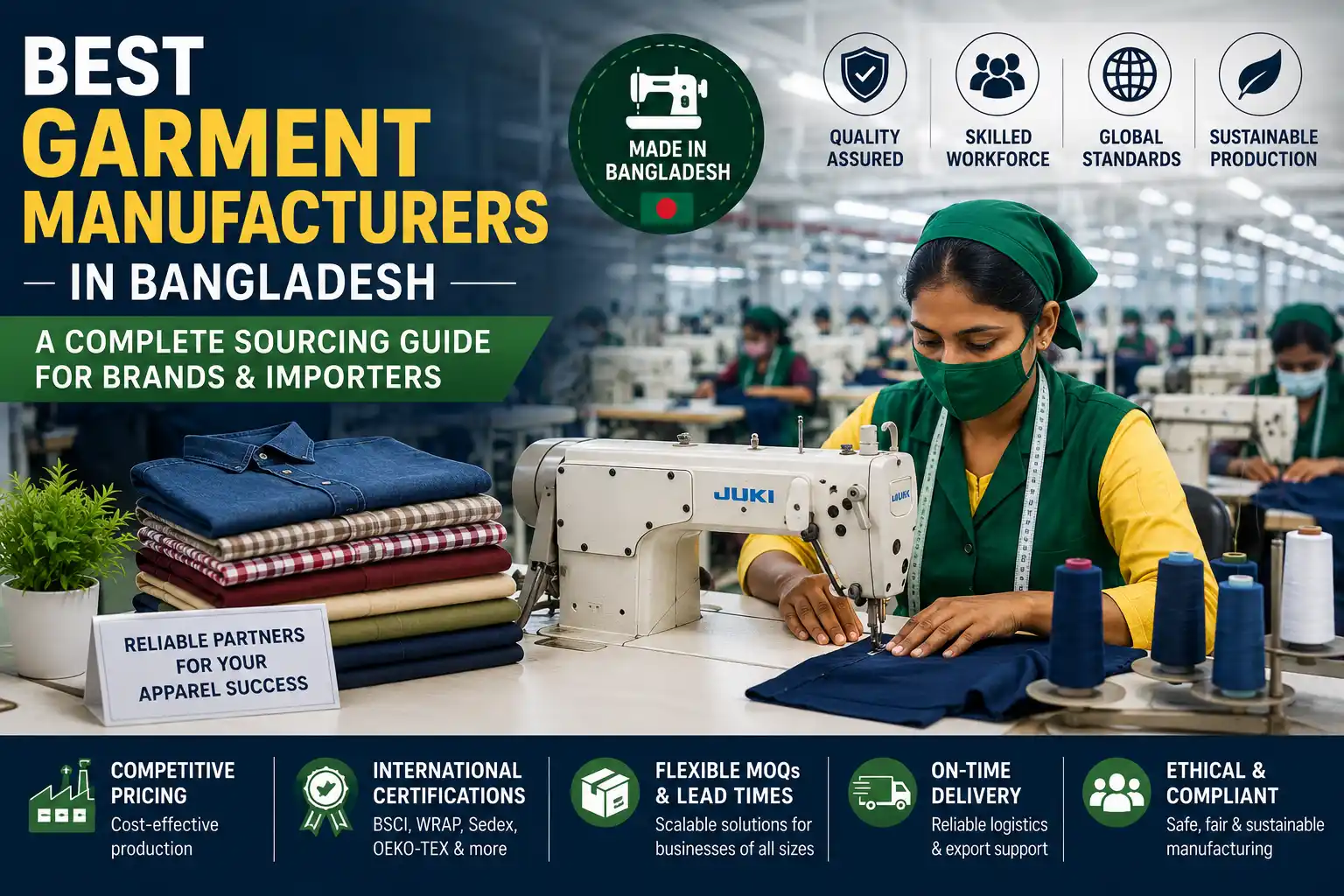
Best Garment Manufacturers in Bangladesh: A Complete Sourcing Guide for Brands and Importers
Bangladesh has built one of the world’s most important apparel supply chains, and finding reliable Garment Manufacturers in Bangladesh is the first step for any brand, retailer, or importer looking to source cost-effective, quality clothing. With decades of RMG (ready-made garment) expertise, a large skilled workforce, and increasingly strong compliance standards, Bangladesh remains a top sourcing destination — but choosing the right factory requires careful research, verification, and due diligence.
This guide breaks down what buyers actually need: how the industry works, which manufacturers are publicly documented and verifiable, how to evaluate MOQs and lead times, what certifications matter, and how to avoid the sourcing mistakes that trip up first-time importers.
Quick Answer: Bangladesh is widely reported as the world’s second-largest apparel exporter, based on recent international trade data. RMG accounts for the majority of Bangladesh’s merchandise export earnings, although the exact share varies by fiscal year. The RMG sector employs several million workers, with women making up a substantial share of the workforce. Publicly documented manufacturers include large groups such as Ha-Meem Group, DBL Group, Beximco, and Square Fashions, alongside many other registered manufacturers. Buyers should always verify a factory through BGMEA/BKMEA membership records, third-party audits (amfori BSCI, WRAP, Sedex/SMETA, or Higg/Worldly), and direct factory visits before committing to production.
Bangladesh’s Garment Industry: An Overview
Bangladesh’s RMG sector began scaling in the 1980s and has since become a central pillar of the national economy. The Bangladesh Garment Manufacturers and Exporters Association (BGMEA), founded in 1983 and headquartered in Dhaka, is the main trade body overseeing the woven, knit, and sweater sub-sectors. BGMEA says it represents around 4,000 registered garment factories, while the Bangladesh Knitwear Manufacturers and Exporters Association (BKMEA) represents knitwear specialists separately.
Roughly 40% of BGMEA member factories focus on knitwear and sweaters, with the remaining 60% producing woven garments. The industry has matured beyond basic cut-make-trim (CMT) work; some manufacturers offer full-package production services, covering design input, fabric sourcing, manufacturing, quality control, and logistics, which can add value for buyers seeking a single accountable partner.
Key competitive advantages that keep global brands sourcing from Bangladesh include a large, experienced garment workforce, preferential access to certain export markets, established backward-linkage industries (spinning, dyeing, finishing), and a growing base of environmentally certified factories. Bangladesh has historically benefited from preferential EU market access under applicable trade preference schemes, subject to rules of origin and current regime terms.
That said, the industry has also faced real scrutiny over worker safety and labor rights following past factory tragedies, which is precisely why compliance verification (discussed below) is non-negotiable for any serious buyer.
Selected, Publicly Verifiable Garment Manufacturers
The following manufacturers are widely documented in industry press, trade directories, and company sources. Always verify current details — ownership, certifications, and export figures change — directly with BGMEA or the company itself before contracting.
Ha-Meem Group — Ha-Meem Group is a documented Bangladeshi apparel group with multiple BGMEA-registered entities, producing across multiple garment categories.
DBL Group — A Bangladeshi knitwear manufacturer with a long-standing presence in the RMG sector. Buyers should request current, factory-specific details on production capacity, client relationships, and sustainability initiatives directly from the company, as these are not independently verified here.
Beximco Apparels / Beximco Textiles and Apparels Ltd. — Part of the wider Beximco Group conglomerate, this manufacturer produces woven garments. Specific buyer relationships should be confirmed directly with the company.
Square Fashions Ltd. — Square Fashions Ltd. is an established apparel manufacturer within Square Group, producing across multiple garment categories.
Epyllion Group — An apparel manufacturer specializing in knit garments. Buyers should confirm current export markets and certifications directly with the company.
Opex-Sinha Group — Opex-Sinha Group is an established apparel manufacturer in Bangladesh. Claims regarding scale or backward-linkage capabilities (spinning, dyeing, finishing) should be verified directly with the company.
AKH Group — A Bangladeshi manufacturer offering knit, woven, and sweater products. Specific buyer relationships and compliance claims should be confirmed directly with the company.
Many mid-size and smaller factories operate across major garment-producing areas such as Dhaka, Gazipur, Narayanganj, and Chattogram. Buyers should identify and verify potential suppliers through BGMEA/BKMEA records, reliable industry sources, and appropriate factory due diligence.
Manufacturer Comparison Table
|
Manufacturer |
Known Specialty |
Notable Buyers/Markets |
Distinguishing Feature |
|---|---|---|---|
|
Ha-Meem Group |
Multi-category apparel |
Not publicly confirmed |
Multiple BGMEA-registered entities |
|
DBL Group |
Knitwear |
Not publicly confirmed |
Long-standing knitwear specialist |
|
Beximco Apparels |
Woven garments |
Not publicly confirmed |
Part of major diversified conglomerate |
|
Square Fashions |
Multi-category apparel |
Not publicly confirmed |
Part of Square Group |
|
Epyllion Group |
Knit garments |
Not publicly confirmed |
Knitwear specialization |
|
Opex-Sinha Group |
Multi-category apparel |
Not publicly confirmed |
Established Bangladeshi manufacturer |
|
AKH Group |
Knit, woven, sweater |
Not publicly confirmed |
Multi-category product range |
Note: Export figures, certifications, and buyer relationships change over time and are not independently verified in this table. Always confirm current details directly with each company.
How to Choose and Verify a Manufacturer
Selecting a factory isn’t just about price. Buyers should evaluate:
- Legal registration — Confirm the factory is a legitimate, licensed entity, ideally a BGMEA or BKMEA member.
- Production capability — Does the factory actually make your product category (woven vs. knit vs. sweater vs. denim)?
- Compliance history — Ask for recent audit reports (amfori BSCI, Sedex/SMETA, or similar frameworks).
- Financial stability — Request trade references or bank reference letters for larger orders.
- Communication and English proficiency — Especially important for smaller or first-time buyers without a local agent.
- Sample quality and consistency — A good sample doesn’t guarantee consistent bulk quality; ask for pre-production and bulk samples.
- On-the-ground verification — Either visit personally or hire a third-party inspection company for a factory audit before placing large orders.
Never rely solely on a company’s own website or marketing claims — cross-check through BGMEA/BKMEA records, business registration documents, official certification databases, factory visits, and independent third-party audits.
Certifications, Audits, and Compliance Frameworks
Bangladeshi garment manufacturers may hold recognized certifications or participate in recognized audit and compliance frameworks, depending on the individual facility and buyer requirements. Buyers should understand the distinction and verify the current status directly with the relevant certification or audit body:
- amfori BSCI — a social compliance audit framework, not a standalone certification.
- WRAP (Worldwide Responsible Accredited Production) — a certification program for socially compliant manufacturing.
- Sedex / SMETA — Sedex is a supply-chain data platform, and SMETA is an audit methodology used on it; neither is a standalone certification.
- OEKO-TEX STANDARD 100 — a textile testing and certification standard relating to harmful substances.
- ISO 9001 — a quality management system standard.
- ISO 14001 — an environmental management system standard.
- Higg Index / Worldly — sustainability assessment and benchmarking tools, not certifications.
- LEED — a green-building certification.
Bangladesh has more than 200 LEED-certified green garment factories, according to recent industry reporting. However, certification and framework participation vary by individual facility, so always ask for the current, valid documentation rather than assuming a group-wide claim applies to every factory under a parent company.
MOQ, Samples, Pricing, and Lead Times
- Minimum Order Quantities (MOQs): MOQs vary widely by manufacturer, product type, fabric, color, and order structure. Larger factories often prefer higher production volumes, which may sometimes run into the thousands of units per style or color. Smaller factories or those working through sourcing agents may accept lower MOQs, often at a higher per-unit cost.
- Sample development: Expect to pay for samples (sample cost is sometimes credited against bulk orders). Sample development may often take around one to three weeks depending on garment complexity, fabric availability, and the manufacturer’s workload, but buyers should confirm the timeline directly with the factory.
- Pricing: Highly dependent on fabric type, order volume, garment complexity, and compliance requirements. Request itemized quotations (fabric, trims, labor, overhead, and shipping) rather than a single lump-sum price, so you can compare fairly across factories.
- Lead times: Bulk production timelines vary by order size and factory capacity, but buyers should build in time for fabric sourcing, sampling approval, bulk production, quality inspection, and shipping — and always confirm dates in writing.
Because these figures vary widely by factory and season, always request current, factory-specific quotes rather than relying on generic industry averages.
Factory Verification and Audit Checklist
Before committing to a manufacturer, buyers should verify:
- ✅ Business registration and BGMEA/BKMEA membership
- ✅ Factory address matches the physical location (via video call, in-person visit, or third-party inspection)
- ✅ Valid, up-to-date compliance certificates or audit reports (not expired)
- ✅ Fire safety and building safety documentation
- ✅ Machinery and production capacity match your order size
- ✅ Worker conditions observed during audits (no signs of forced overtime, underage labor, or unsafe conditions)
- ✅ References from existing international clients
- ✅ Clear, written contract terms covering price, timeline, quality standards, and penalties for delays
Third-party inspection firms can conduct pre-shipment and social compliance audits on your behalf if you cannot visit in person.
OEM vs. ODM vs. Private Label
|
Model |
Description |
Best For |
|---|---|---|
|
OEM (Original Equipment Manufacturer) |
Factory manufactures to your exact design/spec |
Brands with in-house design teams |
|
ODM (Original Design Manufacturer) |
Factory offers its own design/development input |
Brands wanting faster time-to-market with less design overhead |
|
Private Label |
Factory produces existing designs which you rebrand |
Retailers wanting quick, low-investment product lines |
Choosing the right model depends on your design capacity, budget, and how much customization you need. Some larger Bangladeshi manufacturers offer full-package (ODM-style) services, while smaller factories may focus purely on OEM production.
Common Mistakes and Red Flags
- Skipping factory verification because a website looks professional
- Ignoring MOQ mismatches — agreeing to volumes you can’t actually sell
- Not requesting valid, current certificates or audit reports (some factories present outdated documents)
- Paying full amount upfront without milestone-based payment terms
- Vague contracts lacking specific quality standards, delivery dates, and penalty clauses
- No third-party inspection before shipment, especially for first orders
- Overlooking subcontracting — some factories subcontract orders to unverified facilities without informing the buyer
- Choosing solely on price, without checking compliance or communication quality
Step-by-Step Sourcing Guidance
- Define your product spec — fabric, construction, quantity, and target price.
- Build a shortlist using BGMEA’s directory, trade shows, or vetted sourcing agents — not just search engine results.
- Request company profiles — registration details, certifications, buyer references.
- Verify independently — cross-check BGMEA membership and, if possible, commission a factory audit.
- Request samples and evaluate quality, fit, and communication responsiveness.
- Negotiate terms — pricing, MOQ, lead time, and payment milestones, in writing.
- Place a trial order before committing to large-volume production.
- Conduct pre-shipment inspection through a third-party inspector.
- Review the partnership after the first order before scaling up.
Practical Sourcing Checklist
- Product specifications finalized
- Shortlist of 3–5 verified manufacturers
- BGMEA/BKMEA membership confirmed
- Certifications and audit reports requested and validated
- Samples ordered and approved
- Written contract with clear terms
- Payment milestones agreed upon
- Trial order placed before bulk commitment
- Third-party inspection scheduled
- Shipping and logistics confirmed
Frequently Asked Questions
1. Why is Bangladesh a popular garment sourcing destination?
Competitive labor costs, a large skilled workforce, established supply chains, and preferential access to certain export markets, including historical preferential EU access under applicable trade schemes, make it attractive for volume apparel production.
2. How do I confirm a factory is legitimate?
Check BGMEA or BKMEA membership records, request business registration documents, and verify through independent factory audits or site visits.
3. What’s a typical MOQ for Bangladeshi manufacturers?
MOQs vary widely by manufacturer, product type, and order structure. There is no universal figure — always confirm MOQ directly with the specific factory.
4. Are Bangladeshi factories safe and compliant?
Compliance varies by factory. Always request current certifications (such as WRAP, OEKO-TEX, or applicable ISO standards) and audit reports (such as amfori BSCI or SMETA), and verify them independently rather than assuming industry-wide standards apply uniformly.
5. What’s the difference between OEM and private label manufacturing?
OEM produces to your exact specifications; private label involves rebranding a factory’s existing designs, which is faster but less customizable.
6. How long does sampling typically take?
Timelines vary, but sample development may often take around one to three weeks depending on garment complexity, fabric availability, and the manufacturer’s workload. Always confirm directly with the factory.
7. Should I use a sourcing agent?
Agents can help smaller or first-time buyers navigate MOQs, language barriers, and verification, though they add a service cost.
8. What certifications or audits should I prioritize?
Certifications such as WRAP, OEKO-TEX, and applicable ISO standards, alongside audit/compliance frameworks such as amfori BSCI or SMETA, are commonly requested by international buyers. Confirm exactly which apply to a given factory.
9. Can I visit factories before placing an order?
Yes, and it’s strongly recommended for significant orders. If travel isn’t possible, hire a third-party inspection firm to conduct an on-site audit.
10. Where can I find an official list of registered manufacturers?
BGMEA’s member directory (bgmea.com.bd) is the primary official source for verifying registered garment factories in Bangladesh.
Key Takeaways
- Bangladesh is widely reported as the world’s second-largest apparel exporter, with a mature, large-scale RMG industry.
- Publicly documented manufacturers include groups like Ha-Meem, DBL, Beximco, and Square Fashions, alongside many other BGMEA/BKMEA-registered manufacturers.
- Always verify factories independently — through BGMEA records, valid certifications, and third-party audits — rather than relying on marketing claims.
- Understand that MOQ, pricing, and lead times vary significantly by manufacturer, so confirm specifics before committing.
- Choose the right manufacturing model (OEM, ODM, or private label) based on your design capacity and business goals.
- Distinguish between certifications (e.g., WRAP, OEKO-TEX, ISO) and audit/compliance frameworks (e.g., amfori BSCI, SMETA) when evaluating a factory.
- Avoid common sourcing mistakes by using written contracts, milestone payments, and pre-shipment inspections.
Official and Industry Resources
- BGMEA (Bangladesh Garment Manufacturers and Exporters Association) — bgmea.com.bd
- BKMEA (Bangladesh Knitwear Manufacturers and Exporters Association)
- OEKO-TEX — oeko-tex.com
- amfori BSCI — amfori.org
- WRAP — wrapcompliance.org
- Sedex — sedex.com
Final Thoughts
Bangladesh has a large garment manufacturing ecosystem that serves international apparel sourcing, but successful supplier selection depends heavily on due diligence. A suitable manufacturing partner should be transparent about relevant certifications and audit history, provide verifiable business information, and allow appropriate due diligence before production begins. Whether you’re working with a major group or a smaller compliant factory, the fundamentals stay the same: verify registration, confirm certifications and audit reports independently, start with a trial order, and inspect before you ship. Taking these steps protects your business and helps build a long-term, reliable sourcing relationship in one of the world’s most important apparel-manufacturing hubs.