How to Choose a Secure Online Payment Gateway in Bangladesh 2026
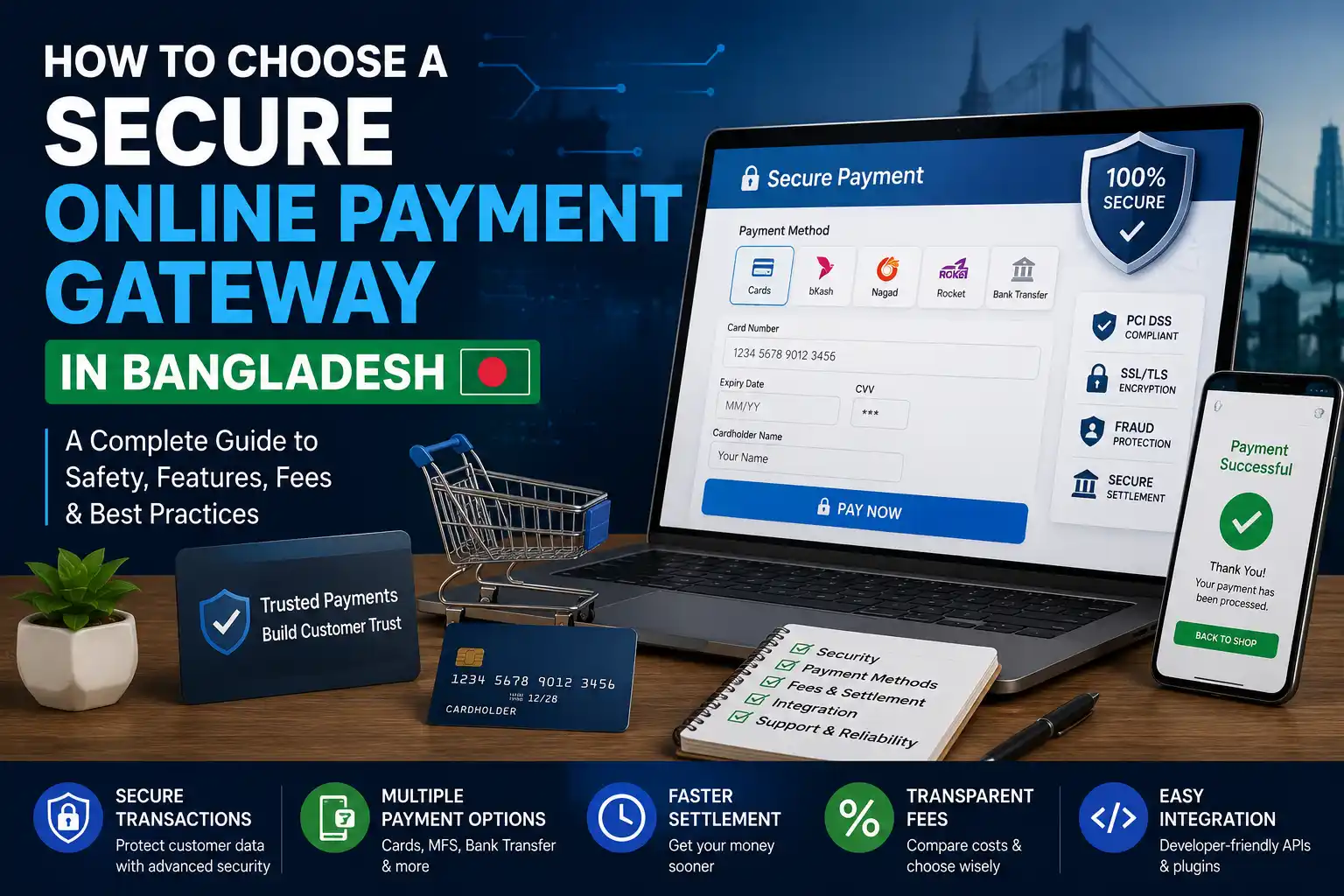
Choosing a secure online payment gateway in Bangladesh means weighing regulatory compliance, security architecture, supported payment methods, and practical business needs against each other, rather than picking whichever option appears first in a search result. As e-commerce, digital services, and online billing continue to grow across the country, the payment gateway a business relies on directly affects customer trust, transaction reliability, and exposure to fraud or data breaches. This guide walks through what a payment gateway actually does, the security features worth evaluating, and the practical steps businesses can take before committing to one.
What Is an Online Payment Gateway?
An online payment gateway is a technology service that authorizes and processes electronic payments for websites, apps, and other digital platforms. It acts as an intermediary between a customer’s payment method — a card, mobile wallet, or bank account — and the business’s bank account, encrypting sensitive payment data and transmitting it securely between the parties involved in a transaction.
In practical terms, a payment gateway is what allows a customer to enter card details or select a mobile wallet at checkout and have that payment verified, authorized, and settled without the business directly handling raw card numbers or account credentials.
How Online Payment Gateways Work
A typical transaction moves through several steps in a matter of seconds:
- A customer enters payment details on a checkout page.
- The payment gateway encrypts this data and sends it to the payment processor or the relevant bank/mobile financial service (MFS) network.
- The issuing bank or MFS provider checks whether the funds or credit are available and whether the transaction appears legitimate.
- An approval or decline response is sent back through the gateway to the merchant’s website.
- If approved, funds are moved toward settlement, which may take anywhere from same-day to several business days depending on the provider and payment method.
Throughout this process, the gateway is responsible for keeping sensitive data encrypted and minimizing the amount of raw payment information that touches the merchant’s own servers.
Types of Payment Gateways Available in Bangladesh
Businesses operating in Bangladesh generally have a few categories of payment gateway to consider.
Local payment gateways are companies that operate within Bangladesh, connecting merchants to local cards, mobile financial services, and internet banking. Some are licensed by Bangladesh Bank as Payment System Operators (PSO) or Payment Service Providers (PSP). Publicly known examples include SSLCommerz, ShurjoPay, PortWallet, and aamarPay, among others. Businesses should verify the current regulatory licensing status of any provider directly with Bangladesh Bank’s published records. These providers are generally built around the specific mix of payment methods used in Bangladesh, including mobile financial services such as bKash and Nagad.
Mobile financial service (MFS)-based gateways allow direct integration with mobile wallets, which are widely used in Bangladesh for both everyday and online payments. bKash, for instance, offers a payment gateway product specifically for merchant websites and apps, alongside its consumer wallet service.
International payment gateways, such as Stripe or PayPal, are widely used globally but historically have had limited direct availability for merchants registered in Bangladesh, with account eligibility, supported currencies, and payout options varying by provider and subject to change. As of 2026, neither Stripe nor PayPal directly supports merchant accounts for businesses registered solely in Bangladesh. Some businesses work around this by using an affiliated entity registered in a supported country, or by relying on third-party solutions that facilitate international payment acceptance, but these approaches carry their own legal, tax, compliance, and operational considerations that should be evaluated carefully, ideally with professional advice. Businesses considering an international gateway should verify current eligibility and terms directly with the provider, since availability for Bangladesh-based merchants is not guaranteed and can differ from country to country.
Local vs. International Payment Gateways
|
Consideration |
Local Gateways |
International Gateways |
|---|---|---|
|
Regulatory oversight |
Some are licensed under Bangladesh Bank’s PSO/PSP framework; businesses should verify current licensing status directly with Bangladesh Bank |
Regulated in their home jurisdiction; Bangladesh-specific terms vary |
|
Mobile financial services |
Often directly integrated with bKash, Nagad, Rocket, and similar services |
Support for Bangladeshi MFS is limited or unavailable |
|
Settlement currency |
Typically settles in Bangladeshi Taka (BDT) |
May settle in foreign currency, subject to provider terms |
|
Local support |
Often includes Bengali-language support and local account teams |
Support is generally centralized and may not be Bangladesh-specific |
|
International card acceptance |
Varies by provider |
Generally strong, given global infrastructure |
Businesses that primarily serve Bangladeshi customers using local payment methods often lean toward local gateways, while those with significant international sales may need to evaluate both options, or use more than one gateway to cover different markets.
Security Features to Evaluate
Security should be one of the first factors evaluated when comparing payment gateways, since a breach or fraud incident can damage both customer trust and business finances.
PCI DSS Compliance
The Payment Card Industry Data Security Standard (PCI DSS) is a global security standard for organizations that handle branded credit card data. A payment gateway that is PCI DSS compliant has met a set of requirements covering network security, access control, encryption, and monitoring. Businesses should ask any prospective gateway provider to confirm their current PCI DSS compliance level directly, since certification status and levels can change over time.
SSL Encryption
Modern HTTPS connections use Transport Layer Security (TLS), the successor to Secure Sockets Layer (SSL), to encrypt data transmitted between a customer’s browser and the payment gateway’s servers. Any legitimate checkout page should load over HTTPS, indicated by a padlock icon in the browser address bar. A payment gateway without proper SSL/TLS encryption should be treated as a significant red flag.
Tokenization
Tokenization replaces sensitive card or account details with a randomly generated “token” that has no exploitable value outside the specific transaction or system it was created for. This means that even if a database is compromised, the tokens stored within it cannot be directly used to make fraudulent charges. Many payment gateways offer tokenization as an option for merchants who want to store customer payment methods for repeat purchases without storing raw card data themselves.
Two-Factor Authentication (2FA)
Two-factor authentication adds a second verification step — such as a one-time password sent via SMS or an authenticator app — beyond a username and password. For merchant-facing dashboards, 2FA reduces the risk that a compromised password alone could give an attacker access to transaction data or account settings.
Fraud Detection and Risk Management
Look for gateways that offer fraud detection features such as transaction risk scoring, velocity checks (flagging unusually rapid repeat transactions), device fingerprinting, and 3D Secure authentication for card payments. The specific tools available vary by provider, so businesses should ask for details on what fraud protection is included versus what requires a separate subscription or configuration.
Supported Payment Methods
Bangladesh has a relatively diverse payment landscape compared to many markets, and the right gateway should support the methods your customers actually use. Common categories include:
- Debit and credit cards (Visa, Mastercard, and others, depending on the provider)
- Mobile financial services (MFS), such as bKash, Nagad, and Rocket
- Internet banking, allowing customers to pay directly from a bank account through online banking portals
- Digital wallets, where supported by the specific gateway
Not every gateway supports every method, and coverage can change as providers add or discontinue integrations, so businesses should confirm the current list of supported payment methods directly with each provider before making a decision.
Settlement Time
Settlement time — how long it takes for approved transaction funds to actually reach a merchant’s bank account — varies by provider, payment method, and sometimes by the merchant’s transaction history or account tier. Some providers offer next-day settlement for certain payment methods, while others may take several business days. Because settlement timelines directly affect a business’s cash flow, this is worth confirming explicitly with any gateway under consideration rather than assuming a standard timeline applies.
Transaction Fees
Payment gateways typically charge some combination of a setup fee, a percentage-based transaction fee, and sometimes a fixed fee per transaction. Fees can vary depending on the payment method used (cards often carry different rates than mobile financial services or internet banking), transaction volume, and whether the transaction is domestic or international. Because published fee structures can change and may not reflect the exact rate a specific business will be offered, it’s best practice to request current, written fee details directly from each provider rather than relying solely on marketing pages or third-party comparison articles.
Integration Options, API, and Developer Support
Most payment gateways offer some combination of the following integration paths:
- Ready-made plugins for common e-commerce platforms such as WooCommerce, Shopify, or Magento
- REST APIs and SDKs for custom-built websites and applications, often available in multiple programming languages
- Hosted checkout pages, where the customer is redirected to a gateway-hosted payment page rather than entering details directly on the merchant’s site
For businesses with in-house development resources, API documentation quality, sandbox/testing environments, and the responsiveness of developer support channels are practical factors worth testing before committing.
Ease of Integration
Even with good documentation, the actual integration effort can vary significantly depending on a business’s existing tech stack and whether the gateway offers a plugin for the specific platform in use. Requesting sandbox access and attempting a test integration before signing a contract can reveal practical friction points that documentation alone may not show.
Customer Support
Responsive customer support matters especially during payment disruptions, disputed transactions, or technical integration issues. Businesses should evaluate:
- Available support channels (phone, email, live chat)
- Whether support is available in Bengali, English, or both
- Typical response times for technical issues
- Whether a dedicated account manager is provided for higher transaction volumes
Business Registration Requirements
Setting up a merchant account with a payment gateway operating in Bangladesh typically requires standard business documentation, which commonly includes:
- Trade license
- Company registration documents (such as RJSC incorporation certificates, where applicable)
- Tax Identification Number (TIN)
- Bank account details for settlement
- Business owner identification documents
Exact documentation requirements vary by provider and business type (sole proprietorship, partnership, or private limited company), so businesses should confirm the current checklist directly with their chosen gateway rather than assuming uniform requirements across providers.
Regulatory Considerations in Bangladesh
Payment gateways operating in Bangladesh typically fall under Bangladesh Bank’s regulatory framework, primarily the Bangladesh Payment and Settlement Systems Regulations, 2014 (BPSSR 2014). Under this framework, Bangladesh Bank may issue two main categories of license: Payment System Operator (PSO), generally covering entities like payment gateways and aggregators that operate settlement infrastructure alongside a principal bank participant, and Payment Service Provider (PSP), generally covering entities that facilitate payments directly to customers and settle transactions through a scheduled bank, such as e-wallet services.
According to public reporting, Bangladesh Bank has licensed a limited number of companies as PSOs over the years, with SSLCommerz among the earlier providers reported to have received a PSO license. Other companies have also received PSO or PSP licenses at various points, and additional providers have applied for licenses without necessarily having been approved at any given time. Licensing status can change, and some providers operating in the market may not hold a current license, so businesses are strongly encouraged to verify a gateway’s current regulatory status directly with Bangladesh Bank’s published records or with the provider itself, rather than relying on marketing claims. Businesses should not assume that public availability of a payment gateway automatically implies current regulatory approval.
Common Mistakes Businesses Make
- Choosing a gateway based on price alone, without evaluating security features, supported payment methods, or reliability.
- Not verifying a provider’s regulatory licensing status before signing an agreement.
- Skipping sandbox testing and integrating directly into a live environment.
- Ignoring settlement time until cash flow problems arise.
- Overlooking fraud detection capabilities, particularly for businesses with higher transaction volumes or international customers.
- Failing to read the full fee schedule, including setup costs, chargeback fees, and currency conversion charges.
- Assuming one gateway covers every payment method a customer might want to use, rather than confirming actual coverage for cards, MFS, and internet banking.
- Not planning for customer support needs, such as language availability or response times during payment disputes.
Best Practices Before Selecting a Payment Gateway
- List your required payment methods based on how your actual customers prefer to pay, rather than assuming.
- Request current documentation on security certifications, including PCI DSS compliance level, directly from each provider.
- Verify regulatory licensing status with Bangladesh Bank’s published information or by asking the provider directly for their license reference.
- Compare fee structures in writing, including setup fees, transaction percentages, and any hidden charges like chargeback or currency conversion fees.
- Test the integration in a sandbox environment before going live, checking checkout flow, error handling, and refund processes.
- Evaluate settlement timelines against your business’s cash flow needs.
- Confirm customer support availability and language options before committing.
- Read the merchant agreement carefully, particularly clauses covering disputes, chargebacks, and account suspension conditions.
Frequently Asked Questions
What is the difference between a payment gateway and a payment processor?
A payment gateway handles the technical process of securely capturing and transmitting payment data from a checkout page, while a payment processor communicates with banks and card networks to actually move funds. In practice, many providers offer both functions bundled together, though the terms are sometimes used interchangeably in casual usage.
Is SSLCommerz the only licensed payment gateway in Bangladesh?
No. According to public reporting, Bangladesh Bank has licensed multiple companies as Payment System Operators or Payment Service Providers over time, including SSLCommerz and others. Businesses should verify the current list of licensed providers directly with Bangladesh Bank, since licensing status can change.
Do I need PCI DSS compliance if I use a hosted payment gateway?
Using a hosted checkout page, where customers are redirected to the gateway’s own payment page, generally reduces a merchant’s direct PCI DSS obligations because sensitive card data does not pass through the merchant’s own servers. However, merchants still have some baseline compliance responsibilities, which vary depending on how the integration is set up, so this should be confirmed with the payment gateway provider.
Can international businesses accept payments in Bangladesh using Stripe or PayPal?
Availability and account eligibility for international gateways like Stripe or PayPal can vary for Bangladesh-based merchants and are subject to change. As of 2026, neither Stripe nor PayPal directly supports merchant accounts for businesses registered solely in Bangladesh. Some businesses use an affiliated entity registered in a supported country or rely on third-party solutions to accept international payments, though these approaches involve their own legal, tax, compliance, and operational considerations. Businesses should check current terms directly with the provider, since supported countries, currencies, and payout methods are determined by each company’s own policies.
How long does it take for payment gateway funds to settle?
Settlement time varies by provider and payment method, ranging from next-day settlement in some cases to several business days in others. This should be confirmed directly with the specific gateway being considered, as it is not standardized across providers.
What documents are typically required to set up a payment gateway account in Bangladesh?
Requirements commonly include a trade license, company registration documents, a Tax Identification Number (TIN), and business bank account details, though exact requirements vary by provider and business structure.
How can I verify if a payment gateway is properly licensed in Bangladesh?
Businesses can check Bangladesh Bank’s published information on licensed Payment System Operators and Payment Service Providers, or request licensing documentation directly from the payment gateway provider.
What should I do if a payment gateway does not support a payment method my customers use?
Some businesses use more than one payment gateway to cover a broader range of payment methods, though this adds integration and reconciliation complexity. Alternatively, businesses can prioritize a single gateway that covers the payment methods most commonly used by their specific customer base.
Final Thoughts
Selecting a secure online payment gateway in Bangladesh involves balancing regulatory compliance, security architecture, supported payment methods, and practical operational factors like settlement time and customer support. There is no single gateway that is objectively correct for every business — the right choice depends on a business’s specific customer base, technical resources, and risk tolerance.
Businesses are best served by verifying claims directly with providers rather than relying solely on marketing materials, confirming current regulatory licensing status with Bangladesh Bank, and testing integrations thoroughly before going live. Taking these steps upfront reduces the risk of security incidents, payment disruptions, and compliance issues down the line.
Disclaimer: Regulatory licensing status, payment gateway features, pricing, supported payment methods, and provider policies may change over time. Businesses should verify the latest information directly with Bangladesh Bank and the respective payment gateway provider before making a final decision. This article is intended for general informational purposes only and should not be considered legal, financial, or regulatory advice.