
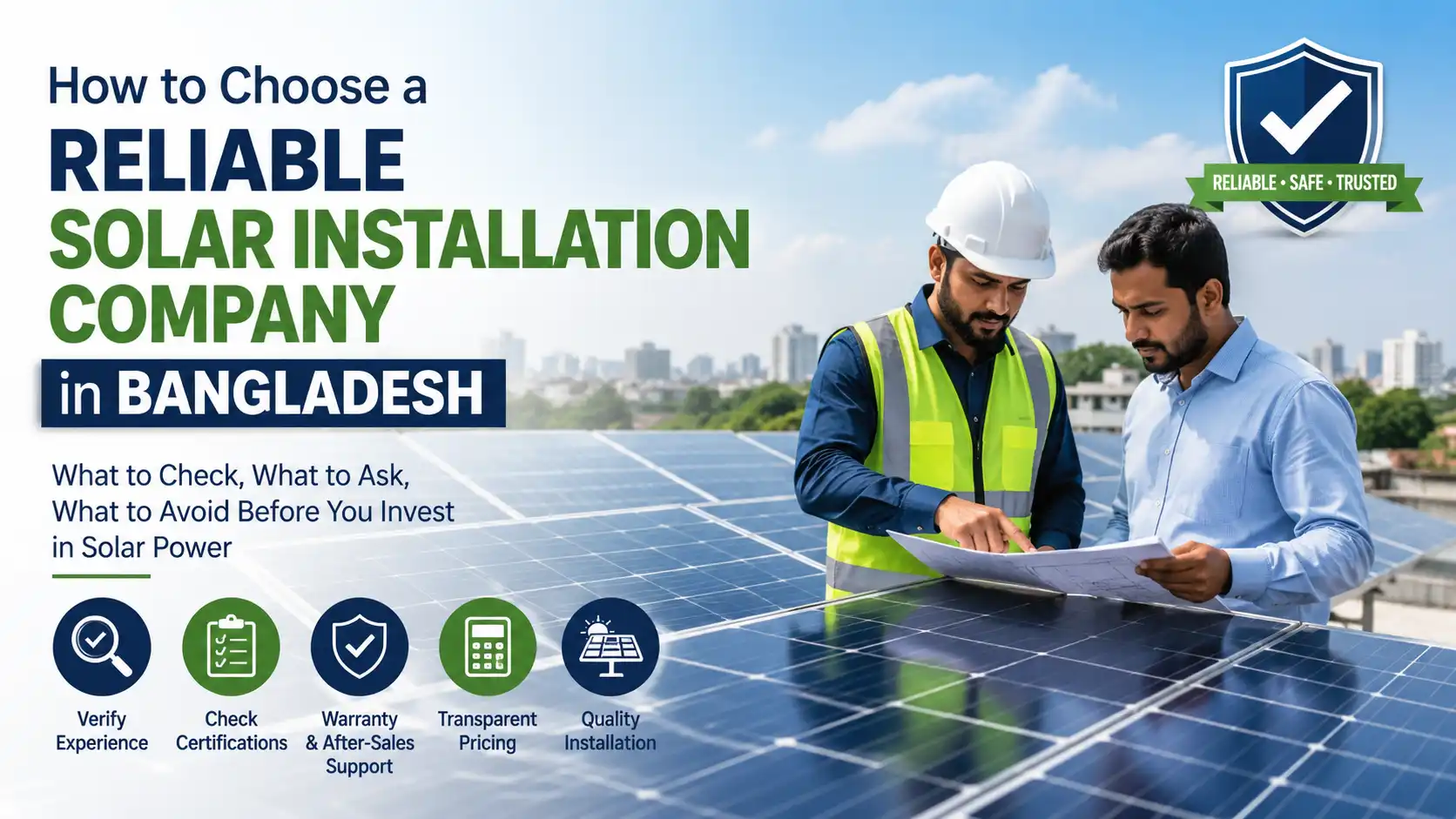
How to Choose a Reliable Solar Installation Company in Bangladesh
Installing a solar power system is a long-term decision. The panels on your roof are expected to generate electricity for twenty years or more — which means the company you hire today will shape your energy costs, safety, and peace of mind for decades. A well-designed, professionally installed system quietly pays for itself year after year. A poorly installed one delivers weak output, safety hazards, and a warranty that evaporates when you need it.
The good news: separating reliable solar installers from unreliable ones is not difficult if you know what to look for. This guide explains how to choose a reliable solar installation company in Bangladesh — what to verify, what to ask, what to avoid, and how the process should work — whether you are a homeowner adding rooftop panels, a factory owner planning a megawatt-scale system, or an institution exploring solar for the first time.
This is an educational guide. It does not recommend or rank any company; the goal is to equip you to evaluate any installer on evidence.
Why Choosing the Right Solar Installation Company Matters
Solar equipment is only half of a solar system. The other half is engineering: assessing your site, designing the right system size, selecting compatible components, installing them safely, and supporting them for years. Two customers can buy identical panels and end up with very different results depending on who installed them.
The stakes are real:
- Performance. Poor design choices — wrong orientation, ignored shading, undersized cabling — can significantly reduce the electricity a system generates for its entire life.
- Safety. Solar systems involve electrical work at height. Substandard wiring, missing protection devices, and careless roof penetrations create fire, shock, and leak risks.
- Money. An underperforming system stretches your payback period; a failed installer leaves you with no warranty support and repair bills.
- Longevity. Systems installed to proper standards last decades; corners cut on mounting structures, connectors, and waterproofing surface as failures within a few years.
In Bangladesh’s growing solar market, installers range from highly professional engineering firms to opportunistic traders with no engineering capability at all. Your job as a buyer is to tell them apart before signing — not after.
Understanding Different Types of Solar Systems
Before evaluating companies, understand what you are buying, because a reliable installer should recommend the type that fits your situation — not simply the type they sell.
On-grid (grid-tied) solar connects to the utility grid and works alongside it. It typically has no batteries: solar power offsets your daytime consumption, and under net metering arrangements, surplus electricity can be exported to the grid for bill credit. It is generally the most cost-effective option where grid supply exists.
Off-grid solar works independently of the grid, storing energy in batteries for use when the sun is not shining. It suits locations without grid access, but batteries add significant cost and require eventual replacement.
Hybrid solar combines both: grid connection plus battery storage, delivering bill savings and backup power during outages. It costs more than on-grid but solves the load-shedding problem that pure grid-tied systems cannot.
On-Grid vs Off-Grid vs Hybrid Solar
|
Factor |
On-Grid |
Off-Grid |
Hybrid |
|---|---|---|---|
|
Grid connection |
Yes |
No |
Yes |
|
Batteries |
Usually none |
Essential |
Yes |
|
Works during power cuts |
Typically no (safety shutdown) |
Yes |
Yes |
|
Relative cost |
Lowest |
High (battery-driven) |
Higher than on-grid |
|
Best for |
Grid-connected homes, factories, offices |
Remote or unelectrified sites |
Areas with unreliable grid supply |
|
Key consideration |
Net metering eligibility |
Battery sizing and replacement |
Balancing battery cost vs backup need |
A trustworthy installer will study your electricity usage and site before recommending a type. If a company pushes one configuration without asking about your consumption, grid reliability, or goals, treat that as your first warning sign.
Key Factors to Consider Before Hiring a Solar Installation Company
Experience and Track Record
Ask how long the company has been installing solar systems — and, more importantly, how many projects of your type and size it has completed. Residential rooftops, industrial megawatt systems, and solar irrigation are different disciplines. Request a project list with locations and system sizes, and ask to visit or contact at least one or two completed installations similar to yours.
Reputation and Customer Reviews
Look beyond the company’s own marketing. Speak to past customers directly, ask within your industry or neighbourhood, and check what independent feedback exists online. Pay attention to how customers describe the company after installation — response to problems reveals more than the sales experience ever does.
Technical and Engineering Capability
Reliable installers employ qualified engineers who perform load analysis, shading assessment, structural evaluation, and proper electrical design. Ask who will design your system and what their qualifications are. A company that cannot explain why it proposes a particular system size, panel layout, or inverter model is selling boxes, not engineering.
Licensing, Certifications, and Approvals
Verify that the company is a legitimately registered business and ask about relevant enlistments or memberships — for example, involvement with recognised programmes, financing bodies, or industry associations in Bangladesh’s renewable energy sector, where applicable. For grid-tied projects, ask specifically about the company’s experience completing net metering applications and utility approvals, since navigating that process is part of what you are paying for. Verify claims independently rather than accepting logos on a brochure.
Product Quality: Panels, Inverters, and Batteries
Components determine how long your system lasts:
- Solar panels. Ask which brands the company offers and whether the panels carry internationally recognised certifications (such as the widely used IEC standards for PV modules). Ask for datasheets — a professional installer provides them without hesitation.
- Inverters. The inverter is the system’s workhorse and its most common failure point. Ask about the brand, its local service arrangements, and warranty terms.
- Batteries (if applicable). For hybrid and off-grid systems, ask about battery chemistry, expected cycle life, warranty conditions, and replacement cost — the honest answer includes the fact that batteries wear out and will need replacement during the system’s life.
Be cautious of companies that cannot name their component brands upfront or that switch brands between quotation and delivery.
Installation Standards and Safety
Ask how the company handles the details that separate professional work from shortcuts: proper mounting structures rated for wind loads, waterproof roof penetrations, correctly sized and protected cabling, earthing and lightning protection, and clean workmanship. Request photos of recent installations — sloppy wiring in their showcase photos tells you everything.
Warranty Coverage
Solar warranties come in layers, and a reliable company explains them clearly:
|
Warranty type |
What it covers |
Who honours it |
|---|---|---|
|
Panel product warranty |
Manufacturing defects in the panel itself |
Panel manufacturer (via installer) |
|
Panel performance warranty |
Long-term power output above a stated level |
Panel manufacturer |
|
Inverter warranty |
Inverter defects and failures |
Inverter manufacturer / local service partner |
|
Battery warranty |
Defects and sometimes cycle-life terms |
Battery manufacturer |
|
Installation / workmanship warranty |
Faults in the installation work itself |
The installer directly |
Exact terms vary by company, brand, and project — get every warranty in writing, and ask the practical question: if a panel fails in year six, who do I call, and what exactly happens? A company that answers vaguely will act vaguely.
After-Sales Support and Maintenance
Solar systems need periodic cleaning, inspection, and occasional repairs. Ask whether the company offers maintenance contracts, how quickly it responds to service calls, whether it monitors system performance remotely, and how long it has actually been supporting past customers. An installer without a service team is a seller, not a partner.
Pricing Transparency and Hidden Costs
Insist on a detailed written quotation that itemises panels (brand, model, quantity), inverter, mounting structure, cabling and protection equipment, batteries if any, installation labour, net metering application costs, and taxes. Ask explicitly what is not included. Vague lump-sum quotes hide both quality shortcuts and surprise charges.
System Design Quality and Energy Assessment
A professional engagement begins with your electricity bills and a site visit — measuring roof space, checking structure and shading, and analysing consumption patterns. The proposal should state expected energy generation with realistic assumptions. Extraordinary generation promises are a sales tactic, not engineering.
ROI Considerations
A reliable company helps you understand payback honestly: system cost against expected bill savings, with reasonable assumptions about tariffs and system performance. Be sceptical of installers promising precise payback periods to the month — honest projections come as ranges with stated assumptions, because tariffs, weather, and usage all vary.
Questions to Ask Before Signing a Contract
Use this checklist in your meetings:
|
# |
Question |
What a good answer looks like |
|---|---|---|
|
1 |
How many systems of my type and size have you installed? |
Specific number, references offered |
|
2 |
Can I visit or contact past customers? |
Immediate yes |
|
3 |
Who designs the system, and what are their qualifications? |
Named engineers, clear process |
|
4 |
Which panel and inverter brands, exactly — with datasheets? |
Brands named in writing, documents provided |
|
5 |
What certifications do the components carry? |
Recognised international standards cited |
|
6 |
What does the written quotation include and exclude? |
Itemised list, exclusions stated plainly |
|
7 |
What warranties apply, and who honours each? |
Layer-by-layer written answer |
|
8 |
Will you handle net metering and utility approvals? |
Yes, with described experience of the process |
|
9 |
What after-sales service do you provide, and how fast? |
Defined response commitments |
|
10 |
What are realistic generation and savings figures for my site? |
Range with assumptions, not miracle numbers |
Get all answers reflected in the written contract — verbal promises do not survive disputes.
Common Mistakes to Avoid
- Choosing on price alone. The lowest quote usually reflects the lowest-grade components and workmanship. Compare quotations item by item, not bottom line by bottom line.
- Skipping the site visit. A quotation prepared without anyone examining your roof and bills is guesswork you will pay for later.
- Ignoring the inverter. Buyers obsess over panels and neglect the component most likely to fail. Give inverter brand, warranty, and local service equal weight.
- Accepting verbal warranties. If it is not written, it does not exist.
- Not asking about net metering. For grid-tied systems, the utility application process affects both timeline and returns — confirm who handles it before signing.
- Overlooking structural questions. Especially for older buildings and industrial sheds, mounting design and roof condition deserve engineering attention, not assumptions.
- Signing under time pressure. “This price is only valid today” is a sales technique, not a reason to skip due diligence on a twenty-year asset.
Red Flags That May Indicate an Unreliable Installer
|
Reliable installer |
Warning signs |
|---|---|
|
Conducts site visit and studies your bills before quoting |
Quotes instantly over the phone without seeing anything |
|
Names component brands with datasheets |
“Imported panels, very good quality” with no specifics |
|
Provides itemised written quotations and contracts |
Lump-sum verbal pricing, reluctance to document |
|
Explains warranties layer by layer in writing |
“Everything guaranteed, no problem” with nothing on paper |
|
Offers references and past project visits |
Excuses why no past customer can be contacted |
|
Gives realistic generation estimates with assumptions |
Promises unusually high output or exact payback dates |
|
Has a service team and maintenance offering |
Disappears from the conversation when after-sales comes up |
|
Registered business with verifiable track record |
Newly appeared operation with pressure-sales tactics |
One warning sign deserves a conversation; several together deserve a different installer.
The Typical Installation Process
Understanding the normal sequence helps you recognise professional work:
- Initial consultation. You share electricity bills, goals, and budget; the company explains options.
- Site assessment. Engineers visit to measure roof area, evaluate structure and shading, and inspect your electrical setup.
- System design and proposal. You receive a written proposal: system size, layout, component brands, expected generation, and itemised pricing.
- Contract signing. Scope, components, warranties, timeline, payment schedule, and after-sales terms go into a written agreement.
- Approvals. For grid-tied systems, the installer prepares net metering and utility applications where applicable; timelines depend on the utility’s process.
- Installation. Mounting structures, panels, inverter, cabling, and protection systems are installed — typically days for homes, longer for industrial projects.
- Testing and commissioning. The system is inspected, tested, connected, and switched on; grid-tied systems are commissioned in coordination with the utility.
- Handover. You receive documentation — warranties, datasheets, wiring diagrams — plus training on monitoring, and the after-sales relationship begins.
Timelines vary by project size and approval processes, so ask for a realistic schedule in writing rather than assuming.
Solar Installation Cost Factors in Bangladesh
Rather than quoting prices — which change with equipment markets, currency movements, and project specifics — understand what drives cost:
- System size. The largest single factor; bigger systems cost more overall but often less per unit of capacity.
- System type. Batteries make hybrid and off-grid systems substantially costlier than grid-tied equivalents.
- Component quality and brands. Panel grade, inverter brand, and battery chemistry create wide price differences — usually reflected in lifespan and warranty.
- Mounting complexity. Roof type, height, structural reinforcement needs, and custom structures affect labour and material costs.
- Site conditions. Cable runs, electrical upgrades, and access difficulty add cost on some sites.
- Approvals and paperwork. Application and interconnection processes involve costs and time for grid-tied projects.
- Service inclusions. Quotes that include maintenance, monitoring, and strong workmanship warranties cost more upfront — and often less over the system’s life.
Collect at least two or three itemised quotations for identical scope, and compare them line by line. Prices in this market change often enough that any figure printed in an article would mislead you — current quotations from installers are the only reliable numbers.
Benefits of Working with a Reliable Solar Company
Choosing carefully pays back in every year that follows:
- A system that performs as promised, designed around your actual consumption and site.
- Safety for your building, family, or workforce through proper electrical and structural work.
- Warranties that mean something, backed by a company that still exists and responds when you call.
- Smooth approvals, with net metering and utility processes handled by people who have done it before.
- Honest economics — realistic projections that your electricity bills then confirm.
- Long-term support: cleaning, maintenance, monitoring, and repairs from a team that knows your system.
- Fewer surprises — in cost, in timeline, and in the decades of operation that follow commissioning.
Frequently Asked Questions
How do I verify a solar company’s experience?
Ask for a written list of completed projects with sizes and locations, then contact or visit at least one or two customers with systems similar to yours. A company confident in its work makes this easy; hesitation is itself an answer.
What is the most important component to check in a quotation?
Check everything, but give special attention to the inverter — its brand, warranty, and local service support — because it is the component most likely to need attention during the system’s life, alongside confirming exact panel brands and certifications.
Do solar installers in Bangladesh handle net metering applications?
Experienced installers of grid-tied systems typically prepare and manage the net metering and utility approval process on the customer’s behalf. Confirm this in writing before signing, including who bears the application effort and any associated costs.
How long should a solar warranty last?
Warranty lengths vary by component, brand, and company: panels typically carry separate product and long-term performance warranties, inverters and batteries carry their own terms, and the installer should provide a workmanship warranty on the installation itself. Exact durations differ — get every warranty documented and understand who honours each.
Is the cheapest solar quotation a bad idea?
Not automatically — but an unusually low quote must be explained. Compare quotations item by item: if the low price comes from unnamed panel brands, a lesser inverter, thinner structures, or missing services, you are not saving money; you are deferring costs to later years.
How much maintenance does a solar system need?
Relatively little, but not zero: periodic panel cleaning, electrical inspections, performance monitoring, and eventual component replacement (inverters and batteries before panels). Ask every prospective installer what maintenance they provide and at what cost.
Can I install solar myself or with a general electrician?
Solar installation involves DC electrical systems, structural loading, and safety protections that general electrical experience does not cover, and improper work risks fire, injury, and voided component warranties. For any system beyond a tiny portable kit, professional installation is strongly advisable.
Final Thoughts
A solar system is only as good as the company that designs, installs, and stands behind it. The evaluation process in this guide — verifying experience, demanding named components and written warranties, comparing itemised quotations, and testing after-sales commitment — takes a few extra weeks. The system you are buying will operate for a few decades. That trade is worth making every single time. Choose the installer you would trust to still answer your call in year ten, and the panels will take care of the rest.
Readers who want to compare solar installation companies, learn about renewable energy solutions, or explore businesses in Bangladesh’s solar sector can also find additional educational resources and relevant business listings on Info Ghor. These resources are designed to help readers research providers, understand available services, and make more informed decisions before investing in a solar power system.