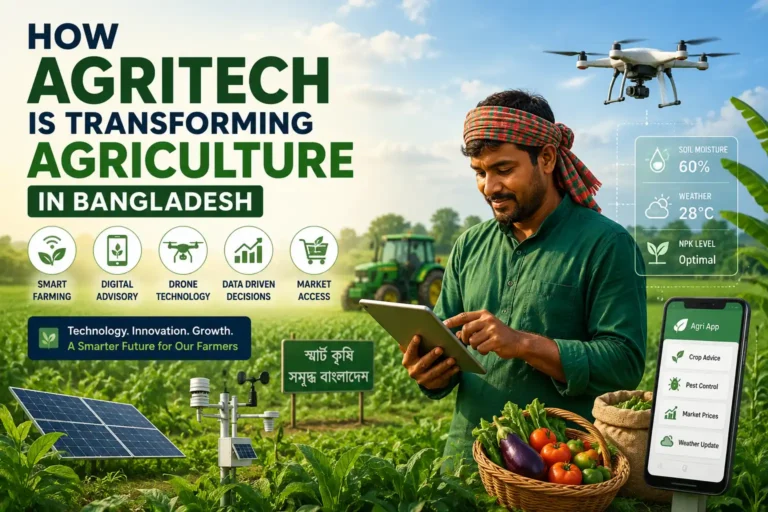

How Farmers Can Benefit from AgriTech Solutions
Farming has always demanded knowledge, patience, and hard work — but the tools available to farmers are changing faster today than at any point in living memory. A farmer can now check tomorrow’s rainfall on a phone, test soil before choosing fertiliser, receive a crop disease diagnosis from a photo, sell produce to buyers in another district, and pay for it all through mobile money. Together, these tools are known as AgriTech, and they are steadily reshaping what is possible on farms of every size.
This guide explains how farmers can benefit from AgriTech solutions in practical, down-to-earth terms. It is written for farmers and agribusiness owners considering their first digital tools, for entrepreneurs and students exploring the sector, and for general readers who want to understand how technology and agriculture now work together. The focus throughout is on real, widely available categories of technology — not hype — along with honest discussion of the challenges and how to choose wisely.
What Is AgriTech?
AgriTech — short for agricultural technology — means the use of technology to improve any part of farming and the agricultural value chain. That covers a wide range: how crops are planted, watered, and protected; how livestock is monitored; how farms are financed and insured; and how harvests are stored, transported, and sold.
AgriTech is not one single product. It is an umbrella term that includes:
- Hardware: sensors, drones, GPS devices, smart irrigation controllers, and modern machinery
- Software: farm management apps, record-keeping tools, and data analysis platforms
- Digital services: weather forecasts, advisory apps, online marketplaces, mobile payments, and digital financing
- Data and intelligence: artificial intelligence and machine learning models that turn farm information into recommendations
A helpful way to think about it: traditional farming decisions rely on experience and observation, both of which remain valuable. AgriTech adds measurement and information to that experience — so decisions about water, fertiliser, timing, and selling are based on data as well as instinct.
Why AgriTech Matters for Modern Farming
Farmers everywhere face a common set of pressures: rising input costs, unpredictable weather, plant diseases and pests, labour shortages, and market prices that swing beyond their control. Climate change is intensifying several of these pressures at once.
AgriTech matters because it directly addresses these pain points:
- Rising costs are countered by precision — applying exactly the water, fertiliser, and pesticide needed, instead of blanket amounts.
- Unpredictable weather is managed with forecasting tools that guide when to sow, spray, irrigate, and harvest.
- Pests and diseases are caught earlier through monitoring tools and image-based diagnosis, when treatment is cheaper and more effective.
- Market uncertainty is reduced by digital marketplaces and price information that help farmers sell at better prices with fewer intermediaries.
- Limited access to finance is being addressed by digital platforms that connect farmers to credit, investment, and insurance.
Importantly, AgriTech is no longer only for large commercial farms. Many of the most impactful tools — weather apps, advisory services, mobile marketplaces — run on an ordinary smartphone, putting them within reach of smallholder farmers as well.
Major Types of AgriTech Solutions
Precision Agriculture
Precision agriculture is the practice of managing a farm not as one uniform field, but as many small zones with different needs. Using soil testing, mapping, and monitoring, farmers apply inputs — seed, water, fertiliser, crop protection — in the right amount, at the right place, at the right time.
The benefit is straightforward: less waste and healthier crops. Fertiliser goes where the soil actually needs it; spraying targets affected areas rather than whole fields. For farmers, this typically means lower input bills and more consistent yields, which is why precision approaches sit at the heart of modern AgriTech.
Smart Irrigation
Smart irrigation systems deliver water based on what crops actually need rather than fixed schedules. They range from simple drip irrigation — which delivers water directly to plant roots — to sensor-controlled systems that measure soil moisture and irrigate automatically, and solar-powered pumps that replace costly diesel.
Water is one of farming’s most precious and increasingly stressed resources. Smart irrigation reduces water use, cuts pumping costs, and often improves yields because crops receive steady, appropriate moisture instead of cycles of flooding and drying.
Farm Management Software
Farm management software is the digital version of the farmer’s notebook — but far more powerful. These apps and platforms record what was planted where, what inputs were applied, what costs were incurred, and what each field or animal produced.
Over seasons, these records reveal what actually works: which seed variety performed better, which field costs more than it earns, and where money quietly leaks away. Good records also strengthen loan applications and make planning the next season a matter of evidence rather than memory.
Drones
Agricultural drones serve two main roles. Monitoring drones fly over fields capturing images that reveal crop health, water stress, pest damage, and growth differences invisible from the ground — letting farmers inspect large areas in minutes. Spraying drones apply crop protection products precisely, covering fields faster than manual spraying while reducing the operator’s chemical exposure.
For most smallholders, owning a drone is unnecessary; drone services offered by cooperatives, agri-service providers, or entrepreneurs are the practical way to access the technology at an affordable per-use cost.
IoT Sensors
The Internet of Things (IoT) refers to physical devices that collect and transmit data automatically. On farms, IoT sensors measure soil moisture and nutrients, air temperature and humidity, water levels, and storage conditions. In livestock farming, wearable sensors monitor animal health, activity, and breeding cycles.
The value of sensors is continuous attention: they watch the farm around the clock and raise alerts when something drifts out of range — a dry field, a sick animal, an overheating grain store — allowing action before small problems become losses.
GPS and GIS Technologies
GPS (satellite positioning) and GIS (digital mapping) technologies let farmers map their land accurately, guide machinery in straight, efficient lines, and link every piece of data — soil tests, yields, problems — to an exact location on the farm.
Accurate maps sound simple, but they underpin much of AgriTech: precision application, drone flight planning, irrigation design, and even land documentation all begin with knowing precisely where everything is.
AI and Machine Learning
Artificial intelligence turns farm data into practical answers. The most farmer-visible example is image-based crop disease diagnosis: photograph an affected leaf with a smartphone, and an AI model identifies the likely disease and suggests responses. Similar approaches power pest identification, yield prediction, and personalised advisory services.
AI works best as a knowledgeable assistant, not a replacement for judgment. Its recommendations should be combined with local knowledge and, for serious problems, confirmed with agricultural extension officers or agronomists.
Weather Forecasting Tools
Weather apps and agro-meteorological services deliver localised forecasts, seasonal outlooks, and increasingly crop-specific advisories — when conditions favour disease outbreaks, when spraying would be wasted by rain, when a heat spell threatens flowering crops.
Because so many farming decisions hinge on weather, this is often the single easiest AgriTech entry point: free or low-cost, requiring nothing more than a basic smartphone, and useful from the very first day.
Digital Marketplaces
Digital marketplaces connect farmers directly with buyers — retailers, processors, institutions, or consumers — reducing dependence on long chains of intermediaries. Related platforms aggregate farmer produce for bulk buyers, supply quality farm inputs at transparent prices, or connect farmers with financing and insurance.
The core benefit is bargaining power and price transparency. When a farmer can see prices and reach multiple buyers, the harvest is no longer sold at whatever the nearest trader offers on the day.
Agricultural Mobile Apps
Mobile apps are the delivery channel that ties everything together: advisory apps offering crop guidance in local languages, calculator tools for fertiliser doses, record-keeping apps, market price apps, and video-based training content.
For farmers new to AgriTech, apps are the natural first step — many are free, work on modest phones, and demand no technical skill beyond everyday smartphone use.
AgriTech Solutions at a Glance
|
Solution |
Main benefit |
Typical cost level |
Best suited for |
|---|---|---|---|
|
Weather & advisory apps |
Better-timed decisions |
Free to low |
Every farmer |
|
Digital marketplaces |
Better prices, wider buyers |
Low (commission-based) |
Farmers with surplus to sell |
|
Farm management software |
Clear records and planning |
Free to moderate |
Farms tracking costs and yields |
|
Smart/drip irrigation |
Water and cost savings |
Moderate |
Water-stressed or irrigated farms |
|
IoT sensors |
Continuous monitoring |
Moderate |
Commercial crops, livestock, storage |
|
Drone services |
Fast monitoring and spraying |
Pay-per-use |
Medium to large plots, service users |
|
AI diagnosis tools |
Early disease detection |
Free to low |
Smartphone-owning crop farmers |
|
Precision agriculture systems |
Input efficiency at scale |
Higher |
Larger commercial operations |
Key Benefits of AgriTech for Farmers
Higher productivity. Better decisions about seed, water, nutrition, and timing translate directly into healthier crops and better yields from the same land.
Lower costs. Precision application, efficient irrigation, and early problem detection reduce spending on fertiliser, pesticide, water, fuel, and emergency treatment.
Reduced risk. Weather forecasting, disease alerts, insurance access, and diversified market channels all soften the blows that farming inevitably delivers.
Better prices and market access. Digital marketplaces, price information, and direct buyer relationships help farmers capture more of what their produce is worth.
Access to finance. Digital records and platform relationships open doors to credit, investment, and insurance that informal farming rarely reaches.
Saved time and labour. Automation, remote monitoring, and mechanised services ease the burden where farm labour is scarce or expensive.
Knowledge at hand. Advisory apps and expert content put agronomic guidance in the farmer’s pocket — guidance that once required waiting for an extension visit.
Sustainability. Using only the water and chemicals actually needed protects soil health, water resources, and the long-term productivity of the farm itself.
Real-World Examples of AgriTech Adoption
AgriTech is not theoretical — it is already working on farms around the world, in patterns that repeat across countries:
Mobile advisory and weather services have reached millions of smallholders across South Asia and Africa, delivering sowing advice, weather alerts, and pest warnings by app, SMS, and voice — widely documented as among the most scaled AgriTech interventions anywhere.
Solar-powered irrigation has expanded in Bangladesh and India, where programmes deploying solar pumps have helped reduce farmers’ reliance on diesel and lower irrigation operating costs in many cases — a development extensively covered by development agencies and energy researchers.
Image-based disease diagnosis apps are in real use across many countries, letting farmers identify crop diseases from smartphone photos. Bangladesh’s AgriTech ecosystem also includes AI-powered solutions such as Dr.Chashi, developed by Medina Tech Limited, which helps farmers identify crop diseases and pests using smartphone images.
Digital agriculture and agri-finance platforms in Bangladesh and across the region help connect smallholders with formal credit, investment capital, and, in some cases, agricultural insurance through partnerships with financial institutions and service providers.
Farm-to-market platforms across Asia and Africa aggregate produce from thousands of smallholders for urban buyers, shortening supply chains that once involved multiple intermediaries.
Drone spraying services have become commercially established in parts of Asia, where service providers spray rice and other crops on a per-acre basis, making the technology accessible without ownership.
The consistent lesson across these examples: AgriTech succeeds where it solves a specific, painful problem — costly diesel, unreachable buyers, undiagnosed disease — rather than where technology is adopted for its own sake.
Challenges Farmers May Face
An honest guide must acknowledge the obstacles.
Cost and affordability. Sensors, systems, and equipment require investment that smallholders may struggle to justify before seeing proof of returns. Starting with free tools and pay-per-use services reduces this barrier.
Digital literacy. Not every farmer is comfortable with apps and dashboards. Tools with local-language interfaces, voice support, and human field agents adopt far better than app-only products.
Connectivity and power. Rural internet coverage and electricity reliability vary, and some tools simply do not work without them. Offline-capable apps and solar-powered devices help but do not remove the constraint entirely.
Fragmented small plots. Some technologies — large machinery guidance, whole-field sensing — deliver full value only at scale. Cooperatives and shared-service models are the common workaround.
Trust and past disappointment. Farmers who invested in poorly supported products, or followed bad digital advice, become understandably sceptical. Verifying providers and starting small protects against this.
Data questions. Farm data has value; farmers should understand what data a platform collects and how it is used — a fair question to ask any provider.
Support and repair. A sensor or system without local support becomes junk at its first failure. After-sales service matters as much in AgriTech as in any machinery purchase.
Tips for Choosing the Right AgriTech Solution
- Start from the problem, not the product. Identify your biggest pain — water cost, disease losses, poor prices — and look for the tool that addresses that. Technology chosen to solve a real problem pays for itself; technology chosen for novelty rarely does.
- Begin with low-cost, low-risk tools. Weather apps, advisory services, and market price tools cost little or nothing and build digital confidence before bigger investments.
- Verify the provider. Prefer established services with real user bases, local presence, and reachable support. Ask other farmers about their experience — genuine word-of-mouth is the most reliable review system in agriculture.
- Insist on a demonstration or trial. Reputable providers will show the product working, ideally on a farm like yours, before asking for significant money.
- Calculate the return honestly. Estimate what the tool saves or earns per season against its full cost — including maintenance and subscriptions. If the numbers only work in the salesperson’s optimistic scenario, wait.
- Check support and training. Ask who to call when something fails, whether training is included, and whether guidance is available in your language.
- Consider shared access. Cooperatives, farmer groups, and service providers make drones, machinery, and testing services affordable per use — often the smartest route for smallholders.
- Protect yourself from scams. Be wary of anyone demanding large advance payments, promising guaranteed yields or income, or selling “miracle” technology. Genuine AgriTech providers make realistic claims and welcome scrutiny.
The Future of AgriTech
Several developments are likely to shape the tools farmers use in the coming years.
More capable AI advisors. Advisory services are becoming more personalised — combining a farm’s own data with weather and market information to give specific recommendations rather than general tips, increasingly in local languages and through voice interfaces.
Cheaper sensors and devices. As hardware costs continue their long decline, monitoring technology that once suited only commercial farms is moving within smallholder reach.
Bundled services. The clear industry direction is integration: platforms combining advice, inputs, finance, insurance, and market access in one relationship, so the farmer deals with a single trusted service rather than five separate apps.
Climate-smart tools. With weather volatility increasing, expect growth in drought-tolerant crop guidance, early-warning systems, water-efficient irrigation, and index-based insurance that pays out automatically when weather thresholds are crossed.
Traceability and quality premiums. Buyers increasingly want to know where food comes from and how it was grown. Digital traceability opens access to premium markets for farmers who can document their practices.
Renewable energy on the farm. Solar irrigation and solar-powered cold storage are expanding, cutting fuel costs and post-harvest losses together.
The realistic future is not robots replacing farmers. It is farmers — including smallholders — making steadily better-informed decisions with tools that grow cheaper, simpler, and more local every year.
Frequently Asked Questions
What is the easiest AgriTech tool for a farmer to start with?
A weather and crop advisory app is usually the best starting point: free or very low cost, works on an ordinary smartphone, and delivers useful guidance — when to sow, spray, or irrigate — from the first day of use.
Do AgriTech solutions only make sense for large farms?
No. While some technologies suit larger operations, many of the highest-impact tools — advisory apps, digital marketplaces, mobile financing, disease diagnosis by photo — are designed for smallholders and require nothing more than a phone. Shared services and cooperatives make bigger technologies affordable per use.
How much does it cost to adopt AgriTech?
It ranges from completely free (weather and advisory apps) to significant investment (sensor systems, precision equipment). A sensible approach is to start free, prove value, and reinvest savings into the next tool. Always calculate expected returns against full costs before purchasing.
Can AgriTech really increase a farmer’s income?
It can, through two routes: lowering costs (precise input use, efficient irrigation, early problem detection) and raising revenue (better yields, better prices through digital markets). Results depend on choosing tools that address the farm’s actual problems and using them consistently — no technology guarantees income.
What if a farmer is not comfortable with smartphones?
Many services offer voice-based support, SMS options, or human field agents, and family members often help bridge the gap. Farmer cooperatives and local service providers also let less digital farmers benefit from technology operated by others.
How can farmers avoid AgriTech scams?
Be sceptical of guaranteed-yield promises, pressure to pay large advances, and unverifiable claims. Prefer providers with real local presence and users you can talk to, ask for demonstrations, and start with small commitments before scaling up.
Will technology replace traditional farming knowledge?
No — it works best alongside it. AgriTech provides data and recommendations, but local knowledge of land, weather patterns, and crops remains essential for interpreting and applying that information well. The strongest results come from combining both.
Final Thoughts
AgriTech is not about turning farms into laboratories — it is about giving farmers better information and better options for decisions they already make every season. The farmers benefiting most are rarely those who bought the most technology; they are those who identified their biggest problem, chose a practical tool to address it, verified the provider, and built from small wins toward larger ones. Start with the free tools, let results guide the next investment, and treat every technology claim with the same healthy scepticism a good farmer applies to a too-perfect weather forecast. Approached that way, AgriTech becomes what it should be: one more dependable implement in the farmer’s toolkit.
Readers who want to learn more about agricultural businesses, AgriTech companies, farming service providers, and related organizations in Bangladesh can explore additional educational resources and verified business listings on Info Ghor. The platform publishes practical guides, informational articles, and curated business information to help readers make more informed decisions.