
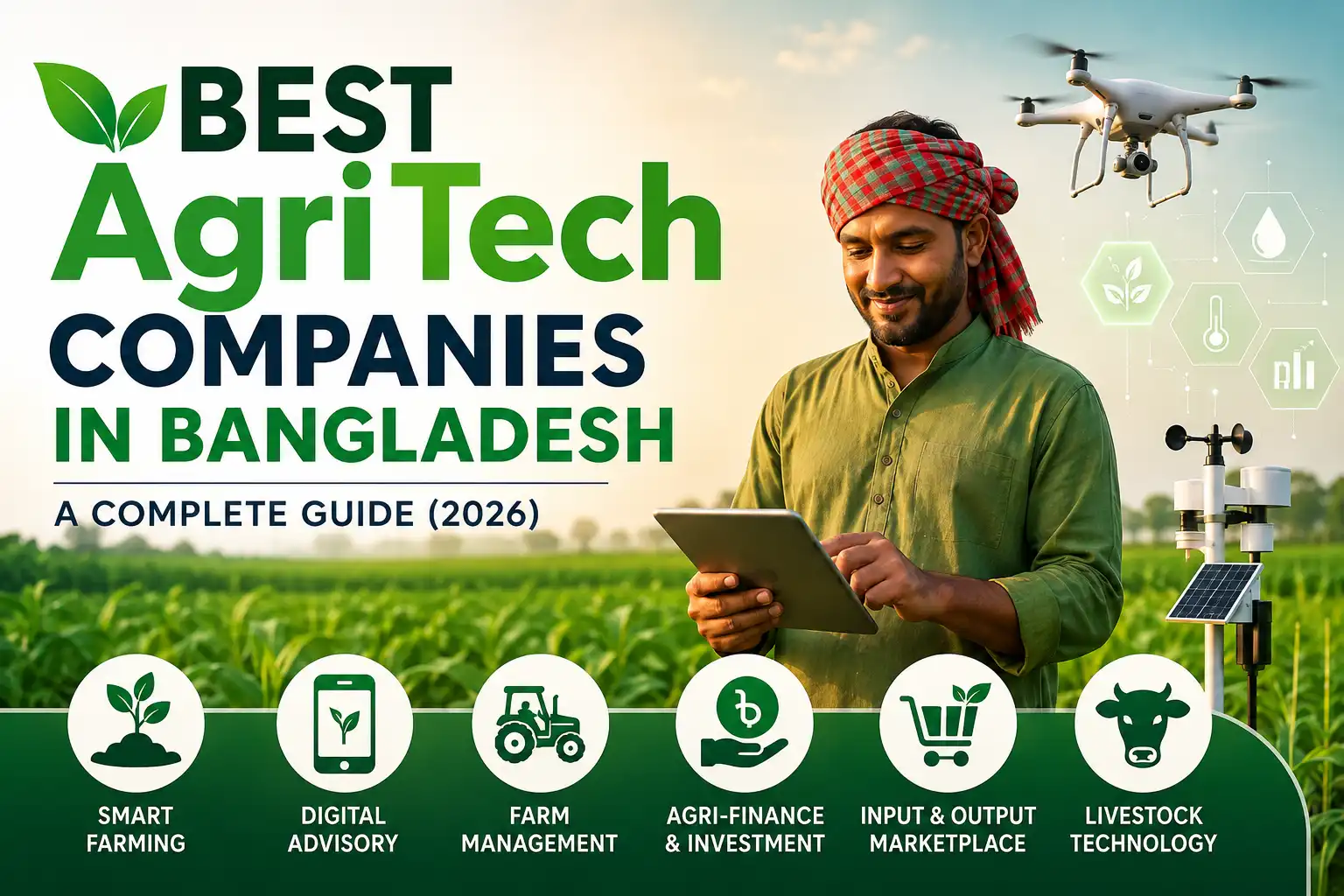
Best AgriTech Companies in Bangladesh: A Complete Guide (2026)
Agriculture remains the backbone of Bangladesh’s economy and the livelihood of a large share of its population, yet the sector has long struggled with fragmented supply chains, limited access to formal finance, and outdated farming practices. Over the past decade, a new generation of technology-driven companies has begun changing that picture. From apps that diagnose crop diseases with a smartphone camera to platforms that connect city investors with rural farmers, AgriTech is quietly reshaping how food is grown, financed, moved, and sold across the country.
This guide profiles the best AgriTech companies in Bangladesh as of 2026 — but an important clarification first. “Best” is a subjective word, and there is no official ranking of AgriTech companies in Bangladesh. The companies featured here were selected based on market presence, innovation, product offerings, public reputation, technology adoption, and publicly available information from industry research, media coverage, and company disclosures. This list is a research starting point, not an endorsement or a definitive ranking. Details such as services, partnerships, and business models change over time, so always verify current information directly with any company before making business decisions.
What Is AgriTech?
AgriTech — short for agricultural technology — refers to the use of technology to improve any part of the agricultural value chain. That includes how crops are planted and monitored, how livestock is managed, how farmers access finance and insurance, how produce moves from field to market, and how buyers and sellers find each other.
In practice, AgriTech in Bangladesh spans several distinct segments:
- Agri-fintech: platforms that connect farmers with financing, investors, or insurance
- Input linkage: marketplaces that supply farmers with quality seeds, fertilisers, and crop protection products
- Output market linkage: platforms that buy produce from farmers and sell to retailers, businesses, or consumers, shortening the traditional supply chain
- Farm management and advisory: apps and services offering agronomic advice, disease detection, and farm record-keeping
- Precision agriculture: IoT sensors, data analytics, and AI tools that support smarter farming decisions
- Livestock technology: digital cattle identification, health monitoring, veterinary services, and livestock insurance
A single company may operate in one segment or combine several into what industry observers commonly call a “full-stack” model.
Why AgriTech Is Growing in Bangladesh
Several forces have converged to make Bangladesh fertile ground for agricultural technology.
A large, underserved farming population. Bangladesh has millions of farmers, most of whom are smallholders cultivating small plots with traditional methods. Industry research consistently notes that a majority of these farmers lack access to formal credit, quality inputs, and fair market prices — exactly the gaps technology companies are built to close.
Inefficient supply chains. Produce traditionally passes through multiple intermediaries between farm and consumer, reducing farmer income while raising consumer prices and increasing waste. Digital platforms that shorten this chain create value on both ends.
Rising smartphone and mobile financial services adoption. Widespread mobile connectivity and the growth of mobile financial services have made it practical to deliver advisory, commerce, and payments to rural users at scale.
Growing investor interest. Several Bangladeshi AgriTech startups have attracted funding from local and international investors in recent years, according to industry trackers and business press coverage, signalling confidence in the sector’s long-term potential.
Climate pressure. As one of the countries most exposed to climate change, Bangladesh has an urgent need for climate-smart farming, better risk management, and agricultural insurance — all areas where technology plays a central role.
Top AgriTech Companies in Bangladesh (Listed Alphabetically)
The companies below are listed alphabetically for easier navigation. Their placement does not represent an official ranking or endorsement. Each is a real, publicly documented business operating in Bangladesh’s agricultural technology space.
ACI Agribusiness
ACI Limited is one of Bangladesh’s established conglomerates, and its agribusiness division has long been a major force in the country’s agricultural sector — spanning crop care, seeds, fertiliser, animal health, and farm machinery. In the AgriTech context, ACI matters because it represents how traditional agribusiness is digitising: industry research has noted that ACI has launched comprehensive digital initiatives combining commerce and farmer services, bringing app-based tools to the farming communities it already serves through physical distribution.
ACI Agribusiness serves an unusually broad base: crop farmers using its seeds and crop protection products, livestock and poultry farmers using its animal health lines, and mechanised farms using its agricultural machinery. Its digital efforts layer advisory, information, and commerce on top of one of the country’s most extensive rural distribution networks.
The division’s key strengths are scale, brand recognition in rural markets, decades of agronomic expertise, and the financial capacity to invest in technology over long horizons — advantages most startups cannot match. Its inclusion here reflects a practical reality for readers: for many farmers, the first experience of digital agriculture comes not from a startup but from the established input supplier they already trust.
Farmers and agri-enterprises choose ACI for product reliability, nationwide availability, and the growing convenience of digital access to its products and services.
Adorsho Prani Sheba
Adorsho PraniSheba Ltd is a Dhaka-based AgriTech company focused on livestock, with a background in ICT-for-development work. The company describes its platform as using IoT, RFID technology, artificial intelligence, and machine-learning-based facial recognition to deliver cattle identification, breed determination, record keeping, breeding and dairy management support, and primary veterinary care — with cattle insurance forming an important part of its offering, according to the company’s own public materials.
The company has developed IoT-enabled solutions to monitor cattle health in real time, using the resulting data to generate health insights and to support insurance and credit facilities for farmers, as documented in industry research. Publicly announced partnerships include collaborations with insurance companies on cattle insurance products and with banks on livestock financing for registered farmers.
Adorsho PraniSheba serves marginal and smallholder cattle farmers, dairy and beef-fattening operations, insurers, and financial institutions. Its service ecosystem also extends to online veterinary support and market linkage for livestock.
The company’s key strengths are its depth in livestock technology — an underserved niche compared with crop-focused platforms — and its data-driven approach that turns animal monitoring into financial access. Farmers choose Adorsho PraniSheba because it packages identification, health monitoring, veterinary care, insurance, and financing into a single relationship built specifically around livestock.
Agroshift
Agroshift is a business-to-business AgriTech platform focused on transforming the fresh produce supply chain. The company takes orders from B2B customers and micro-retailers, collects produce from farmers through its network of collection centres, and distributes directly to buyers — removing layers of intermediaries in the process.
One of Agroshift’s most distinctive innovations — as described in media reports and startup ecosystem coverage, rather than necessarily on the company’s main product page — is its deployment of ordering points and lean storefronts inside garment factory premises, allowing thousands of workers to order fresh produce at their workplace at accessible prices. This model connects rural farm supply directly with concentrated urban demand in a way few competitors have replicated.
Agroshift serves farmers seeking reliable buyers and fair prices, garment factories and their workers, micro-retailers, and other institutional food buyers. Its technology stack includes digital ordering systems, demand aggregation, and supply chain management tools that give farmers visibility into market demand before harvest.
The company attracted one of the sector’s notable early-stage funding rounds from local and international investors, according to industry trackers and press coverage. Businesses and farmers choose Agroshift because its model delivers benefits on both sides of the transaction: farmers gain predictable demand and better prices, while buyers receive fresher produce at competitive rates with organised logistics.
Bhalo Social Enterprises
Bhalo Social Enterprises — styled simply “bhalo” — is an agri-input marketplace designed to help smallholder farmers increase production and income. Founded in 2019, according to industry coverage, the company connects farmers and rural retailers with high-quality agricultural input suppliers, offering curated seeds, fertilisers, and crop protection products bundled with agronomic advisory and access to credit.
Bhalo operates what industry researchers describe as a managed marketplace or omnichannel model: it works directly with input manufacturers and distributors to aggregate quality products, then reaches farmers through a network of sales agents, logistics hubs, and retail outlets, supported by technology. The company has publicly disclosed partnerships with established input suppliers and financial institutions, and began its field operations with a focus on northern districts such as Kurigram, according to published profiles.
The company serves smallholder farmers, rural input retailers, input manufacturers, and microfinance partners. Its key strengths are its focus on input quality — a persistent problem in rural markets where counterfeit or substandard inputs are common — and its bundling of advisory services with products, helping farmers choose the right input and apply best practices.
Bhalo has received recognition through international accelerator and impact programmes, according to public announcements. Farmers choose Bhalo because it combines trustworthy products, practical advice, and financing access in one relationship.
Chaldal (Chaldal Vegetable Network)
Chaldal is best known as one of Bangladesh’s most prominent online grocery platforms, but it has also become a meaningful player in agricultural supply chains through its vegetable network initiative, commonly referenced in industry research as CDVN. Through this operation, Chaldal works directly with farmers to source fresh produce, bypassing parts of the traditional intermediary chain and integrating farm output directly into its urban delivery infrastructure.
Industry analysis of Bangladesh’s AgriTech landscape has repeatedly cited Chaldal’s agricultural operations as an example of how established retail and grocery players are entering the output-market-linkage space — leveraging existing logistics, warehousing, and customer demand to create direct farm-to-consumer channels at a scale most standalone startups cannot yet match.
Chaldal’s agricultural sourcing serves vegetable and produce farmers on the supply side and urban household consumers on the demand side, supported by the company’s warehouse network and delivery technology. Its key strengths in the agricultural context are scale, established last-mile logistics, consistent daily demand, and the financial stability of a mature technology company.
Farmers who supply Chaldal’s network gain access to steady, high-volume urban demand, while consumers benefit from fresher produce with fewer handling stages. For readers researching AgriTech, Chaldal illustrates an important trend: the line between e-commerce and agricultural technology is increasingly blurred.
Dr. Chashi
Dr. Chashi is an AI-focused AgriTech venture best known for its crop disease detection technology. Using machine learning and computer vision, the platform allows farmers to point their smartphone camera at an affected plant and receive an identification of critical diseases attacking their crops, along with guidance on response — a capability documented in national business press coverage.
Beyond individual diagnosis, the technology carries broader significance: as coverage of the company has noted, aggregated disease detection data could eventually help government bodies and development organisations map, track, and limit the spread of crop diseases across the country, turning a farmer-facing tool into an early-warning system for national agriculture.
Dr. Chashi serves smallholder farmers who lack easy access to agronomists and plant pathologists, as well as the broader agricultural extension ecosystem. Its key technologies are machine learning, image recognition, and mobile-first product design suited to rural users.
The company’s main strength is its focus: rather than building a broad marketplace, it addresses one high-stakes problem — crop disease — with a technically sophisticated solution accessible through a device most farming households already own. Farmers choose Dr. Chashi because rapid disease identification can mean the difference between saving a harvest and losing a season’s income, and because smartphone-based diagnosis costs far less than waiting for expert visits. It is regularly listed among Bangladesh’s notable AgriTech startups by industry data platforms.
Fashol
Fashol is a wholesale agricultural marketplace that connects farmers with urban retailers. The company sources fruits, vegetables, and other produce from farming regions across the country, processes them through its distribution centres using an in-house sorting system, and delivers directly to partner retailers’ doorsteps.
The core problem Fashol addresses is the inefficiency of the traditional produce supply chain, where multiple intermediaries erode farmer income and inflate retail prices. By consolidating sourcing, sorting, and last-mile delivery, Fashol aims to offer retailers competitive prices while paying farmers more fairly — a value proposition covered repeatedly in the national business press.
Fashol serves smallholder farmers on the supply side and small urban retailers — such as neighbourhood produce shops — on the demand side, with publicly stated ambitions to expand into supplying restaurants and additional product categories. Its strengths include its retailer-focused B2B model, its distribution centre network, and its position among the funded startups in the sector, having raised venture investment according to startup data platforms and news coverage.
Retailers choose Fashol for doorstep delivery, consistent sourcing, and price competitiveness; farmers choose it for reliable offtake and reduced dependence on traditional intermediaries. The company is regularly named among the notable output-market-linkage players in Bangladeshi AgriTech industry research.
iFarmer
iFarmer is one of the most frequently cited names in Bangladesh’s AgriTech landscape and among the earliest significant players in the sector. The company began as an agri-fintech platform, connecting smallholder farmers with retail and institutional investors to provide collateral-free financing for farming projects. Over time, it has evolved into what industry observers describe as a full-stack AgriTech company, expanding into farm inputs, agronomic advisory, and output market linkage, with agricultural machinery access also described in public interviews and industry profiles of the company.
Its core model allows individuals and institutions to fund agricultural projects digitally, while farmers receive financing, quality inputs, training, and support selling their harvest. The company has also worked with banks and non-bank financial institutions to expand agricultural lending channels, according to industry coverage, and Shariah-aligned financing options have been mentioned in public interviews and industry profiles alongside conventional structures — readers should verify the latest offerings through iFarmer’s official channels.
iFarmer serves smallholder crop and livestock farmers, agri-input suppliers, financial institutions, and food buyers. Its key strengths are the breadth of its model — covering finance, inputs, advisory, and market access in one ecosystem — and its position as one of the more heavily funded startups in the vertical, according to startup data platforms. Farmers and partners are drawn to iFarmer because it addresses several pain points at once rather than solving a single link in the chain, reducing the number of separate relationships a smallholder must manage.
iPAGE Bangladesh
iPAGE is a data-driven AgriTech company that applies IoT devices, intelligent sensors, and machine learning to support decision-making for farming communities. Where many Bangladeshi AgriTech players focus on marketplace or financing models, iPAGE’s identity is rooted in precision agriculture — using soil data, sensor readings, and analytics to tell farmers what to plant, when, and how to manage it.
According to national press coverage, iPAGE leverages IoT and intelligent sensing technologies to enable evidence-based farming decisions, and works to connect farmers more efficiently to the broader value chain by reducing information gaps between production and distribution. The company positions its services around helping smallholders produce more efficiently while improving their linkage to buyers and service providers.
iPAGE serves smallholder farmers, agricultural extension programmes, and development-sector partners interested in data-driven approaches to rural livelihoods. Its key technologies include soil testing and analysis, sensor-based monitoring, and machine-learning-driven advisory.
The company has appeared in international venture and impact platforms as a recognised Bangladeshi AgriTech venture. Farmers and partner organisations choose iPAGE because its advisory is grounded in measured data rather than general guidance — a meaningful difference in a country where soil conditions and climate risks vary sharply between regions and where input misuse remains a costly problem.
InsureCow
InsureCow is a livestock-focused technology company that has built a comprehensive platform for cattle insurance and wellbeing monitoring. Its services span cattle registration and identification, insurance product design and underwriting support, claim management, data management and visualisation, and payment facilitation for stakeholders across the livestock insurance chain, according to industry research profiles.
One of InsureCow’s most publicised innovations is its livestock muzzle identification technology — using the unique pattern of a cow’s muzzle, comparable to a human fingerprint, to identify and tag insured animals. This addresses one of the fundamental obstacles to livestock insurance in Bangladesh: reliably verifying which animal is insured and preventing fraudulent claims. National press coverage has noted the company’s work with established insurance providers who underwrite the insured assets.
InsureCow serves cattle farmers, small and medium livestock enterprises, NGOs, insurance companies, and financial institutions that need dependable livestock identification and risk data before extending coverage or credit.
Its key strengths are its specialised technology, its position at the intersection of AgriTech and InsurTech, and its role in enabling a livestock insurance market that has historically been difficult to operate. Farmers and institutions choose InsureCow because credible identification and monitoring unlock financial products — insurance and loans — that were previously out of reach for most cattle owners.
Khaas Food
Khaas Food is a food brand and commerce platform that operates in the output-market-linkage segment of Bangladesh’s AgriTech landscape. According to industry research, the company works directly with farmers to collect produce and sells it to consumers through its e-commerce website and retail chain, positioning itself around the promise of safe, authentic, and responsibly sourced food.
The company’s model addresses a demand-side problem that has grown steadily in urban Bangladesh: consumer concern about food adulteration, chemical use, and unclear sourcing. By managing sourcing relationships with farmers and producers directly, Khaas Food offers traceability and quality assurance that conventional retail chains often cannot.
Khaas Food serves quality-conscious urban consumers, along with the network of farmers and producers who supply its catalogue, which spans fresh produce, staples, dairy, honey, and other food categories. Its key operational strengths include direct sourcing relationships, a hybrid online-plus-physical retail presence, and an established brand identity built around food safety.
Consumers choose Khaas Food because it reduces uncertainty about where food comes from and how it was produced, while supplying farmers gain a committed buyer that values quality over lowest-price sourcing. The company is regularly named among the notable output-linkage players in published overviews of Bangladeshi AgriTech, illustrating how brand-led food commerce and agricultural technology increasingly overlap.
WeGro Technologies
WeGro is a technology-based agricultural financing platform that connects individual and institutional investors with farmers and their agricultural projects. The company’s stated goal is to simplify investing in agriculture: investors can browse farming projects through WeGro’s digital platform, fund them in units, track progress, and collect returns after harvest.
For farmers, the model provides access to financing with minimal paperwork — a meaningful advantage in a market where formal lenders have traditionally avoided agricultural credit. WeGro’s projects have included crop cultivation in northern districts such as Bogura, according to media coverage. Industry reports have also referenced initiatives connecting farmers to livestock insurance technology through partner organisations, though readers should verify current partnership details directly with the company.
WeGro primarily serves smallholder farmers seeking working capital, along with retail and institutional investors looking for exposure to agricultural projects. Its technology centres on a digital investment platform with project tracking and portfolio management features. The company has received backing from regional investors, including accelerator programmes, according to industry reporting.
Farmers choose WeGro for the speed and simplicity of its financing compared with traditional channels, while investors are attracted by the ability to participate in real agricultural projects with transparency into how their money is used. As with any investment platform, prospective investors should review current terms, protections, and risks directly with the company.
How to Choose the Right AgriTech Company
With companies operating across financing, inputs, supply chains, livestock, and data services, choosing the right partner depends entirely on your specific need. Consider these factors:
Technology. Assess whether the company’s technology genuinely fits your problem. A farmer battling crop disease needs diagnostic tools; a retailer needs reliable sourcing; an investor needs a transparent platform. Ask for a demonstration before committing.
Support. Rural technology succeeds or fails on support. Check whether the company offers field agents, phone support in Bangla, training, and help during critical moments such as harvest, disease outbreaks, or claim events.
Pricing. Understand the full cost structure — platform fees, commissions, interest or profit rates on financing, delivery charges, and any hidden costs. Compare against your traditional alternatives honestly.
Scalability. If your farm or business grows, can the platform grow with you? A solution that works for one acre or one shop may struggle at ten.
Experience. Companies with several seasons of operation have survived Bangladesh’s real-world challenges — floods, price swings, logistics breakdowns. Ask how long they have operated in your district specifically.
Industry specialisation. A livestock farmer is usually better served by a livestock-focused platform than a general marketplace, and vice versa. Match the company’s core specialism to your operation.
Whatever you choose, verify the company’s registration, physical presence, and current terms directly. Public reputation is a starting point, not a substitute for due diligence.
Benefits of Using AgriTech Solutions
For farmers, businesses, and investors alike, agricultural technology offers tangible advantages:
- Better market access. Digital platforms connect farmers to buyers directly, improving price realisation and reducing dependence on layers of intermediaries.
- Access to finance. Agri-fintech platforms extend credit and investment to farmers whom traditional lenders have historically excluded.
- Improved input quality. Curated input marketplaces reduce exposure to counterfeit or substandard seeds, fertilisers, and pesticides.
- Data-driven decisions. Sensors, soil analysis, and AI advisory replace guesswork with evidence, improving yields and reducing waste.
- Risk management. Livestock and crop insurance backed by digital identification and monitoring protects farming households from catastrophic loss.
- Reduced post-harvest loss. Shorter, better-organised supply chains mean fresher produce and less waste between field and plate.
- Transparency and traceability. Buyers increasingly want to know where food comes from; digital sourcing makes that possible.
Challenges Facing Bangladesh’s AgriTech Industry
The sector’s promise is real, but so are its obstacles.
Digital literacy and trust. Many smallholder farmers remain unfamiliar or uncomfortable with app-based services, and adoption often depends on in-person field agents — which raises operating costs.
Access to capital. Industry observers have noted that investment in Bangladeshi AgriTech remains modest relative to the sector’s economic importance, limiting how fast companies can scale.
Infrastructure gaps. Cold storage, rural logistics, and reliable connectivity remain uneven across the country, constraining supply chain models.
Fragmented landholdings. With most farmers cultivating small plots, achieving efficient scale requires aggregating thousands of tiny suppliers — an operationally demanding task.
Climate volatility. Floods, cyclones, and erratic weather can wipe out projects and test the resilience of financing and insurance models.
Policy and regulatory evolution. Areas such as crowdfunded agricultural investment and digital insurance are still maturing from a regulatory standpoint, and companies must adapt as frameworks develop.
Quality consistency at scale. Maintaining consistent produce quality across a dispersed farmer network is one of the hardest challenges for output-linkage platforms, as industry research has repeatedly highlighted.
Future of AgriTech in Bangladesh
Several trends are likely to shape the sector’s next phase.
Deeper AI adoption. Disease detection, yield prediction, and personalised advisory powered by machine learning are expected to move from novelty to standard practice, building on foundations laid by companies already using computer vision and data analytics.
Convergence of finance and farming. The line between AgriTech, fintech, and InsurTech will continue to blur, with bundled offerings — financing plus inputs plus insurance plus market access — becoming the norm rather than the exception.
Corporate and startup collaboration. Established agribusinesses, banks, insurers, and retail platforms are increasingly partnering with startups rather than competing with them, combining institutional scale with startup agility.
Climate-smart agriculture. As climate pressure intensifies, demand will grow for drought-tolerant practices, precision irrigation, parametric insurance, and early-warning systems — creating room for new specialised ventures.
Livestock and aquaculture technology. Industry analysts have pointed to livestock and aquaculture as segments with significant room for new entrants, given how few companies currently serve them relative to crop-focused platforms.
Rural digital inclusion. Continued growth in smartphone penetration and mobile financial services will steadily expand the addressable market, making models viable in districts that were previously out of reach.
The sector remains young, and not every company will survive its growing pains. But the direction is clear: technology is becoming a permanent part of how Bangladesh farms.
Frequently Asked Questions
What does an AgriTech company actually do?
An AgriTech company applies technology to agriculture. Depending on the company, that can mean financing farmers, supplying quality inputs, buying and distributing produce, diagnosing crop diseases with AI, monitoring livestock with IoT devices, or providing farm management software.
Which are the most well-known AgriTech companies in Bangladesh?
Frequently cited names in industry research and business press include iFarmer, WeGro, Agroshift, Fashol, Bhalo, iPAGE, Dr. Chashi, InsureCow, and adorsho praniSheba, alongside the agricultural operations of larger players such as Chaldal and ACI. This is not an official ranking — verify each company’s current status directly.
How do agricultural investment platforms work?
Platforms in this space typically let individuals or institutions fund specific farming projects digitally. Farmers receive financing and support, and investors receive returns after harvest. Terms, protections, and risks vary by platform, so read current documentation carefully before investing.
Can small farmers actually use these technologies?
Yes — most Bangladeshi AgriTech companies are designed specifically for smallholders, often combining mobile apps with field agents, call centres, and local retail points so that farmers without strong digital skills can still participate.
Is AgriTech only for crop farmers?
No. Companies such as InsureCow and adorsho praniSheba focus specifically on livestock, offering cattle identification, health monitoring, veterinary services, insurance, and financing. Aquaculture is an emerging area as well.
How does AgriTech help reduce food prices?
By shortening the supply chain between farmers and buyers, digital platforms reduce the margins taken by multiple intermediaries and cut post-harvest waste — savings that can benefit both the farmer’s income and the consumer’s price.
Are these companies regulated?
AgriTech companies are registered businesses subject to the laws applicable to their activities, and areas such as insurance involve regulated partners. Regulatory frameworks for newer models, such as digital agricultural investment, continue to evolve. Verify a company’s registration and current standing before entering significant commitments.
How can I verify an AgriTech company before working with it?
Check the company’s registration, visit its official website and social channels, confirm its physical office, ask for references from farmers or businesses in your area, and review recent media coverage. Business directories can help you discover and compare companies, but directory listings alone are not proof of legal registration.
What should farmers ask before joining an AgriTech platform?
Ask about total costs and commissions, payment timing, what happens if crops fail or prices fall, whether support is available locally, and what the exit process looks like. Get commitments in writing.
Is AgriTech a good sector for entrepreneurs and investors in Bangladesh?
Industry observers widely view the sector as early-stage with substantial long-term potential, given agriculture’s economic weight and the scale of unsolved problems. Like any emerging sector, it carries meaningful risks, and outcomes vary significantly between companies.
Final Thoughts
Bangladesh’s AgriTech story is still in its early chapters, but the companies profiled in this guide demonstrate how much is already changing — farmers financed without collateral, diseases diagnosed by smartphone, cattle insured through muzzle recognition, and produce moving from field to shop with fewer hands in between. The “best” AgriTech company for you depends on your role in the value chain, your location, and your specific needs, which is why independent verification should always follow initial research.
Readers looking to explore more verified business information — including agricultural companies, suppliers, and service providers across Bangladesh — can discover additional companies through Info Ghor’s business directory, a Bangladesh-focused business directory that also publishes informational articles and guides like this one.