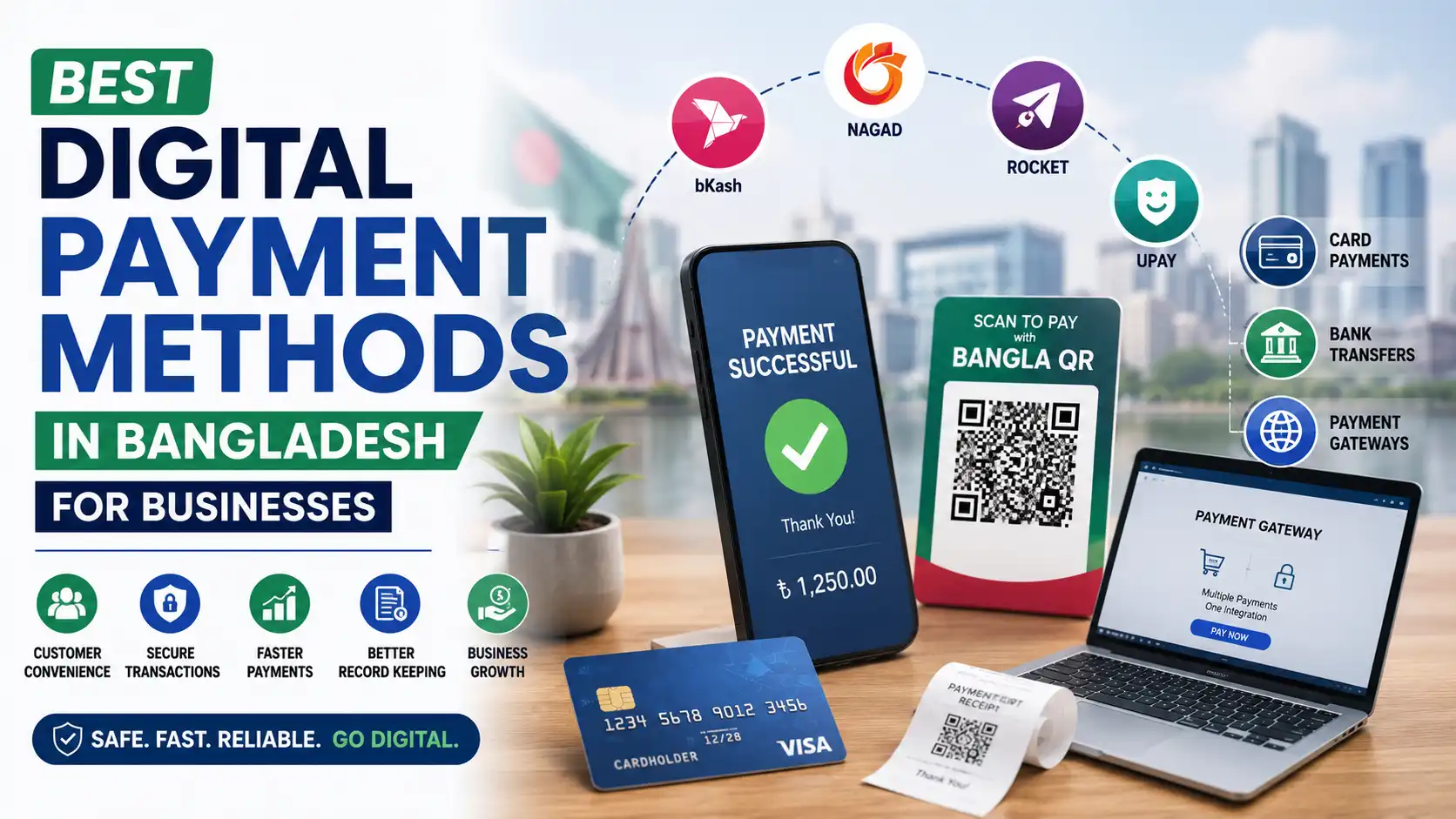
Best Digital Payment Methods in Bangladesh for Businesses
Cash still changes hands everywhere in Bangladesh, but the direction of travel is unmistakable. Customers now expect to scan a QR code at a tea stall, pay a boutique through bKash, settle an invoice by bank transfer, and check out of an online store with a card — all without touching a banknote. For businesses, accepting digital payments has shifted from a modern convenience to a competitive necessity: the business that cannot accept a customer’s preferred payment method increasingly loses that customer to one that can.
This guide explains the best digital payment methods in Bangladesh for businesses — what each method is, how businesses use it, and how to choose among them. Two clarifications before we begin:
First, this is not an official ranking. The payment methods here are discussed based on business adoption, convenience, accessibility, security features, ecosystem support, and publicly available information. Different methods suit different businesses, and no single provider is universally superior.
Second, payment features, fees, and policies change frequently. Merchant charges, transaction limits, settlement arrangements, and onboarding requirements are set by providers and regulators and are revised over time. This article deliberately avoids quoting specific fees or settlement times as fixed facts — always verify the latest details directly with the respective payment provider before making decisions.
What Are Digital Payment Methods?
A digital payment method is any way of transferring money electronically — without physical cash — between a customer and a business. The money moves through regulated channels: mobile financial service (MFS) wallets, bank accounts, card networks, or payment gateways.
A typical digital payment works in three steps: the customer initiates the payment (scanning a QR code, entering card details, or confirming in an app), the system authorises and processes it through the relevant network, and the funds are settled into the business’s wallet or bank account.
The main types of digital payments available to Bangladeshi businesses are:
- Mobile financial services (MFS): wallet-based payments through providers such as bKash, Nagad, Rocket, and Upay
- Card payments: debit and credit cards on networks such as Visa, Mastercard, and American Express
- QR code payments: including the interoperable Bangla QR standard
- Bank-based payments: direct transfers, internet banking, and mobile banking apps
- Online payment gateways: services that let websites and apps accept multiple payment types through one integration
For businesses, digital payments bring faster settlement than cheque-based collection, automatic transaction records, reduced cash-handling risk, and access to customers who simply prefer paying digitally.
Why Businesses in Bangladesh Should Accept Digital Payments
Customer convenience. Millions of Bangladeshis carry an MFS wallet on their phone. Meeting customers where they already are removes friction at the exact moment of purchase.
Faster payments. Digital collection eliminates the delays of cheque clearing and the trips to deposit cash, improving cash flow visibility.
Better record keeping. Every digital transaction creates an automatic record — invaluable for accounting, reconciliation, tax preparation, and understanding sales patterns.
Reduced cash handling. Less cash on premises means less theft risk, fewer counting errors, no counterfeit notes, and lower costs of transporting and securing money.
Business growth. Digital acceptance unlocks online sales channels — e-commerce, social commerce, delivery platforms — that are impossible to serve with cash alone, and a documented digital transaction history can support loan applications.
Financial transparency. Clean digital records strengthen a business’s credibility with banks, investors, suppliers, and regulators alike.
Best Digital Payment Methods in Bangladesh (Listed Alphabetically)
The methods below are listed alphabetically; the order does not represent a ranking. Each method or payment infrastructure discussed below has a publicly documented role in Bangladesh’s digital payment ecosystem at the time of writing. Availability and merchant access may vary by provider. Features, charges, limits, and onboarding requirements change over time — verify current details directly with each provider.
aamarPay
aamarPay is a Bangladeshi online payment gateway. According to publicly available information at the time of writing, aamarPay has been listed as a Payment Systems Operator (PSO). Because licensing status and regulatory classifications may change, businesses should verify the provider’s current licence status directly through Bangladesh Bank’s latest publications and the provider’s official website before onboarding. It allows websites, apps, and institutions to accept payments from multiple sources — cards such as Visa and Mastercard, and mobile financial services including bKash, Nagad, and Rocket — through a single integration.
Businesses use aamarPay primarily for online collection: e-commerce checkouts, education fee collection, ticketing, and service payments. The gateway offers plugins for common website platforms along with APIs for custom integration, and publicly describes tiered merchant plans suited to different business types.
Key advantages include broad payment-method coverage under one agreement, local support, and onboarding processes designed around Bangladeshi documentation. Limitations mirror those of any aggregator: per-transaction charges apply, settlement follows the provider’s schedule rather than being instant, and merchants depend on the gateway’s uptime.
Typical use cases include SME e-commerce stores, schools and coaching centres collecting fees online, and service businesses invoicing customers digitally. Supported payment methods, integrations, merchant features, and settlement arrangements may change over time, so businesses should verify the latest information — including current pricing plans — directly with aamarPay before implementation.
Bangla QR
Bangla QR is the interoperable QR code payment standard introduced under Bangladesh Bank’s guidelines. Its defining feature is interoperability: a single printed QR code at a shop can, in principle, accept payments from customers using different banks’ apps and participating payment providers — rather than requiring a separate code for every wallet.
Businesses use Bangla QR by obtaining a merchant QR through a participating bank or acquirer, displaying it at the point of sale, and receiving payments directly into their account when customers scan and pay through Bangla QR-enabled apps.
Key advantages include extremely low setup requirements — a printed code needs no terminal hardware, electricity, or rental — making it especially suitable for small traders, and its contactless, cash-free nature. The interoperable design reduces counter clutter and simplifies acceptance.
Limitations include dependence on customer familiarity, which is still developing outside urban areas, and the fact that participation and features vary among banks and providers.
Typical use cases include retail shops, restaurants, groceries, pharmacies, and small traders wanting card- and app-based acceptance without investing in POS hardware. Businesses should confirm participating institutions, onboarding requirements, and any applicable charges with their bank, as the ecosystem continues to develop.
Bank Transfers (BEFTN and RTGS)
Direct bank-to-bank transfers remain a backbone of business payments in Bangladesh, operating through national systems administered under Bangladesh Bank — including the Bangladesh Electronic Funds Transfer Network (BEFTN) for routine electronic transfers and the Real Time Gross Settlement (RTGS) system, which is generally used for larger-value, time-critical transactions.
Businesses use bank transfers for supplier payments, salary disbursement, B2B invoicing, rent, and any transaction where both parties deal through bank accounts. Customers and business partners initiate transfers through branches, internet banking, or banking apps.
Key advantages include suitability for large amounts that exceed MFS wallet limits, direct settlement into business accounts, strong audit trails, and universal acceptance among formal businesses. Transfers avoid per-transaction percentage charges typical of card and wallet payments, though banks apply their own fee schedules.
Limitations include less convenience for spontaneous consumer purchases, processing that follows banking-system schedules, and the need for accurate account details — errors are troublesome to reverse.
Typical use cases are B2B trade, corporate transactions, payroll, and high-value payments. Businesses should confirm current transfer types, cut-off times, limits, and charges with their own bank, as these vary by institution and change over time.
bKash Merchant Payments
bKash is Bangladesh’s most widely recognised mobile financial service, and its merchant payment offering allows businesses of all sizes — from street vendors to national retail chains — to accept payments from bKash customers. Merchants receive a dedicated merchant account, payments arrive through customer app payments or QR scans, and the bKash merchant app provides transaction management.
Businesses use bKash acceptance both offline (QR codes and merchant numbers at physical counters) and online (payment gateway integration for websites and apps, widely supported by Bangladeshi gateways and platforms).
Key advantages include an enormous existing customer base — meaning most walk-in customers can already pay — strong brand familiarity, straightforward onboarding designed for small businesses, and features for tracking and managing collections.
Limitations include per-transaction merchant charges (set by bKash and subject to change), wallet-based transaction limits that make very large payments impractical, and dependence on the customer having sufficient wallet balance.
Typical use cases span retail shops, restaurants, online sellers, delivery-based businesses, and service providers. Since merchant pricing, account categories, and features are revised periodically, businesses should verify current terms directly with bKash before onboarding.
Card Payments (Visa, Mastercard and American Express)
International card networks operate in Bangladesh through issuing and acquiring banks. Visa and Mastercard cards — debit, credit, and prepaid — are issued by many Bangladeshi banks, while American Express is available in Bangladesh through partnerships with selected local banks, and its acceptance depends on the acquiring bank’s arrangements; businesses should verify current card-brand support directly with their acquiring bank or payment gateway. Businesses accept cards through bank-provided POS terminals offline or payment gateways online.
Businesses use card acceptance to serve salaried professionals, corporate customers, tourists, and higher-value purchases where customers prefer credit facilities or card rewards.
Key advantages include suitability for larger transactions than wallet limits allow, international acceptance capability relevant for hotels and tourism-linked businesses, and the professional credibility card acceptance signals. Card payments also settle into business bank accounts with clear records.
Limitations include merchant discount rates charged on each transaction (set by acquiring banks and subject to agreements), POS hardware requirements for offline acceptance, chargeback exposure — customers can dispute transactions through their banks — and onboarding requirements that are more documentation-heavy than MFS.
Typical use cases include restaurants, retail chains, hotels, hospitals, electronics stores, and e-commerce. Businesses should discuss current merchant rates, settlement arrangements, and terminal options directly with acquiring banks, as terms vary between banks and merchant categories.
Internet Banking and Mobile Banking Apps
Most Bangladeshi banks now offer internet banking portals and mobile banking apps through which account holders can pay businesses directly — transferring to business accounts, paying bills, and in many cases paying merchants within e-commerce checkouts via gateway integrations.
Businesses use bank-app payments in two main ways: sharing business account details for direct transfers (common for invoices, bookings, and B2B payments), and accepting bank-app payments as one of several options inside an online payment gateway checkout.
Key advantages include settlement directly into the business’s bank account, suitability for customers who keep their money in banks rather than wallets, and strong record keeping on both sides. For higher-value consumer purchases — furniture, electronics, travel packages — bank payments often suit customers better than wallet limits allow.
Limitations include a checkout experience that is less instant than wallet payments for spontaneous purchases, variation in features between banks, and reliance on the customer’s bank supporting the relevant payment route.
Typical use cases include invoice-based businesses, travel agencies, education fee collection, and e-commerce serving banked customers. Businesses should confirm with their own bank what collection features are available for merchants, as offerings differ significantly between institutions.
Nagad Merchant
Nagad is one of Bangladesh’s major mobile financial services. It was launched in association with the Bangladesh Post Office and has evolved over time; readers should verify the latest corporate structure, licensing status, and merchant information through Nagad’s official documentation and Bangladesh Bank. Its merchant service enables businesses to accept payments from Nagad’s large customer base and, like other MFS merchant offerings, supports payment through the customer app, merchant QR codes, and online gateway integrations.
Businesses use Nagad merchant accounts at physical counters — displaying QR codes or merchant numbers — and online through payment gateways and e-commerce platforms that include Nagad among their supported methods.
Key advantages include access to a substantial and growing user base, competitive positioning that has made the service popular among cost-conscious users, and acceptance infrastructure that requires no special hardware. For businesses aiming to serve the broadest range of wallet users, offering Nagad alongside other MFS options captures customers who primarily use one service.
Limitations parallel other wallet services: merchant charges apply per transaction, wallet limits constrain large payments, and terms are set by the provider and revised over time.
Typical use cases include retail, food businesses, online sellers, and utility-style collections. Businesses should verify current merchant onboarding requirements, charges, and features directly with Nagad, as the service’s terms and structure have evolved and may continue to change.
National Payment Switch Bangladesh (NPSB)
NPSB is not a consumer-facing app but national payment infrastructure operated under Bangladesh Bank. It interconnects banks so that transactions can route between them — enabling, for example, a customer of one bank to use another bank’s ATM, make interbank card transactions at POS terminals, or transfer funds between banks through internet banking channels.
Businesses encounter NPSB indirectly but importantly: when a customer pays with a card issued by one bank at a POS terminal acquired by another, or transfers money between banks online, national switching infrastructure of this kind is what makes the interoperability work.
The advantage for businesses is practical: interoperability dramatically widens the pool of customers who can pay. A business does not need its customers to bank where it banks — the infrastructure connects them.
The limitation is simply that NPSB is not something a business “signs up for” directly; access flows through banks and the payment services built on top of the infrastructure.
For business owners, the key takeaway is awareness: when choosing banks and payment services, interoperability through national infrastructure is part of what makes card acceptance and interbank transfers broadly usable. Specific routing, limits, and charges are matters to confirm with banks, and regulatory arrangements are defined by Bangladesh Bank.
POS Terminal Payments
Point-of-sale (POS) terminals are the card machines familiar from retail counters — devices provided through acquiring banks that let businesses accept debit and credit cards, and increasingly contactless payments, in person.
Businesses use POS terminals wherever in-person card payment matters: retail stores, restaurants, hotels, hospitals, pharmacies, and superstores. Modern terminals typically support chip-and-PIN and contactless “tap” payments, and some acquirers offer terminals or apps that also present QR-based options at the same counter.
Key advantages include acceptance of higher-value payments beyond wallet limits, service to card-preferring customer segments, contactless convenience for fast checkout, and settlement into the business’s bank account with consolidated reporting.
Limitations include terminal costs or rental arrangements (varying by bank and agreement), merchant discount rates on transactions, dependence on connectivity, and more involved onboarding documentation than MFS merchant accounts. Chargebacks are also a consideration in card acceptance.
Typical use cases are established physical businesses with meaningful card-paying footfall. Businesses should compare terminal offerings, current merchant rates, settlement schedules, and support quality across more than one acquiring bank before committing, as terms differ between banks and are periodically revised.
Rocket Merchant
Rocket is the mobile financial service of Dutch-Bangla Bank, one of the earliest entrants in Bangladesh’s MFS market, and its merchant arrangements allow businesses to accept payments from Rocket users at counters and through supported online channels.
Businesses use Rocket acceptance in the familiar MFS pattern: merchant accounts receiving customer payments via app or QR at physical locations, and inclusion as a payment option through gateways online — where Rocket appears among the mobile banking options supported by major Bangladeshi payment gateways.
Key advantages include the service’s long-standing presence and its connection to Dutch-Bangla Bank’s broader banking ecosystem, which suits customers who move money between bank accounts and mobile wallets. For businesses aiming at comprehensive wallet coverage, adding Rocket captures its established user segment.
Limitations follow the MFS pattern: per-transaction charges, wallet-based limits, and provider-defined terms subject to change. Rocket’s user base and merchant footprint also differ from the largest wallets, so its priority depends on your customer mix.
Typical use cases include retail, services, and online stores offering multiple MFS options at checkout. Verify current merchant onboarding, charges, and supported features directly with Dutch-Bangla Bank, as arrangements evolve.
ShurjoPay
ShurjoPay is a Bangladeshi online payment gateway that enables businesses to accept a wide range of payment methods — cards including Visa, Mastercard, and American Express, mobile financial services, and internet banking options — through one integration. According to publicly available information at the time of writing, ShurjoPay has been listed as a Payment Systems Operator (PSO). Because licensing status and regulatory classifications may change, businesses should verify the provider’s current licence status directly through Bangladesh Bank’s latest publications and the provider’s official website before onboarding.
Businesses use ShurjoPay to power online checkouts for e-commerce sites, service platforms, and institutional collections, integrating via APIs and platform plugins.
Key advantages include consolidated acceptance of many payment types under a single merchant relationship, developer-oriented integration resources, and local merchant support — characteristics publicly highlighted in industry coverage of the gateway. Aggregators of this kind spare businesses from negotiating separate arrangements with every wallet and bank.
Limitations mirror the aggregator model generally: transaction charges apply, settlement follows the gateway’s schedule, onboarding involves documentation and approval, and the business depends on the gateway’s uptime and support responsiveness.
Typical use cases include online retailers, startups, subscription services, and organisations collecting fees digitally. Supported payment methods, integrations, merchant features, and settlement arrangements may change over time, so businesses should verify the latest information — including current pricing and integration options — directly with ShurjoPay before implementation.
SSLCommerz
SSLCommerz is one of Bangladesh’s most widely used online payment gateways — widely recognised in industry coverage as one of Bangladesh’s established online payment gateways. According to publicly available information at the time of writing, SSLCommerz has been listed as a Payment Systems Operator (PSO). Because licensing status and regulatory classifications may change, businesses should verify the provider’s current licence status directly through Bangladesh Bank’s latest publications and the provider’s official website before onboarding. A single SSLCommerz integration gives a business access to cards (Visa, Mastercard, American Express), major mobile financial services including bKash, Nagad, and Rocket, and internet banking options.
Businesses use SSLCommerz for e-commerce checkouts, app-based payments, and institutional collections, choosing between hosted payment pages (simplest to implement), embedded checkout, and full API integration. The company has also been publicly involved in Bangla QR merchant acquisition alongside banks and card networks.
Key advantages include the broadest commonly cited payment-method coverage in one integration, extensive platform plugins, established market presence, and documentation depth that suits both simple stores and complex platforms.
Limitations include per-transaction charges under provider-defined plans, approval and onboarding processes, and — as with any single point of integration — dependence on gateway availability.
Typical use cases span everything from small online shops to large e-commerce platforms and enterprise collections. Supported payment methods, integrations, merchant features, and settlement arrangements may change over time, so businesses should verify the latest information — including current plans and charges — directly with SSLCommerz before implementation.
Upay Merchant
According to publicly available corporate information at the time of writing, Upay operates as the mobile financial service brand of UCB Fintech Company Limited, associated with United Commercial Bank. Businesses should verify its latest corporate, licensing, and merchant information through official sources. Upay offers merchant acceptance for businesses serving its user base, and its merchant services follow the established MFS model: merchant accounts, QR-based and app-based payment collection, and availability as a payment option through gateways.
Businesses use Upay acceptance at physical counters and within online checkouts, typically as one option in a multi-wallet acceptance strategy that ensures no customer is turned away for using a particular service.
Key advantages include straightforward merchant onboarding in the MFS pattern, QR-based acceptance without hardware investment, and connection to a bank-backed fintech operation. Upay has also been publicly associated with digital payment services in specific niches, including toll and fee collections.
Limitations are consistent with the category: provider-set merchant charges, wallet transaction limits, and a user base smaller than the market leaders — making it a complementary option rather than a first integration for most businesses.
Typical use cases include retail and service businesses broadening their wallet coverage and online platforms offering comprehensive MFS choice at checkout. Confirm current merchant terms, charges, and features directly with Upay, as they are subject to change.
Comparing the Main Categories
|
Factor |
MFS Wallets (bKash, Nagad, Rocket, Upay) |
Cards & POS |
Bank Transfers |
Online Gateways |
|---|---|---|---|---|
|
Best for |
Everyday consumer payments, small tickets |
Higher-value in-person purchases |
B2B and large transactions |
Websites and apps needing many methods |
|
Hardware needed |
None (QR/app) |
POS terminal for offline |
None |
None (software integration) |
|
Customer reach |
Very broad, including unbanked |
Banked, urban, corporate segments |
Businesses and banked individuals |
All of the above via one checkout |
|
Setup complexity |
Low |
Moderate (bank onboarding) |
Low (existing account) |
Moderate (approval + integration) |
|
Key consideration |
Wallet limits, per-transaction charges |
Merchant rates, chargebacks |
Less suited to spontaneous retail |
Gateway charges, settlement schedule |
How to Choose the Right Digital Payment Method
Start with your customers, not the technology. A neighbourhood grocery serves wallet users; a corporate supplier gets paid by bank transfer; an online fashion store needs cards and wallets together. Ask what your actual customers already use.
Match methods to business size and volume. A micro-business may need only one wallet QR code; a growing retailer benefits from wallets plus POS; a serious e-commerce operation needs a gateway covering everything.
Online vs offline matters. Physical counters prioritise QR codes and POS terminals; online businesses prioritise gateway integration; many businesses need both.
Consider integration effort. Gateways offer plugins for common platforms — check that your website platform is supported before committing, and test in a sandbox environment.
Evaluate security and compliance. Prefer licensed providers (Bangladesh Bank publishes information about regulated payment operators), and for card acceptance, understand that security standards such as PCI DSS apply to how card data is handled — hosted checkout pages reduce this burden for small merchants.
Compare total cost honestly. Look beyond headline rates at setup fees, per-transaction charges across methods, settlement timing, and any monthly costs — and get current figures in writing from providers, since published numbers go stale quickly.
Test customer support before you depend on it. Payment problems are urgent problems; a provider’s responsiveness during onboarding is a preview of its responsiveness during a crisis.
Common Challenges Businesses Face
Internet connectivity. QR and app payments fail without data connections — a real constraint in some areas and during outages. Keeping a fallback method available protects sales.
Fraud. Fake payment confirmation screenshots, social-engineering of staff, and account takeover attempts all target merchants. Verification habits — confirming money actually arrived before releasing goods — are essential.
Chargebacks. Card payments can be disputed by customers through their banks. Clear receipts, delivery proof, and honest product descriptions are a merchant’s best protection where chargebacks apply.
Customer awareness. Not every customer is comfortable with every method; staff who can politely guide a first-time QR user turn friction into loyalty.
Technical issues. Gateway downtime, app updates, and integration bugs happen. Offering more than one payment route keeps checkout alive when one method hiccups.
Merchant onboarding. Documentation requirements — trade licences, bank details, identity verification — vary by provider and can take time. Starting the process before you urgently need acceptance avoids painful gaps.
Digital Payment Security Best Practices
- Use strong authentication everywhere. Protect merchant apps, gateway dashboards, and business email with strong unique passwords and multi-factor authentication — these accounts control your money.
- Verify before you deliver. Train staff to confirm payments inside the official merchant app or dashboard, never from a customer’s screenshot, which can be faked.
- Monitor transactions. Review settlements and reports regularly; unexpected patterns deserve immediate attention.
- Understand PCI DSS if you touch card data. Businesses accepting cards online should prefer hosted payment pages so card details never touch their own systems, dramatically reducing security obligations.
- Choose licensed, secure gateways. Prefer providers with regulatory licences and publicly described security practices, and keep integrations updated.
- Train employees. Most payment fraud succeeds through people — OTP-sharing scams, fake “provider support” calls, refund tricks. Brief staff on the patterns.
- Secure the devices. The phone running the merchant app and the computer accessing the dashboard need screen locks, updates, and protection like any other business-critical device.
- Verify unusual customer requests. Overpayment-and-refund schemes and urgent-change requests are classic fraud patterns; slow down and verify independently.
Future of Digital Payments in Bangladesh
Bangla QR expansion. The interoperable QR standard continues to extend into small-merchant segments, supported by banks, card networks, and gateways — pointing toward a future where one code at any counter accepts payment from any participating app.
Contactless growth. Tap-to-pay cards and NFC-based payments are becoming more common at modern retail points, following the global shift toward contactless checkout.
FinTech innovation. Bangladesh’s fintech ecosystem — payment gateways, MFS providers, and banking technology — continues to produce new merchant tools, from smarter dashboards to embedded payment features inside business software.
Deepening digital wallets. MFS providers keep adding merchant-relevant features, and competition among wallets tends to benefit businesses through better tools and onboarding.
AI-powered fraud detection. Global card networks, banks, and payment service providers increasingly use AI-assisted or machine-learning-based fraud detection systems. The availability and sophistication of these capabilities vary by provider.
Embedded finance. Payments are increasingly built directly into platforms businesses already use — e-commerce systems, delivery apps, accounting tools — reducing the distance between making a sale and getting paid.
Interoperability initiatives. National infrastructure efforts, including interoperable transfer platforms introduced under Bangladesh Bank’s framework, aim to connect banks and MFS providers more seamlessly — a direction that, as it matures, would further simplify how businesses collect money.
The cashless trajectory. Government and central bank initiatives promoting digital transactions continue to push the ecosystem forward. The realistic future is not the disappearance of cash, but a Bangladesh where digital acceptance is simply expected of every business.
Frequently Asked Questions
What is the easiest digital payment method for a small business to start with?
For most small businesses, an MFS merchant account — such as bKash or Nagad — with a QR code at the counter is the simplest starting point: no hardware, familiar to customers, and quick to set up. Verify current onboarding requirements with the provider.
What is the difference between a personal and a merchant MFS account?
A merchant account is designed for receiving business payments, with business-oriented features, reporting, and terms, whereas personal accounts are meant for individual use. Providers set different rules and charges for each — check the provider’s current policies for details.
What is Bangla QR and why does it matter?
Bangla QR is the interoperable QR payment standard under Bangladesh Bank’s guidelines. One Bangla QR code can accept payments from customers using different participating banks’ apps, so a merchant does not need a separate code for every service.
Do I need a payment gateway if I already accept bKash and Nagad?
If you sell online through a website or app, a gateway lets customers pay by cards, multiple wallets, and internet banking through one checkout — broadening who can buy from you. Purely offline businesses may not need one.
How do businesses accept card payments in Bangladesh?
Offline, through POS terminals provided by acquiring banks; online, through licensed payment gateways such as SSLCommerz, aamarPay, or ShurjoPay that support Visa, Mastercard, and — where applicable — American Express. Terms come from the acquiring bank or gateway.
What fees do businesses pay for digital payments?
Fees vary by provider, method, and merchant agreement, and they change over time — which is why this guide does not quote specific rates. Request current pricing in writing from each provider and compare total costs, not just headline percentages.
How quickly do businesses receive their money?
Settlement timing differs between providers and plans — some methods settle into wallets or accounts quickly, while gateways and card acquirers follow their own settlement schedules. Confirm the current settlement arrangement with your specific provider before relying on it for cash flow.
Are digital payments safe for businesses?
Digital payments through licensed providers are built on regulated, secure infrastructure, but businesses must do their part: verify payments in official apps rather than screenshots, protect merchant accounts with strong authentication, and train staff against common scams.
Can a business accept digital payments without a website?
Yes. QR codes, merchant numbers, and POS terminals all work for physical businesses without any website. Many businesses also collect payments through social media selling combined with MFS payments — though a proper checkout requires a gateway.
What documents are needed to become a merchant?
Requirements vary by provider and account type but commonly involve identity documents, business documentation such as a trade licence, and bank account details. Since onboarding requirements are set by each provider and revised over time, check the provider’s current merchant requirements directly.
Final Thoughts
Digital payment acceptance is no longer a question of whether for Bangladeshi businesses — only which methods and in what combination. The right answer depends on who your customers are, where you sell, and how you operate: a QR code may transform a corner shop, while an e-commerce platform needs a full gateway behind its checkout. Compare providers carefully, read merchant agreements before signing, and — because fees, features, integrations, and compliance requirements change continually — verify the latest details directly with payment providers before implementation. The businesses that treat payment acceptance as a strategic choice, rather than an afterthought, are the ones that convert Bangladesh’s digital payment growth into their own.
Readers looking for payment service providers, fintech companies, banks, and other verified businesses in Bangladesh can explore Info Ghor’s business directory, a Bangladesh-focused business directory that also publishes informational articles and guides like this one.