
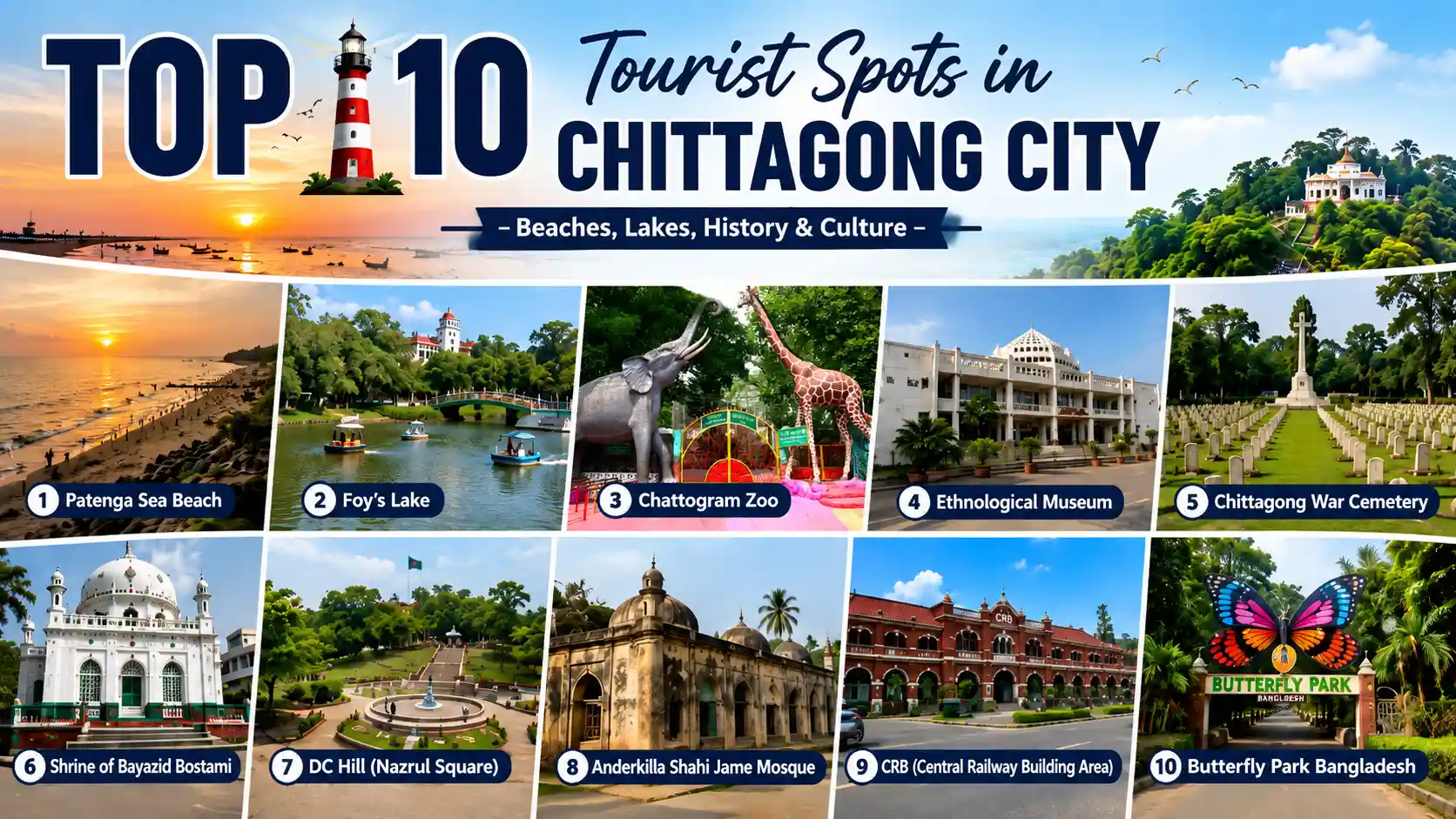
Top 10 Tourist Spots in Chittagong City
Chittagong — officially known as Chattogram — is Bangladesh’s second-largest city and its main port, wedged between the hills of the east and the Bay of Bengal to the west. Unlike the flat river delta that defines much of the country, Chittagong City rises and falls across low hills, giving it hilltop parks, colonial-era buildings on ridgelines, a working seaport, and a coastline that meets the Karnaphuli River right at the edge of the urban area.
For visitors, this means a city trip here doesn’t feel like just one thing. In a single day you can walk through a centuries-old Mughal mosque, watch the sunset over the Bay of Bengal, visit a hilltop Sufi shrine known for its rare turtles, and ride a small rollercoaster at a historic lakeside park — all within the city’s boundaries, without a long-distance day trip. Chittagong City is also a practical base: it has an international airport, a railway network connecting it to Dhaka and Cox’s Bazar, and a full range of hotels, so it works well whether you’re stopping over for a day or exploring for several.
This guide focuses only on attractions inside Chittagong City and its immediate urban area. Well-known Chattogram District destinations such as Sitakunda Eco Park, Chandranath Hill, Kaptai Lake, or Parki Beach are genuinely worth visiting, but they sit well outside the city and are not included here.
Quick Answer: What Are the Top Tourist Spots in Chittagong City?
The most popular tourist spots within Chittagong City include Patenga Sea Beach, Foy’s Lake, Chattogram Zoo, the Ethnological Museum, Chittagong War Cemetery, the Shrine of Bayazid Bostami, DC Hill (also referred to as Nazrul Square), Anderkilla Shahi Jame Mosque, the Central Railway Building (CRB) area, and Butterfly Park Bangladesh. Together they cover beaches, hills, museums, religious heritage, colonial architecture, and family-friendly parks, all reachable within the city without a long day trip.
|
No. |
Tourist Spot |
Location |
Best For |
Suggested Visit Time |
|---|---|---|---|---|
|
1 |
Patenga Sea Beach |
Patenga, south Chittagong City |
Sunsets, couples, families |
1.5–2 hours |
|
2 |
Foy’s Lake |
Khulshi/Pahartali, north Chittagong City |
Families, amusement rides, boating |
2–4 hours |
|
3 |
Chattogram Zoo |
Near Foy’s Lake, South Khulshi |
Families with children |
1–1.5 hours |
|
4 |
Ethnological Museum |
Agrabad, Chittagong City |
Culture, students, first-time visitors |
45 min–1 hour |
|
5 |
Chittagong War Cemetery |
Dampara, Chittagong City |
History lovers, quiet reflection |
30–45 minutes |
|
6 |
Shrine of Bayazid Bostami |
Nasirabad, Chittagong City |
Cultural/religious tourism |
30–45 minutes |
|
7 |
DC Hill (sometimes called Nazrul Square) |
Nandan Kanan, near Zero Point |
Walking, city views, culture |
30–45 minutes |
|
8 |
Anderkilla Shahi Jame Mosque |
Anderkilla, old Chittagong City |
Mughal-era architecture, history |
20–30 minutes |
|
9 |
CRB (Central Railway Building area) |
CRB Road, near Tiger Pass |
Couples, walking, photography |
30–60 minutes |
|
10 |
Butterfly Park Bangladesh |
Patenga, near the airport |
Families with young children |
1–1.5 hours |
Note: This is not an official government ranking. The order reflects a mix of visitor popularity, historical and cultural significance, accessibility from the city center, and variety of experience, based on available travel and reference sources.
1. Patenga Sea Beach
Why Visit
Patenga Sea Beach is where Chittagong meets the sea. It sits near the point where the Karnaphuli River meets the Bay of Bengal, so visitors get a rare mix of river traffic — cargo ships anchored offshore, waiting to enter the port — and open ocean views in the same frame. Patenga Sea Beach is one of the most popular and widely recognised tourist attractions in Chattogram City, and it’s often a first stop for tourists.
What to See and Do
The beach has a long concrete walkway built in recent years for strolling, along with food stalls selling local seafood snacks, souvenir shops, horse rides, and boat or speedboat rides depending on the season. The main draw for most visitors is the sunset, when the sky over the Bay of Bengal turns orange and purple and the anchored ships silhouette against the light.
Location
Patenga is in the southern part of Chittagong City, close to Shah Amanat International Airport and the Bangladesh Naval Academy, near the point where the Karnaphuli River meets the Bay of Bengal.
Best Time to Visit
Late afternoon into early evening is best for the sunset. The cooler months from November to February are generally more comfortable for walking along the beach than the hot, humid summer.
Entry Fee and Opening Hours
General access to the beach itself is generally free, and specific posted opening or closing hours were not reliably confirmed for this article — visitors should check locally before planning a late-night or very early visit. Individual activities such as horse rides, boat rides, or photography services are paid separately, priced informally by vendors, and not part of any general beach entry fee, so agree on a price before starting.
How to Get There
From central Chittagong, Patenga is reachable by CNG auto-rickshaw, ride-hailing apps, or local bus routes heading toward the airport and Naval Academy. It’s one of the closest beaches to the main city area, so travel time is shorter than to beaches farther down the coast.
Swimming at Patenga is considered risky rather than strictly prohibited: the water can be murky and currents can be strong, so visitors are generally advised against swimming and should exercise caution rather than assume there is a formal, permanent ban.
2. Foy’s Lake
Why Visit
Foy’s Lake is a historic artificial lake and recreation area in Chattogram, and one of the city’s oldest recreational landmarks. It was constructed in 1924 by the Assam-Bengal Railway to supply water to a railway colony. Today it combines a scenic lake with a modern amusement park and water park built around it, making it a rare mix of natural and man-made attractions in one visit.
What to See and Do
Visitors can take boat rides on the lake itself, walk through the surrounding forested hills, or head into the adjoining Foy’s Lake Concord Amusement World, which has rides such as a roller coaster, Ferris wheel, and a haunted house, plus a separate water park (Sea World). Families often spend a half-day or more here between the lake and the rides.
Location
Foy’s Lake is in the Khulshi/Pahartali area in the northern part of Chittagong City, close to Pahartali Railway Station.
Best Time to Visit
The cooler months, roughly from November to February, are generally more comfortable for visiting Foy’s Lake, especially if you plan to spend several hours exploring the lake and amusement park. Weekdays are usually a better choice for visitors who prefer smaller crowds than on weekends and public holidays. Operating schedules may change because of maintenance, weather, holidays, or other operational reasons, so it is advisable to confirm the current opening hours with the operator before visiting.
Entry Fee and Opening Hours
There is no single universal ticket price at Foy’s Lake — pricing depends on which package you choose. According to the current operator page, lake-only entry is priced at Tk 300, while regular entry combined with five rides is priced at Tk 500; separate Sea World water park and combination packages are priced differently again. Opening hours are Saturday–Thursday, 10:00 am–7:00 pm, and Friday and government holidays, 10:00 am–8:00 pm. Because prices and hours are managed by a private operator and can change, confirm current ticket packages and timings with the operator before visiting.
How to Get There
Foy’s Lake is accessible by CNG auto-rickshaw, ride-hailing apps, local bus, or by train to Pahartali Railway Station, which is close to the lake entrance.
3. Chattogram Zoo
Why Visit
Chattogram Zoo sits right at the entrance to Foy’s Lake, making it easy to combine with a lake visit. It is commonly reported as having been established in 1989, though this article could not directly confirm that date from the zoo’s own official page, so it should be treated as widely reported rather than independently verified. The zoo has become known in recent years for its white tigers: the zoo states that the first white tiger born in Bangladesh was born there in 2018.
What to See and Do
According to official zoo information, the collection includes 66 species and around 520 animals, including tigers, lions, zebra, bears, deer, hoolock gibbons, monkeys, pythons, crocodiles, emus, peafowl, and other birds. Because it’s compact, most visitors can walk through the whole zoo in about an hour. Animal holdings can change over time, so the exact species on display at any given visit may differ from this list.
Location
The zoo is in the South Khulshi area, at the entrance to Foy’s Lake, in the northern part of Chittagong City.
Best Time to Visit
Cooler morning or late-afternoon hours are more comfortable for walking around and for seeing the animals more active.
Entry Fee and Opening Hours
Current opening hours are not reliably confirmed because official and current sources conflict; visitors should verify directly with Chattogram Zoo before travelling. A ticket price of Tk 70 per person was reported in March 2026, but this should also be confirmed through the official ticket channel before your visit, since prices can change.
How to Get There
Since the zoo sits at the entrance to Foy’s Lake, it’s reached the same way — by CNG, ride-hailing app, local bus, or train to Pahartali Railway Station, then a short walk or short ride to the zoo gate.
4. Ethnological Museum
Why Visit
The museum’s official description calls it Bangladesh’s only ethnological museum, and it exists specifically because Chittagong sits close to the Chittagong Hill Tracts, home to a number of the country’s indigenous ethnic communities. It was established in 1965, and the museum was created to build understanding between Bangladesh’s many ethnic groups.
What to See and Do
The museum’s galleries cover the lifestyles, clothing, tools, and material culture of ethnic groups connected to the Chittagong Hill Tracts and wider Bangladesh. It’s a useful stop for anyone wanting cultural context before or after visiting the wider Chittagong Hill Tracts region. Exact gallery layouts and specific displays can vary, so treat detailed exhibit descriptions from any source, including this one, as general rather than definitive.
Location
The museum is in the Agrabad commercial area of Chittagong City.
Best Time to Visit
Weekday mornings tend to be quieter. The museum is indoors, so it’s also a reasonable option during hot afternoons or light rain.
Entry Fee and Opening Hours
Current official admission fees are Tk 20 for domestic tourists, Tk 100 for SAARC-country tourists, Tk 200 for other foreign tourists, and Tk 5 for secondary-level students. The museum is closed on Sunday and public holidays; exact current daily opening hours were not reliably confirmed, so visitors should check before visiting.
How to Get There
Agrabad is a major commercial hub in Chittagong City and is well served by CNG auto-rickshaws, ride-hailing apps, and buses from the city center and railway station.
5. Chittagong War Cemetery
Why Visit
The Chittagong War Cemetery is a Commonwealth War Graves Commission cemetery holding the graves of soldiers, airmen, and sailors who died during the Second World War. It’s one of the most well-maintained and quietly moving historical sites in the city.
What to See and Do
According to the Commonwealth War Graves Commission, the cemetery contains 731 Commonwealth burials from the 1939–45 war, including 17 unidentified casualties. CWGC separately records 715 identified Commonwealth casualties, plus 20 foreign-national burials and four non-war UK military burials. There’s also a memorial to Indian Navy and Merchant Navy personnel lost at sea. The grounds are landscaped with trees and are kept in careful, formal condition typical of CWGC cemeteries worldwide.
Location
The cemetery is in the Dampara locality on Badsha Mia Chowdhury Road, near the Chittagong Arts College and the well-known Chatteshwari Temple road.
Best Time to Visit
Morning or late afternoon, to avoid the midday heat, and to allow time for a quiet, unhurried walk through the grounds.
Entry Fee and Opening Hours
Current CWGC visiting hours are daily 8:00 am–12:00 noon and 2:00 pm–5:00 pm. No admission fee is listed by CWGC; confirm locally. There is no official signage directing visitors from the main road, so it can be worth confirming directions with your driver in advance.
How to Get There
It’s reachable by CNG auto-rickshaw or ride-hailing app from the city center; mentioning “Dampara” or “Chatteshwari Road” to your driver may help, since some drivers are unfamiliar with the term “war cemetery.”
6. Shrine of Bayazid Bostami
Why Visit
This hilltop shrine complex is one of Chittagong’s most distinctive religious and cultural sites, known locally for the rare turtles living in the pond in front of the tomb. It’s associated with the Persian Sufi saint Bayazid Bostami, and while historians note there’s no definitive historical record confirming the saint personally visited Chittagong, the shrine has been a major pilgrimage and visitor site for centuries and draws people of multiple faiths.
What to See and Do
The complex includes a tomb enclosed in a modern structure, an old Mughal-style mosque believed to date to the era of Emperor Aurangzeb, and a large pond home to Bostami turtles (Nilssonia nigricans), a Critically Endangered species. Do not feed the turtles unless shrine or wildlife authorities explicitly provide approved food and instructions; follow any conservation signage on site. The shrine remains an active pilgrimage site with daily visitors.
Location
The shrine sits on a hillock in the Nasirabad area, near Chittagong Cantonment, within the city.
Best Time to Visit
The site can be visited any time of day; mornings are generally quieter than late afternoons and evenings, when local visitor numbers pick up.
Entry Fee and Opening Hours
Exact entry fees and opening hours were not reliably confirmed for this article — access as a religious site is generally understood to be free, though some visitors choose to make a voluntary donation. Confirm current access details locally before visiting. Modest dress is recommended, and female visitors may want to bring a head covering out of respect for the site.
How to Get There
CNG auto-rickshaw or ride-hailing apps from the city center are the most straightforward way to reach Nasirabad; ask for “Bayazid Bostami Mazar,” which is the name most local drivers recognize.
7. DC Hill
Why Visit
Known locally as DC Hill, this green hilltop park is located in the central Nandan Kanan area of Chattogram, near Zero Point. Some sources refer to it as Nazrul Square, in reference to national poet Kazi Nazrul Islam, though this article did not find an authoritative source confirming an official renaming. The popular name “DC Hill” is generally associated with the site having once housed the Deputy Commissioner’s official residence.
What to See and Do
The park is used for morning and evening walks by locals, and it hosts open-air stage plays, cultural events, and film screenings throughout the year. It’s especially lively during Pohela Boishakh (Bengali New Year), when it becomes one of the city’s main gathering points for celebrations. The hillside gardens and quiet paths also make it a pleasant short stop for city views.
Location
DC Hill is on Buddhist Temple Road in the Nandan Kanan area, close to Chittagong’s Zero Point.
Best Time to Visit
Early morning or evening, both for cooler temperatures and to see the park at its most active with local walkers and, during festivals, cultural events.
Entry Fee and Opening Hours
The park is a public green space and is generally free to enter. Public access and event hours can vary; verify locally before planning your visit, particularly if you intend to visit outside typical daytime hours or during a scheduled event.
How to Get There
DC Hill is centrally located and easily reached on foot, by CNG, or by ride-hailing app from most parts of central Chittagong.
8. Anderkilla Shahi Jame Mosque
Why Visit
The Mughal-era mosque was established in 1667 under Emperor Aurangzeb’s authority by Buzurg Umed Khan, son of Subahdar Shaista Khan. It is considered one of the earliest Mughal-era buildings in Chittagong and is associated with the Mughal reconquest of Chattogram from regional Arakanese and Portuguese-linked forces during the seventeenth century — a period of contested control over the port that involved multiple regional powers rather than a simple two-sided conflict. It remains an active mosque and a significant piece of the city’s architectural history.
What to See and Do
The mosque sits atop a hill called Ander-Qila (“inner fort”), built above ground level on the hilltop. It’s a working place of worship, drawing local worshippers, particularly for Friday prayers, as well as a heritage site of interest to visitors curious about Mughal-era architecture in Bengal. Access to interior prayer areas depends on mosque management, prayer times, and any arrangements made with staff on site, so visitors should ask before entering. Photography should be done only with permission.
Location
The mosque is in the Anderkilla area of old Chittagong City.
Best Time to Visit
Outside of prayer times, particularly Friday (Jumu’ah) prayers, when the mosque is at its busiest with worshippers. Modest dress is expected, as at any active mosque.
Entry Fee and Opening Hours
There is no entry fee for visiting an active mosque of this kind, though as with any place of worship, visitors should avoid entering during active prayer times unless participating, and should dress and behave respectfully.
How to Get There
The mosque is centrally located in old Chittagong City and is reachable by CNG, ride-hailing app, or on foot from nearby landmarks such as J.M. Sen Avenue.
9. CRB (Central Railway Building Area)
Why Visit
The Central Railway Building was completed in 1872 and served as the headquarters of the Assam-Bengal Railway. It is one of Chittagong’s most recognizable pieces of colonial-era architecture, a red-brick building on a low hilltop that continues to serve railway administration functions today. The area is often described locally as one of the city’s green lungs, because of how much open, tree-covered space it preserves inside a busy city — though this is a local description rather than an official designation.
What to See and Do
Beyond the building itself, the CRB area is known for its walking paths, old rain trees, and quiet, hilly terrain that offers a break from city traffic. The adjoining CRB Shirish Tala area is a traditional gathering spot for Pohela Boishakh festivities, including the local Bolikhela wrestling competition. A steam locomotive is displayed on the grounds, and the area includes colonial-era bungalows and staff housing.
Location
CRB is centered on CRB Road near Tiger Pass, in the heart of Chittagong City.
Best Time to Visit
Late afternoon into evening is popular for walking and photography, when temperatures are cooler and the golden light suits the colonial architecture.
Entry Fee and Opening Hours
Public access to parts of the surrounding area is generally possible, but CRB is an active railway complex. Visitors must follow railway security instructions and should not enter restricted areas. There is no general entry fee for the publicly accessible outdoor areas, but this is not the same as unrestricted access to the whole compound.
How to Get There
CRB is centrally located near Tiger Pass and is easily reached by CNG, ride-hailing app, or on foot from much of central Chittagong.
10. Butterfly Park Bangladesh
Why Visit
Butterfly Park Bangladesh is described by its operator as Bangladesh’s first tropical garden with live butterflies. The park features live butterflies and breeding facilities; published figures for the number of butterflies and species vary by source. Government information reports approximately 70 species, while other non-official sources cite different figures, so no single species count should be treated as an established, permanent fact. It is one of the more unusual attractions in Chattogram City and can be particularly appealing to families with young children.
What to See and Do
The park includes a live butterfly zone, a butterfly museum displaying species from Bangladesh and abroad, an artificial lake, waterfalls, and play areas.
Location
The park is on Naval Academy Road in Patenga, close to Shah Amanat International Airport and not far from Patenga Sea Beach, making it easy to combine both in one outing.
Best Time to Visit
Sunny mornings to early afternoons are best, since butterflies are most active in direct sunlight and tend to shelter under leaves on cloudy days or in the late afternoon. The breeding season (roughly March to October) generally means more butterflies are visible.
Entry Fee and Opening Hours
Current ticket prices and opening hours were not reliably confirmed as of this writing and visitors should verify directly with the operator before visiting. Older published pricing tiers (separate rates for Bangladeshi citizens, SAARC nationals, other foreign tourists, and children) have been reported in the past, but these should not be treated as current August 2026 prices without checking directly with the park.
How to Get There
From central Chittagong, take a bus or CNG toward Patenga Sea Beach, then a short auto-rickshaw ride to the park entrance beside the airport; ride-hailing apps can also take you directly.
Best Tourist Spots in Chittagong for Families
Families with children are generally best served by attractions that combine open space, animals, or hands-on activity with manageable visit lengths:
- Foy’s Lake and Chattogram Zoo work well together as a half-day or full-day outing, combining boat rides, amusement park rides, and animal viewing in one area.
- Butterfly Park Bangladesh is compact, visually engaging for young children, and has dedicated play areas.
- Patenga Sea Beach offers open space for children to run and play, along with horse rides and food stalls, though supervision near the water is important given reported strong currents.
- DC Hill is a low-effort, free option for a short evening walk with children, particularly during cultural events like Pohela Boishakh.
Best Places in Chittagong for Couples
For a relaxed, scenic day out, several of the city’s spots suit couples well:
- Patenga Sea Beach, especially around sunset, is one of the city’s best-known scenic spots for couples and other visitors looking for a relaxed seaside outing.
- CRB, with its quiet, tree-lined walking paths and colonial architecture, offers a calmer, less crowded alternative for an evening stroll.
- DC Hill provides hilltop views and gardens within easy reach of the city center, suited to a short, unhurried walk.
- Foy’s Lake offers boat rides on the lake for a quieter, scenic outing away from the amusement park crowds if timed outside peak hours.
Best Historical and Cultural Places in Chittagong
Visitors focused on history and culture should prioritize:
- Anderkilla Shahi Jame Mosque, for Mughal-era architecture and its role in Chittagong’s conquest history.
- Chittagong War Cemetery, for Second World War history and a quiet, reflective visit.
- Shrine of Bayazid Bostami, for centuries of Sufi pilgrimage tradition and folklore tied to the shrine’s turtles.
- Ethnological Museum, for context on the ethnic diversity of the wider Chittagong Hill Tracts region.
- CRB, for British colonial-era railway architecture and its ongoing role in local cultural events.
Visitors with extra time may also want to look into Batali Hill, commonly described as the highest hill within Chittagong City and located close to Foy’s Lake, though this article did not independently verify detailed visitor information for it and it is not included in the main Top 10 list above.
Best Time to Visit Chittagong
Chittagong has a tropical monsoon climate, broadly similar to much of coastal Bangladesh. November–February is usually the most comfortable period for outdoor sightseeing in Chattogram, since it tends to be drier and cooler than the rest of the year. March–May is generally hotter, while June–September is wetter, with monsoon rainfall that can disrupt outdoor plans, particularly at beach and hill locations. This is a general seasonal pattern rather than a universal guarantee, so visitors should check the current weather forecast closer to their travel dates, especially before beach visits.
How to Plan a One-Day Chittagong City Tour
Trying to cover attractions across central, north, and south Chattogram in a single day can end up feeling rushed, because of traffic, weekends, public holidays, weather, and attraction opening hours that don’t always align neatly. Rather than attempting all 10 spots in one day, it’s more realistic to group attractions geographically and plan around two separate, shorter routes — either on two different days, or by choosing the one that best matches your interests if you only have a single day available.
Option 1 — Central/North Chattogram: Anderkilla Mosque or DC Hill → Ethnological Museum → Bayazid Bostami Shrine → Foy’s Lake and Chattogram Zoo
This route stays within the central and northern parts of the city and mixes a historical/religious morning with a lake-and-zoo afternoon.
Option 2 — South Chattogram: Butterfly Park → Patenga Sea Beach for sunset
This shorter, more relaxed route suits an afternoon or half-day visit, ending with the beach at sunset.
Exact travel times between these points depend heavily on Chittagong’s traffic conditions, so build in buffer time, particularly if moving across the city during rush hours. Visitors with two or more days can comfortably combine both options, along with the Chittagong War Cemetery and CRB, without needing to rush.
Practical Travel Tips for Visiting Chittagong
- Traffic: Chittagong’s roads can be congested, especially around Agrabad, Tiger Pass, and the port areas during weekday rush hours. Build extra time into your itinerary.
- Transportation: CNG auto-rickshaws and ride-hailing apps are the most practical way to get between attractions; agree on fares in advance with CNG drivers if a meter isn’t used.
- Weather: Carry an umbrella or light raincoat during the monsoon months, and sun protection (hat, sunscreen) during the hot season.
- Clothing: Modest dress is appropriate at religious sites such as Anderkilla Shahi Jame Mosque and the Shrine of Bayazid Bostami; a light scarf is useful for female visitors at religious sites.
- Hydration: Carry water, particularly for outdoor stops like Patenga Beach, Foy’s Lake, and DC Hill, where shade can be limited at midday.
- Family considerations: Supervise children closely near water at Patenga Sea Beach, where swimming is considered risky due to reportedly strong currents and murky water.
- Respecting religious/cultural sites: Avoid loud behavior or photography of worshippers inside active prayer areas without permission at mosques and shrines.
- Photography restrictions: Some sites, particularly religious complexes and any areas near naval, port, or military installations, may restrict photography; check for posted signage or ask on-site staff before photographing sensitive areas.
- Verify current details: Ticket prices and opening hours at attractions like Foy’s Lake, Chattogram Zoo, the Ethnological Museum, and Butterfly Park can change; confirm current information locally or through official booking channels before visiting.
Final Thoughts
Chittagong City packs a genuinely varied set of experiences into a relatively compact urban area — a working seafront, hilltop parks, centuries-old religious sites, a colonial railway headquarters, and family-oriented attractions like Foy’s Lake and Butterfly Park. Because most of these places sit within a reasonable travel radius of each other, it’s realistic to build a satisfying day trip or a longer multi-day visit without needing to leave the city limits, while still leaving Chattogram District’s beaches, hills, and lakes as a separate trip for those with more time.
Frequently Asked Questions
What are the best tourist spots in Chittagong City?
Patenga Sea Beach, Foy’s Lake, Chattogram Zoo, the Ethnological Museum, Chittagong War Cemetery, the Shrine of Bayazid Bostami, DC Hill, Anderkilla Shahi Jame Mosque, CRB, and Butterfly Park Bangladesh are among the most commonly recommended attractions within the city.
What is the most famous tourist place in Chittagong?
Patenga Sea Beach is one of the most popular and widely recognised tourist attractions in Chattogram City, largely due to its accessibility and its sunset views over the Bay of Bengal, though no single official source ranks it as the definitive “most famous” spot.
Which tourist places can I visit in Chittagong in one day?
A realistic one-day route depends on which part of the city you prioritize. A central/north route could cover Anderkilla Mosque or DC Hill, the Ethnological Museum, the Bayazid Bostami shrine, and Foy’s Lake with the zoo. A shorter south-city route could cover Butterfly Park and Patenga Sea Beach for sunset. Trying to combine both routes in a single day is possible but can feel rushed because of traffic and opening hours.
What are the best places to visit in Chittagong with family?
Foy’s Lake with Chattogram Zoo, Butterfly Park Bangladesh, and Patenga Sea Beach are generally the most family-friendly options, offering open space, animals, and hands-on activities suited to children.
What are the best places for couples in Chittagong?
Patenga Sea Beach at sunset, the quiet walking paths of CRB, and the hilltop gardens of DC Hill are commonly recommended for couples looking for scenic, relaxed spots.
Is Patenga Sea Beach worth visiting?
Yes, based on its consistent popularity and reviews, though visitors should treat swimming as risky rather than routine, given reportedly strong currents and murky water, and the beach can get crowded at peak times, particularly around sunset.
What is the best time to visit Chittagong?
November–February is usually the most comfortable period for outdoor sightseeing in Chattogram. March–May is generally hotter, while June–September is wetter. This is a general pattern rather than a guarantee, so check the current weather forecast closer to your travel dates, especially before beach visits.
Are there historical places to visit in Chittagong City?
Yes. Anderkilla Shahi Jame Mosque (established 1667), Chittagong War Cemetery (Second World War era), the Shrine of Bayazid Bostami, and the CRB colonial-era railway building are among the city’s key historical sites.
How many days are enough to explore Chittagong City?
One full day is enough to see a limited, geographically focused selection of attractions (see the one-day route options above), while two to three days allow a more relaxed pace covering more of the Top 10, plus time for a possible day trip to nearby Chattogram District attractions outside the city.
Do I need to pay entry fees at every attraction in Chittagong City?
No. Several attractions, including DC Hill, CRB’s publicly accessible outdoor areas, Anderkilla Shahi Jame Mosque, the Shrine of Bayazid Bostami, and Patenga Sea Beach, are generally free to enter as public spaces or religious sites, while Foy’s Lake, Chattogram Zoo, the Ethnological Museum, and Butterfly Park Bangladesh charge ticketed entry fees that should be confirmed directly with each attraction before visiting, since current prices were not reliably confirmed for all of them at the time of writing.
Sources & References
Information in this guide was cross-checked using official and reputable sources, including the Chattogram District Government tourism portal, Commonwealth War Graves Commission (CWGC), Banglapedia, official or operator-published information for individual attractions, and established Bangladeshi news sources. Opening hours, ticket prices, and other visitor information may change, so travellers should confirm current details with the relevant attraction or operator before visiting.