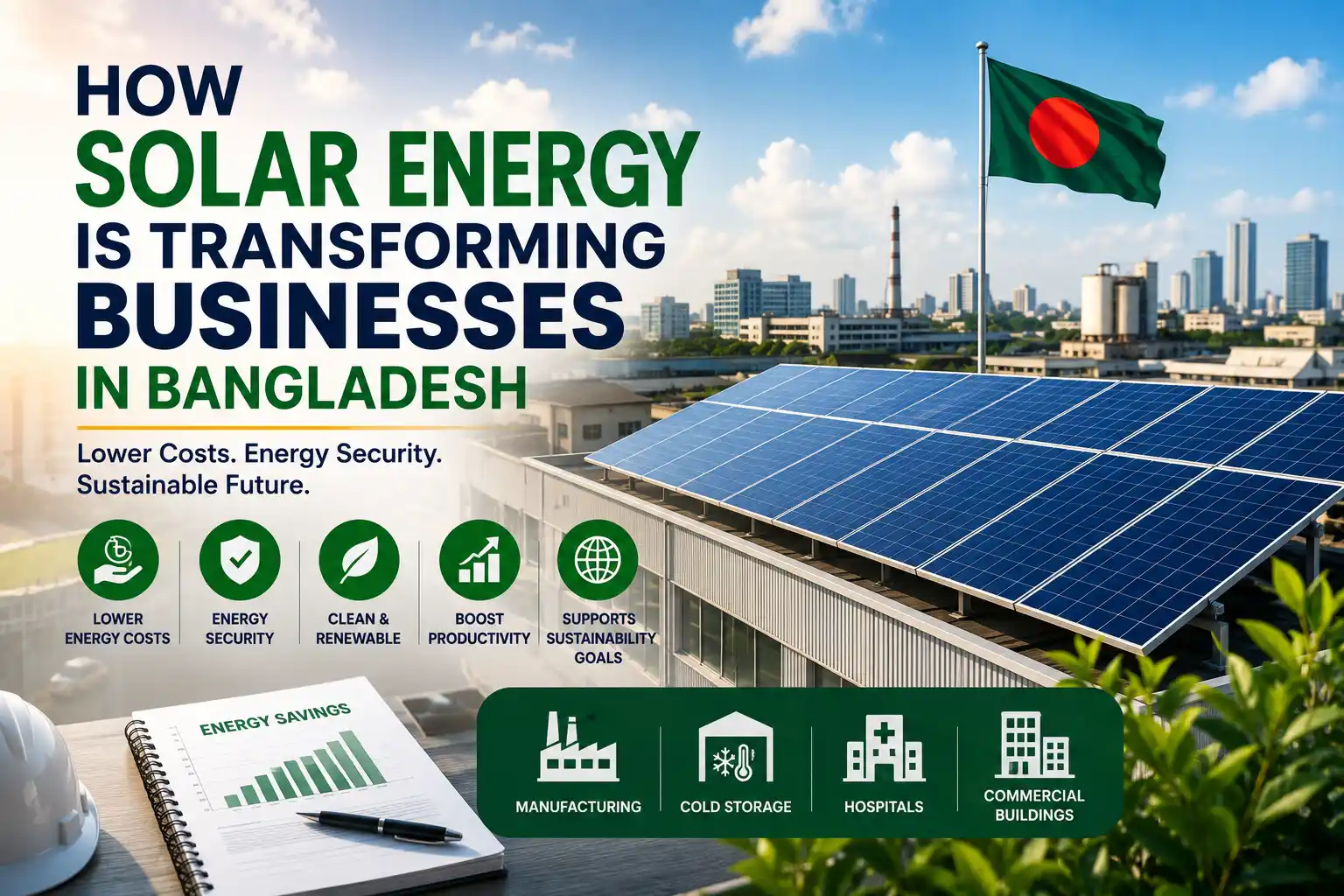
How Solar Energy Is Transforming Businesses in Bangladesh
Energy costs have become a growing line item on the balance sheets of Bangladeshi businesses. Industrial and commercial electricity tariffs have risen over recent years, and for energy-intensive sectors such as manufacturing, textiles, and cold storage, power expenses can represent a significant share of operating costs. At the same time, electricity demand across the country continues to climb as the economy grows and more businesses and households connect to the grid.
This rising demand brings its own pressures. Periods of peak load can strain grid capacity, and businesses that depend on an uninterrupted power supply — from garment factories running production lines to hospitals maintaining critical equipment — have to think seriously about load management and energy security. Grid outages or voltage fluctuations can disrupt operations, damage sensitive equipment, or delay production schedules, all of which carry real costs.
Against this backdrop, a growing number of businesses are exploring solar energy as one way to manage these pressures. Solar power offers a way to generate electricity on-site, reducing dependence on grid supply during daylight hours and, in some cases, offsetting electricity bills through arrangements such as net metering. Renewable energy more broadly is also gaining a larger role in Bangladesh’s energy conversation, driven by government policy targets, pressure from international buyers on export-oriented industries to lower their carbon footprint, and the falling cost of solar equipment worldwide. Solar is not a solution for every business, and its suitability depends on factors such as available roof space, energy consumption patterns, and financing — but for many companies, it has moved from a niche consideration to a mainstream part of energy planning.
What Is Solar Energy?
Solar energy is electricity generated from sunlight, most commonly through solar photovoltaic (PV) systems, which use semiconductor materials in solar panels to convert sunlight directly into electricity. This electricity can power equipment and lighting, be stored in batteries, or be exported to the grid.
A commercial solar PV system typically includes roof-mounted panels, an inverter that converts the direct current (DC) electricity from the panels into the alternating current (AC) used by business equipment, mounting structures, wiring, and monitoring equipment.
On-grid systems remain connected to the national grid and draw power from it when solar generation is insufficient, such as at night or on cloudy days. Off-grid systems operate independently, typically relying on battery storage for round-the-clock supply, and are more common where grid access is unreliable or full energy independence is the goal. Many commercial systems in Bangladesh combine both approaches — hybrid systems — using batteries for backup while remaining grid-connected.
Net metering is a billing arrangement that lets businesses with grid-connected solar systems feed surplus electricity back into the grid and receive credit or compensation for it. Bangladesh’s Net Metering Guideline, first issued in 2018 and revised in 2025, sets out eligibility, capacity limits, and metering requirements administered through the relevant distribution utility.
Businesses adopt solar for a combination of reasons: managing rising electricity costs, reducing exposure to grid instability, and increasingly, meeting sustainability expectations from buyers, investors, and regulators. The right approach depends on a business’s energy consumption profile, available space, and financial planning.
Why Businesses in Bangladesh Are Turning to Solar Energy
Rising electricity costs are one of the most immediate drivers. Industrial and commercial tariffs have increased in recent years, and businesses with high, predictable daytime energy use — such as factories operating standard shifts — are often well positioned to offset a portion of their grid consumption with solar generation.
Energy independence reduces reliance on grid supply, which can be valuable in areas where load shedding or voltage instability affects production. This supports business continuity, particularly for operations that cannot tolerate power interruptions, such as cold storage facilities and hospitals — though solar alone does not guarantee uninterrupted power, since battery storage or backup generation is often still required.
Sustainability goals and ESG (environmental, social, and governance) considerations are increasingly relevant for export-oriented businesses. Bangladesh’s ready-made garment industry, in particular, faces growing pressure from international buyers to demonstrate lower carbon emissions, and rooftop solar is one visible way factories can respond. Carbon footprint reduction follows the same logic, since solar generation displaces electricity from Bangladesh’s largely fossil-fuel-based grid mix, though the actual impact depends on system size relative to total consumption.
Long-term operational savings are frequently cited as a motivation, though actual savings vary widely based on system size, electricity tariffs, financing costs, and maintenance quality. Businesses considering solar should treat savings estimates as projections rather than guarantees.
How Solar Energy Is Transforming Businesses
Different types of businesses are adopting solar power in different ways, shaped by their energy needs and available infrastructure.
Manufacturing industries and garment factories — a major segment of Bangladesh’s export economy — have seen some of the most visible solar adoption, partly driven by buyer requirements around sustainability. Large, flat-roofed facilities with predictable daytime demand are often well suited to rooftop solar, and several export-oriented units have added systems in recent years to reduce grid dependence and support sustainability reporting to international clients.
Commercial buildings, hotels, and shopping malls often have large roof areas and high daytime cooling loads, allowing solar to offset a meaningful share of consumption during business hours, though available roof area relative to total energy demand varies by property.
Hospitals face strict requirements for uninterrupted power, and while solar cannot replace backup generation for critical care equipment, it can help offset daytime costs for non-critical loads such as general lighting and administration. Cold storage facilities, which run energy-intensive refrigeration continuously, can use solar to offset daytime load, though round-the-clock refrigeration means it typically supplements rather than replaces grid or backup power.
Agro-processing businesses, such as rice mills, and warehouses, with typically low equipment density but large roof areas, often have suitable rooftop space that aligns well with solar generation patterns — warehouses in particular can sometimes generate more than they use and export the surplus under net metering. Educational institutions, including universities, have also installed rooftop solar systems, both to reduce operating costs and, in some cases, as demonstration or research projects tied to engineering or sustainability programs.
In each case, the practical value of solar depends on matching system size to actual energy consumption patterns, rather than installing the maximum possible capacity a roof can hold.
Key Benefits of Solar Energy for Businesses
Lower electricity bills are the benefit most businesses look for first, achieved by offsetting grid consumption with self-generated power during sunlight hours. Long-term cost savings may follow if the system performs as expected, though this depends on maintenance, equipment quality, and tariff trends — outcomes are not guaranteed and vary by installation.
Reduced dependence on the grid can improve business resilience during periods of load shedding or grid instability, particularly for operations with daytime energy needs that align with solar generation hours. Solar power is also a cleaner energy source at the point of generation compared with grid electricity drawn from a fossil-fuel-heavy generation mix, and predictable operating costs can result from reducing exposure to fluctuating grid tariffs.
A better corporate sustainability profile is an increasingly tangible benefit for export-oriented businesses, particularly in sectors like ready-made garments where international buyers may factor renewable energy adoption into sourcing decisions. This can translate into a potential contribution to ESG initiatives and corporate reporting, though the scale of that contribution depends on how much of a business’s total energy use solar actually displaces.
Challenges Businesses Should Consider
Solar adoption also comes with real limitations that businesses should weigh carefully.
Initial investment for a commercial-scale system remains substantial, and while financing options exist, upfront capital costs can be a barrier, particularly for smaller businesses. Roof space limitations affect how much capacity a business can install; older buildings, shared roof structures, or roofs with obstructions may not support the system size needed to meaningfully offset consumption.
Weather dependency means solar output varies with sunlight availability, and Bangladesh’s monsoon season and cloud cover can reduce generation for extended periods, which businesses need to factor into their energy planning. Maintenance is required to keep panels clean and functioning efficiently, particularly given dust accumulation in industrial areas, and neglecting it can noticeably reduce output over time.
Financing structures vary, and businesses should carefully compare loan terms, lease arrangements, or third-party ownership models, since the most attractive-sounding option is not always the most cost-effective over the system’s lifetime. Technical expertise is needed both during installation and for ongoing monitoring; working with a qualified, SREDA-compliant installer is important for system safety, performance, and net metering eligibility.
Battery storage costs remain relatively high, which is why many commercial systems in Bangladesh are grid-tied without significant battery backup — businesses seeking full off-grid resilience should budget accordingly. Regulatory considerations, including net metering eligibility, capacity limits tied to a business’s sanctioned electrical load, and approval processes through the relevant distribution utility, need to be understood before committing to a system size.
Government Policies and Industry Support
Bangladesh’s renewable energy policy framework is coordinated primarily through the Sustainable and Renewable Energy Development Authority (SREDA), a government agency under the Ministry of Power, Energy and Mineral Resources responsible for promoting renewable energy and energy efficiency nationwide. SREDA maintains an approved list of solar equipment and installers and oversees implementation of the Net Metering Guideline.
The Net Metering Guideline, first published in 2018 and revised in 2025, sets the rules under which businesses and households with grid-connected solar systems can export surplus electricity and receive compensation. Recent revisions have expanded eligibility and increased the share of sanctioned load that can be net-metered, according to SREDA notifications, though implementation details and processing times vary by distribution utility.
The Bangladesh Power Development Board (BPDB) and other distribution utilities, including DESCO, DPDC, Bangladesh Rural Electrification Board (BREB), WZPDCL, and NESCO depending on the region, handle grid interconnection and administer net metering at the utility level.
On the financing side, the Infrastructure Development Company Limited (IDCOL), a state-owned financial institution, has supported renewable energy projects, including rooftop solar financing for industrial facilities. IDCOL has worked with the Bangladesh Garment Manufacturers and Exporters Association (BGMEA) to promote industrial rooftop solar adoption and has stated intentions to expand its financing portfolio, according to public statements from IDCOL officials.
Bangladesh’s Renewable Energy Policy 2025 sets national targets of generating 20% of total electricity from renewable sources by 2030 and 30% by 2040, according to statements from the Ministry of Power, Energy and Mineral Resources, though achieving these targets depends on continued investment, grid capacity, and policy implementation. Businesses considering solar should verify current incentives and requirements directly with SREDA or their installer, as policy details are periodically revised.
Real Examples of Solar Adoption in Bangladesh
Rooftop solar adoption among Bangladeshi businesses has grown steadily, particularly in the export-oriented manufacturing sector, though it still represents a small share of total industrial electricity consumption nationwide.
According to IDCOL and industry reporting, a number of factories have installed IDCOL-financed rooftop solar systems, including projects at Square Textiles in Kashimpur, Fakhruddin Textile Mills in Sreepur, and Far East Spinning Industries in Habiganj, among others financed through IDCOL’s renewable energy program.
A notable large-scale project has been developed at the Karnaphuli Export Processing Zone (KEPZ) in Chattogram, where Youngone Corporation has worked with Bangladeshi solar company Solaric as the engineering, procurement, and construction (EPC) partner; the companies describe it as one of the largest single-site rooftop solar projects globally. The project currently has 16 MW operational under Phase 1, within a planned development of 40 MW.
Rahimafrooz Renewable Energy Ltd. (RREL), part of the long-established Rahimafrooz business group, is another Bangladeshi solar company active in commercial and institutional installations, including a rooftop project at Independent University, Bangladesh, as well as installations at government and public-sector buildings, according to the company’s own project listings.
Industry surveys, including one conducted by the Mapped in Bangladesh platform at BRAC University, have found that rooftop solar currently contributes only a small share of total electricity consumption across surveyed ready-made garment factories, even as significant additional rooftop potential remains largely untapped. Awareness and interest continue to grow, particularly under pressure from international apparel buyers with their own sustainability targets, and this gap between installed capacity and total potential suggests the sector remains in a relatively early phase of adoption despite growing activity.
Choosing the Right Solar Solution for Your Business
Selecting an appropriate solar system starts with an energy consumption analysis — understanding how much electricity a business uses, when it uses it, and how that pattern aligns with daylight hours, since solar is most cost-effective when generation closely matches demand. Roof suitability needs to be assessed for structural capacity, available unshaded area, orientation, and remaining roof lifespan, since installing solar on a roof that will need replacement in a few years adds unnecessary cost.
Installer selection matters significantly; businesses should work with SREDA-listed installers with relevant commercial experience who can provide proper documentation for net metering applications. System quality, including panel and inverter brands, affects performance and longevity, and using SREDA-approved equipment is a requirement for net metering eligibility. Warranties and maintenance support arrangements should be reviewed and clarified before installation, since they affect long-term cost of ownership and upkeep.
ROI expectations should be based on realistic, business-specific calculations rather than generic industry figures, accounting for actual tariffs, financing costs, system degradation, and maintenance expenses — any payback period should be treated as an informed projection, not a guarantee. Compliance with regulations, including net metering applications, sanctioned load limits, and any zone-specific restrictions (some export processing zones have historically restricted on-site rooftop solar), should be confirmed with the relevant utility and SREDA before finalizing system design.
Future of Solar Energy for Businesses in Bangladesh
Rooftop solar growth among Bangladeshi businesses may continue, particularly in export-oriented manufacturing sectors facing sustainability pressure from international buyers, though the pace will depend on financing availability and regulatory processing times. Smart energy management systems, which help businesses monitor and optimize how solar generation, grid supply, and consumption interact throughout the day, could become more common as costs decline and digital monitoring tools become more accessible.
Battery storage. Global battery costs may continue to decline over time, although local pricing in Bangladesh remains comparatively high. This may make hybrid and off-grid systems more financially viable for businesses seeking greater energy resilience, though this depends on global battery technology trends and local market conditions. Hybrid energy systems, combining solar with battery storage and grid or generator backup, may become a more standard approach for businesses that need both cost savings and continuity of supply.
Corporate sustainability reporting expectations, particularly for export-oriented businesses in global supply chains, may continue to encourage renewable energy adoption, though the extent of this influence will vary by industry and buyer relationships. Broader renewable energy trends, including national policy targets and possible continued reductions in global solar technology costs, could support gradual growth in commercial solar adoption in Bangladesh, even as financing, grid capacity, and regulatory processes continue to influence the pace of expansion.
Frequently Asked Questions
Is solar energy suitable for businesses in Bangladesh?
Solar energy can be suitable for many businesses, particularly those with available roof space and daytime electricity consumption that aligns with solar generation hours. Suitability depends on factors such as energy usage patterns, roof condition, and financing options, and is best assessed on a case-by-case basis.
What is net metering?
Net metering is a billing arrangement that allows businesses with grid-connected solar systems to export surplus electricity to the grid and receive credit or payment for it. Bangladesh’s Net Metering Guideline, first introduced in 2018 and revised in 2025, sets the rules for eligibility, capacity limits, metering requirements, and the application process.
How long do commercial solar panels last?
Commercial solar panels are typically designed to operate for around 25 years or more, though actual performance and output can gradually decline over time, and the effective lifespan depends on equipment quality, installation, and maintenance.
Can solar reduce electricity bills?
Solar can reduce electricity bills by offsetting grid consumption with self-generated power, particularly during daylight hours. The actual amount of savings depends on system size relative to energy use, local tariffs, and how consistently the system is maintained; it should not be treated as a guaranteed fixed reduction.
What industries benefit most from solar energy?
Industries with large rooftop areas and predictable daytime electricity use — such as manufacturing, garment production, warehousing, and agro-processing — are often well positioned to benefit from solar, since their consumption patterns tend to align closely with solar generation hours.
What should businesses consider before installing solar?
Businesses should assess their energy consumption patterns, roof suitability, financing options, installer credentials, equipment quality, warranty terms, and regulatory requirements such as net metering eligibility before committing to a solar installation.
Final Thoughts
Solar energy offers Bangladeshi businesses a practical way to manage rising electricity costs, reduce dependence on an often-strained grid, and respond to growing sustainability expectations from buyers, investors, and regulators. Real-world adoption — from garment factories and textile mills to universities and commercial buildings — shows that rooftop solar can play a meaningful role in a business’s energy strategy, even as it still represents a relatively small share of total industrial electricity use nationwide.
The benefits of solar are not automatic, however. Outcomes depend on system design, installation and equipment quality, ongoing maintenance, financing terms, and how closely a system is matched to actual energy needs. Businesses considering solar are best served by working with qualified, SREDA-compliant installers, conducting realistic energy and financial assessments, and staying current with evolving net metering and renewable energy policies.
Info Ghor regularly covers business and technology developments relevant to Bangladesh, including the energy solutions shaping how local companies operate.