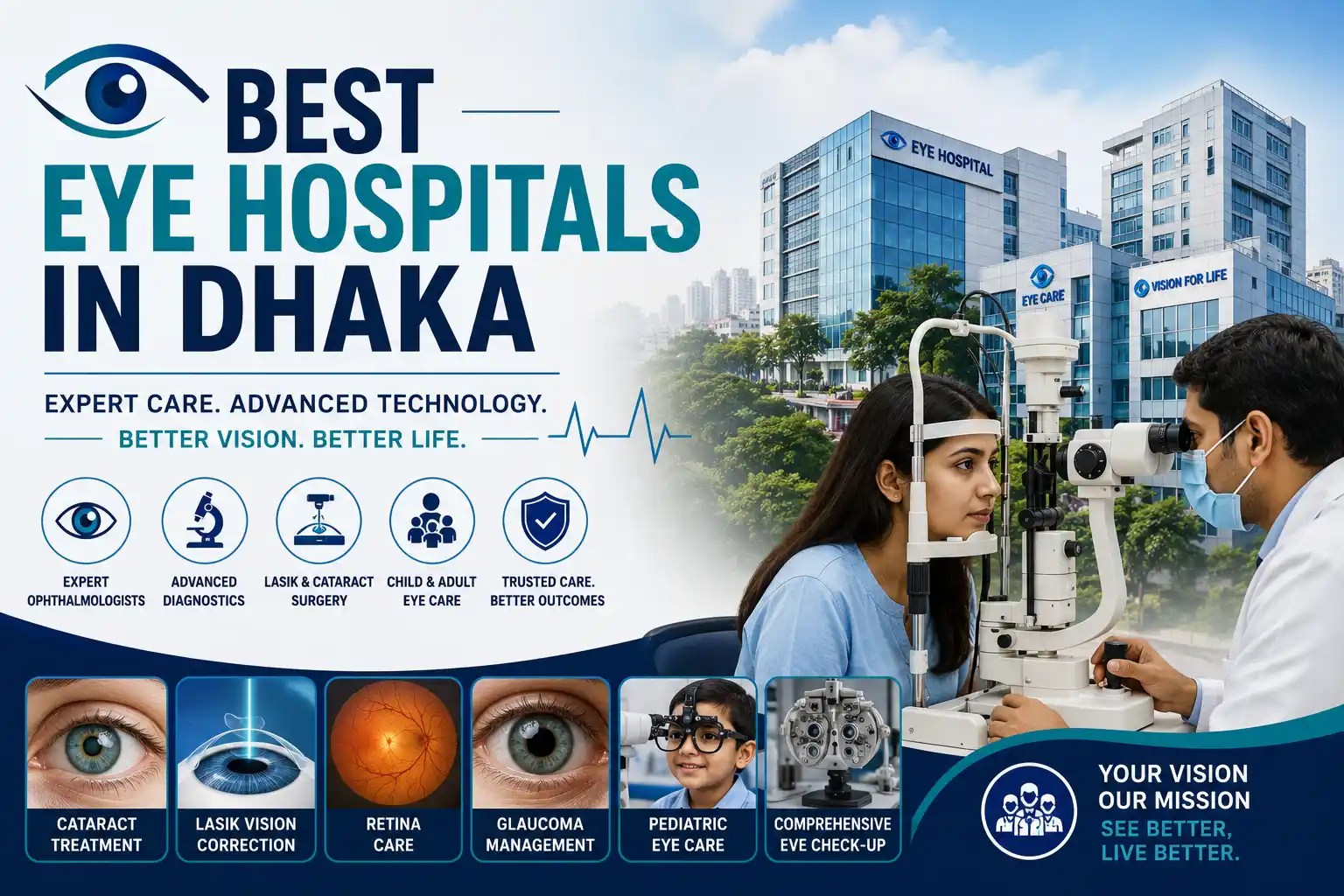
Best Eye Hospitals in Dhaka 2026
Good eyesight is something most people take for granted until a problem appears. Yet the eyes are among the most sensitive and hard-working organs in the body, and timely, expert care can be the difference between preserving vision and losing it. In a densely populated city like Dhaka, where dust, pollution, screen use, and rising rates of diabetes all take a toll on eye health, access to reliable ophthalmic care matters more than ever.
Bangladesh faces a familiar set of eye problems. Cataracts remain a major cause of avoidable blindness, while refractive errors, glaucoma, diabetic retinopathy, dry eye, conjunctivitis, and various retinal disorders are all common. Children have their own concerns, from squints to refractive problems that, if missed, can affect development. Many of these conditions are treatable — but often only if caught early.
Knowing when to see an eye specialist is important. Persistent blurring, eye pain, redness that does not settle, sudden vision changes, flashes or floaters, or difficulty seeing at night are all reasons to seek professional assessment rather than waiting. Routine check-ups also matter, especially for people with diabetes, a family history of eye disease, or age-related risk.
Choosing the right eye hospital matters because ophthalmology is highly specialised, spanning distinct areas such as cataract, retina, glaucoma, cornea, and paediatric care. The right facility for one person’s condition may not be the right one for another’s.
One clarification before the list: this article is not an official ranking. The hospitals below are included based on publicly available information, specialist services, facilities, reputation, accessibility, and recurring themes in public feedback — not on any scoring system. Inclusion is not an endorsement, and no hospital is presented as better than another.
Finally, doctors, departments, equipment, appointment systems, consultation fees, and operating hours all change over time. Always verify the current details directly with a hospital, and consult a qualified ophthalmologist for any diagnosis or treatment decision.
How We Selected These Eye Hospitals
The hospitals in this guide were chosen using publicly available information and observable signals, with the goal of helping readers in Dhaka compare real eye care options. The aim is usefulness, not judgement, and nothing here is medical advice.
Selection was based on the following criteria:
- Public hospital presence — the hospital is publicly listed and clearly operating in Dhaka.
- Range of eye care services — the breadth of ophthalmic services publicly documented.
- Availability of specialist departments — publicly referenced specialties such as retina, glaucoma, cornea, or paediatric care.
- Publicly documented facilities — diagnostic and surgical facilities the hospital publicly describes.
- Accessibility — location and ease of access within Dhaka.
- Recurring public feedback themes — general themes in publicly visible feedback, without quoting ratings.
- Overall usefulness — whether the hospital is genuinely helpful to include for someone comparing eye care options.
To be clear, inclusion in this list is not an endorsement, and it is not a claim that one hospital is better than another. Many capable eye hospitals and ophthalmologists practise in Dhaka beyond those listed here, and a hospital’s absence does not imply anything negative. Readers should compare options themselves, verify details directly, and rely on a qualified ophthalmologist for medical guidance.
Best Eye Hospitals in Dhaka
The hospitals below are listed alphabetically. Each description reflects publicly available information and recurring public feedback themes. Doctors, departments, equipment, appointment systems, and operating hours should always be confirmed directly before visiting.
Bangladesh Eye Hospital
Bangladesh Eye Hospital (BEH) is a specialised private eye hospital with a public presence in Dhaka, headquartered in the Dhanmondi area and operating through multiple branches in and beyond the city. It publicly presents itself as a specialised ophthalmic hospital offering a range of eye care services through its branch network.
Its publicly documented services include cataract treatment and LASIK vision correction, alongside general ophthalmology. Because service menus differ by branch and change over time, confirm which specific treatments and specialists are available at the branch nearest you.
On facilities, BEH publicly presents itself as a specialised eye care institute with dedicated ophthalmic services across its branch network. The availability of specific departments such as retina, glaucoma, or paediatric care should be confirmed directly.
Public feedback themes reference a patient-focused environment and its multi-branch accessibility. As with any hospital, individual experiences vary between branches, departments, and doctors, so it helps to confirm details and read a range of feedback.
Bangladesh Eye Hospital may suit patients seeking a specialised eye hospital with several access points across Dhaka. Before visiting, verify the current doctor schedules, appointment system, operating hours, and whether the specific treatment or specialist you need is available at your chosen branch. Because these details and any fees change over time, confirm them directly, and consult an ophthalmologist about your specific condition.
Dhaka Eye Care Hospital
Dhaka Eye Care Hospital is an eye hospital located in Uttara, in the northern part of Dhaka, with a public presence as a dedicated ophthalmic facility. Its Uttara location makes it a convenient option for patients in that part of the city.
As an eye-focused hospital, its work centres on ophthalmic consultation and eye care services. The specific specialties, diagnostic facilities, and surgical services it offers should be confirmed directly, since these vary between facilities and change over time.
On departments and facilities, patients should verify directly which services — such as cataract surgery, retina care, glaucoma treatment, or paediatric ophthalmology — are currently available, rather than assuming a full range.
Public feedback and its public presence point to an operating eye hospital serving the Uttara area. As with any hospital, experiences vary between departments and doctors, so confirming details in advance is sensible.
Dhaka Eye Care Hospital may suit patients in and around Uttara who want a nearby eye care facility. Before visiting, verify the current doctor availability, appointment methods, operating hours, and the specific treatments and specialists offered. Because these details and any fees change over time, confirm them directly with the hospital, and consult a qualified ophthalmologist for diagnosis and treatment decisions.
Fashion Eye Hospital
Fashion Eye Hospital Ltd. is an eye hospital with a public presence in the Moghbazar area of Dhaka. It operates as a dedicated ophthalmic facility serving patients in the central part of the city.
As an eye-focused hospital, its services centre on ophthalmic consultation and eye care. The specific specialties, diagnostic tools, and surgical services available should be confirmed directly, since these differ between facilities and change over time.
On departments and facilities, patients should verify which services — such as cataract surgery, retinal care, glaucoma management, LASIK, or paediatric ophthalmology — are currently offered, rather than assuming availability.
Public feedback and its public presence point to an operating eye hospital in the Moghbazar area. As with any hospital, experiences vary between doctors and departments, so it is worth confirming details in advance.
Fashion Eye Hospital may suit patients seeking an eye care facility in central Dhaka. Before visiting, verify the current doctor schedules, appointment system, operating hours, and the specific treatments and specialists available. Because these details and any fees change over time, confirm them directly with the hospital, and rely on a qualified ophthalmologist for any diagnosis or treatment plan rather than assumptions.
Green Eye Hospital
Green Eye Hospital is an eye and general hospital with a public presence in the Dhanmondi area of Dhaka. Its Dhanmondi location places it within a part of the city known for several healthcare facilities.
As a hospital with an eye care focus, its work includes ophthalmic consultation and treatment. The specific ophthalmic specialties, diagnostic facilities, and surgical services should be confirmed directly, as these vary between hospitals and change over time.
On departments and facilities, patients should verify which specific services — such as cataract surgery, retina care, glaucoma treatment, or paediatric eye care — are currently available before relying on the hospital for a particular condition.
Public feedback and its public presence point to an operating eye and general hospital in Dhanmondi. As with any hospital, experiences vary between departments and doctors, so confirming details in advance is sensible.
Green Eye Hospital may suit patients in the Dhanmondi area seeking an eye care facility, potentially alongside general medical services. Before visiting, verify the current doctor availability, appointment methods, operating hours, and the specific treatments and specialists offered. Because these details and any fees change over time, confirm them directly, and consult a qualified ophthalmologist for diagnosis and treatment decisions.
Harun Eye Foundation Hospital
Harun Eye Foundation Hospital is an eye hospital with an established public presence in the Dhanmondi area of Dhaka, located on Mirpur Road. It has a visible public presence and works with a range of consultant ophthalmologists across different subspecialties.
Its publicly documented services span a broad range of eye care, including cataract, glaucoma, cornea, retina, and laser treatments, along with paediatric eye care and vision testing. Several of its consultants also publicly reference LASIK and phaco (cataract) surgery. Confirm which specialists and services are available for your specific need.
On facilities, the hospital publicly references modern equipment and a structured appointment system. Its Dhanmondi location makes it reasonably accessible within central Dhaka.
Public feedback themes reference its convenient location, range of consultants, and appointment process. As with any hospital, individual experiences vary between doctors and departments, so it helps to confirm details in advance.
Harun Eye Foundation Hospital may suit patients seeking a Dhanmondi-based hospital with a broad panel of eye specialists. Before visiting, verify the current doctor schedules, appointment system, operating hours, and the specific treatments available, since consultant visiting hours in particular vary by day. Because these details and any fees change over time, confirm them directly, and consult an ophthalmologist about your condition.
Ispahani Islamia Eye Institute and Hospital
Ispahani Islamia Eye Institute and Hospital (IIEI&H) is a multispecialty eye institute in Dhaka, located in the Farmgate area near Sher-e-Bangla Nagar. Operating as a not-for-profit institution, it is also a teaching centre through its associated institute of ophthalmology.
Its publicly documented services are comprehensive, spanning cataract surgery, glaucoma, corneal conditions, vitreoretinal (retina) diseases, oculoplasty, and paediatric ophthalmology, along with LASIK using excimer laser technology. It publicly references both general and private outpatient departments to serve different needs.
On facilities, according to its public information, the hospital describes its diagnostic and surgical facilities as up to date, and it serves a high volume of daily patients, supported by collaborations with international eye-health organisations. It also trains ophthalmologists and other eye care staff.
Public feedback themes reference accessible, affordable care of a recognised standard, alongside the long waiting times that can come with very high patient volumes. As with any large hospital, experiences vary by department and doctor.
Ispahani Islamia may suit patients seeking a comprehensive, multispecialty eye institute with a wide range of subspecialty departments. Before visiting, verify the current doctor schedules, appointment system, operating hours, and department availability. Because these details and any fees change over time, confirm them directly, and consult an ophthalmologist for your specific care.
Lions Eye Institute & Hospital
Lions Eye Institute & Hospital (also referenced as Lions Eye & General Hospital) is an eye hospital located in the Agargaon area of Dhaka, on Begum Rokeya Sarani. It operates as a dedicated eye institution with an associated general hospital function.
Its publicly documented work centres on ophthalmic care, and it is publicly associated with subspecialty expertise including retina, with several retina specialists linked to the institution. Confirm directly which specialists and services are available for your specific need.
On facilities, patients should verify which specific services — such as cataract surgery, glaucoma treatment, retina care, LASIK, or paediatric ophthalmology — are currently offered, since availability varies and changes over time.
Public feedback and its public presence point to an operating eye institute in Agargaon, an area also home to other specialised health facilities. As with any hospital, experiences vary between departments and doctors.
Lions Eye Institute & Hospital may suit patients seeking a dedicated eye institution in the Agargaon area. Before visiting, verify the current doctor schedules, appointment methods, operating hours, and the specific treatments and specialists available. Because these details and any fees change over time, confirm them directly with the hospital, and rely on a qualified ophthalmologist for diagnosis and treatment decisions.
Mojibunnessa Eye Hospital
Mojibunnessa Eye Hospital Limited is an eye hospital with a public presence in the Dhanmondi area of Dhaka. It operates as a dedicated ophthalmic facility serving patients in that part of the city.
As an eye-focused hospital, its services centre on ophthalmic consultation and eye care. The specific specialties, diagnostic facilities, and surgical services it offers should be confirmed directly, as these vary between facilities and change over time.
On departments and facilities, patients should verify which specific services — such as cataract surgery, retina care, glaucoma treatment, or paediatric ophthalmology — are currently available, rather than assuming a full range.
Public feedback and its public presence point to an operating eye hospital in Dhanmondi. As with any hospital, experiences vary between departments and doctors, so confirming details in advance is sensible.
Mojibunnessa Eye Hospital may suit patients in the Dhanmondi area seeking a nearby eye care facility. Before visiting, verify the current doctor availability, appointment methods, operating hours, and the specific treatments and specialists offered. Because these details and any fees change over time, confirm them directly with the hospital, and consult a qualified ophthalmologist for any diagnosis or treatment plan.
National Institute of Ophthalmology & Hospital
The National Institute of Ophthalmology & Hospital (NIOH) is a government specialised eye institute located in the Sher-e-Bangla Nagar area of Dhaka. As a public tertiary institution, it also functions as a teaching and training centre for ophthalmology.
Its publicly documented work spans comprehensive eye care, including subspecialties such as vitreo-retina, glaucoma, and cataract, supported by senior specialists in areas like retina. Confirm directly which departments and services are currently available for your specific need.
On facilities, as a public tertiary institute NIOH publicly serves a high volume of patients and provides subsidised services, which can make it an accessible option, though it may also involve waiting.
Public feedback and its public presence point to a busy government eye institute with subspecialty departments. As with any large public hospital, experiences vary by department and doctor, and waiting can be a factor.
NIOH may suit patients seeking a government tertiary eye institute with subspecialty care. Before visiting, verify the current doctor schedules, appointment or registration process, operating hours, and department availability, since public-hospital procedures differ from private ones. Because these details change over time, confirm them directly, and consult an ophthalmologist for your specific condition.
OSB Eye Hospital
OSB Eye Hospital is an eye hospital in the Mirpur area of Dhaka, associated with the Ophthalmological Society of Bangladesh. It operates as a dedicated ophthalmic facility with a professional-body connection.
As an eye-focused hospital, its services centre on ophthalmic consultation and eye care. The specific specialties, diagnostic facilities, and surgical services available should be confirmed directly, since these differ between facilities and change over time.
On departments and facilities, patients should verify which specific services — such as cataract surgery, retina care, glaucoma treatment, or paediatric ophthalmology — are currently offered, rather than assuming availability.
Public feedback and its public presence point to an operating eye hospital in Mirpur. As with any hospital, experiences vary between departments and doctors, so confirming details in advance is sensible.
OSB Eye Hospital may suit patients in the Mirpur area seeking a dedicated eye care facility. Before visiting, verify the current doctor availability, appointment methods, operating hours, and the specific treatments and specialists offered. Because these details and any fees change over time, confirm them directly with the hospital, and rely on a qualified ophthalmologist for diagnosis and treatment decisions rather than assumptions.
Vision Eye Hospital
Vision Eye Hospital (also presented as Vision Eye Institute & Hospital) is an eye hospital with a public presence in Dhaka. According to its public information, the hospital offers comprehensive ophthalmology services supported by consultant ophthalmologists and diagnostic facilities.
Its publicly documented services include cataract surgery, glaucoma treatment, and refractive surgery such as LASIK, alongside general ophthalmology. Confirm directly which specialists and services are available for your specific need, and whether departments such as retina or paediatric care are offered.
On facilities, the hospital publicly references advanced diagnostic and surgical technology. As always, patients should verify the specific equipment and services relevant to their condition.
Public feedback themes reference skilled doctors and accurate diagnosis, alongside recurring concerns about appointment waiting times, with some patients reporting long delays past their scheduled times. As with any hospital, experiences vary, so it helps to confirm timing and details in advance.
Vision Eye Hospital may suit patients seeking comprehensive ophthalmology including refractive surgery options. Before visiting, verify the current doctor schedules, appointment system, expected waiting times, operating hours, and the specific treatments available. Because these details and any fees change over time, confirm them directly, and consult a qualified ophthalmologist about your specific condition and options.
Comparison Table
The table below is a general guide based on publicly available information. Services vary by hospital and change over time, and where a service cannot be verified consistently it is marked “Verify.” Always confirm the specific department, specialist, and service availability directly before visiting.
|
Hospital |
Cataract |
LASIK |
Retina |
Pediatric Eye Care |
Suitable For |
|---|---|---|---|---|---|
|
Bangladesh Eye Hospital |
✔ |
✔ |
Verify |
Verify |
Multi-branch access in Dhaka |
|
Dhaka Eye Care Hospital |
Verify |
Verify |
Verify |
Verify |
Uttara-area patients |
|
Fashion Eye Hospital |
Verify |
Verify |
Verify |
Verify |
Central Dhaka (Moghbazar) |
|
Green Eye Hospital |
Verify |
Verify |
Verify |
Verify |
Dhanmondi-area patients |
|
Harun Eye Foundation Hospital |
✔ |
Verify |
✔ |
✔ |
Broad specialist panel, Dhanmondi |
|
Ispahani Islamia Eye Institute and Hospital |
✔ |
✔ |
✔ |
✔ |
Comprehensive multispecialty care |
|
Lions Eye Institute & Hospital |
Verify |
Verify |
✔ |
Verify |
Agargaon-area, retina focus |
|
Mojibunnessa Eye Hospital |
Verify |
Verify |
Verify |
Verify |
Dhanmondi-area patients |
|
National Institute of Ophthalmology & Hospital |
✔ |
Verify |
✔ |
Verify |
Government tertiary care |
|
OSB Eye Hospital |
Verify |
Verify |
Verify |
Verify |
Mirpur-area patients |
|
Vision Eye Hospital |
✔ |
✔ |
Verify |
Verify |
Refractive surgery options |
A ✔ indicates a service the hospital is publicly associated with. “Verify” means the service should be confirmed directly, since availability varies by hospital and changes over time.
Common Eye Problems Treated
Understanding common eye conditions helps you recognise symptoms early and seek appropriate care. The following are among the most frequently treated in Bangladesh.
- Cataracts. A clouding of the eye’s natural lens that blurs vision, cataracts are a major cause of avoidable blindness. Treatment typically involves surgery to replace the clouded lens, and it is one of the most commonly performed eye procedures.
- Glaucoma. Often linked to raised pressure inside the eye, glaucoma can damage the optic nerve and cause irreversible vision loss if untreated. Because early stages may have no symptoms, regular check-ups are important for at-risk groups.
- Diabetic Retinopathy. A complication of diabetes that damages the blood vessels in the retina, this condition is a growing concern given rising diabetes rates. Regular retinal screening for people with diabetes is key to catching it early.
- Refractive Errors. Conditions such as myopia, hyperopia, and astigmatism affect how the eye focuses light, causing blurred vision. They are commonly corrected with glasses, contact lenses, or, in suitable cases, refractive surgery.
- Dry Eyes. Insufficient or poor-quality tears cause irritation, redness, and discomfort, often worsened by screen use, air conditioning, and pollution. Management ranges from drops to addressing underlying causes.
- Conjunctivitis. Inflammation of the conjunctiva — commonly known locally as eye flu — can be caused by infection or allergy, leading to redness, discharge, and irritation. It can be contagious, so timely assessment matters.
- Retina Disorders. Conditions affecting the retina, including tears, detachment, and macular problems, can seriously threaten vision and often need specialist retinal care. Symptoms like sudden floaters or flashes warrant prompt attention.
- Children’s Eye Problems. Squints, refractive errors, and other paediatric conditions can affect a child’s development and learning if missed. Early screening and specialist paediatric eye care are important for young patients.
How to Choose the Right Eye Hospital
Choosing the right eye hospital means matching the facility to your specific condition and needs. A few practical considerations make the decision clearer.
Specialist availability. Ophthalmology has distinct subspecialties. If you need retina, glaucoma, cornea, or paediatric care, confirm that the hospital has the relevant specialist rather than assuming general eye care covers it.
Diagnostic facilities. Accurate diagnosis depends on proper equipment. Check that the hospital offers the diagnostic tests your condition may require, and that results can be interpreted by qualified specialists.
Surgical services. If surgery may be needed — for cataract, retina, or refractive correction — confirm that the hospital performs the specific procedure and has experienced surgeons for it.
Emergency care. For sudden vision loss, injury, or acute symptoms, timely care is critical. Ask whether the hospital provides emergency eye care and what its process is for urgent cases.
Appointment system. A clear appointment system saves time and frustration. Confirm how to book, expected waiting times, and consultant visiting hours, which often vary by day and doctor.
Accessibility. Location and ease of access matter, especially for follow-up visits. A conveniently located hospital can make ongoing care far easier to maintain.
Follow-up care. Many eye conditions and surgeries need follow-up. Confirm how follow-up appointments work and whether you will see the same specialist, since continuity of care can affect outcomes.
Common Mistakes to Avoid
A little care in how you approach eye health prevents many avoidable problems. These are common mistakes to watch out for.
- Delaying eye examinations. Putting off check-ups allows conditions like glaucoma or diabetic retinopathy to progress silently. Regular examinations, especially for at-risk groups, catch problems early.
- Ignoring early symptoms. Blurring, pain, redness, floaters, or vision changes are signals worth acting on. Dismissing early symptoms can allow treatable conditions to worsen.
- Choosing only by cost. The cheapest option is not always appropriate for your condition. Weigh cost against specialist availability, facilities, and the specific care you need.
- Skipping follow-up appointments. Many treatments and surgeries depend on follow-up to succeed. Skipping these can undermine results and delay detection of complications.
- Self-medicating with eye drops. Using over-the-counter or leftover drops without advice can mask symptoms or worsen some conditions. Eye medication should be used under professional guidance.
- Not confirming specialist availability. Assuming a hospital has the right specialist can lead to wasted visits. Confirm the relevant subspecialist is available for your specific condition before going.
Frequently Asked Questions
When should I visit an eye specialist?
You should see an eye specialist if you notice persistent blurring, eye pain, redness that does not settle, sudden vision changes, flashes or floaters, or difficulty seeing at night. Routine check-ups are also wise, particularly for people with diabetes, a family history of eye disease, or increasing age. When in doubt, it is safer to have symptoms assessed by a qualified ophthalmologist rather than waiting.
Which eye hospital is suitable for cataract surgery?
Several eye hospitals in Dhaka publicly document cataract services, and the suitable choice depends on your specific situation, the surgeon’s expertise, and your convenience. Rather than relying on reputation alone, confirm directly that the hospital performs cataract surgery, ask about the specialists involved, and discuss your case with a qualified ophthalmologist who can advise on the most appropriate option for you.
Do eye hospitals in Dhaka provide LASIK surgery?
Yes, several eye hospitals in Dhaka publicly reference LASIK and other refractive surgery services. However, availability, equipment, and suitability vary, and LASIK is not appropriate for everyone. If you are considering it, confirm directly that the hospital offers the procedure, ask about the technology and specialists, and have an ophthalmologist assess whether you are a suitable candidate.
Can I book appointments online?
Some hospitals offer phone-based booking, and some provide online or app-based appointment systems, but methods vary between hospitals and change over time. Rather than assuming, check each hospital’s current appointment options directly. It is also worth confirming consultant visiting hours and expected waiting times, since these can differ significantly by doctor and day.
Are pediatric eye specialists available?
Some eye hospitals in Dhaka publicly document paediatric ophthalmology departments, while others may not offer dedicated children’s services. Because early care matters for children’s eye conditions, confirm directly that a hospital has a paediatric eye specialist before booking, and seek a qualified specialist’s assessment for any concern about a child’s vision.
What should I bring to my eye appointment?
It is generally helpful to bring any current glasses or contact lenses, a list of your symptoms, records of previous eye tests or treatments, and details of any medications or medical conditions such as diabetes. If you may have your pupils dilated, arranging for someone to accompany you can help, since vision can be temporarily blurry afterwards. Confirm any specific requirements with the hospital when booking.
Final Thoughts
Dhaka has a range of eye hospitals and specialised institutes, from comprehensive multispecialty centres to government tertiary institutions and focused private facilities. The best way to choose is to compare hospitals based on specialist expertise, available services, diagnostic facilities, accessibility, and follow-up care rather than reputation alone.
Before you visit, take the time to verify the latest doctor schedules, appointment systems, consultation fees, treatment availability, and operating hours directly with the hospital. These details change over time, and a direct check helps you avoid surprises. Most importantly, eye health is a medical matter — consult a qualified ophthalmologist for any diagnosis or treatment decision rather than relying on general information alone.
Readers looking for eye hospitals and other healthcare providers in Bangladesh can also explore Info Ghor’s business directory.
Info Ghor is a Bangladesh-focused business directory that publishes practical business guides and informational articles.