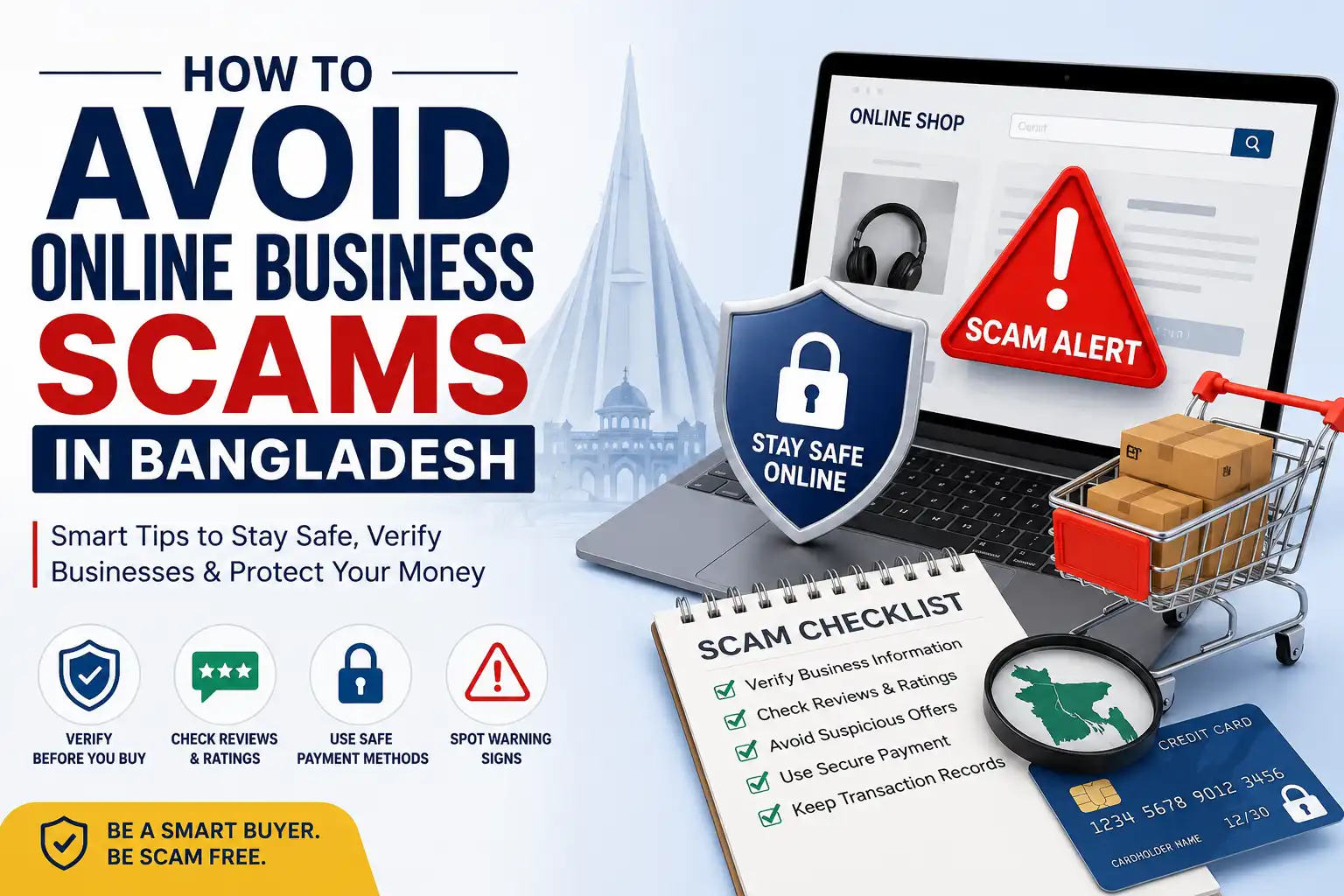
How to Avoid Online Business Scams in Bangladesh
Online shopping and online services have made daily life in Bangladesh genuinely easier — and, like every growing digital market, they have also attracted people who imitate real businesses without ever intending to deliver. The encouraging truth is that most online scams follow predictable patterns, and predictable patterns can be recognized before any money moves.
Avoiding online business scams is not about fear or avoiding the internet. It is about a small set of practical habits: knowing what scam operations typically look like, verifying a business before paying, choosing payment methods that keep leverage on your side, and keeping records that protect you if something goes wrong. None of these habits require technical expertise, and together they can substantially reduce your risk.
This guide covers the full picture for consumers in Bangladesh: the common scam types seen in online buying and selling, the warning signs that appear before a payment, step-by-step verification, safe payment practices, what to do if you suspect you have been scammed, and the checklists that turn all of it into a repeatable routine.
Who Should Read This Guide?
This guide is written for anyone who buys, orders, or hires online:
- Online shoppers ordering from e-commerce sites, Facebook shops, and marketplace sellers.
- Families and students paying for courses, coaching, subscriptions, or admission-related services online.
- Service seekers hiring providers found through search, social media, or ads.
- Small business owners paying online suppliers, agencies, and freelancers — business buyers face the same patterns at larger amounts.
- Anyone helping less-experienced relatives navigate online payments safely; the habits in this guide are teachable.
If money or personal information moves from you to a business you found online, this guide applies to you.
What Are Online Business Scams?
What is an online business scam? An online business scam is a deceptive operation that presents itself as a legitimate business — through a website, social media page, or listing — to collect money or personal information without delivering what was promised. Common forms include fake shops, advance-payment fraud, and impersonation of real brands.
An online business scam is deception dressed as commerce. The operation looks like a business — it has a page, product photos, prices, maybe reviews — but its actual product is your payment or your information.
It helps to distinguish three situations that buyers often lump together:
- A scam: the operation never intended to deliver. The “shop” exists to collect payments and disappear, or to harvest personal and financial information.
- A bad business: a real business that delivers late, poorly, or handles complaints badly. Frustrating, but different — it can be pursued, reviewed, and held accountable.
- A dispute: a genuine misunderstanding between a real buyer and a real seller, usually resolvable through communication and records.
This guide focuses on the first category — but the same verification habits protect you in all three, because they establish identity, evidence, and leverage before problems can occur. That is also why this guide pairs naturally with our broader guide to choosing a trusted business in Bangladesh, which covers trust evaluation beyond scam avoidance alone.
Why Online Business Scams Happen
Understanding why scams flourish online — without fear-mongering — makes the defenses more intuitive:
Low cost of imitation. Creating a convincing page takes an afternoon: copied photos, a plausible name, a few fabricated reviews. The storefront that once required rent and a signboard now requires nothing that anchors the operator to consequences.
Distance and anonymity. Online, the buyer usually cannot see the premises, the stock, or the people. Scammers exploit exactly this gap between what is shown and what can be checked.
Advance payment culture. Where paying before delivery is normal — deposits, full advance transfers, booking fees — the scam simply stops after the payment step. The money moves first; the accountability never arrives.
Urgency and emotion. Flash discounts, limited stock, prize deadlines, job offers that expire tonight — manufactured urgency exists to compress the checking that would expose the scheme.
Asymmetry of effort. A scammer runs the same script hundreds of times; each buyer faces it once, often unprepared. Guides like this one exist to remove that asymmetry — the patterns are reusable knowledge.
Consumer surveys and complaint reports indicate that online shopping fraud and transaction-related complaints remain a significant concern in Bangladesh — which is exactly why the habits in this guide are worth building.
None of this means online commerce is unsafe. It means the burden of the old filters — location, reputation, familiarity — has shifted to verification habits the buyer can apply in minutes.
Common Types of Online Business Scams in Bangladesh
The specific stories change constantly; the underlying patterns repeat. Common types seen in online buying and selling include:
|
Scam Type |
How It Typically Works |
The Core Tell |
|---|---|---|
|
Fake online shop |
A page or site advertises products at attractive prices, collects advance payment, then stalls and disappears |
Unrealistic prices + advance payment only |
|
Non-delivery / partial delivery |
Payment is taken; nothing arrives, or a cheap substitute arrives instead of what was shown |
Stock photos only; refuses inspection-based delivery |
|
Brand impersonation |
A lookalike page mimics a known shop or brand — similar name, copied logo and photos — and runs “offers” |
Slightly altered name; page created or renamed recently |
|
Advance-fee schemes |
A fee is required to unlock something larger: a job, a prize, a loan, a shipment held “in customs” |
You must pay to receive; the story escalates with more fees |
|
Fake service providers |
A “company” takes deposits for services — design, visas, admissions, repairs — and vanishes mid-process |
No verifiable address or registration; deposits to personal accounts |
|
Investment and earning schemes |
Platforms promise unusually high, fast, or guaranteed returns, often requiring recruitment or top-ups |
Guaranteed returns; withdrawal problems appear after deposits grow |
|
Phishing and OTP fraud |
Messages or calls impersonate payment providers, banks, or delivery services to extract OTPs, PINs, or account access |
Anyone asking for your OTP or PIN, for any reason |
|
Fake payment confirmation |
A “buyer” sends a doctored payment screenshot to a seller and pressures for delivery before the money actually clears |
Screenshot instead of balance confirmation in your own account/app |
Notice the pattern behind the patterns: every type either (a) collects money before anything verifiable exists, or (b) extracts the credentials that let money be taken directly. Every defense in this guide targets one of those two moves.
Warning Signs Before You Make a Payment
What are common online scam warning signs? Common warning signs include prices far below market rate, pressure to pay immediately, advance payment demanded to personal accounts, no verifiable address or registration, recently created or renamed pages, copied product photos, reviews that appear in bursts, and requests for OTPs or PINs. Multiple signs together mean walk away.
Individually, a warning sign is a question to resolve. Several together are a decision already made:
- Prices far below every comparable seller — the single most common lure. Ask how a real business could afford it; if there is no plausible answer, there usually isn’t one.
- Manufactured urgency — countdowns, “only 2 left,” “offer ends tonight,” pressure to confirm before you can check.
- Advance payment only, to a personal account — with refusal of cash on delivery or any protected alternative.
- No verifiable address — or evasion when asked where the business operates.
- A young or renamed page — created recently, or switched from an unrelated identity, now running aggressive promotions.
- Copied or catalog-only photos — and inability to provide a real photo or short video of the actual item.
- Review bursts — clusters of generic five-star praise within days, or testimonials that exist only in the seller’s own posts.
- Mismatched identity — different names or numbers across the page, website, and payment instructions.
- Communication that degrades under questions — vague, evasive, or hostile responses the moment you ask about registration, address, or policies.
- Any request for OTPs, PINs, or passwords — no legitimate transaction requires them; this sign alone ends the interaction.
Legitimate Business vs Scam Warning Signs
|
Signal Area |
Typically Legitimate |
Warning Sign |
|---|---|---|
|
Pricing |
Market-consistent, itemized, confirmed in writing |
Dramatically below market; shifts after contact |
|
Identity |
Same name and details everywhere |
Lookalike names; mismatches across platforms |
|
Address |
Specific and findable |
Missing, vague, or dodged |
|
History |
Footprint spanning months or years |
Page created or renamed days ago |
|
Photos |
Real premises and products, imperfect and consistent |
Stock or copied images only |
|
Payment |
COD or recorded channels offered |
Full advance to personal account, no alternative |
|
Reviews |
Mixed, detailed, accumulated over time |
Bursts of generic praise |
|
Under questioning |
Patient, specific answers |
Pressure, evasion, or hostility |
When to Walk Away
Stop the transaction immediately if:
- The seller pressures you to pay immediately or discourages verification.
- The business identity, address, or contact details cannot be verified consistently.
- Payment is requested only to an unrelated personal account with no reasonable explanation.
- The seller asks for your OTP, PIN, password, or other sensitive account credentials.
- Multiple trust signals conflict across different sources (website, Google Business Profile, business directories, reviews, or social media).
How to Verify an Online Business
How do I verify an online business? Verify an online business by confirming its exact name and cross-checking it across sources: a findable address, working phone, consistent details on its website, Google Business Profile, and social pages, genuine reviews on independent platforms, and — for significant payments — registration details and written policies. Consistency across sources is the test.
A practical sequence you can complete in 15–30 minutes for any significant purchase:
- Pin down the exact name. Impersonation lives in one-letter differences. Confirm you are dealing with the business you think you are.
- Search the name with reputation keywords. Add “review,” “complaint,” or “scam” — in English and Bangla. Look for patterns in consumer groups and forums, and note a total absence of footprint for any business claiming to be established.
- Check the address on Google Maps. Does a matching business appear at a specific, findable location? For local high-value purchases, a visit remains the strongest check.
- Test the contact channels. Call the number, message the page with a specific question. Knowledgeable, patient answers indicate a real operation; deflection indicates risk.
- Cross-check the digital presence. Website, Google Business Profile, and social pages should tell one consistent story — same name, address, and phone. Page Transparency information (where available) shows creation dates and name changes. If the seller runs a website that collects personal or payment information, HTTPS (the padlock icon) is a baseline security requirement — but many scam websites also use HTTPS, so the padlock alone is never proof of legitimacy. Our guide to finding verified businesses online covers each of these sources in depth.
- Read reviews for patterns, not scores. Negative reviews first; repeated non-delivery complaints outweigh any star average.
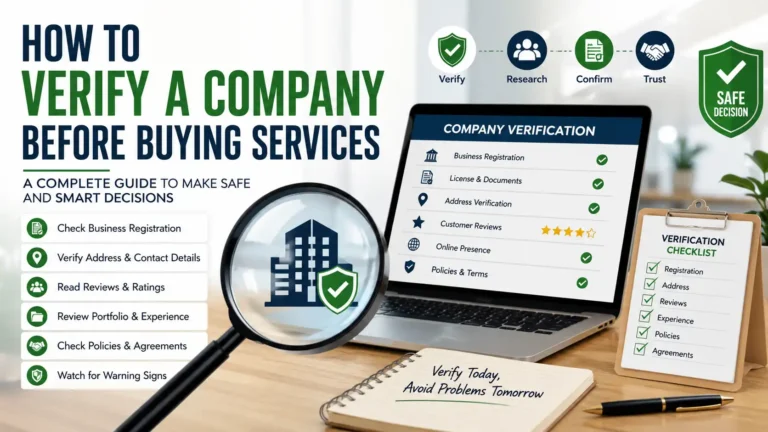
- Go deeper for bigger payments. Registration questions, written policies, itemized pricing — the full due-diligence sequence in our company verification guide applies whenever the amount justifies it.
- Save everything. Listing, price, conversation, and payment proof — records are leverage you collect before you need it.
When in doubt, delay. Legitimate businesses survive a day of checking; scam operations depend on you not taking one.
How to Check Business Registration and Contact Information
Registration checks move a business from “claims to exist” to “legally exists” — the floor of trust on which everything else stands.
In Bangladesh, the practical reference points are:
- Trade License: local authorities — city corporations, municipalities, and union parishads — generally issue trade licenses for businesses operating in their areas. Physical businesses often display them; online sellers can be asked. Established sellers handle the question routinely; evasion is itself an answer.
- RJSC: companies presenting themselves as limited entities (“Ltd.”) are registered with the Registrar of Joint Stock Companies and Firms. That claim corresponds to a registered identity, and businesses can substantiate it by sharing relevant registration documents when asked.
- NBR and BIN: VAT-registered businesses hold a Business Identification Number from the National Board of Revenue, and formal invoices reflect it. Requirements and thresholds may change under government regulations, so treat proper documentation as a positive indicator rather than memorizing rules.
Contact information checks are simpler and just as revealing:
- A specific address (building, road, area) beats a city name; findable on a map beats stated.
- A phone number that is answered professionally, by someone who knows the products and policies.
- Consistency across every source — the website, profile, page, and invoice should agree. A business whose own details contradict each other has a question to answer before it has your payment.
Keep proportion: a small honest seller may hold only a trade license and operate from home — that is normal. What separates legitimacy from risk is not size but verifiability: real details, consistently presented, substantiated on request.
The Role of Customer Reviews and Business Directories
Reviews and directories are the two most accessible verification tools consumers have — used correctly.
Customer reviews show how a business behaves across many transactions. Read them as evidence, not decoration:
- Genuine patterns: specific details, mixed ratings, gradual accumulation, customer photos, professional responses to criticism.
- Manipulation patterns: bursts of generic praise, empty reviewer accounts, uniform five-star walls.
- Read negatives first, and weigh the last few months most heavily.
- Cross-check at least two platforms; a record that exists in only one place, controlled by the seller, is marketing.
Reviews also work in the other direction — they are how honest businesses build visible reputations, which is why review behavior itself is a signal. A business that answers criticism accountably in public is showing you how it handles problems; our guide on why customer reviews matter for businesses explains that dynamic from the business’s side.
Business directories organize businesses with structured details — name, category, address, contact — which makes them practical starting points for discovery and cross-checking. A listing gives you concrete, testable details in one place, and comparing several businesses side by side makes transparency differences visible. Established businesses also tend to maintain consistent listings across the web because that consistency supports their own visibility — as covered in our guide to how business directories help local SEO — which means coherent, maintained listings are themselves a modest positive signal.
The honest caveat applies to both tools: a listing is organized information, not certification, and reviews are evidence, not proof. Both are starting points that make your own verification faster — neither replaces it.
Safe Payment Practices
What should I do before paying an online business? Before paying, confirm the seller’s identity is consistent across sources, verify the address and phone, read recent independent reviews, confirm the total price in writing, prefer cash on delivery or payment channels that create records, avoid full advance payment to personal accounts of unverified sellers, and save all screenshots and payment proof.
Payment is the moment leverage changes hands. These practices keep as much of it with you as possible:
- Prefer cash on delivery (COD) with unfamiliar sellers. Where available, COD remains the simplest protection: you pay when the product actually arrives, and where the seller’s policy allows, after inspecting it.
- Treat full advance payment as a decision, not a default. If advance payment is unavoidable, complete verification first, keep the first order small, and prefer sellers verifiable on every other signal. An unverifiable seller demanding full advance payment to a personal account is the classic setup for online purchase fraud.
- Prefer channels that create records. Payments with transaction records, references, and receipts give you evidence and a dispute path. Undocumented transfers give you a story.
- Confirm the total in writing before paying — product, delivery charge, and any fees. Screenshots of the agreed price prevent the oldest dispute there is.
- Send payments only to the identity you verified. A business whose payment account name has no connection to its business identity — with no explanation — is presenting a mismatch at the worst possible moment.
- Never share OTPs, PINs, or passwords with anyone. Not with “customer care,” not with “delivery agents,” not to “receive a refund.” No legitimate process requires them; every request for them is an attempt at fraud.
- Verify received payments inside your own app or account (for sellers): a screenshot from a buyer proves nothing — confirm the balance yourself before handing over goods.
- Keep every record: order confirmation, chat, invoice, payment proof. Records convert “he said, she said” into a case.
Safer Payment Practices vs Riskier Payment Practices
|
Safer |
Riskier |
|---|---|
|
Cash on delivery with inspection where offered |
Full advance payment to an unverified seller |
|
Payments through channels with records and receipts |
Undocumented transfers with no reference trail |
|
Paying a verified business account matching the seller’s identity |
Paying a personal account with no connection to the business name |
|
Small first order with a new seller |
Large first payment based on ads alone |
|
Total price confirmed in writing before payment |
Verbal prices that shift at delivery |
|
Credentials kept private, always |
Sharing OTPs or PINs with callers or “agents” |
How to Communicate Safely with Online Businesses
Communication habits protect both your money and your information:
- Keep the conversation on the record. Message threads on the platform where the business operates create a trail; sellers who push conversations into unrecorded channels while avoiding anything documented are removing your evidence in advance.
- Share the minimum. A purchase needs your delivery details — not your identification documents, card details, or account credentials. Be especially cautious with requests for photos of identity documents for routine purchases.
- Ask specific questions and grade the answers. “What is the exact model?” “What does the warranty cover?” “What is your return process?” Real operations answer specifics; scams answer with pressure.
- Beware of the follow-up call script. Impersonators who call about a “problem with your delivery” or “refund verification” and steer toward OTPs or payments are running the second half of a data-collection scam. Hang up and contact the business or provider through its official, independently found channels.
- Slow the conversation down when pushed. Urgency is a tool. A polite “I’ll confirm tomorrow after checking” costs a legitimate seller nothing and costs a scam its window.
- Screenshot as you go. Product claims, prices, promises — captured when made, not reconstructed after a dispute.
What to Do If You Suspect a Scam
If something feels wrong — before or after payment — act methodically rather than emotionally:
If you have not paid yet:
- Stop the transaction. No explanation is owed to someone pressuring you.
- Keep your records — screenshots of the page, conversation, and offer.
- Warn others where appropriate: honest reviews and reports on the platform help the next buyer.
If you have already paid:
- Document everything immediately: the listing, conversation, payment proof, transaction references, dates, and the account details you paid.
- Contact the seller once, in writing, stating the problem and what you expect (delivery or refund) by a clear date. Some situations are bad service rather than fraud, and a documented request resolves them — or proves you tried.
- Use the platform’s process. If the purchase went through a marketplace or involved a payment provider, report the transaction through their official dispute or support channels promptly — timeliness often matters.
- Report the page or profile to the social platform if impersonation or fraud is involved.
- Escalate to the authorities where warranted. The Directorate of National Consumer Rights Protection (DNCRP) is the government body responsible for consumer rights protection; consult its official channels for the current complaint procedure. Depending on the nature of the incident, online payment fraud and cybercrime may also be reported through the Cyber Crime Investigation Division of Bangladesh Police and the government’s ScamCheck portal — check current official procedures, and bring your documented records.
- Protect your accounts if any credentials or OTPs were shared: change passwords, notify your payment provider or bank through official contact channels, and monitor transactions.
Two things worth saying plainly: recovery after payment is genuinely harder than prevention before it — which is why the rest of this guide exists — and being scammed is not a personal failing. These operations are scripts refined against thousands of people; reporting them, with records, is both self-protection and a public service.
Common Mistakes That Increase Scam Risk
- Trusting the ad instead of the seller. Sponsored placement is purchased visibility, not endorsement. Screen advertised sellers exactly like any other.
- Letting price do the thinking. Deals dramatically below market are the bait in most schemes; the discount is the cost of skipping your checks.
- Paying in full, in advance, to save a little. A small discount for full advance payment transfers all risk to you — usually the worst trade available.
- Skipping checks for small amounts — repeatedly. Small-ticket fraud runs on volume; repeated small losses are the model.
- Treating follower counts as legitimacy. Followers can be bought; popularity is marketing, verification is evidence.
- Sharing OTPs “just this once.” There is no legitimate version of this request. None.
- Keeping no records. Without screenshots and payment references, even a valid complaint has nothing to stand on.
- Rushing under pressure. Every scam script compresses time. Any deal that cannot survive a day of checking was not a deal.
Business Scam Prevention Checklist
Run through this list before paying any online business you haven’t used before:
Identity
- Exact business name confirmed — no lookalike spelling
- Same name, address, and phone across page, website, and listings
- Address specific and findable on Google Maps
- Phone answered professionally; questions answered specifically
History & Reputation
- Page/website age and name history checked (Page Transparency, where available)
- Reviews read on at least two independent sources — negatives first
- Name searched with “review” / “complaint” keywords in English and Bangla
- Real photos of actual products or premises available on request
Substance (for significant payments)
- Trade license / registration substantiated on request (RJSC for “Ltd.” claims)
- Written return, refund, or service policy exists and is saved
- Total price confirmed in writing — product, delivery, fees
Payment
- COD or a recorded payment channel chosen where possible
- No full advance payment to an unverified personal account
- Payment recipient matches the verified business identity
- First order kept small with any new seller
- All records saved: listing, chat, invoice, payment proof
Always
- No OTP, PIN, or password shared with anyone — ever
- Any pressure to pay immediately treated as a warning sign in itself
Business Scam Best Practices
The durable habits, stated plainly:
- Verify before you pay — every time the seller is new. The sequence takes minutes; recovery takes months.
- Let consistency be your test. Real businesses tell one story across every source; scams contradict themselves somewhere.
- Keep leverage until delivery wherever the payment method allows it.
- Treat urgency as information. Pressure to skip checking is the strongest reason to check.
- Guard credentials absolutely. OTPs and PINs are the keys to your money; no legitimate party ever needs them.
- Collect records as you go, not after a problem.
- Scale diligence to stakes. Light checks for small orders, full verification for significant payments.
- Report what you find. Reviews, platform reports, and formal complaints protect the next buyer — and build the paper trail that protects you.
Common Myths About Online Business Scams
|
Myth |
Reality |
|---|---|
|
Only careless or uneducated people get scammed. |
Scam scripts are refined against thousands of people, including experienced buyers. Preparation, not intelligence, is the variable that matters. |
|
A professional-looking page means a real business. |
Pages are built in an afternoon. Judge consistency, verifiable details, and independent footprint — not design quality. |
|
Lots of followers and likes prove legitimacy. |
Engagement can be purchased and manufactured. Popularity is marketing; verification is evidence. |
|
If the seller answers quickly, it must be genuine. |
Responsiveness is part of the script. Grade the content of answers — specifics versus pressure — not the speed. |
|
Small payments aren’t worth verifying. |
Small-ticket fraud runs on volume, and repeated small losses add up. Light checks scale down; skipping them doesn’t. |
|
Once you’ve paid, nothing can be done. |
Recovery is harder than prevention but not always impossible — documented records, prompt platform disputes, and formal complaints through official channels all improve the odds. |
Before Paying vs After Verifying
|
Before Verifying |
After Verifying |
|---|---|
|
The seller’s ads are your only information |
Identity confirmed across independent sources |
|
Price and urgency drive the decision |
Evidence and consistency drive the decision |
|
Payment terms are whatever the seller demands |
Payment method keeps leverage with you |
|
A screenshot conversation is your only record |
Listing, price, chat, and payment proof are saved |
|
A vanished seller is untraceable |
A located, registered business can be pursued |
|
Every purchase is a fresh gamble |
Buying online is a repeatable, low-risk routine |
Key Takeaways
- Online business scams follow predictable patterns — collect money before anything verifiable exists, or extract the credentials that let money be taken — and both moves are defensible.
- Multiple warning signs together (unrealistic prices, urgency, advance-payment demands, mismatched identity) are a decision to walk away, not a puzzle to solve.
- Verification is consistency-checking: real businesses tell one story across their page, website, listings, address, and reviews.
- Payment method is leverage: prefer cash on delivery or recorded channels, keep first orders small, and never send full advance payment to unverified personal accounts.
- OTPs, PINs, and passwords are never shared — with anyone, for any stated reason.
- If a scam is suspected, document everything, use platform disputes promptly, and escalate through official channels such as the DNCRP with your records.
Online commerce in Bangladesh keeps growing because, most of the time, it works: real businesses delivering real products to satisfied customers. The habits in this guide are not about distrusting that system — they are about participating in it on informed terms. A few minutes of verification before each new seller is the difference between hoping a page is honest and knowing you checked.
Make the checklist above part of your routine, teach it to the people you help with online purchases, and let the businesses that verify cleanly earn your money. Verification rewards exactly the sellers who deserve it — and quietly starves the operations that don’t.
Frequently Asked Questions
What is the most common online scam in Bangladesh?
Patterns vary over time, but advance-payment fraud is among the most commonly reported forms in online buying: a page advertises attractive products, collects payment in advance — often to a personal account — and then stalls or disappears. Its defenses are equally common-sense: verification before payment, cash on delivery where available, and small first orders with new sellers.
How can I tell if a Facebook shop is real before ordering?
Check the page’s transparency information (where available) for its creation date and name changes; look for a specific, findable address and a phone that is answered; read reviews across more than the page itself; ask for a real photo or short video of the actual item; and prefer cash on delivery for a first order. Multiple gaps across these checks are your answer.
Is cash on delivery completely safe?
No method removes all risk, but COD substantially shifts leverage to the buyer: you pay only when something actually arrives, and where the seller’s policy allows inspection, only after seeing it. Remaining risks — such as receiving a wrong or substandard item — are managed by inspecting at delivery where possible and keeping the order record.
What should I do immediately after realizing I’ve been scammed?
Document everything first: listing, conversation, payment proof, transaction references, and the account you paid. Contact the seller once in writing with a clear demand and deadline. Then use the platform’s dispute process promptly, report the page, and escalate through official channels — the DNCRP for consumer complaints, and the police for fraud — bringing your records.
Can I get my money back after an online scam?
Sometimes, and the odds improve with speed and documentation. Prompt disputes through the marketplace or payment provider’s official process, complete records, and formal complaints all help. Honest framing: recovery is genuinely harder than prevention, which is why verification before payment remains the core protection.
Is it safe to pay an advance to an online seller?
It is a risk decision, not a rule. Advance payment to a thoroughly verified business — consistent identity, findable address, genuine review history, written policies — is routine commerce. Advance payment to an unverified seller, especially a full amount to a personal account under time pressure, is the classic fraud setup. Verify first, start small, and keep records.
How do scammers use OTPs, and why must I never share mine?
An OTP (one-time password) authorizes actions on your account — payments, logins, resets. A scammer who has your number and your OTP can act as you. Impersonation calls (“verifying your refund,” “confirming your delivery”) exist purely to extract that code. No legitimate business, bank, or payment provider needs your OTP or PIN — every request for one is fraud.
Are online reviews reliable for spotting scam sellers?
They are useful when read correctly: look for detailed, dated reviews accumulated over time on more than one platform, and read negative reviews for repeating patterns like non-delivery. Be skeptical of bursts of generic praise and reviewer accounts with no history — manufactured reviews are themselves a warning sign.
Do business directories protect me from scams?
They help without guaranteeing. A directory listing gives you structured, testable details — name, category, address, contact — and side-by-side comparison makes transparency gaps visible. Treat listings as reliable starting points that speed up your own verification, not as certification that replaces it.
What government body handles consumer complaints in Bangladesh?
The Directorate of National Consumer Rights Protection (DNCRP) is the government body responsible for consumer rights protection, and consumers may consult its official website or offices for the current complaint procedure and requirements. Keep your records — screenshots, invoices, payment proof, and communication — as they are essential to any complaint, there or elsewhere.