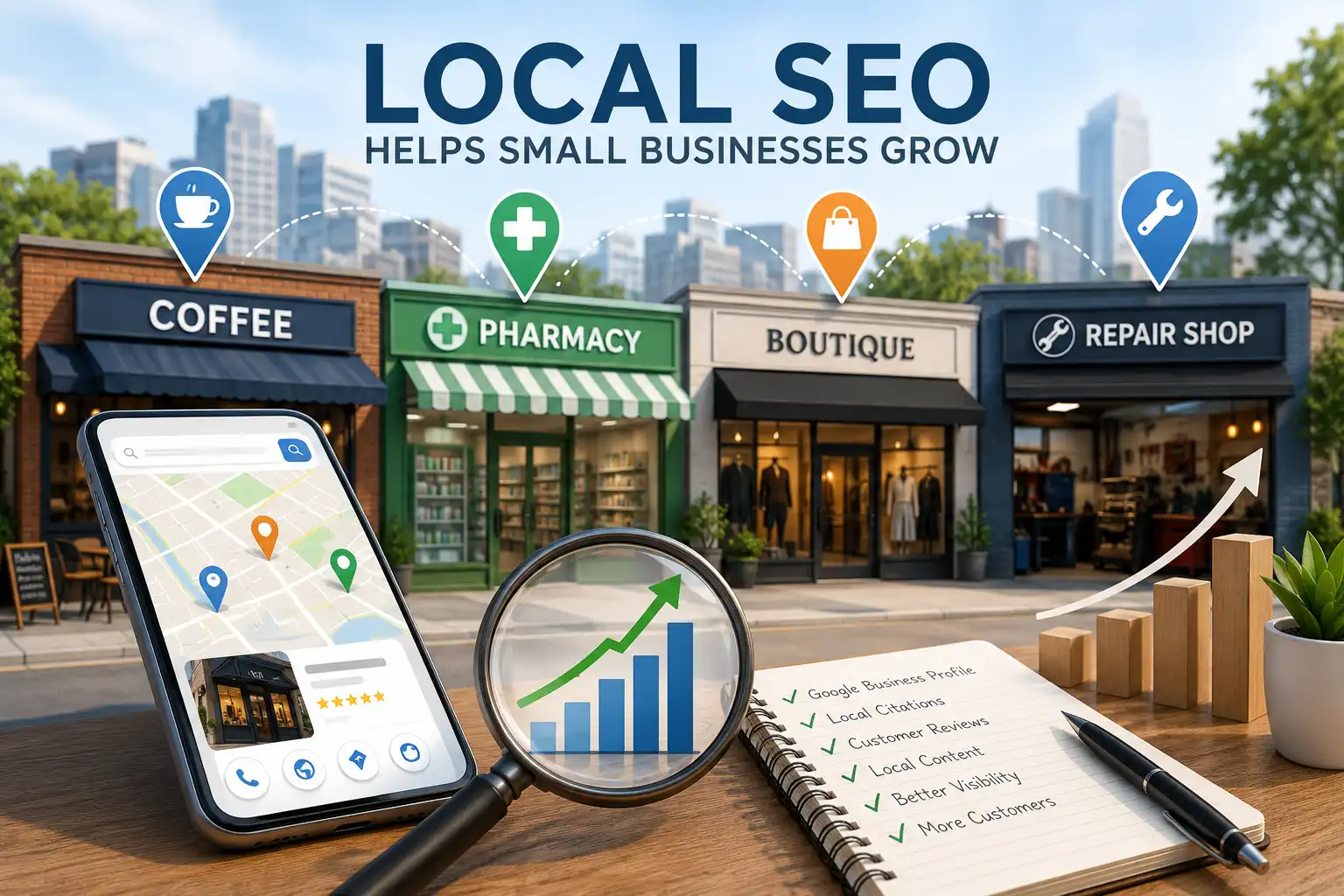
How Local SEO Helps Small Businesses Grow
Most small businesses serve customers within a specific area — a neighborhood, a city, a delivery zone. Local SEO is the practice of making sure those nearby customers can actually find the business when they search: “pharmacy near me,” “catering service in Uttara,” “AC repair Chattogram.” It is not a trick or a paid shortcut; it is the ongoing work of presenting accurate, consistent, trustworthy business information where local searches happen.
For small businesses, this work matters more than almost any other form of marketing, for a simple reason: local searchers arrive with intent. Someone searching for a nearby service is usually ready to call, visit, or order. Showing up accurately at that moment — with the right details, real reviews, and a complete profile — can turn search visibility into a steady stream of discovery opportunities, without an advertising budget.
This guide explains how local SEO actually works and how small businesses can use it realistically: what Google has said about local ranking, the role of Google Business Profile, business directories, NAP consistency, and customer reviews, the mistakes that quietly waste effort, and a practical checklist any small business can follow. No guarantees are offered anywhere in this guide — because honest local SEO doesn’t come with any. What it offers instead is a compounding, durable foundation for growth.
Who Should Read This Guide?
This guide is written for the people who actually run local businesses:
- Shop, restaurant, and clinic owners whose customers come from the surrounding area.
- Service providers — electricians, tutors, repair technicians, photographers, contractors — hired by people who search first and call second.
- Home-based and online-local businesses — caterers, bakers, tailors, delivery-based sellers — serving a defined area without a storefront.
- New businesses in Bangladesh building their first online presence and deciding where to spend limited time.
- Owners who tried “SEO” before and were burned by promises of guaranteed rankings — this guide explains what is actually within your control.
No technical background is assumed. Everything here can be done by a business owner with a phone, patience, and accurate information.
What Is Local SEO?
What is Local SEO? Local SEO (local search engine optimization) is the practice of improving a business’s visibility in location-based searches — queries like “salon near me” or “printing press in Dhaka.” It centers on accurate business information, a complete Google Business Profile, consistent listings, genuine reviews, and locally relevant website content.
Local SEO is the local branch of search optimization: instead of competing for the whole internet’s attention, a business works to appear when people search for what it offers in the area it serves.
Local search results typically show up in two forms:
- Map results: the map and accompanying business listings that appear for location-based queries, drawing heavily on Google Business Profile data.
- Organic results: the regular web results, where locally relevant pages — business websites, directory pages, and articles — can rank.
Traditional SEO vs Local SEO
|
Aspect |
Traditional SEO |
Local SEO |
|---|---|---|
|
Goal |
Visibility for a topic, anywhere |
Visibility for a service, in a specific area |
|
Competition |
Potentially global |
The businesses in your area and category |
|
Core asset |
Website content and authority |
Google Business Profile + consistent local presence |
|
Key signals |
Content relevance, links, site quality |
Relevance, distance, and popularity/prominence signals |
|
Typical winner |
Deep content and strong authority |
Complete, accurate, well-reviewed local presence |
For a small business, this difference is good news: you are not competing with the entire internet. You are competing with the other businesses in your category and area — and many of them have incomplete profiles, inconsistent details, and unanswered reviews. Care and consistency go remarkably far.
Why Local SEO Matters for Small Businesses
Why is Local SEO important? Local SEO matters because customers increasingly search online before choosing nearby businesses, and local searches carry high intent — people searching for a nearby service are often ready to contact or visit. Appearing accurately in those searches creates discovery opportunities that don’t depend on advertising spend.
Local searches carry buying intent. Someone searching “tile shop near me” is not browsing for entertainment. Local visibility places a business in front of people at the moment they are deciding — the most valuable moment in any customer journey.
The search happens whether you participate or not. Your potential customers are already searching your category in your area. The only question local SEO answers is whether they find you — with accurate details — or find only your competitors.
It rewards accuracy over budget. Unlike paid advertising, the fundamentals of local visibility — a complete profile, consistent details, genuine reviews — cost time rather than money. This levels the field for small businesses in a way few marketing channels do.
Customers verify before they choose. Buyers in Bangladesh are increasingly careful: they cross-check details, read reviews, and compare options — habits our consumer guide to choosing a trusted business in Bangladesh actively teaches. Local SEO work and trust-building work are largely the same work: complete, consistent, verifiable information serves both.
Its results compound. Ads stop when spending stops. A well-maintained local presence — profile, listings, reviews, content — keeps working continuously, growing more credible as history accumulates.
How Local SEO Works
Understanding the mechanics prevents wasted effort. Google has described local ranking in terms of three broad factors:
- Relevance: how well a business listing matches what the person searched for. Precise categories, accurate services, and clear descriptions feed relevance.
- Distance: how far the business is from the searcher or the searched location. Distance is largely outside your control — which is why the other factors deserve your effort.
- Popularity: how well-known a business appears, based on information from across the web. The SEO community commonly refers to this factor as prominence. Reviews, consistent citations, mentions, and overall web presence feed it.
The practical translation for a small business:
- You cannot move your shop closer to searchers — so stop worrying about distance.
- You can maximize relevance — precise categories, complete service information, accurate descriptions.
- You can build popularity/prominence honestly — genuine reviews, consistent listings across credible sources, a real web presence.
One more principle underlies everything: search engines corroborate. They assemble their picture of your business from many sources — your profile, your website, directories, reviews — and consistency across those sources builds confidence in the data. This is the same cross-checking careful buyers perform before purchasing, as our guide to verifying a company before buying services shows from the customer’s side. A business that tells one consistent story everywhere satisfies both audiences at once.
Google Business Profile and Local Search
For most small businesses, the Google Business Profile is the single most important local SEO asset — it is the listing that appears in Google Search and Google Maps, carrying your details, photos, reviews, hours, and posts.
Getting it right:
- Claim and verify the profile. An unclaimed profile means your public listing is built from whatever data Google gathered — and you can’t correct it.
- Complete every section. Name (your real one), address, phone, precise categories, services, hours, photos, description. Completeness feeds relevance and earns clicks.
- Use your exact real-world business name. Adding keywords to the name field (“Rahim Electronics – Best Cheap TV Dhaka”) violates Google’s guidelines and creates citation inconsistency.
- Add real photos. Premises, products, work in progress — customer-facing authenticity outperforms stock imagery.
- Keep hours current, including holidays. Wrong hours are among the most common ways a listing actively costs customers.
- Use the profile’s features where relevant: posts, service lists, and Q&A keep the listing active and informative.
- Monitor and respond to reviews — covered fully below.
Optimized Listing vs Incomplete Listing
|
Aspect |
Optimized Listing |
Incomplete Listing |
|---|---|---|
|
Details |
Complete, current, exact canonical NAP |
Gaps, stale hours, variant names |
|
Categories |
Precise primary + accurate secondary |
Wrong, missing, or over-broad |
|
Photos |
Real, recent, customer-relevant |
None or stock only |
|
Reviews |
Invited honestly, answered professionally |
Ignored |
|
Effect |
Earns clicks, calls, and directions |
Loses comparisons to complete neighbors |
An honest note on scope: a Google Business Profile supports visibility, but it is not proof of legal registration and does not certify a business — a distinction our consumer guides consistently make. From the owner’s side, that means the profile is one layer of a trustworthy presence, not the whole of it.
Business Directories and Local SEO
Do business directories improve Local SEO? Business directories contribute one local citation signal among many. Accurate, consistent listings on credible directories help corroborate a business’s name, address, and phone across the web, support how established it appears, and can produce direct referral visits — but no directory listing guarantees rankings.
After the Google Business Profile and website, directories are the supporting layer of local presence.
A citation is any published mention of your business’s core details — and directory listings are the most structured citations available. Their contribution is corroboration: when your details appear identically on your website, your profile, and credible directories, search systems find agreement wherever they look. Directories can also produce direct referral traffic from people browsing categories with intent.
Practical guidance for small businesses:
- Choose few, credible, relevant directories — platforms relevant to your country, city, or industry that real people actually use. For businesses in Bangladesh, a Bangladesh-focused directory such as Info Ghor is one practical example of a relevant platform; the realistic benefits and limits of listing there are covered honestly in our guide to the benefits of listing your business on Info Ghor.
- Complete every listing fully with your canonical details, precise category, and a natural description.
- Maintain what you create. A stale listing is worse than no listing — it publishes wrong information under your name.
- Skip mass-submission services. Blasting your details to hundreds of obscure directories creates the inconsistency and clutter this whole system penalizes.
The full mechanics — citations, directory selection, optimization, and measurement — are covered in depth in our dedicated guide to how business directories help local SEO.
Google Business Profile vs Business Directories
|
Aspect |
Google Business Profile |
Business Directories |
|---|---|---|
|
Priority |
First — the foundational local asset |
After profile and website are solid |
|
Role |
Visibility in Google Search and Maps |
Corroborating citations + category-browsing referrals |
|
Audience |
Searchers at decision moments |
Comparison-stage category browsers |
|
Guarantee |
None |
None |
NAP Consistency Explained
What is NAP consistency? NAP stands for Name, Address, Phone number. NAP consistency means presenting these details identically everywhere your business appears — website, Google Business Profile, directories, and social pages. Consistent NAP helps search engines corroborate your information and prevents customers from encountering conflicting or outdated details.
NAP consistency is the least glamorous and most foundational discipline in local SEO.
Why it matters twice: search systems cross-reference your details across sources, and agreement builds confidence in the data. Customers do the same, more painfully — an old address on a forgotten listing sends a real person to the wrong place.
|
Element |
Consistent |
Inconsistent |
|---|---|---|
|
Name |
“Karim Traders” everywhere |
“Karim Traders” / “Karim Traders BD” / “Karim Trading & Sons” across platforms |
|
Address |
Same full, specific address on every source |
Old location still live on two directories after moving |
|
Phone |
One primary number everywhere |
Three different numbers, one disconnected |
The routine that solves it:
- Write down your canonical details once — exact name, full address, primary phone.
- Use that version verbatim everywhere your business appears.
- After any change — move, new number, rebrand — update every platform, not just one.
- Once or twice a year, search your own business name and audit what appears; fix drift before customers find it.
Trivial formatting differences (“Road” vs “Rd”) matter far less than substantive conflicts — different names, numbers, or addresses. Aim for one clear, true story told everywhere.
Customer Reviews and Local SEO
How important are Google reviews? Genuine reviews are one meaningful trust signal — not a direct ranking guarantee. Reviews contribute to how established a business appears in local search, and visible ratings influence which listing searchers click. Recency, detail, and professional responses matter more than chasing a perfect score or a target count.
Reviews connect to local growth through two channels at once:
The visibility channel. Review signals form part of the popularity/prominence picture — genuine feedback accumulated over time on your profile and other platforms contributes to how established your business appears. Ratings also display directly in map listings, influencing which result earns the click regardless of position.
The persuasion channel. Once a searcher is looking at options, reviews often decide the contact. Recent, specific reviews — and professional responses, especially to criticism — supply the confidence that converts a viewer into a caller.
The working rules for small businesses:
- Ask every real customer for an honest review at the natural moment, with a direct link. Asking is legitimate; filtering who you ask (review gating) and paying for reviews are not.
- Respond to everything — specifically to praise, accountably to criticism. Responses are read by every future customer.
- Never fabricate. Fake reviews violate platform policies, are increasingly detectable, and are exactly what informed buyers are taught to spot.
- Read reviews as feedback data. Repeated complaints are an operations to-do list delivered free.
The complete picture — why reviews persuade, response examples, measurement — is in our dedicated guide on why customer reviews matter for businesses.
Local Content and Location Pages
Your website’s job in local SEO is to prove, in Google-readable and human-readable form, what you do and where you do it.
Local content means pages and posts genuinely useful to your local audience: what services you provide in which areas, answers to the questions local customers actually ask, guides related to your work, updates that show an operating business. Written naturally, this content feeds relevance — it uses the same words your customers search with.
Location pages matter for businesses serving multiple areas or operating multiple branches: a page per location or service area, each with its own accurate details, rather than one vague page claiming everywhere.
Practical standards:
- One clear page per real location or service area — with that location’s canonical NAP, hours, and specifics.
- Write for the customer, not the crawler. A location page should genuinely help someone deciding whether you serve them. Thin, duplicated pages stuffed with area names help no one and impress no algorithm.
- Keep your site’s core details visible and current — the contact page and footer are where both people and systems look first.
- Match everything to your profile and listings. The website is the reference point other sources are checked against; it must agree with them.
A modest, accurate website consistently beats an ambitious, neglected one. For a small business, a handful of true, useful, current pages is enough foundation.
Common Local SEO Mistakes
|
Mistake |
Why It Hurts |
|---|---|
|
Leaving the Google Business Profile unclaimed or half-empty |
Concedes your most visible listing to defaults and competitors |
|
Keyword-stuffing the business name |
Violates guidelines, breaks citation consistency, reads as spam |
|
Inconsistent NAP across the web |
Undermines the corroboration both search systems and customers rely on |
|
Buying reviews or gating them |
Policy violations, detectable patterns, and customer distrust when noticed |
|
Ignoring negative reviews |
The complaint becomes the listing’s unanswered last word |
|
Mass-submitting to hundreds of directories |
Creates low-quality, inconsistent citations that are painful to fix |
|
Publishing thin, duplicated location pages |
Adds noise instead of relevance; helps no searcher |
|
Set-and-forget everything |
Details drift; stale information quietly works against the business |
|
Chasing shortcuts and “guaranteed rankings” |
No one can guarantee rankings; money spent on guarantees is spent on the past |
|
Measuring nothing |
Without calls, clicks, and customer attribution tracked, effort can’t be judged or improved |
Nearly all of these reduce to two root errors: pretending to be something other than the real business, or publishing information without maintaining it.
Simple Local SEO Checklist for Small Businesses
A realistic sequence any small business can follow — most of it once, some of it on a schedule:
Foundation (do once, carefully)
- Canonical details written down: exact name, full address, primary phone
- Google Business Profile claimed and verified
- Profile completed fully: categories, services, hours, description, real photos
- Website (even one page) carries the same canonical details, visible and current
Presence (build gradually)
- Listings created on a few credible, relevant directories — completed fully
- Social pages aligned with canonical details
- Location/service-area pages added where genuinely applicable
Reputation (ongoing habit)
- Every real customer invited to review, with a direct link
- All reviews answered — praise specifically, criticism accountably
- No gating, no purchasing, no fabrication — ever
Maintenance (scheduled)
- Any change updated everywhere at once, from the canonical record
- Self-audit every 6–12 months: search your name, call your listed number, check your map pin
- Results tracked monthly: profile actions (calls, directions, clicks), and “how did you find us?” answers
Nothing on this list requires a budget. All of it requires accuracy and follow-through — which is precisely why it differentiates.
How Local SEO Supports Long-Term Business Growth
Does Local SEO help small businesses? Local SEO can help small businesses grow by increasing discovery opportunities among nearby, high-intent searchers, building a trustworthy and verifiable online presence, and compounding reputation through accumulated reviews and consistent information. Results build gradually and are never guaranteed — but the fundamentals cost time rather than money.
Viewed over years rather than weeks, local SEO contributes to growth through four compounding effects:
Discovery compounds. Every month of accurate presence puts the business in front of another cohort of local searchers at their moment of intent — a continuous channel that doesn’t reset when a campaign ends.
Reputation compounds. Reviews accumulate into a track record; consistent information accumulates into credibility. Both grow harder for competitors to replicate the longer they build.
Trust habits favor the prepared. Buyers are becoming more careful — cross-checking details, reading feedback, avoiding the unverifiable, as consumer education (including guides on avoiding online business scams in Bangladesh) spreads. That shift structurally rewards businesses whose information verifies cleanly everywhere — which is exactly what local SEO work produces.
The same work serves every audience. Complete, consistent, honest information satisfies search systems, persuades careful customers, and feeds the AI search tools now answering local questions — systems that draw on both structured and unstructured web information, from profiles and directories to articles and reviews. One discipline, three audiences, no shortcuts required.
The honest boundaries, restated: local SEO does not guarantee rankings, traffic, customers, or revenue — nothing does, and anyone promising otherwise is selling the promise, not the result. What it reliably produces is the precondition for all of those: being findable, checkable, and credible where your customers are already looking. Growth is built on that precondition plus the thing no SEO can supply — a business worth choosing. Buyers ultimately discover businesses across many channels, and presenting well in all of them — search, maps, directories, reviews — is the same preparation, as our consumer guide to finding verified businesses online shows from the other side of the search box.
Local SEO Myths
|
Myth |
Reality |
|---|---|
|
Local SEO delivers results in days. |
Local presence builds gradually — profiles gain history, reviews accumulate, citations settle. Judge trends over months, not days. |
|
You must pay to appear in local results. |
The core of local visibility — a complete profile, consistent listings, genuine reviews — is free. Ads are a separate, optional channel. |
|
More directory listings always mean better rankings. |
Directories contribute one citation signal among many; quality and consistency drive their value, and mass submissions backfire. |
|
Google prefers businesses simply because they use directories. |
No platform membership earns preference. Directories help by corroborating accurate information — the corroboration is the value, not the membership. |
|
A perfect 5.0 rating is the goal. |
Genuine mixed feedback with professional responses persuades careful buyers more than suspicious perfection — and honesty is the only sustainable review strategy. |
|
Once set up, local SEO is finished. |
Details drift, reviews age, competitors improve. Local presence is maintained, not completed. |
|
Guaranteed-ranking services are worth trying. |
Rankings cannot be guaranteed by anyone. Spend that money on the fundamentals — or on serving customers well enough to be reviewed. |
Key Takeaways
- Local SEO is the work of being accurately findable where nearby, high-intent customers already search — a channel that rewards care and consistency over budget.
- Google describes local ranking around relevance, distance, and popularity (commonly called prominence); relevance and honest prominence are the factors within your control.
- The Google Business Profile is the foundational asset: claimed, complete, truthful, and maintained.
- Directories contribute one citation signal among many — few, credible, fully completed, and kept current.
- NAP consistency — identical name, address, and phone everywhere — is the discipline everything else rests on.
- Genuine reviews are one trust signal, not a ranking guarantee: earn them honestly, answer them professionally, and read them as feedback.
- No one can guarantee rankings, traffic, or customers — realistic expectations are part of doing this work honestly.
Local SEO, done honestly, is less like advertising and more like maintenance of the truth: keeping the web’s picture of your business complete, current, and consistent, then letting accumulated reviews and history do their slow, compounding work. There are no shortcuts in that description because there are none in practice — the businesses that win local search over time are overwhelmingly the ones whose information checks out everywhere and whose customers keep saying so publicly.
That is also why this work is worth a small business’s limited time: every hour spent on it produces something durable — a more complete profile, a corrected listing, an answered review — that keeps serving the business long after the hour is spent. Start with the checklist, keep the details true, and let consistency compound.
Frequently Asked Questions
How long does Local SEO take to show results?
Expect gradual, cumulative progress over months rather than sudden movement. Referral visits from a completed profile or listing can begin immediately; visibility effects build as reviews accumulate, citations settle, and history grows. Track monthly — profile actions, calls, and customer attribution — and judge trends rather than daily fluctuations.
Is Local SEO free?
The fundamentals are: claiming and completing a Google Business Profile, maintaining consistent listings, earning genuine reviews, and keeping a simple accurate website all cost time rather than money. Paid options — ads, featured directory placements, professional help — are optional additions, best judged by the measurable results they produce.
Does my small business need a website for Local SEO?
A website strengthens local presence — it is the reference point other sources corroborate, and it can carry local content and location details. That said, even a single accurate page helps, and a business without a site should focus first on a complete Google Business Profile and consistent listings while treating a simple website as the next step.
What is the single most important Local SEO task?
Claiming and fully completing your Google Business Profile with your exact real-world details — then keeping it current. It is typically a local business’s most visible asset, it anchors your reviews, and it is the listing most searchers encounter first. Everything else in local SEO builds around it.
Do I need to hire an SEO agency?
Not necessarily. The fundamentals in this guide — profile, consistency, reviews, maintenance — are owner-doable without technical skills. If you do hire help, apply the same verification you would to any service provider: check their track record, insist on written scope, and walk away from anyone guaranteeing rankings, which no honest provider can do.
How many directories should my business be listed in?
A small, credible, relevant set: the widely used platforms for your country and city, plus one or two directories specific to your industry — each completed fully and kept current. Quality and consistency create citation value; mass submissions to obscure directories create inconsistency and maintenance burden instead.
Can good reviews improve my local ranking directly?
Reviews are one trust signal among the factors that shape how established a business appears — not a direct, guaranteed ranking lever. Their most certain effects are visible ones: ratings influence which listing searchers click, and review content persuades comparison-stage buyers. Earn them genuinely and respond professionally; treat any ranking benefit as a bonus.
What is a local citation?
A citation is any published mention of your business’s core details — name, address, phone — such as a directory listing or a mention in an article. Accurate citations on credible platforms help search systems corroborate your information. Their value comes from accuracy and consistency, which is why maintaining a few good citations beats accumulating many careless ones.
My business serves customers at their homes. Does Local SEO still apply?
Yes. Service-area businesses — repair services, caterers, tutors, delivery-based sellers — can present a service area rather than a storefront on their Google Business Profile, and every other fundamental applies unchanged: consistent details, genuine reviews, relevant listings, and honest local content describing where you serve.
What should I check first if my business isn’t appearing in local searches?
Audit the foundation in order: Is your Google Business Profile claimed, verified, and fully completed with precise categories? Do your name, address, and phone match exactly across your profile, website, and listings? Are there duplicate or outdated listings contradicting you? Is your profile gathering genuine reviews? Fix consistency first — it underlies everything else, and drift there quietly suppresses the rest.