Best Ways to Find Verified Businesses Online: The Complete Guide
Finding a business online is easy. Finding a verified business — one whose identity, registration, and track record you can actually confirm — takes a method. Search results, ads, and social media pages all present businesses the way those businesses want to be seen. Verification sources show you what can be checked.
The difference matters because discovery is where most bad transactions begin. People rarely get defrauded by businesses they investigated carefully; they get defrauded by businesses they found in thirty seconds and trusted by default. Learning where to look — and how to cross-check what you find — turns online discovery from a gamble into a process.
This guide walks through the practical channels for finding verified businesses online: business directories, official government registries, Google Business Profile and Google Maps, professional associations, review platforms, LinkedIn, and more. It explains what each source can and cannot prove, how to combine them, and the red flags that should remove a business from your shortlist immediately.
Who Should Use This Guide?
Anyone who chooses businesses online will find this guide useful, because the discovery habits it teaches apply across situations:
- Consumers searching for shops, repair services, clinics, or online sellers can filter options before spending money.
- Small business owners sourcing suppliers, agencies, or service vendors can turn these steps into a lightweight vendor-screening routine.
- Homeowners looking for contractors and technicians can shortlist providers whose identity and history check out.
- Freelancers and professionals evaluating clients, platforms, or training providers can avoid too-good-to-be-true offers.
- Students and families comparing coaching centers, institutions, or admission services can verify claims before committing fees.
- Organizations can adapt the checklists here into formal procurement screening.
If money, data, or time will change hands based on what you find online, this guide applies to you.
Why Finding Verified Businesses Matters
What is the best way to find verified businesses online? The most reliable approach is to combine sources: discover options through business directories, search engines, and Google Maps, then confirm each candidate against official registries, its Google Business Profile, independent reviews, and its own website. No single source proves legitimacy — verification comes from consistency across several.
The internet removed the old filters. A generation ago, a business needed a physical shop, a signboard, and neighbors who knew it. Today, anyone can create a page, run ads, and look established within a day — which means the burden of filtering has shifted to you, the buyer.
Choosing verified businesses matters for practical reasons:
Your money is safer. A business whose identity, address, and registration can be confirmed can also be held accountable. An anonymous seller cannot.
Your information is safer. Businesses receive your phone number, address, and sometimes payment or account details. Verified operations have reputations to protect; untraceable ones do not.
Your time is spent once. A verified business that delivers correctly costs you one transaction. An unverified one that fails costs you the money, the follow-up, the dispute, and the replacement purchase.
Good businesses get rewarded. Every buyer who checks before paying makes fraud less profitable and pushes honest, transparent businesses up the market. Verification is not just self-protection — it shapes the marketplace.
When Should You Verify a Business?
Verification is not one big investigation — it is a habit applied in layers, deepening as your commitment grows:
|
Stage |
Recommended Action |
|---|---|
|
While discovering options |
Light screening: does the business appear in a directory, on Google Maps, or in search results with a consistent identity? |
|
Before contacting |
Check its Google Business Profile, website, and social pages for matching details |
|
Before sharing personal details |
Confirm working contact channels and read recent independent reviews |
|
Before paying or signing |
Complete deeper checks: registration, policies, written pricing, and — for services — references |
Light checks filter your shortlist in minutes. Full verification is reserved for the one or two businesses you actually intend to pay.
Best Ways to Find Verified Businesses Online (At a Glance)
Where can I find verified companies? Practical places to find and confirm companies include curated business directories, official government registries (such as RJSC in Bangladesh for registered companies), Google Business Profile and Google Maps, professional associations, LinkedIn company pages, and established customer review platforms — used together rather than relying on any single source.
Each discovery channel answers a different question. The table below summarizes what each source is genuinely good for:
|
Source |
What It Helps Confirm |
Limitation |
|---|---|---|
|
Business directories |
Organized listings, categories, contact details |
Listing quality varies by directory |
|
Government registries |
Legal existence and registered identity |
Says nothing about service quality |
|
Google Business Profile |
Location, contact details, photos, reviews |
Not proof of legal registration |
|
Google Maps |
Real, findable physical presence |
Remote businesses may not appear |
|
Search engines |
Reputation footprint, complaints, news |
Results mix marketing with evidence |
|
Professional associations |
Industry membership and standards |
Membership requirements vary |
|
LinkedIn company pages |
Professional footprint, team, history |
Pages are self-maintained |
|
Industry certifications |
Specific credentials and compliance |
Must be traced to the issuer |
|
Review platforms |
Customer experience over time |
Reviews can be manipulated |
|
Social media |
Page age, activity, engagement |
Popularity is not legitimacy |
|
Business websites |
Identity, policies, and consistency |
Entirely controlled by the business |
The rest of this guide covers each source in depth — and then how to combine them.
Step-by-Step Business Discovery Checklist
How do I know if a business is legitimate? A legitimate business can be confirmed across independent sources: its name appears consistently on its website, Google Business Profile, and social pages; its address is findable; its contact channels work; and — where applicable — its registration (such as a trade license or company incorporation) can be substantiated on request.
Use this sequence whenever you are choosing a business online:
- Define what you need — category, location, budget range — so you compare like with like.
- Build a shortlist from organized sources: a business directory, Google Maps, and a search engine query for your category and area.
- Screen each candidate’s identity: consistent name, specific address, working phone, real website or active page.
- Check the reputation footprint: reviews on at least two independent platforms, plus a search for the business name with words like “review” or “complaint.”
- Cross-check details: website vs Google Business Profile vs social pages — mismatches are questions to resolve.
- Go deeper on your finalists: registration where applicable, policies, written pricing, and references for services.
- Decide with evidence: choose the business whose claims survived checking — not the one with the loudest marketing.
Each step takes minutes. Together, they remove most bad options before any money is at risk.
Business Directories
A business directory is a curated, categorized collection of business listings — and it solves the first problem of discovery: finding organized options in one place instead of scattered ads and random search results.
Directories can be useful in several ways:
- Category browsing: comparing several businesses of the same type side by side — restaurants, hospitals, coaching centers, agencies — makes differences in transparency immediately visible.
- Structured information: listings typically present name, address, contact details, and descriptions in a consistent format, which makes cross-checking easier.
- A starting point for verification: every detail in a listing — the phone number, the address, the website link — is something you can test using the steps in this guide.
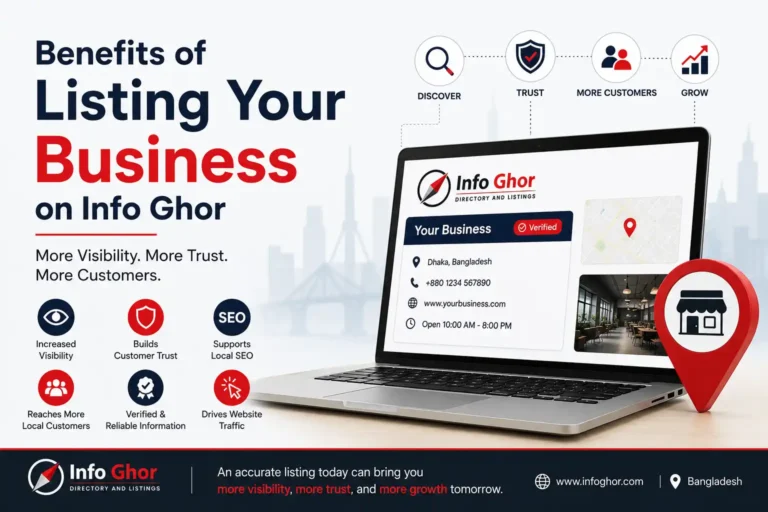
Bangladesh-focused directories serve local discovery particularly well because they organize businesses by familiar categories and locations. Info Ghor, for example, functions as a business directory where users can browse categories, view business profiles, and check contact information as the starting point for their own verification, alongside company reviews and related guides.
The honest limitation: a directory listing is organized information, not a guarantee. Treat any directory — including this one — as the beginning of verification, not the end of it. The value is in having accurate, structured details to check, all in one place.
Official Government Registries
Government registries answer the most fundamental question: does this business legally exist?
In Bangladesh, the relevant reference points include:
- Registrar of Joint Stock Companies and Firms (RJSC): companies structured as limited entities are registered here. If a business calls itself “Ltd.,” that claim corresponds to a registered identity that should be substantiable. Where public records provide limited detail, businesses can usually substantiate their registration by sharing relevant registration documents during the verification process.
- Trade license: local authorities — city corporations, municipalities, and union parishads — generally issue trade licenses for businesses operating in their areas. Physical businesses often display them; others can be asked.
- National Board of Revenue (NBR): VAT-registered businesses hold a Business Identification Number (BIN). Proper invoices from formal businesses reflect this registration. Requirements and thresholds may change under government regulations, so confirm current rules from official sources when it matters.
Government Registry vs Business Directory
These two sources are often confused, but they do different jobs:
|
Aspect |
Government Registry |
Business Directory |
|---|---|---|
|
Purpose |
Legal record of existence |
Discovery and comparison |
|
Maintained by |
Government authority |
Directory operator |
|
Proves |
Registered identity |
Organized listing details |
|
Covers quality? |
No |
Only indirectly, via reviews/profiles |
|
Practical use |
Confirming a finalist’s legal identity |
Building and screening a shortlist |
Use directories to find options; use registries (and registration documents requested directly) to confirm the one you choose. For readers unfamiliar with these documents, a business registration guide covering trade licenses, incorporation, and tax registration in detail is a useful companion resource.
Google Business Profile
A Google Business Profile — the business panel that appears in Google Search and Maps — is one of the most convenient cross-checking tools available. It gathers location, contact details, photos, opening hours, and customer reviews in one place.
How to use it well:
- Match the details. The name, address, and phone number on the profile should match the business’s website, social pages, and what its staff tell you. Consistency across sources is the pattern you are looking for.
- Read the photos. Customer-uploaded photos of a real operation carry more evidential weight than polished marketing images.
- Check the review timeline. Reviews accumulated steadily over months or years suggest a real customer base; a burst of praise within days suggests a campaign.
The essential caveat: a Google Business Profile — even a verified one — is not proof of legal registration, and unverified profiles can also exist. Treat it as a cross-checking tool to be used together with registration records, reviews, and the other methods in this guide.
Google Business Profile vs Business Directory
|
Aspect |
Google Business Profile |
Business Directory |
|---|---|---|
|
Strength |
Location, hours, photos, and reviews in one panel |
Category browsing and side-by-side comparison |
|
Coverage |
Businesses that maintain a profile |
Businesses listed in the directory |
|
Best for |
Cross-checking one specific business |
Discovering and shortlisting options |
|
Proof of registration? |
No |
No |
The two work best in sequence: shortlist through a directory, cross-check each candidate’s profile.
Google Maps
Google Maps answers a simple but powerful question: is this business physically findable?
- Confirm the address exists. A specific building, road, and area that appears on the map is accountability you can locate.
- Look at the surroundings. Street imagery and area photos can show whether the location plausibly matches the business’s claimed scale.
- Check for a matching listing. A business operating at a location for a meaningful time usually appears there, often with reviews attached.
A business absent from Maps is not automatically illegitimate — newer businesses, service-area businesses that travel to customers, and fully remote providers may have a limited or no visible Maps presence despite operating legitimately. But for any business claiming a physical presence, a findable address is a baseline expectation, and for local high-value purchases, an in-person visit remains the strongest check of all.
Search Engines
A search engine is your reputation microscope. Beyond finding businesses, it reveals what the internet remembers about them:
- Search the exact business name. Consistent results across a website, profile, listings, and mentions build confidence; a name that returns nothing at all is unusual for any business claiming to be established.
- Add reputation keywords. Searching the name together with words like “review,” “complaint,” “scam,” or “experience” — in both English and Bangla for Bangladeshi businesses — surfaces discussion that marketing never will.
- Check the footprint’s age. Old mentions, dated posts, and archived pages help confirm how long a business has genuinely existed, which can be compared against its own claims.
- Distinguish evidence from advertising. Paid placements and the business’s own content describe intent; independent mentions, news items, and customer discussion describe track record.
A few minutes of deliberate searching is often the difference between a shortlist and a mistake.
Professional Associations
Many industries have professional associations or trade bodies — organizations whose members operate in a specific sector, often under stated standards or codes of conduct.
Membership can be a useful signal because it typically means the business identified itself formally within its industry, and in some associations, met defined entry requirements. It can also give you a route for complaints in some sectors.
How to use this signal carefully:
- Verify the claim, not the logo. Membership badges are images; the association’s own member list or verification channel is the evidence.
- Understand what membership means. Requirements vary widely — some associations vet members, others primarily collect fees. The signal’s weight depends on the body behind it.
- Treat it as one signal among several. Association membership complements registration, reviews, and references; it does not replace them.
LinkedIn Company Pages
LinkedIn company pages are particularly useful when evaluating B2B providers, agencies, and professional services firms:
- Team visibility: real employees who list the company on their own profiles are difficult to fabricate at scale.
- History and activity: page age, posting record, and follower base add to the picture of continuity.
- Cross-referencing people: the founders and managers a company names should exist as professionals with plausible histories.
Keep proportion: LinkedIn pages are self-maintained, and a polished page is a professional footprint — not proof of registration or quality. Its value is highest when combined with the other checks in this guide, and lowest when treated as sufficient on its own.
Industry Certifications
Certifications and licenses matter most in fields where they are required or widely expected — and in those fields, they should be verified, not assumed:
- Ask who issued it and when. A genuine credential always traces to a specific issuing body.
- Use the issuer’s verification channel where the organization provides a public register or confirmation process.
- Be alert to vague credentials. “Internationally certified” with no named issuer is marketing language, not qualification.
A certification that can be traced adds real confidence. One that cannot should be treated as unproven.
Customer Review Platforms
Reviews show you how a business behaves across many transactions — the closest thing to interviewing its past customers. Useful places include Google Business Profile reviews, Facebook page feedback, marketplace seller ratings, and consumer discussion groups where buyers share experiences. Reading company reviews collected in a business directory adds one more independent angle.
Read reviews for patterns, not scores:
- Genuine patterns: specific details, mixed ratings (including 3–4 stars), gradual accumulation over time, customer photos, and professional business responses — especially to criticism.
- Manipulation patterns: bursts of five-star praise in a short window, generic interchangeable wording, reviewer accounts with no other history, and near-perfect scores at high volume.
- Read the negatives first. One-off bad days happen to every business; repeating complaints — non-delivery, surprise charges, vanishing support — are the pattern that matters.
- Weigh recency. The last twelve months tell you more than the first twelve.
Cross-checking two or three review sources gives a far more reliable picture than any single platform.
Social Media Verification
For many businesses in Bangladesh, a Facebook page is the most active public face — which makes social pages both a discovery channel and a verification target:
- Page age and name history: Facebook’s Page Transparency feature (where available) shows when a page was created and whether it has changed names; the information may appear in different locations depending on the interface or device. A page recently renamed from an unrelated identity, or created days before a big promotion, warrants caution.
- Posting consistency: a steady record of activity over months or years suggests continuity; a burst of content around one campaign does not.
- Engagement quality: real customer comments and conversational replies look different from generic, manufactured engagement.
- Public complaint handling: how a business responds to criticism in public previews how it will handle yours in private.
Remember that follower counts can be purchased and popularity is not legitimacy. Social signals are context — the identity checks still apply.
Business Websites
A business’s own website is entirely under its control — which is exactly why it is useful. It shows you what the business commits to in writing:
- Identity consistency: the name, address, and phone on the website should match the Google Business Profile, social pages, and any directory listings.
- Real content: filled-in About, Services, and Contact pages, rather than placeholder text and stock phrases.
- Policies in writing: terms, refund policy, and privacy policy are accountability accepted in advance; their absence tells you the practical answer to future disputes may be “no.”
- HTTPS: the padlock icon means the connection is encrypted — necessary for any page collecting your information, but never sufficient as proof of honesty on its own.
- Signs of maintenance: functioning links, dated updates, and current information suggest an operation with continuity.
A missing website is not disqualifying for a small local business — but for any company presenting itself as established or digital-first, it is a gap that other signals must work harder to cover.
How to Compare Multiple Businesses
Once your shortlist has two to four candidates, compare them on evidence rather than impressions:
- Build a simple comparison sheet. Rows: identity consistency, address findability, review pattern, policy transparency, pricing clarity, responsiveness. Columns: your candidates.
- Contact each one with the same specific question. The speed, clarity, and substance of replies is directly comparable — and a preview of the working relationship.
- Request written pricing from each. Itemized quotations reveal both cost and transparency; a candidate that resists writing things down has answered a different question.
- Weigh reviews by pattern, not average. A business with mixed but detailed reviews and professional responses often outperforms one with a suspiciously perfect score.
- Let red flags eliminate, and evidence promote. Any candidate showing multiple red flags exits the comparison regardless of price; the remaining decision is made on confirmed strengths.
Comparison discipline protects you from the most common trap: choosing the business that markets hardest instead of the one that verifies cleanest.
Trust Signals That Increase Confidence
No single signal proves that a business is legitimate. Confidence builds when several independent signals point the same way:
- Verified business registration (trade license, and RJSC incorporation where applicable)
- A consistent business name across website, profiles, listings, and invoices
- A specific, findable physical address
- A professional email address on the business’s own domain
- An active Google Business Profile with details matching other sources
- Genuine customer reviews accumulated over time on independent platforms
- Established social pages with real engagement and no suspicious renames
- Transparent, itemized pricing provided in writing
- Clear, written refund and privacy policies
- Responsive, knowledgeable pre-sales support
Weigh these against the stakes: the more money involved, the more of them you should require before proceeding.
Red Flags to Watch For
How can I avoid fake businesses online? Avoid fake businesses by cross-checking every candidate across independent sources before paying: confirm the name, address, and contact details match everywhere; read reviews on multiple platforms; be skeptical of unrealistic prices and urgency; and never send advance payment to a business whose identity you could not verify.
Individually, a red flag is a question to resolve. Several together are a decision already made:
- Prices far below every comparable business — the most common lure in online fraud
- No findable address, or evasion when asked where the business operates
- Mismatched identity: different names or numbers across the website, profile, and pages
- Recently created or renamed pages running aggressive promotions
- Reviews that exist only in bursts or only in the business’s own posts
- No written policies — no refund terms, no privacy policy, nothing in writing
- Full advance payment demanded, especially to personal accounts, with no alternative offered
- Manufactured urgency: countdowns, “last chance” pressure, pay-now-or-lose framing
- Communication that degrades the moment you ask verification questions
- Requests for OTPs, PINs, or account access that no legitimate transaction requires
Green Flags vs Red Flags
|
Signal Area |
Green Flag |
Red Flag |
|---|---|---|
|
Identity |
Same name and details everywhere |
Mismatches across platforms |
|
Address |
Specific and findable on a map |
Missing, vague, or evasive |
|
History |
Footprint spanning months or years |
Page created or renamed recently |
|
Reviews |
Mixed, detailed, accumulated over time |
Bursts of generic five-star praise |
|
Policies |
Written refund and privacy policies |
Nothing in writing |
|
Pricing |
Itemized and confirmed before payment |
Shifting, verbal-only, or “pay first” |
|
Payment |
Options that create records; COD where relevant |
Full advance to a personal account only |
|
Communication |
Specific, patient answers |
Pressure, vagueness, or hostility |
If you believe you have been treated unfairly by a business in Bangladesh, the Directorate of National Consumer Rights Protection (DNCRP) is the government body responsible for consumer rights protection; consult its official channels for the current complaint procedure, and keep your records — listings, chats, invoices, and payment proof — to support any complaint. Guides on scam awareness and consumer rights can help you prepare that escalation properly.
Common Mistakes People Make
- Trusting the first search result. Ranking reflects relevance and marketing effort, not verification. Treat position as visibility, nothing more.
- Confusing ads with endorsements. Sponsored placements are purchased. Screen advertised businesses exactly as you would any other.
- Stopping at one source. A convincing website, or a good profile, or nice reviews — any single source can be curated. Verification lives in cross-checking.
- Reading only star ratings. The information is in the review text, especially the critical reviews and the business’s responses.
- Mistaking popularity for legitimacy. Followers can be bought and virality can be engineered; neither confirms identity or conduct.
- Skipping checks for small purchases — repeatedly. Small losses to unverified sellers add up, and small purchases are where fraudulent operations build volume.
- Verifying after paying. Every check in this guide has power only while your money is still yours.
- Letting urgency compress diligence. A deal that cannot survive a day of checking was not a deal.
Common Myths About Finding Verified Businesses
|
Myth |
Reality |
|---|---|
|
The top result on Google is the most reliable business. |
Ranking reflects relevance and optimization, not verification. Screen top results exactly like any other candidate. |
|
A verified social media badge means the business is legitimate. |
Platform verification confirms account identity to the platform’s standard — not legal registration, and not conduct. |
|
A business listed in a directory is automatically safe. |
A listing is organized information and a starting point for checks — not a guarantee. Verify listed details yourself. |
|
Lots of followers means a trustworthy business. |
Followers can be purchased and engagement can be manufactured. Popularity is marketing; verification is evidence. |
|
A professional website proves a real company. |
Websites can be built in a day. Judge consistency, policies, and independent footprint alongside appearance. |
|
If it were fake, someone would have shut it down already. |
Enforcement takes time, and pages reappear under new names. Your own checks are the protection that works immediately. |
Before Verification vs After Verification
|
Without Verification |
After Proper Verification |
|---|---|
|
You choose based on ads and appearance |
You choose based on cross-checked evidence |
|
Identity rests on what the business claims |
Identity is confirmed across independent sources |
|
Reviews are skimmed as a score |
Reviews are read for patterns and responses |
|
Red flags surface after payment |
Red flags eliminate candidates before payment |
|
A failed seller is hard to trace |
A registered, located business can be pursued |
|
Every purchase is a fresh gamble |
Discovery becomes a repeatable, low-risk routine |
Final Business Discovery Checklist
Run through this list before choosing a business online. For high-value transactions, every unchecked box is a conversation to have first.
Discovery
- Options gathered from organized sources (directory, Maps, search)
- Shortlist compares like with like (same category, area, budget)
Identity
- Business name consistent across website, profile, pages, and listings
- Specific address stated and findable on a map
- Phone and messages answered professionally
- Website (or active page) has real content and working details
Reputation
- Reviews checked on at least two independent platforms
- Negative reviews read; no repeating fraud or non-delivery pattern
- Name searched with “review” / “complaint” keywords
- Page age and name history checked where available
Substance (for finalists)
- Registration substantiated where applicable (trade license, RJSC for “Ltd.” claims)
- Written policies exist (refund, privacy, terms)
- Itemized written pricing received
- Payment method creates records; no unprotected full advance
- All records saved — listings, chats, quotations, payment proof
For deeper guidance on the checks themselves, a dedicated business verification guide pairs naturally with this checklist, along with resources on online safety.
Official Sources You Can Use
|
Resource |
What You Can Verify |
When to Use |
|---|---|---|
|
Registrar of Joint Stock Companies and Firms (RJSC) |
Company incorporation and registered identity |
When a business presents itself as a registered company (e.g., “Ltd.”) |
|
Trade license (local authorities) |
Local authorization to operate |
Confirming a finalist’s basic legal standing |
|
National Board of Revenue (NBR) |
VAT/BIN registration context and formal invoicing |
Significant purchases and contracts |
|
Google Business Profile |
Location, contact details, photos, reviews |
Cross-checking a specific business’s details |
|
Google Maps |
Real, findable physical presence |
Before visiting, ordering from, or paying a local business |
|
Facebook Page Transparency |
Page creation date and name history (where available) |
Assessing social-media-based sellers |
|
LinkedIn Company Page |
Professional footprint and team visibility |
Evaluating B2B and professional providers |
|
Professional associations |
Industry membership claims |
Sectors where membership or standards apply |
|
Directorate of National Consumer Rights Protection (DNCRP) |
Consumer complaint procedures and rights information |
If you believe you have been treated unfairly |
Note: No single source can confirm every aspect of a business. For important decisions, compare information from multiple independent sources before making a payment or signing an agreement.
Availability and procedures for official resources can change over time, so confirm current processes through each organization’s official channels.
Key Takeaways
- Discovery and verification are different steps: directories, Maps, and search find options; cross-checking confirms them.
- No single source proves legitimacy — confidence comes from consistency across registries, profiles, reviews, and the business’s own website.
- Read reviews for patterns and responses, not star averages.
- Treat rankings, ads, badges, and follower counts as visibility, never as verification.
- Let multiple red flags — unrealistic prices, mismatched identity, advance-payment pressure — eliminate a candidate immediately.
- Verify in proportion to the stakes, and always before money moves.
Frequently Asked Questions
What is the most reliable way to find verified businesses online?
Combine sources rather than trusting any single one. Build a shortlist through a business directory, Google Maps, and search results; cross-check each candidate’s identity across its Google Business Profile, website, and social pages; verify business registration where applicable; review independent customer feedback on at least two platforms; and compare information across multiple trusted sources before deciding.
How can I check if an online business is registered in Bangladesh?
Ask the business about its trade license, which local authorities such as city corporations, municipalities, or union parishads generally issue. Companies presenting themselves as limited entities are registered with the Registrar of Joint Stock Companies and Firms (RJSC), and VAT-registered businesses hold a BIN from the National Board of Revenue. Established businesses provide such details for significant transactions as a matter of routine.
Is a business directory listing proof that a business is verified?
No. A directory listing provides organized, structured information — name, category, contact details — that makes your own verification faster. Treat it as a reliable starting point: test the listed phone number, confirm the address, and read independent reviews before paying.
Does a verified badge on social media mean a business is legitimate?
Not by itself. Platform verification confirms an account’s identity to that platform’s standard; it does not confirm legal registration or honest conduct. Combine it with identity cross-checks, review patterns, and — where relevant — registration details.
How do I spot a fake business page on Facebook?
Check the Page Transparency feature (where available) for the creation date and name-change history, examine posting consistency and real customer engagement, confirm the page discloses a findable address and working phone, and search the business name with words like “review” or “complaint.” New or recently renamed pages running heavy promotions and demanding advance payment warrant strong caution.
Can I trust a business that only exists on social media?
Sometimes — many legitimate small sellers in Bangladesh operate through social pages alone. In that case, weigh other signals more heavily: page age and history, genuine accumulated reviews, a verifiable address or pickup point, responsive communication, and payment options such as cash on delivery that keep leverage with you.
Are Google reviews reliable for judging a business?
They are useful when read correctly. Look for detailed, dated reviews accumulated over time, a natural mix of ratings, and professional business responses. Be skeptical of bursts of generic five-star praise or reviewer accounts with no other history — and cross-check against at least one other platform.
What should I do before paying an online seller for the first time?
Confirm the seller’s identity is consistent everywhere, verify the address and phone, read recent independent reviews, confirm the total price in writing, prefer cash on delivery or payment channels that create records, keep the first order small, and save screenshots of the listing, conversation, and payment.
Where can I complain about a fraudulent business in Bangladesh?
The Directorate of National Consumer Rights Protection (DNCRP) is the government body responsible for consumer rights protection; consult its official website or offices for the current complaint procedure. If the purchase went through a marketplace platform, also use the platform’s own dispute process. Keep all records — they are essential to any complaint.
How long does it take to verify a business online?
Light screening — identity consistency, address, and a scan of reviews — takes a few minutes per business. Full verification of a finalist, including registration questions, policies, and written pricing, usually fits within a day. Both are far cheaper than the time and money a failed transaction costs.