How to Verify a Company Before Buying Services: The Complete Guide
Buying a service is different from buying a product. When you order a product, you can inspect it on delivery. When you buy a service — web design, construction work, consulting, event management, repairs, training, or anything else — you pay for something that doesn’t exist yet. Your money moves first, and the value arrives later, if at all. That gap is exactly where most service-related disputes and scams live.
The way to close that gap is verification: a structured check of who the company is, whether it legally exists, what its track record shows, and how it behaves before any money changes hands. Verification doesn’t require legal training or insider access. It requires a checklist, a little patience, and the discipline to walk away when the evidence doesn’t add up.
This guide provides that checklist. It covers every practical verification step — from business registration and address checks to review analysis, portfolios, references, and the questions worth asking before you sign or pay — along with the warning signs that should stop a deal immediately.
Who Should Verify a Company Before Buying Services?
Anyone who pays for a service before receiving it benefits from verification — the checklist simply scales with the stakes.
- Individuals hiring repair technicians, tutors, designers, or personal services protect themselves from advance-payment loss and abandoned work.
- Small businesses outsourcing accounting, marketing, IT, or supply services protect not only money but also business data and continuity — a vendor failure can stall an entire operation.
- Homeowners engaging contractors, electricians, or renovation teams face some of the highest-value service risks, where milestone payments and written scopes matter most.
- Freelancers buying tools, subcontracting work, or paying for training and platforms are frequent targets of too-good-to-be-true offers.
- Students purchasing courses, coaching, admission consulting, or skill training can verify credentials and refund policies before committing limited budgets.
- Organizations — offices, NGOs, and institutions — procuring services at scale can turn this guide’s checklist into a standard vendor-screening step.
The common thread: whenever money moves before the service exists, verification is the buyer’s main protection. The rest of this guide shows exactly how to do it.
Why Verifying a Company Matters
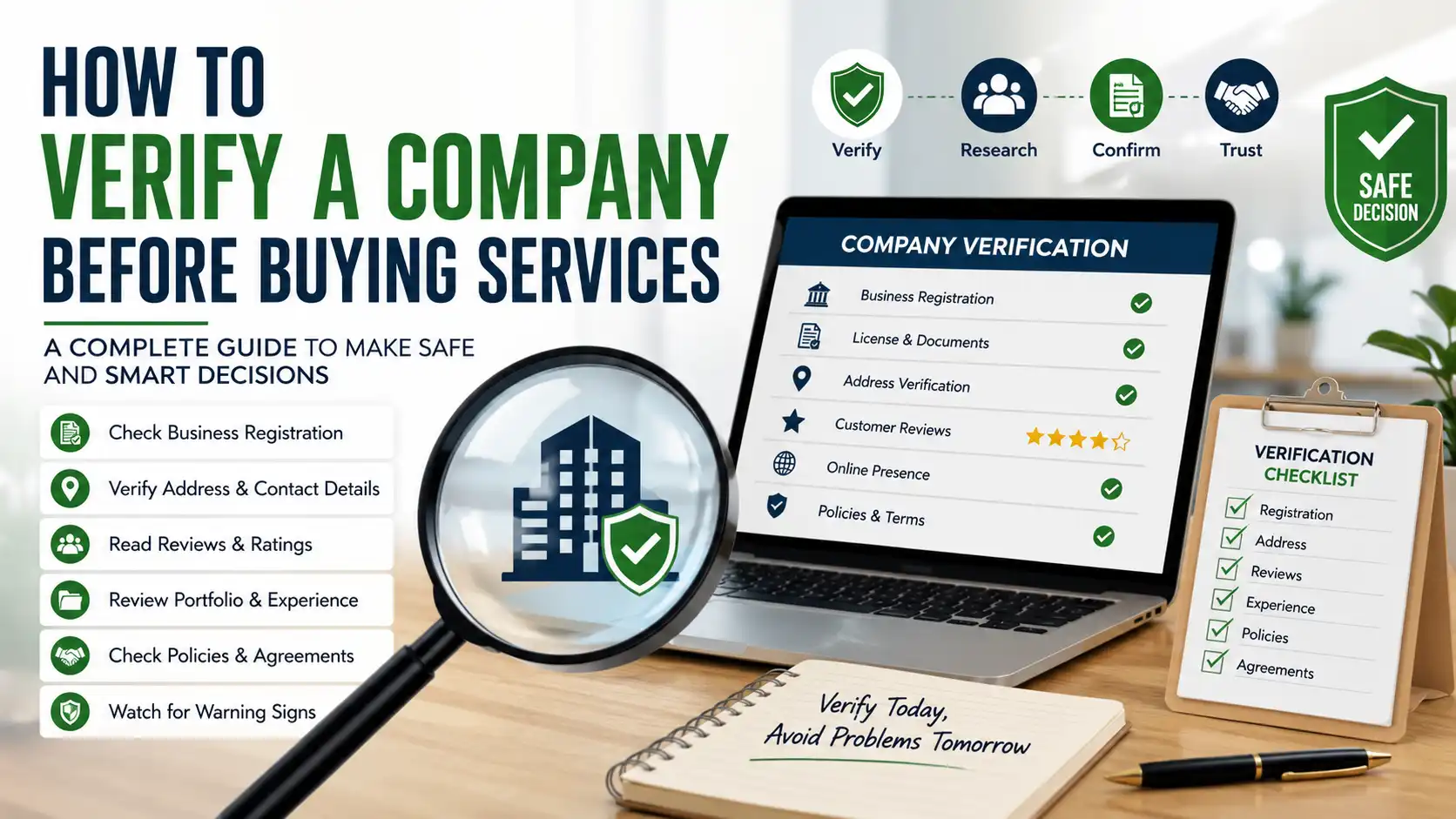
How do you verify a company? To verify a company, confirm its legal registration and licenses, verify its physical address and contact details, examine its website and social media history, analyze independent customer reviews, review its portfolio and references, and evaluate its policies and communication — all before making any payment or signing an agreement.
Service transactions run on trust extended in advance. You commit money, time, and often sensitive information — your home address, business data, or project details — to a company based on what it promises. Verification converts that blind trust into informed trust.
Verification matters for three practical reasons:
It protects your money before it moves. Recovering a payment from a company that underdelivers or disappears is slow, stressful, and often unsuccessful. Checking a company first costs minutes; chasing a refund can cost months.
It predicts the working relationship. How a company presents itself during verification — its transparency about registration, its willingness to share references, the quality of its answers — is usually a preview of how it will behave during the project.
It filters your options efficiently. When comparing several providers, a verification checklist gives you an objective way to shortlist. Companies that pass every check rise to the top; companies that dodge basic questions eliminate themselves.
Verification is not an accusation. Legitimate businesses are generally prepared to answer reasonable verification questions, while hesitation or inconsistent responses may suggest that additional due diligence is appropriate.
Risks of Buying Services from an Unverified Business
Skipping verification exposes you to a predictable set of risks:
- Advance payment loss. The most common outcome of dealing with a fraudulent service provider: a deposit or full payment is collected, then communication slows and eventually stops.
- Abandoned or incomplete work. The provider starts, collects a milestone payment, and disappears midway — leaving you to pay someone else to finish or fix the job.
- Quality far below what was promised. Without a verifiable track record, marketing claims are the only “evidence” you have — and marketing claims are free to make.
- No accountability after delivery. Warranties, revisions, and support commitments are worthless if the company cannot be found once the invoice is paid.
- Data and privacy exposure. Service providers often receive access to your premises, systems, accounts, or personal information. Handing that access to an unverified party is a risk independent of the money involved.
- Legal dead ends. If a dispute escalates, your options depend heavily on whether the company legally exists and can be identified. An unregistered, anonymous operation leaves you with little recourse.
None of these risks can be reduced to zero — but every one of them shrinks dramatically with the checks described below.
When Should You Verify a Company?
Verification works best as a layered habit rather than a single event. Deeper checks belong at the stages where your commitment increases:
|
Stage |
Recommended Action |
|---|---|
|
Before contacting |
Quick screening: website, Google Business Profile, social pages, and a scan of reviews to decide if the company is worth your time |
|
Before requesting a quotation |
Confirm identity basics: consistent business name, verifiable address, working contact channels |
|
Before signing |
Complete the deeper checks: registration details, references, portfolio, and written terms, refund, and privacy policies |
|
Before making payment |
Final confirmation: itemized written quotation, agreed milestone structure, payment channel that creates records, and all documents saved |
Verifying in stages keeps the effort proportional — light checks filter your shortlist quickly, and full verification is reserved for the company you actually intend to pay.
How to Verify a Company: Step-by-Step Checklist
What should you check before buying services? Before buying services, check the company’s business registration and applicable licenses, physical address, working contact channels, website and social media history, independent customer reviews, portfolio and client references, written pricing, and its terms, refund, and privacy policies. Confirm everything important in writing before paying.
Here is the full verification sequence at a glance. Each step is explained in detail in the sections that follow.
|
Step |
What to Verify |
How |
|---|---|---|
|
1 |
Legal identity |
Registration, trade license, tax/VAT documentation |
|
2 |
Location |
Physical address confirmed on a map or by visit |
|
3 |
Contact channels |
Phone, email, and messaging actually answered |
|
4 |
Website quality |
Real content, policies, HTTPS, consistent branding |
|
5 |
Google Business Profile |
Details match; reviews accumulated over time |
|
6 |
Social media |
Page age, activity, engagement, name history |
|
7 |
Reviews |
Independent platforms; patterns, not just scores |
|
8 |
Track record |
Years in business, portfolio, case studies |
|
9 |
References |
Past clients you can actually contact |
|
10 |
Certifications |
Licenses and credentials checked with issuers where possible |
|
11 |
Policies |
Terms, refund policy, privacy policy in writing |
|
12 |
Pricing |
Itemized written quotation; no hidden charges |
|
13 |
Communication |
Clear, knowledgeable, professional responses |
|
14 |
Payment structure |
Milestone-based; never 100% advance to unverified parties |
For small, low-risk services, a subset of these checks may be enough. For expensive or long-term engagements, complete the full list.
Verify the Company’s Legal Identity
How can you tell if a business is legitimate? A legitimate business can demonstrate legal registration — such as a trade license and, where applicable, company incorporation and tax registration — and operates from a verifiable address with working contact channels. Legitimacy confirms the business legally exists; combine it with reviews and references to judge quality.
Check Business Registration
Start with the most basic question: does this company legally exist?
In Bangladesh, businesses generally hold a trade license issued by the relevant local authority (city corporation, municipality, or union parishad). Companies structured as limited entities are registered with the Registrar of Joint Stock Companies and Firms (RJSC). Different business types carry different registration requirements, so the right question is whether the company holds the registrations applicable to its structure and industry.
Practical approach:
- Ask directly: “Is your business registered, and can you share your trade license or registration details for our agreement?” Established companies handle this question routinely.
- Match names. The name on the registration should match — or clearly connect to — the name on the website, invoice, and agreement. Unexplained mismatches deserve answers.
- Put the registered name on paper. Agreements and receipts should carry the company’s formal identity, not just a brand nickname.
If a company claims to be a “Ltd.” entity, that claim is checkable in official records — and a company unwilling to substantiate its own legal identity is telling you something important. For readers new to these documents, a business registration guide explaining trade licenses, incorporation, and tax registration in detail makes a useful companion to this section.
Verify Tax/VAT Information (Where Applicable)
Businesses in certain categories and above certain thresholds are generally required to register with the National Board of Revenue (NBR) and hold a Business Identification Number (BIN) for VAT purposes. VAT registration thresholds may change under government regulations, so current requirements should be confirmed from official sources. It is also worth noting that a BIN relates to VAT registration, while a Taxpayer Identification Number (TIN) is a separate tax identification used for income tax and other regulatory purposes. You don’t need to memorize tax rules; you need to observe behavior:
- Does the company issue proper invoices with its business identity on them?
- Is it willing to provide formal documentation for a significant contract?
Formal invoicing signals a company operating inside the formal economy — which also means it has a reputation and legal identity to protect. Treat proper documentation as a positive indicator rather than applying a fixed rule.
Verify the Physical Address
An address you can find is accountability you can rely on. For service companies:
- Confirm the stated address is specific — building, road, area — not just a city name.
- Check it on Google Maps: does a matching business appear? Do photos suggest a real operation?
- For significant local engagements, visit the office before signing. A ten-minute visit answers questions no website can.
- Be cautious when a company claiming significant scale cannot name a single physical location.
Some legitimate modern service providers work remotely or from shared spaces — that alone is not disqualifying. In those cases, weigh the other identity signals (registration, track record, references) more heavily.
Verify Certifications and Licenses
Some services are regulated or credential-based — and in those fields, claimed certifications should be verified, not assumed:
- Ask which body issued the certification or license and when.
- Where the issuing organization provides a public register or verification channel, use it.
- Be alert to vague credentials (“internationally certified”) that name no issuer.
A genuine credential can always be traced to its source. One that can’t is marketing, not qualification.
Evaluate the Company’s Digital Presence
Check Website Quality
A company’s website is its public identity document. Evaluate it for substance, not beauty:
- Real content: filled-in About, Services, Contact, and policy pages — not placeholder text or thin, generic copy.
- HTTPS: the padlock icon confirms the connection is encrypted. Its absence on a site collecting your information is a red flag; its presence alone proves nothing about honesty.
- Consistency: the business name, address, and phone number on the website should match what appears everywhere else.
- Specificity: genuine service companies describe how they work — process, timelines, deliverables. Vague pages promising everything to everyone deserve skepticism.
- Signs of age and maintenance: dated blog posts, project updates, and functioning links suggest an operation with continuity.
A missing website is not automatically disqualifying for a small local provider — but for any company presenting itself as established or digital-first, it is a serious gap.
Review Contact Information
Listed contact details are only meaningful if they work. Test them:
- Call the phone number. Does someone answer professionally and knowledgeably?
- Send an email or message with a specific pre-sales question. Evaluate the speed, clarity, and substance of the reply.
- Prefer multiple channels. Phone, email, and a physical address together are stronger than any single channel.
Be cautious when a company communicates exclusively through one anonymous channel, frequently changes numbers, or pushes all conversation toward personal messaging apps while avoiding anything on the record.
Review the Google Business Profile
A Google Business Profile (the panel in Google Search and Maps) is useful for cross-checking a company’s details: it shows location, contact details, photos, and customer reviews in one place. However, a profile — even a verified one — is not proof of legal registration, and unverified profiles can also exist. Use it together with other verification methods rather than as evidence on its own:
- Do the name, address, and phone number match what the company told you?
- Do photos show a real operation?
- Have reviews accumulated gradually over time, or did they appear all at once?
Consistent details across the profile, website, and social pages strengthen confidence. Mismatches are questions to ask before paying.
Check Social Media Activity
Social pages reveal history that websites can hide:
- Page age and name history: Facebook’s Page Transparency feature (where available) shows when a page was created and whether it changed names. A page that recently switched from an unrelated identity is a caution sign.
- Posting consistency: a steady record of activity over months or years suggests continuity.
- Engagement quality: read customer comments and the company’s replies. Real engagement looks conversational; manufactured engagement looks generic.
- Complaint handling in public: how a company responds to public criticism is a preview of how it will handle yours.
Verify Years in Business
Longevity is a meaningful — though not decisive — signal. A company that has operated for years has survived customer scrutiny; a company registered last month has not yet been tested. To estimate age honestly:
- Cross-check the claimed founding date against observable evidence: page creation dates, earliest reviews, earliest portfolio work, archived website versions.
- Treat unverifiable age claims (“serving clients for 15 years”) as unproven if nothing observable supports them.
New companies can be excellent — everyone starts somewhere — but a new company should be transparent about being new, and you should adjust payment structure and expectations accordingly.
Trust Signals That Can Increase Confidence
No single signal proves that a company is legitimate. Trust builds when several independent signals point the same way — and weakens when they conflict. Signals that can increase confidence include:
- Verified business registration (trade license, and RJSC incorporation where applicable)
- A consistent business name across registration, website, invoices, and social pages
- A professional email address on the company’s own domain
- An active, consistent Google Business Profile
- Genuine customer reviews accumulated over time on independent platforms
- Transparent, itemized pricing provided in writing
- Willingness to put scope, timeline, and terms into a written agreement
- A physical office or otherwise verifiable business address
- Responsive, knowledgeable customer support before the sale
- Clear, written refund and privacy policies
Consider these signals together, and weigh them against the value of the engagement: the more money at stake, the more of them you should require.
Analyze Customer Reviews Carefully
Reviews are the closest thing to interviewing a company’s past customers at scale — if you read them correctly.
What Genuine Review Patterns Look Like
- Specific details: named services, real timelines, concrete outcomes
- A natural mix of ratings, including some 3- and 4-star feedback
- Reviews spread across months or years rather than clustered in bursts
- Customer-uploaded photos of completed work
- Professional company responses, especially to criticism
How to Spot Fake Reviews
- Bursts of five-star praise within a short window
- Generic, interchangeable wording with no service-specific detail
- Reviewer accounts with no other review history
- Near-perfect scores at high volume — statistically unusual for real operations
- Sudden waves of one-star attacks can also be manipulation; judge content, not just direction
How to Read Reviews for Decisions
- Read negative reviews first. Look for repeating patterns — missed deadlines, surprise charges, vanishing support — rather than isolated bad days.
- Check the company’s responses. Accountability in public is a strong positive signal; hostility or silence is the opposite.
- Cross-check at least two platforms. Google reviews, Facebook feedback, marketplace ratings, and consumer discussion groups each catch things the others miss.
- Weigh recency. A company’s last twelve months matter more than its first twelve.
Browsing company reviews collected in a business directory can add one more independent source to cross-check against platform reviews.
Assess Experience, Portfolio, and References
Review Portfolio and Case Studies
For service companies, past work is the most direct evidence of capability:
- Ask for examples relevant to your type of project, not just their most impressive work.
- Look for verifiable details: live websites they built, locations they renovated, events they managed — things that exist outside their own marketing.
- For case studies, look for the problem–approach–result structure. Real case studies contain specifics; fabricated ones contain adjectives.
- Be alert to portfolio theft. If something seems inconsistent with the company’s scale or style, a reverse image search or a direct question (“can you tell me more about how you delivered this?”) often clarifies quickly.
Ask for References
References remain one of the strongest verification tools — because they move you from the company’s claims to a customer’s experience:
- Ask for two or three past clients you can actually contact, ideally with projects similar to yours.
- Keep reference calls short and concrete: Was the work delivered as agreed? Were there surprises in cost or timeline? How were problems handled? Would you hire them again?
- Treat refusal to provide any reference — for an established company seeking a significant engagement — as a meaningful signal.
Respect that some client work is confidential; a professional company will explain what it can and cannot share, and usually offer alternatives.
Review Policies, Pricing, and Communication
Review Terms, Refund, and Privacy Policies
Policies are the company’s promises written down before a dispute exists:
- Terms of service: what exactly is being delivered, by when, with what revision or correction process.
- Refund policy: under what conditions money is returned, in what timeframe, through what process. A written refund policy is accountability accepted in advance; the absence of one tells you the practical answer may be “no refunds.”
- Privacy policy: how your data — personal, business, or project-related — is handled and protected.
Read these before paying, and keep copies or screenshots. For custom services, insist that key commitments (scope, timeline, price, revision terms) appear in a written agreement or at minimum a written message both sides can reference.
Check Pricing Transparency
Transparent pricing behavior predicts honest billing behavior:
- Request an itemized written quotation: labor, materials, fees, and taxes listed separately.
- Confirm the total payable amount and what could change it. “It depends” is acceptable only when the dependency is spelled out.
- Compare at least two or three quotations for significant work — not only for price, but for how clearly each provider explains its numbers.
- Treat quotes dramatically below every competitor with the same caution as any deal that looks too good.
Evaluate Communication Quality
Every pre-sales interaction is a free sample of the working relationship:
- Knowledge: can they answer specific questions about their own process, or do they deflect to slogans?
- Clarity: are commitments stated plainly, or wrapped in vagueness that could mean anything later?
- Responsiveness: reasonable reply times before the sale rarely improve after it.
- Pressure: professionals give you room to decide; operations dependent on impulse push you to commit now.
If communication is evasive, inconsistent, or pushy at the stage when the company is trying to win your business, expect worse when it already has your money.
Common Scam Warning Signs
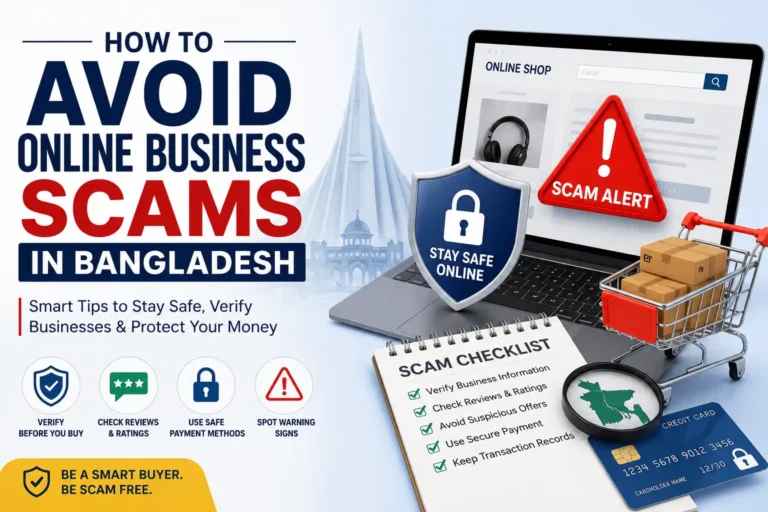
How do you avoid online business scams? Avoid online business scams by verifying a company’s registration, address, and reviews before paying; refusing to send full advance payment to unverified or personal accounts; insisting on written quotations and agreements; ignoring artificial urgency; and walking away whenever multiple warning signs — like unrealistic prices or evasive answers — appear together.
Individually, a warning sign is a question to resolve. Several together are a decision already made. Watch for:
- Prices far below every legitimate competitor — the most common lure in service fraud
- Full advance payment demanded, especially to a personal account, with refusal of any milestone structure
- No verifiable address or evasion when asked where the business operates
- Untraceable identity: no registration details, mismatched names across platforms, recently renamed pages
- Portfolio that can’t be substantiated — stolen images, projects no one can discuss in detail
- No written agreement offered — or resistance when you request one
- Manufactured urgency: “offer ends tonight,” “pay now to lock the slot”
- Communication that degrades the moment you ask verification questions
- Testimonials that exist only in the company’s own posts, never on independent platforms
- Requests for OTPs, passwords, or account access that the service doesn’t plausibly require
Green Flags vs Red Flags
|
Signal Area |
Green Flag |
Red Flag |
|---|---|---|
|
Identity |
Registration and license shared on request |
Evasion when asked about registration |
|
Address |
Specific, map-verifiable location |
No address, or vague “city only” answers |
|
Payment |
Milestone-based structure offered |
100% advance demanded to a personal account |
|
Pricing |
Itemized written quotation |
Verbal-only pricing that shifts over time |
|
Reviews |
Mixed, detailed, accumulated over time |
Bursts of generic five-star praise |
|
References |
Past clients provided on request |
Refusal to name any past client |
|
Agreement |
Written scope, timeline, and terms |
“We don’t need paperwork, trust us” |
|
Communication |
Specific, patient, knowledgeable answers |
Pressure, vagueness, or hostility to questions |
If you believe you have been treated unfairly by a business in Bangladesh, the Directorate of National Consumer Rights Protection (DNCRP) is the government body responsible for consumer rights protection, and consumers may consult its official channels for the current complaint procedure. Keeping your records — quotations, agreements, messages, and payment proof — will support any complaint you decide to make.
Questions to Ask Before Hiring
Direct questions do double duty: their answers inform you, and the company’s manner of answering informs you even more.
|
Question |
What the Answer Reveals |
|---|---|
|
“Is your business registered? Can registration details go on our agreement?” |
Legal identity and willingness to be accountable |
|
“Can you show me past work similar to my project?” |
Relevant capability, not just general marketing |
|
“Can I speak with one or two past clients?” |
Confidence in its own track record |
|
“What exactly is included in this price — and what isn’t?” |
Pricing transparency; protection against surprise charges |
|
“What happens if the work is delayed or doesn’t meet the agreed scope?” |
Accountability structure before problems occur |
|
“What is your payment structure? Can we tie payments to milestones?” |
Willingness to share risk fairly |
|
“Who will actually perform the work, and who is my point of contact?” |
Whether the sales promise matches delivery reality |
|
“What is your refund or revision policy, in writing?” |
Documented commitments versus verbal comfort |
A company that answers these questions clearly and without irritation has passed a meaningful test. A company that treats basic due diligence as an insult has failed one.
Mistakes People Commonly Make
Even careful buyers fall into predictable traps:
- Verifying after paying. Verification only has power while the money is still yours.
- Trusting appearance over evidence. A polished website or a big ad budget proves marketing spend, not reliability.
- Reading only the star rating. The information is in the review text — especially the negative ones.
- Accepting verbal promises. If it matters, it goes in writing. Memory disputes are unwinnable.
- Paying everything up front to save a little. A discount for full advance payment transfers all risk to you — usually a bad trade with an unverified party.
- Ignoring small early warning signs. Slow replies, shifting numbers, and dodged questions before the sale are previews, not accidents.
- Assuming a referral equals verification. A friend’s recommendation is one good signal — it doesn’t replace checking registration, agreements, and pricing yourself.
- Letting urgency compress diligence. Any deal that cannot survive 24 hours of checking was not a deal worth having.
Common Myths About Company Verification
|
Myth |
Reality |
|---|---|
|
A professional website always means a trustworthy company. |
A polished website proves design investment, not reliability. Judge substance — real policies, consistent identity, verifiable details — alongside appearance. |
|
Five-star reviews always prove quality. |
Review sets can be manipulated. Genuine feedback shows mixed ratings, specific details, and gradual accumulation; read patterns, not scores. |
|
Business registration guarantees honest service. |
Registration confirms legal existence, not conduct. It is the floor of trust — combine it with reviews, references, and written terms. |
|
A verified Google Business Profile proves legitimacy. |
Even a verified profile is not proof of legal registration. Use it for cross-checking details, together with other verification methods. |
|
A friend’s recommendation makes verification unnecessary. |
A referral is one good signal, but it doesn’t replace checking registration, pricing, and written agreements for your specific engagement. |
|
Verification takes too long to be practical. |
Basic screening takes minutes, and even full verification usually fits within a day — far less than the time a bad transaction costs. |
Before Verification vs After Verification
A quick view of what changes when you invest a little time in checking:
|
Without Verification |
After Proper Verification |
|---|---|
|
You rely on the company’s own marketing claims |
You rely on registration records, reviews, and references |
|
Payment terms are set entirely by the seller |
Payments are tied to milestones you agreed in writing |
|
Pricing can shift after work begins |
An itemized written quotation defines the total cost |
|
Disputes rest on memory and verbal promises |
Disputes rest on written scope, terms, and saved records |
|
A vanished provider is nearly impossible to trace |
A registered, located business can be identified and pursued |
|
Red flags are noticed only after money moves |
Red flags are caught before any payment is made |
|
Trust is a hope |
Trust is a conclusion drawn from evidence |
Final Verification Checklist
Run through this list before signing or paying. For high-value services, every unchecked box is a conversation to have first.
Legal Identity
- Business registration or trade license confirmed
- Tax/VAT documentation available where applicable
- Name consistent across registration, website, invoice, and agreement
- Relevant licenses/certifications verified with issuers where possible
Presence & Reachability
- Physical address verified on map (or visited)
- Phone answered professionally; email/messages responded to
- Website has real content, policies, and HTTPS
- Google Business Profile details match other sources
- Social pages show age, consistent activity, and no suspicious renames
Track Record
- Reviews checked on at least two independent platforms
- Negative reviews read; no repeating fraud/non-delivery pattern
- Portfolio includes relevant, verifiable work
- At least one reference contacted for significant engagements
- Claimed years in business consistent with observable evidence
Terms & Money
- Itemized written quotation received
- Scope, timeline, and deliverables in writing
- Refund/revision policy read and saved
- Privacy policy exists (where data is involved)
- Payment tied to milestones; no full advance to unverified parties
- All records — quotes, chats, invoices, payment proof — saved
For readers who want to go deeper, this checklist pairs naturally with resources on business verification, scam awareness, and consumer rights, as well as browsing established providers through a business directory with company reviews.
Official Sources You Can Use for Company Verification
The table below summarizes practical resources for company verification and when each is most useful:
|
Resource |
What You Can Verify |
When to Use |
|---|---|---|
|
Registrar of Joint Stock Companies and Firms (RJSC) |
Company incorporation and registered identity |
When a business presents itself as a registered company (e.g., “Ltd.”) |
|
National Board of Revenue (NBR) |
VAT/BIN registration status and tax documentation context |
For significant contracts requiring formal invoicing |
|
Google Business Profile |
Location, contact details, photos, and customer reviews |
Cross-checking a company’s stated details |
|
Google Maps |
Whether the stated address corresponds to a real, findable location |
Before visiting, signing, or paying a local provider |
|
Facebook Page Transparency |
Page creation date and name-change history (where available) |
Assessing the history of social-media-based sellers |
|
Official Company Website |
Services, policies, contact details, and consistency of identity |
Early screening of any provider |
|
LinkedIn Company Page |
Company presence, team members, and professional footprint |
Evaluating B2B and professional service providers |
|
Directorate of National Consumer Rights Protection (DNCRP) |
Consumer complaint procedures and rights information |
If you believe you have been treated unfairly by a business |
Availability and procedures for official resources can change, so confirm current processes through each organization’s official channels.
Key Takeaways
- Verify a company’s legal identity, address, and contact channels before any money moves.
- Judge track record through independent reviews, verifiable portfolios, and references — not marketing claims.
- Get scope, price, timeline, and refund terms in writing every time.
- Structure payments around milestones and never send full advance payment to an unverified party.
- Treat multiple warning signs — unrealistic prices, evasion, urgency — as a decision to walk away.
- When in doubt, delay: legitimate companies survive a day of due diligence.
Before making a payment or signing an agreement, take a few extra minutes to verify the company using the checklist in this guide. Spending a little time on verification today may help you avoid unnecessary costs, delays, disputes, and disappointment later.
Frequently Asked Questions
How do I verify if a company is registered in Bangladesh?
Ask the company for its trade license, which local authorities such as city corporations, municipalities, or union parishads generally issue. Companies structured as limited entities are registered with the Registrar of Joint Stock Companies and Firms (RJSC), and VAT-registered businesses hold a BIN from the National Board of Revenue. Established companies provide these details for agreements as a matter of routine.
What is the safest way to pay for a service?
Tie payments to progress. A common reasonable structure is a partial payment to begin (where materials or setup costs exist) and the balance on satisfactory completion as defined in writing. Use payment channels that create records, keep proof of every payment, and avoid sending full advance payment — especially to personal accounts of providers you haven’t verified.
How can I tell if a service company’s reviews are fake?
Look for bursts of five-star reviews posted within a short period, generic wording with no service-specific details, reviewer accounts with no other history, and near-perfect scores at unusually high volume. Genuine review sets show mixed ratings, specific details, gradual accumulation over time, and professional company responses to criticism.
Should I hire a company that has no website?
It depends on the context. Small local providers can be perfectly legitimate without a website — many operate through a physical location or social media. In that case, weigh other signals more heavily: verifiable address, working phone, established page history, genuine reviews, references, and a milestone-based payment structure. For a company claiming to be established or digital-focused, a missing website is a more serious gap.
What questions should I ask before hiring a service provider?
Ask about business registration, relevant past work, client references, exactly what the quoted price includes and excludes, the payment structure, who will perform the work, what happens if delivery is late or below scope, and the written refund or revision policy. Clear, patient answers are themselves a strong positive signal.
What are the biggest red flags when buying services online?
The strongest red flags are prices far below every competitor, demands for full advance payment to personal accounts, no verifiable address, evasion about registration, portfolios that cannot be substantiated, refusal to provide written agreements, manufactured urgency, and communication that deteriorates when you ask verification questions. Several of these together mean walk away.
How many references should I ask for?
For significant engagements, two or three contactable references with projects similar to yours is a reasonable request. Keep the calls short and concrete: whether work was delivered as agreed, whether costs or timelines shifted, how problems were handled, and whether the client would hire the company again.
Is a Google Business Profile proof that a company is legitimate?
No. A Google Business Profile is useful for checking business information — location, contact details, photos, and reviews in one place — but even a verified profile is not proof of legal registration. Always consider it together with registration records, independent reviews, and the other verification methods in this guide.
Can a newly established company be trustworthy?
Yes — every established company was new once. A trustworthy new company is transparent about its age, shows the capability of its people (even from prior roles), offers written agreements, and accepts milestone-based payments. Adjust your risk accordingly: smaller first engagements, stronger written terms, and no large advance payments.
What should I do if a company refuses to answer verification questions?
Treat refusal as your answer. Legitimate companies handle questions about registration, references, pricing, and written terms routinely, because those questions cost them nothing and win them business. A provider that responds to basic due diligence with evasion, irritation, or pressure has failed the cheapest test you can run — before any money was at risk.