
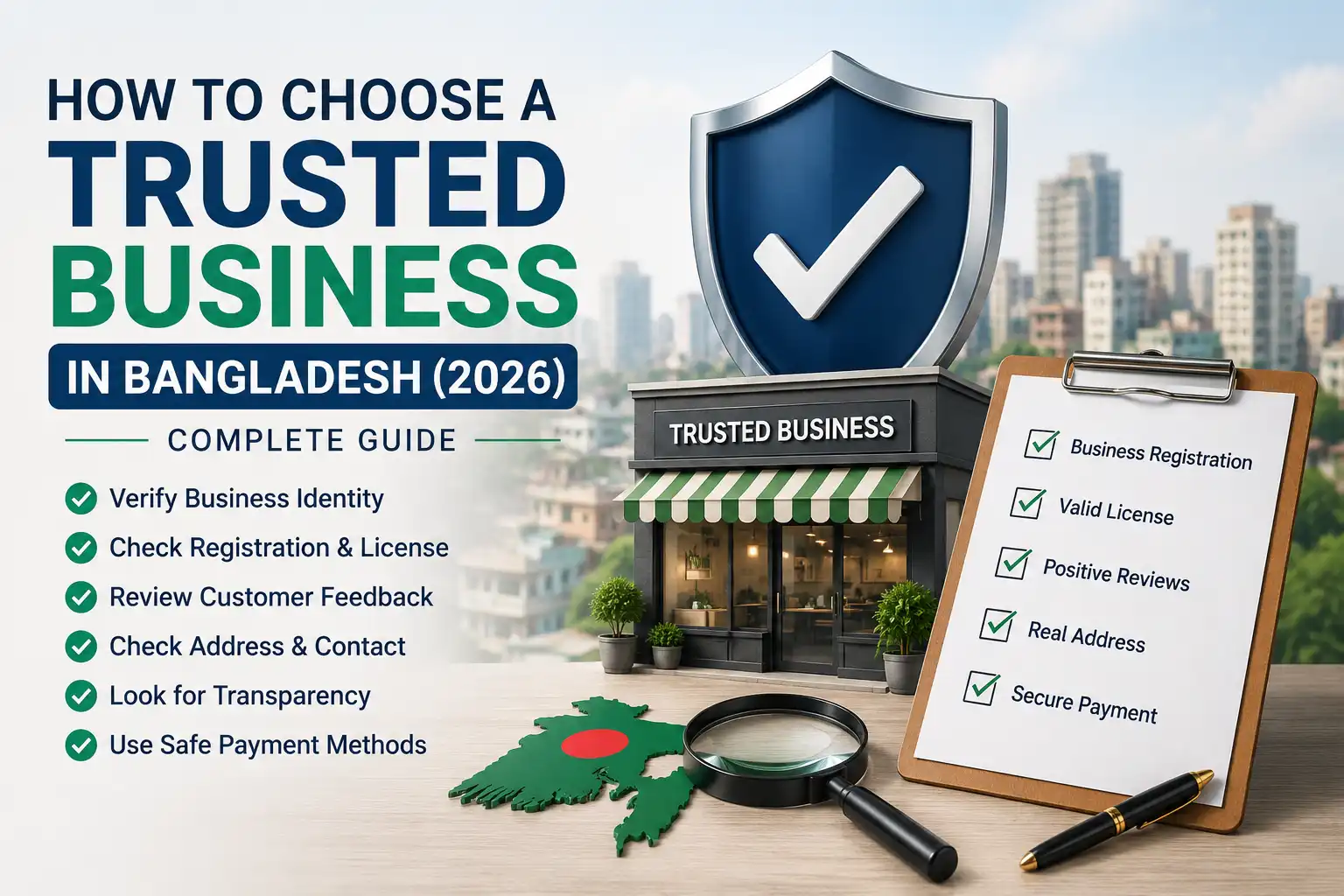
How to Choose a Trusted Business in Bangladesh (2026): Complete Guide
Choosing a trusted business in Bangladesh means verifying that a company is legally registered, transparent about its identity, reachable through real contact channels, and consistent in how it treats customers — before you hand over any money. This guide explains, step by step, how to do that verification yourself, whether you are shopping online, buying from a physical shop, or hiring a local service provider.
Bangladesh’s business landscape now stretches from traditional markets and retail chains to Facebook-based sellers, delivery-driven online brands, and independent service providers. That growth has brought real convenience — and made it genuinely harder to tell reliable businesses apart from unreliable ones. Undelivered orders, products that don’t match their photos, and advance payments that disappear are problems consumers in every growing digital economy face, and Bangladesh is no exception.
The encouraging part is that protecting yourself doesn’t require legal expertise or special tools. It requires knowing which trust signals to check, how to check them, and which warning signs should make you pause — skills that take minutes to apply once you know them.
This guide walks through all of it: the signals that separate trustworthy businesses from risky ones, a step-by-step verification routine, how to read reviews, the red flags that matter most, and practical checklists for online shopping and hiring services. It starts with the foundation every good decision rests on — understanding what “trusted” actually means.
What Is a Trusted Business?
A trusted business is one that has earned customer confidence through verifiable identity, legal compliance, transparent practices, and a consistent track record of honoring its commitments. Trust is not a single document — it is a combination of signals that, taken together, reduce your risk.
To evaluate businesses accurately, it helps to distinguish three related but different terms:
Legitimate Business
A legitimate business is one that legally exists. In Bangladesh, this generally means the business holds the registrations applicable to its type — such as a trade license from the relevant local authority, and, where applicable, tax registration or company incorporation. Legitimacy answers one question: Is this business legally recognized to operate?
Important nuance: a legitimate business is not automatically a good one. A shop can hold a valid trade license and still provide poor service. Legitimacy is the floor, not the ceiling.
Verified Business
A verified business is one whose identity and details have been checked and confirmed — either by you, by a platform, or by a directory. Verification can include confirming that the address is real, the phone number works, the website matches the business name, and the registrations it claims actually exist. Verification answers: Has anyone confirmed this business is what it says it is?
Trusted Business
A trusted business combines both of the above with something more: a track record. It is legitimate, its details check out, and — over time — customers report that it delivers what it promises, handles problems reasonably, and communicates honestly. Trust answers: Based on evidence, is this business likely to treat me fairly?
Quick Comparison
|
Term |
What It Means |
What It Proves |
What It Doesn’t Prove |
|---|---|---|---|
|
Legitimate |
Legally registered to operate |
The business legally exists |
Quality of products or service |
|
Verified |
Identity and details confirmed |
The business is what it claims to be |
How it treats customers over time |
|
Trusted |
Legitimate + verified + positive track record |
A pattern of fair dealing |
A guarantee — trust reduces risk, it never eliminates it |
As a consumer, your goal is to move a business from “unknown” to at least “verified” before making a significant payment — and to prefer “trusted” businesses for high-value or advance-payment purchases.
Why Choosing a Trusted Business Matters
Choosing a trusted business matters because it directly protects your money, your personal information, and your time — and because recovering losses after a bad transaction is usually far harder than avoiding the transaction in the first place.
Here is what is actually at stake:
Financial Safety
The most immediate risk is losing money — paying in advance for a product that never arrives, or paying for a service that is abandoned midway. With unverified sellers, especially online, recovering an advance payment can be difficult and time-consuming. Verification before payment is much cheaper than dispute resolution after payment.
Fraud Prevention
Fraudulent operations often imitate real businesses: copied logos, lookalike page names, stolen product photos, and fake “offers.” Knowing how to check registrations, addresses, and digital footprints helps you spot imitations before engaging with them.
Better Customer Experience
Trusted businesses tend to invest in the parts of a transaction that are invisible until something goes wrong: accurate product descriptions, honest delivery timelines, responsive support, and clear communication. Choosing them means fewer surprises and less frustration.
Product Quality
A business that is transparent about its identity has an incentive to protect its reputation — which usually translates into more consistent product quality. Anonymous sellers face fewer consequences for selling substandard or counterfeit goods.
After-Sales Service
Warranties, replacements, servicing, and refunds only have value if the business will still answer your call after the sale. A business with a real address, a real registration, and a public reputation is far more likely to honor after-sales commitments than one that can simply disappear.
15 Signs of a Trusted Business in Bangladesh
The most reliable way to judge a business is to look for multiple independent trust signals rather than relying on any single one. Below are fifteen signs worth checking, with practical guidance for each.
1. Trade License
In Bangladesh, businesses are generally required to obtain a trade license from the relevant local government authority — such as a city corporation, municipality (pourashava), or union parishad — to operate legally. A trade license indicates the business is formally recognized in its locality.
Practical tip: Physical shops often display their trade license on the premises. For online sellers, you can politely ask whether they hold one; established sellers usually answer without hesitation. A seller who becomes evasive when asked about basic registration is showing you something important.
2. BIN / VAT Registration
Businesses above certain thresholds, and businesses in certain categories, are generally required to register with the National Board of Revenue (NBR) and obtain a Business Identification Number (BIN) for VAT purposes. A VAT-registered business that issues proper receipts is signaling that it operates within the formal economy.
Practical tip: Look at your receipt. Formal invoices from VAT-registered businesses typically include registration details. Requirements and thresholds can change, so treat the presence of proper tax documentation as a positive signal rather than memorizing specific rules.
3. Company Registration (Where Applicable)
Larger businesses structured as companies are registered with the Registrar of Joint Stock Companies and Firms (RJSC). Not every business needs to be a registered company — many perfectly legitimate small businesses are sole proprietorships operating on a trade license alone. But if a business claims to be a “Ltd.” company, that claim should be checkable.
Practical tip: If a business presents itself as a limited company, its registered name should exist in official records. Inconsistency between the name a business advertises and any registered identity it claims is worth questioning.
4. Physical Business Address
A real, findable address is one of the strongest practical trust signals — because it means the business can be located if something goes wrong. This applies to online businesses too: reputable online sellers usually disclose an office, warehouse, or pickup point.
Practical tip: Check whether the stated address is specific (building, road, area) rather than vague (“Dhaka, Bangladesh”). For significant purchases, you can verify the address on a map, look for photos of the location, or — for local businesses — visit before paying.
5. Official Website
A proper website with the business’s own domain name suggests a level of investment and permanence. A business operating solely through a social media page can still be legitimate — many small Bangladeshi sellers start on Facebook — but a real website adds accountability: it typically carries the business’s identity, policies, and history in one verifiable place.
Practical tip: Check how long the website appears to have existed, whether its pages (About, Contact, Policies) are filled in with real information, and whether the domain name matches the business name. A site full of placeholder text or broken pages is a caution sign.
6. HTTPS Security
HTTPS (shown as a padlock icon in your browser’s address bar) means the connection between you and the website is encrypted. Any website that asks for personal information or payment details should use HTTPS.
Practical tip: HTTPS is necessary but not sufficient — it proves the connection is encrypted, not that the business is honest. Treat a missing padlock as a red flag, but don’t treat its presence alone as proof of trustworthiness.
7. Professional Business Email
Established businesses typically use email addresses on their own domain (for example, support@businessname.com) rather than only generic free addresses. This isn’t an absolute rule — small legitimate sellers often use free email — but a domain-based email shows the business controls its own digital identity.
Practical tip: Be cautious when a business claiming to be large or established communicates only through a free personal email address, especially for invoices or payment instructions.
8. Google Business Profile
A Google Business Profile (the panel that appears in Google Search and Maps) is a useful practical trust signal because it shows a business’s location, contact details, photos, maps presence, and customer reviews in one place. However, it is not official verification — anyone can create a profile, and its presence does not confirm legal registration. Treat it as one signal to weigh alongside other verification methods such as business registration, trade license, an official website, and direct contact with the business.
Practical tip: Search the business name on Google Maps. Check whether the location, phone number, and name match what the business told you. Mismatched details across platforms deserve an explanation before you pay.
9. Customer Reviews
Reviews are one of the most valuable — and most manipulated — trust signals. A meaningful review history shows how the business behaves across many transactions, not just in its own marketing.
Practical tip: Read beyond the star rating. Look at how the business responds to negative reviews: a business that engages professionally with complaints is often more trustworthy than one with suspiciously perfect scores. (A full section on evaluating reviews appears later in this guide.)
10. Social Media Presence
In Bangladesh, a business’s Facebook page is often its most active public face. Look at the page’s age, posting consistency, follower engagement, and — importantly — the comments and reactions from real customers.
Practical tip: On Facebook, check the page transparency information (such as when the page was created and whether it has changed names). A page that recently changed its name from something unrelated, or that was created days before launching a big “offer,” warrants caution.
11. Contact Information
Trusted businesses make themselves reachable through multiple channels: phone, email, physical address, and social media. The key test is not just whether contact details are listed, but whether they work.
Practical tip: Before a significant purchase, call the listed number. Does someone answer professionally? Do they know their own products and policies? A two-minute call can reveal more than an hour of browsing.
12. Transparent Pricing
Clear, consistent pricing — including delivery charges and any other fees, stated before checkout — is a hallmark of businesses that respect their customers. Hidden charges revealed only at the last step, or prices that change depending on who is asking, are warning signs.
Practical tip: For services, ask for a written quotation that itemizes costs. For online shopping, confirm the total payable amount (product + delivery + any fees) before confirming the order.
13. Return & Refund Policy
A written return and refund policy tells you what happens when something goes wrong — and businesses that publish one are accepting accountability in advance. The policy should state timeframes, conditions, and the process for claims.
Practical tip: Read the policy before buying, and keep a screenshot. If a seller has no stated policy at all, assume the practical answer to “can I return this?” may be no, and decide accordingly.
14. Privacy Policy
A privacy policy explains how a business handles your personal data — name, phone number, address, and payment information. Its presence signals that the business takes data handling seriously, which matters more each year as digital transactions grow.
Practical tip: You don’t need to read every word. Check that the policy exists, mentions what data is collected, and provides a way to contact the business about data concerns.
15. Customer Support
Real support — a responsive inbox, a working helpline, staff who resolve issues rather than deflect them — is what separates businesses that merely sell from businesses that stand behind what they sell.
Practical tip: Test support with a pre-sales question. Slow, dismissive, or copy-paste responses before the sale rarely improve after the sale.
A note on weighing these signals: No single sign proves trustworthiness, and the absence of one sign doesn’t automatically prove the opposite — a small family shop may lack a website yet serve its neighborhood honestly for decades. What matters is the overall pattern. The more money at stake, the more signals you should require.
How to Verify a Business Before Buying
To verify a business before buying, confirm its identity, check its digital footprint, test its responsiveness, and match its claims against independent sources — in that order. Here is a practical sequence you can follow in 15–30 minutes for any significant purchase:
Step 1: Confirm the Exact Business Name
Note the precise name the business uses. Fraudulent pages often use names that are one letter or one word away from well-known brands. Make sure you are dealing with the business you think you are dealing with.
Step 2: Search the Business Name Online
Search the name along with words like “review,” “complaint,” or “experience” (in English and Bangla). Look for discussion in consumer groups, forums, and marketplaces. A pattern of unresolved complaints is a strong signal; so is a complete absence of any footprint for a business claiming to be established.
Step 3: Check the Address and Map Presence
Verify the stated address on Google Maps. Does a matching business appear at that location? Do the photos look like a real operation? For local, high-value purchases, consider visiting in person.
Step 4: Verify Contact Channels
Call the phone number. Message the page or email. Evaluate not just whether they respond, but how — knowledgeable, specific answers indicate a real operation; vague or pushy responses indicate risk.
Step 5: Examine the Website and Social Pages
Check the website’s About, Contact, and Policy pages for real content. On Facebook, review page transparency details: page creation date, previous name changes, and follower engagement quality.
Step 6: Review the Payment Method Being Requested
This step matters most. Prefer payment methods that keep leverage on your side — cash on delivery where available, or payment channels with records — and be very cautious about requests for full advance payment to a personal account, especially from a seller you haven’t verified.
Step 7: Ask About Registration for Larger Transactions
For expensive purchases or service contracts, it is reasonable to ask about trade license and tax registration, and to request a written invoice. Legitimate businesses handle these questions routinely.
Step 8: Keep Records
Save screenshots of the product listing, price, conversation, and payment confirmation. If a dispute arises, records are your strongest asset — including if you later escalate a complaint to a consumer protection authority.
When in doubt, delay. Legitimate businesses will still be there tomorrow. Pressure to pay right now is itself a warning sign.
How to Evaluate Online Reviews
To evaluate online reviews effectively, look for detailed, specific, dated feedback spread over time — and be skeptical of large volumes of short, generic, five-star reviews posted in bursts. Reviews are powerful evidence, but only if you know how to read them.
Signs of Genuine Reviews
- Specific details: mentions of the actual product, delivery time, packaging, or a named staff interaction
- Mixed sentiment: genuine review sets almost always include some 3- and 4-star reviews alongside 5-star ones
- Spread over time: reviews accumulating steadily across months or years, not clustered into a few days
- Photos from customers: real, imperfect photos of received products
- Business responses: a business that replies to feedback — especially negative feedback — professionally
Signs of Fake or Manipulated Reviews
- Bursts of praise: dozens of glowing reviews within a short window, often around a promotion
- Generic language: “Great product! Highly recommended!” repeated with slight variations, with no product-specific detail
- Reviewer profiles with no history: accounts that have reviewed only this one business
- Perfect scores with high volume: near-100% five-star ratings across hundreds of reviews is statistically unusual for any real business
- Attacks and counter-attacks: sudden waves of one-star reviews can also be manipulation (by competitors), so read the content, not just the score
Review Patterns to Study
Rather than asking “is the rating high?”, ask:
- What do the negative reviews complain about — and is it a pattern (e.g., repeated non-delivery) or one-off issues?
- How does the business respond to complaints?
- Are recent reviews consistent with older ones, or has quality visibly changed?
Where to Look
Useful places to read customer feedback in Bangladesh include Google Business Profile reviews, Facebook page reviews and comment sections, marketplace seller ratings, and consumer discussion groups where buyers share experiences. Cross-checking two or three sources gives a far more reliable picture than any single platform.
Common Red Flags
A red flag is any signal that a business may not deliver what it promises — and the correct response to multiple red flags is to walk away, regardless of how attractive the offer looks. Watch for these:
Unrealistic Discounts
Prices dramatically below market rate — a flagship phone at half price, branded goods at a fraction of retail — are among the most common lures in online fraud. Ask yourself: how could a real business afford this? If there’s no plausible answer, there usually isn’t one.
No Physical Address
A business that cannot or will not tell you where it is located is asking you to trust someone you cannot find. For anything beyond a trivial purchase, treat a missing address as disqualifying.
Copied or Stock-Only Images
If every product photo looks like it came from a catalog and the seller cannot provide a real photo or video of the actual item, the item may not exist as described. Reverse image search can reveal photos copied from other websites.
Fake Testimonials
Screenshots of “customer messages” are trivially easy to fabricate. Testimonials that exist only in the seller’s own posts — never on independent platforms — carry little weight.
No Customer Support
If pre-sales questions go unanswered, ignored, or met with pressure to “just order,” expect worse after your payment clears.
Advance-Payment-Only Policies
Requiring full advance payment — especially to a personal mobile financial account — while refusing cash on delivery or any buyer-protected channel shifts all risk onto you. Some legitimate custom-order businesses do require deposits, but they will be verifiable on every other signal in this guide. An unverifiable seller demanding full advance payment is the single most common setup for online purchase fraud.
Pressure and Urgency
“Only 2 left!”, “Offer ends in 1 hour!”, “Pay now or lose the deal!” — manufactured urgency exists to stop you from doing exactly what this guide recommends: checking. Real businesses survive a day of due diligence.
Recently Created or Renamed Pages
A Facebook page created last month, or one that changed its name from an unrelated topic, running aggressive paid promotions is a pattern worth treating with high caution.
Trusted Business Checklist
Use this checklist before any significant purchase or service booking. The more boxes you can tick, the lower your risk.
Identity & Legal
- Exact business name confirmed (no lookalike spelling)
- Physical address stated and verifiable
- Trade license held (displayed, or confirmed on request)
- Tax/VAT documentation available where applicable
- Company registration consistent with claims (for “Ltd.” businesses)
Digital Footprint
- Official website with real About/Contact/Policy pages
- HTTPS enabled on any page taking your data
- Google Business Profile matches stated details
- Social pages show age, consistency, and real engagement
- No recent suspicious page name changes
Reputation
- Reviews found on at least two independent platforms
- Negative reviews read — no repeating pattern of fraud or non-delivery
- Business responds to complaints professionally
Transaction Safety
- Full price (including delivery/fees) confirmed in writing before payment
- Return/refund policy read and screenshotted
- Payment method keeps leverage with you (COD or recorded channel where possible)
- Invoice or receipt provided
- All communication and payment records saved
Support
- Phone/messages answered within reasonable time
- Staff can answer specific product/service questions
Tips for Safe Online Shopping in Bangladesh
Safe online shopping in Bangladesh comes down to verifying the seller, controlling the payment, and keeping records. These practical habits cover most situations:
- Prefer cash on delivery (COD) for unfamiliar sellers. Where COD is available, it remains the simplest way to ensure you only pay for what actually arrives. Inspect the product at delivery where the seller’s policy allows it.
- Be extra careful with advance payments. If advance payment is unavoidable, complete the full verification steps in this guide first, keep the amount small on a first order, and keep payment records.
- Start small with new sellers. A small first order is an inexpensive test of delivery time, product accuracy, and communication.
- Confirm the total cost in writing — product price, delivery charge, and any fees — before confirming the order.
- Check the seller’s return policy before paying, not after a problem appears.
- Never share OTPs, PINs, or passwords. No legitimate seller or payment provider needs them. Anyone asking is attempting fraud.
- Shop over secure connections. Use HTTPS websites and official apps; avoid entering payment details over public Wi-Fi.
- Keep screenshots of everything: listing, price, chat, order confirmation, payment proof.
- Know your escalation path. Bangladesh has a consumer rights protection framework under the Directorate of National Consumer Rights Protection (DNCRP), where consumers can lodge complaints against unfair business practices. Check the DNCRP’s official channels for the current complaint procedure. Marketplace platforms also have their own dispute processes — use them when buying through a platform.
- Trust the pattern, not the promise. Marketing tells you what a business says; verification tells you what it does.
Tips Before Hiring Local Service Providers
Before hiring a service provider in Bangladesh — an electrician, contractor, tutor, designer, repair technician, event planner, or any professional — verify their identity, define the work in writing, and structure payments around progress. Services carry different risks than products: the “product” doesn’t exist yet when you pay.
- Verify identity first. Real name, phone number, and — for businesses — address and license. For individuals entering your home, ask for identification.
- Check work history. Ask for examples of previous work, references you can actually contact, or reviews from prior clients.
- Get the scope in writing. What exactly will be done, with what materials, by what date. Ambiguity at the start becomes a dispute at the end.
- Get an itemized written quotation. Labor, materials, and any extras listed separately. Compare at least two or three quotations for significant work.
- Avoid paying 100% up front. A reasonable structure ties payment to progress — a portion to start (where materials must be purchased), the balance on satisfactory completion. Be cautious with anyone insisting on full payment before any work begins.
- Agree on what “done” means. For repairs and construction especially, define completion and any warranty on the work before starting.
- Keep communication on record. Even a simple message summarizing what was verbally agreed (“As discussed: X work, Y taka, done by Z date”) creates a reference point both sides can rely on.
- Watch how they handle questions. A professional who explains their process, pricing, and timeline clearly before hiring will usually behave the same way during the job.
How Info Ghor Helps Users Find Businesses
Verifying a business is much easier when its basic information is already organized in one place — and that is the role a business directory plays. Info Ghor is a Bangladesh-focused business directory and blog where users can browse businesses by category, view business profiles, and check contact information as a starting point for their own verification.
In practice, a directory helps in a few specific ways:
- Discovery by category: instead of relying only on ads or random search results, users can browse businesses by type — from restaurants and hospitals to software companies and local services — and see multiple options side by side.
- Comparing profiles: viewing several business profiles together makes differences in transparency visible: which businesses publish full contact details, addresses, and descriptions, and which don’t.
- A starting point for contact verification: listed phone numbers, addresses, and links give users concrete details to test using the verification steps in this guide.
- Context from articles: guides and comparisons published alongside the directory help users understand categories before choosing within them.
A directory listing is a starting point, not a substitute for your own checks. The verification steps in this guide apply to every business you consider — including businesses found on Info Ghor or any other directory. The goal is simply to make informed decisions easier by putting organized information in front of you first.
Frequently Asked Questions
How can I check if a business is registered in Bangladesh?
Start by asking the business directly about its trade license, which is issued by local government authorities such as city corporations, municipalities, or union parishads. Businesses structured as companies are registered with the Registrar of Joint Stock Companies and Firms (RJSC), and VAT-registered businesses hold a Business Identification Number (BIN) from the National Board of Revenue. For significant transactions, request an official invoice — formal documentation is routine for registered businesses.
What is the safest way to pay when shopping online in Bangladesh?
For unfamiliar sellers, cash on delivery (where available) is generally the safest option because you pay only when the product arrives. If advance payment is required, verify the seller thoroughly first, prefer payment channels that create records, keep the first order small, and save all payment proof. Avoid sending full advance payment to personal accounts of unverified sellers.
How do I know if a Facebook shop is legitimate?
Check the page’s transparency information (creation date and any name changes), the age and consistency of its posts, engagement from real customers in comments, whether it discloses a physical address and working phone number, and what independent reviews say. Be cautious with newly created pages running heavy promotions and demanding advance payment.
What are the biggest red flags of a fraudulent online seller?
The most common red flags are prices far below market rate, refusal to offer cash on delivery combined with demands for full advance payment, no verifiable address, copied product photos, unanswered pre-sales questions, and artificial urgency (“pay within one hour”). Multiple red flags together mean you should walk away.
Where can I complain about a business in Bangladesh?
Consumers in Bangladesh can lodge complaints with the Directorate of National Consumer Rights Protection (DNCRP), the government body responsible for consumer rights protection. Check the DNCRP’s official website or offices for the current complaint procedure and requirements. If you bought through a marketplace platform, also use the platform’s own dispute and refund process. Keep your records — receipts, screenshots, and communication — as they are essential for any complaint.
Can a business without a website still be trustworthy?
Yes. Many legitimate small businesses in Bangladesh operate through physical shops or social media pages only. In such cases, weigh the other signals more heavily: a verifiable address, a working phone number, an established page history, genuine customer feedback, and safe payment options such as cash on delivery.
How many reviews should a business have before I trust it?
There is no magic number — quality and pattern matter more than volume. A business with thirty detailed, dated reviews spread over two years, including some critical ones handled professionally, is more credible than one with five hundred generic five-star reviews posted in a single month. Read the negative reviews first and look for repeating patterns.
Is HTTPS enough to prove a website is safe?
No. HTTPS (the padlock icon) proves the connection is encrypted, which protects your data in transit — but it says nothing about the honesty of the business behind the website. Treat missing HTTPS as a red flag, and treat present HTTPS as one baseline requirement among many, not as proof of trustworthiness.
Should I pay a service provider in advance?
Avoid paying 100% in advance. A reasonable arrangement ties payment to progress: a portion at the start if materials must be purchased, and the balance upon satisfactory completion as defined in writing beforehand. Providers who insist on full payment before any work begins — and who cannot be verified on other signals — represent elevated risk.
What should I do before making a large purchase from an unfamiliar business?
Follow a short verification routine: confirm the exact business name, search for reviews and complaints, verify the address on a map, call the listed number, read the return policy, confirm the total price in writing, choose a payment method that keeps leverage with you, and save records of everything. Fifteen to thirty minutes of checking is the cheapest insurance available.
Key Takeaways
- Always verify a business before making any payment — verification is far cheaper than dispute resolution.
- Rely on multiple independent trust signals (registration, address, digital footprint, support) rather than any single one.
- Read customer reviews for patterns and details, not just star ratings, and check how the business responds to complaints.
- Prefer payment methods that keep leverage with you, such as cash on delivery or channels that create records.
- Keep invoices, receipts, screenshots, and payment records for every significant transaction.
- When in doubt, delay the purchase — legitimate businesses will still be there tomorrow.
Final Thoughts
Choosing a trusted business in Bangladesh is not about luck — it is a repeatable skill built on a simple principle: verify before you pay.
The core of that skill fits in a few lines:
- Understand the difference between a business that merely exists, one that has been verified, and one that has earned trust over time.
- Look for multiple independent signals — registration, address, digital footprint, reviews, responsive support — rather than any single one.
- Read reviews for patterns, not scores.
- Treat unrealistic prices, missing addresses, and advance-payment pressure as the warnings they are.
- Control the transaction: written prices, safe payment methods, and saved records.
- When in doubt, delay. Legitimate businesses will still be there tomorrow.
Most businesses in Bangladesh work hard to serve their customers honestly, and they deserve informed customers who can recognize that effort. The habits in this guide protect you from the exceptions — and reward the businesses doing things right.
Before your next significant purchase or service booking, run through the checklist above. A few minutes of verification is the difference between shopping with confidence and hoping for the best.
This guide provides general consumer information. Registration requirements, complaint procedures, and platform policies can change over time — always confirm current requirements from official sources such as the relevant government authorities or the business itself before making decisions.